The information was never missing. The order was.

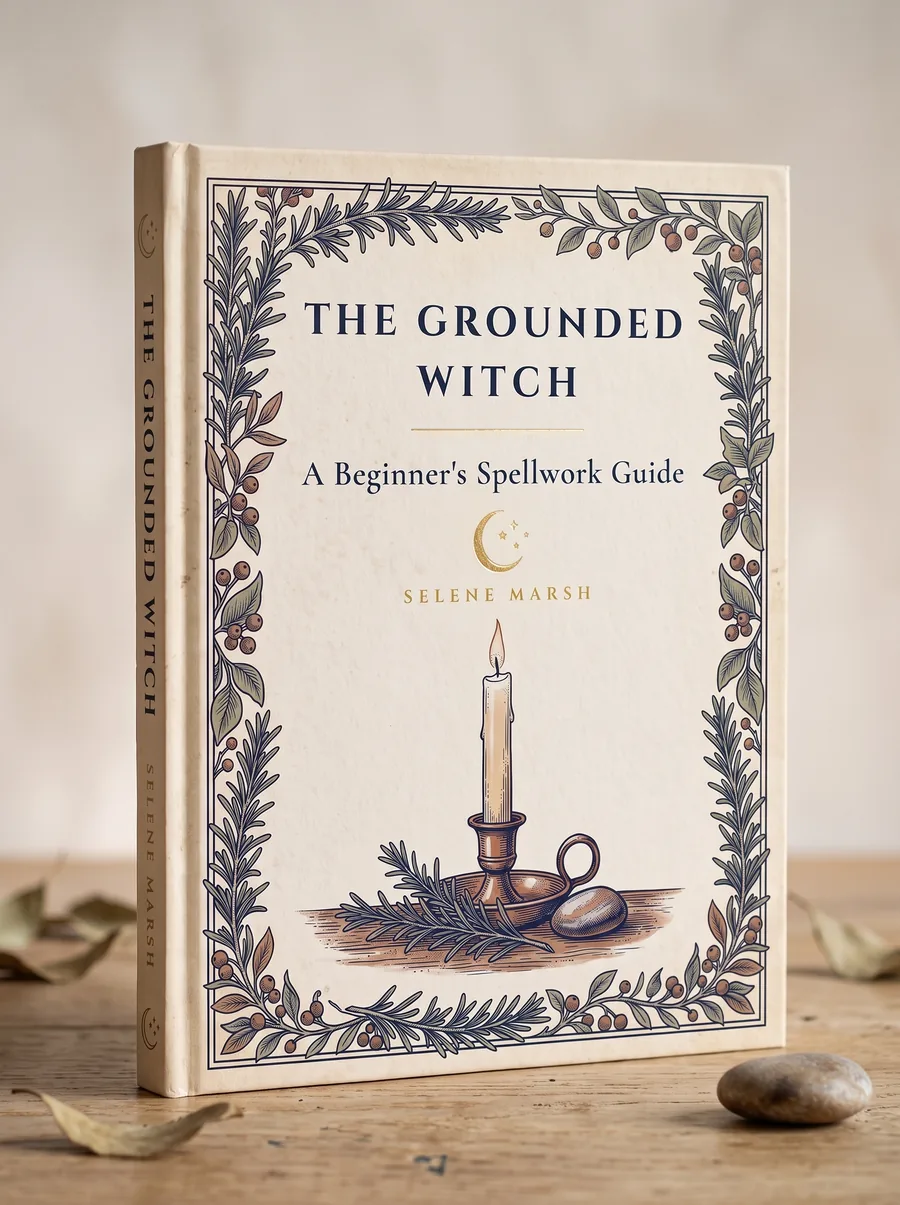
The Grounded Witch

A blueprint, not a firehose: your first year of the craft, step by step.

Get Instant Access

You already have more saved posts, screenshots, and half-read books than any beginner in history, and it still doesn't feel real, because a pile of information is not a path. There is a sequence that turns what you've saved into what you practice.

It starts somewhere almost nobody starts. And its first chapter settles a question most beginners have stopped saying out loud.

The Grounded Witch, a beginner's spellwork guide

13 chapters. 20+ spells. 10 sourced tables. One honest order.

One of those workings you could cast tonight, with a candle already in your kitchen drawer. What has to happen before you light it is the part almost every tutorial skips.

By the last chapter you will have cast real workings, kept a record you trust, and built a practice that feels real instead of researched.

CLICK HERE TO PURCHASE YOUR BOOK NOW

Inside, you'll soon learn:

  • The question that keeps most beginners lurking for years ("am I even a real witch"), settled in chapter one and never reopened.
  • The "$200 starter kit" lie, and the grocery-aisle swaps that do the identical job for pocket change.
  • Your first candle spell, walked moment by moment, including the part no tutorial warns you about.
  • How to use a correspondence table without memorizing a single line of it.
  • The moon as a beginner's clock: which half of the month practitioners use to draw in, and which half to release.
  • The honest reason a spell fizzles, and it is never "you didn't believe hard enough."

Every one of those has a page number. But first: who put this in order, and why should you trust them?

I'm Selene Marsh. I write and research spirituality at Myriapath, and I should tell you up front what I am not. I'm not a high priestess. I don't claim a lineage, an initiation, or a secret teacher on a mountain. I'm a writer and researcher, and I'm telling you that in the first paragraph because this guide exists precisely because of what happens when nobody tells you things up front.

If you've spent any time trying to learn the craft online, you already know the shape of the problem. One video says always use salt. The next says salt offends the spirits. One creator says a spell fails if the candle flame flickers left. Another says flame-reading is nonsense invented last Tuesday. Everyone contradicts everyone, follower counts stand in for authority, and the algorithm keeps feeding you contradictions long after you've followed the good people. The information isn't missing. It's everywhere. What's missing is an honest sequence.

So beginners do the only sensible thing: they research. And research. They buy a third book and a fourth, save two hundred posts, and never light the candle. The community has a name for it, the research trap, and underneath it sits a quieter question that almost everyone in those threads eventually asks out loud:

"Am I even a real witch?"

That question is the reason this guide exists. The community answered it long before I got here, and it deserves to be said plainly: you don't need anything, or anyone's permission, to be a witch. If you feel the connection, you are one. There is no checklist.

What a guide can do is what a feed cannot: put things in order. At Myriapath I spend my working days reading the sources behind this practice, the forum threads, the beginner books, the histories, the arguments, and writing guides that separate what is documented from what is tradition from what is one creator's Tuesday opinion. The Grounded Witch is that work, sequenced. Inner work before outcome spells. Your record before your correspondences. Tools last, because the tools were never the point. Cunning folk worked powerful folk magic for centuries with river stones, kitchen herbs, and whatever was at hand; the sequence matters more than the shopping list ever did.

Two more commitments shaped every page. First, honesty about claims: documented history is presented as history, tradition as tradition, belief as belief. When the Book of Shadows turns out to be a twentieth-century creation, the guide says so, and says why that is good news for you. When a practice is closed, the guide names whose it is and offers an open alternative instead of pretending the question doesn't exist. Second, the guide holds both readings of the craft at once. Maybe the universe responds. Maybe a ritual is a psychology you consent to. Practitioners in this community hold both, sometimes in the same breath, and every working in this book is written so it makes sense in either key. You will not be told what to believe here.

And one rule sits above all of it, stated in the front matter and repeated where it matters: mundane before magical. Spellwork in this guide is never a substitute for medical, mental-health, legal, financial, or emergency help. Any resource that tells you otherwise is not protecting you.

This book is for the person who is done cross-checking twelve tabs, and wants one grounded, sourced, judgment-free path from "where do I even start" to a practice that feels real.
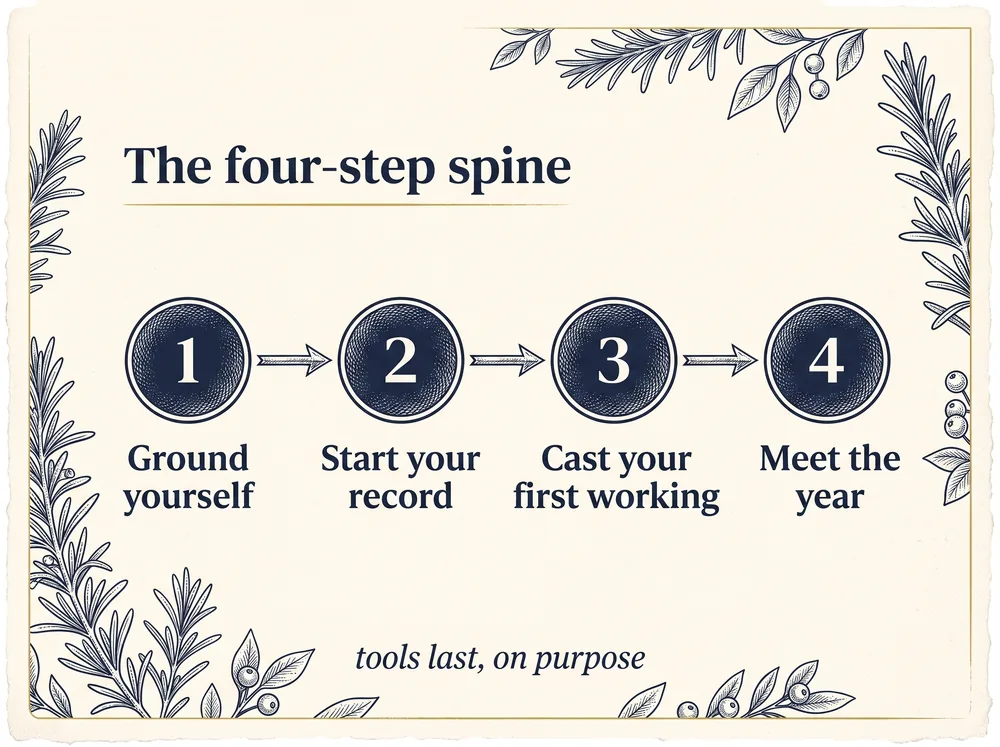
The four-step spine: ground yourself, start your record, cast your first working, then meet the year
The guide's spine: four stages in an order almost nobody teaches, tools last on purpose. What living inside that order looks like is next.
A two-page interior spread from the guide

Read it front to back: the four-step spine.

The chapters run in the honest order almost nobody teaches: four stages, each one earning the next, and the tools arriving last on purpose. Thirteen chapters across roughly 120 designed pages, each one short enough to finish tonight and concrete enough to practice tomorrow. By the last chapter you have cast real workings, kept a real record, and met the full Wheel of the Year.

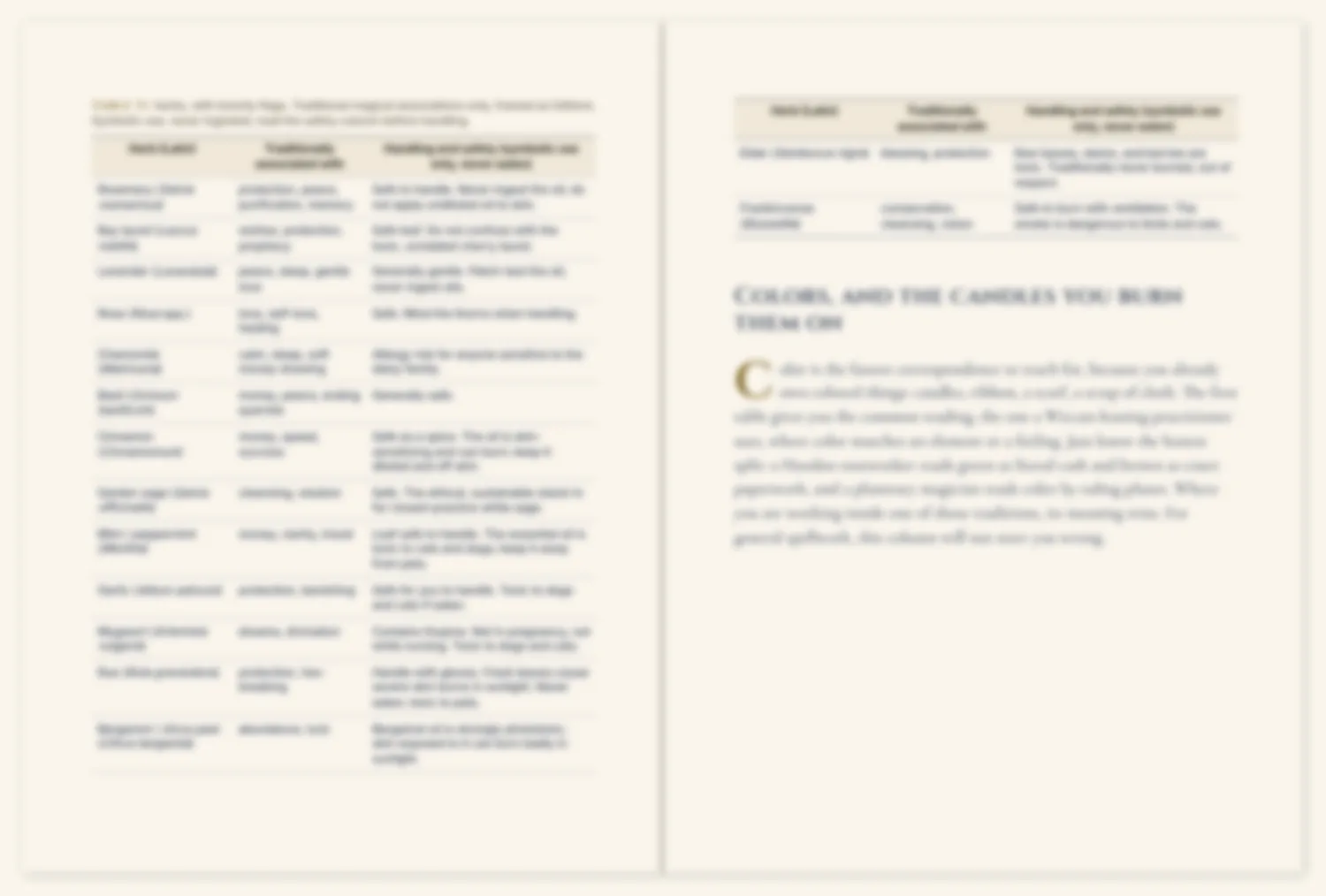
An interior spread showing a sourced correspondence table

Or dip in anywhere: the reference layer.

Woven through the chapters and consolidated in the appendix are ten sourced correspondence tables, herbs to moon phases to the eight Sabbats, plus a printable set of pages for your own record-keeping. More than 20 complete spells and rituals live in these pages, and every one of them is castable with things you already own. When you need the right candle color on a Tuesday night, the answer is one page-flip away instead of forty contradictory videos.

On page 11

Everyone else's altar is perfect, and yours is mismatched candles and a scarf. Why yours is already enough.

An interior spread from chapter one

You've seen the photos. Crystal grids arranged like jewelry displays, antique cabinets, candlelight that somehow never overexposes. Then you look at your own windowsill and something in you says: not a real witch.

Chapter one takes that feeling apart piece by piece. Not with a pep talk, but with the question that dissolves it, and it is not "do you believe enough." Practitioners have been settling this exact doubt for as long as the craft has existed, and their answer has never once involved better furniture.

By the end of the chapter, the comparison spiral has a name, a cause, and an off switch. The mismatched candles stay. They were never the problem.

On page 19

The "$200 starter kit" lie, and the grocery-aisle swaps that do the identical job.

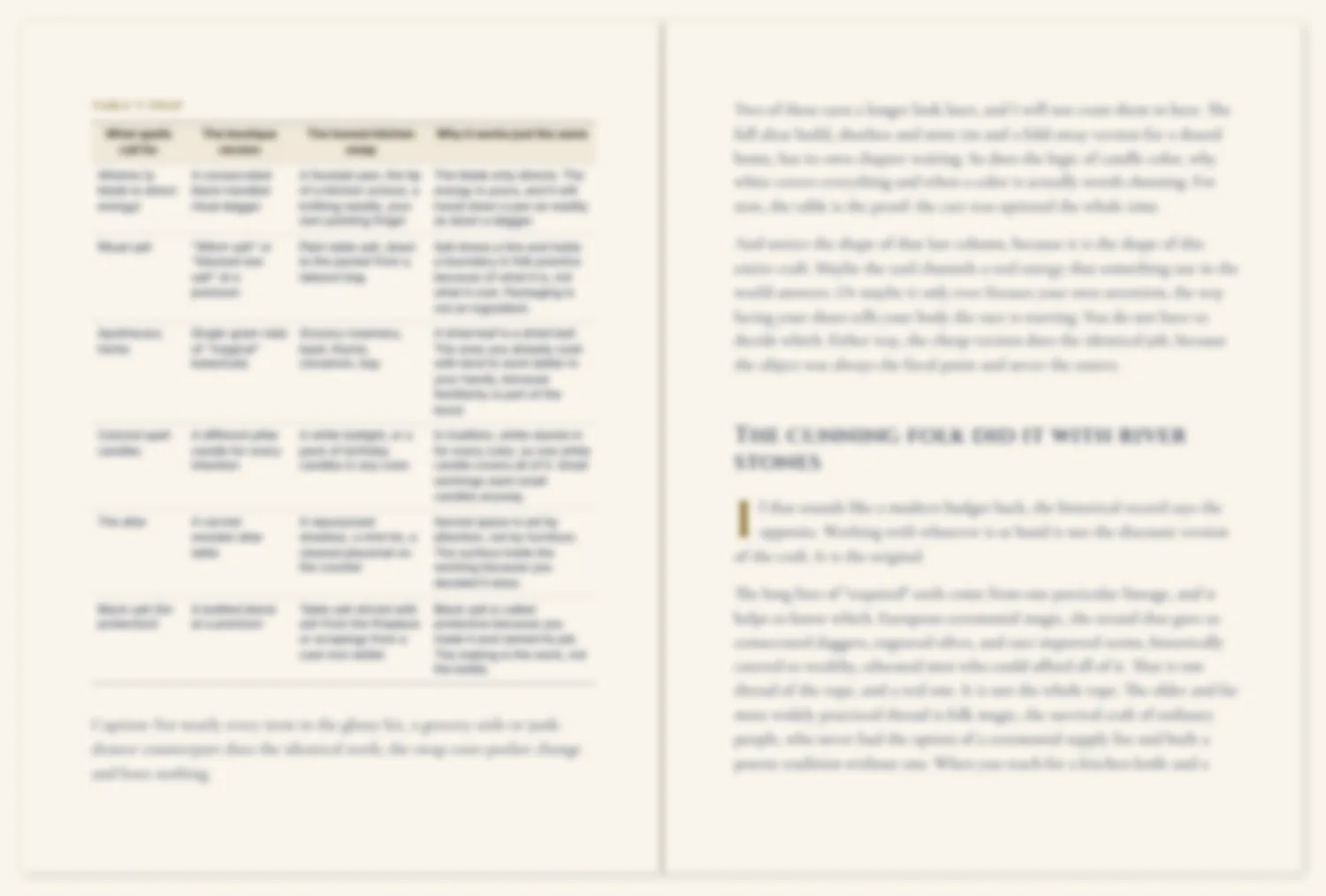
An interior spread showing the household-swap table

Somewhere along the way, "begin your practice" started meaning "assemble a shopping cart." Chapter two names where that idea came from, and why the people selling it needed you to believe it.

Then it walks the aisles with you. For nearly every item in the glossy kits, there is a grocery-store or dollar-store counterpart that practitioners have used for generations, and the chapter maps them one to one. Table salt. A birthday candle. A jar you were about to recycle.

Buy the beautiful chalice if it makes your practice feel like yours. The chapter's point is sharper: nothing on that receipt was ever a requirement. The cunning folk of documented history worked with whatever was at hand, and so can you, starting tonight.

On page 26

The sixty-second grounding drill practitioners do before any working, and what tends to happen when you skip it.

An interior spread showing the grounding drill

Almost every "my spells feel like nothing" story starts the same way: the caster went straight to the candle. In the craft, the inner work comes first, and chapter three teaches its smallest complete unit, a tree-roots drill you can run standing at your own kitchen counter in about a minute.

The chapter explains why practitioners treat this as non-negotiable, and why the ones who skip it so often get jumpy, scattered results and wrongly conclude that magic doesn't work for them.

It also gives you the drill in both keys. Read it as moving energy, or read it as a nervous-system cue you consent to. The steps are identical. You get to decide what they mean.

On page 34

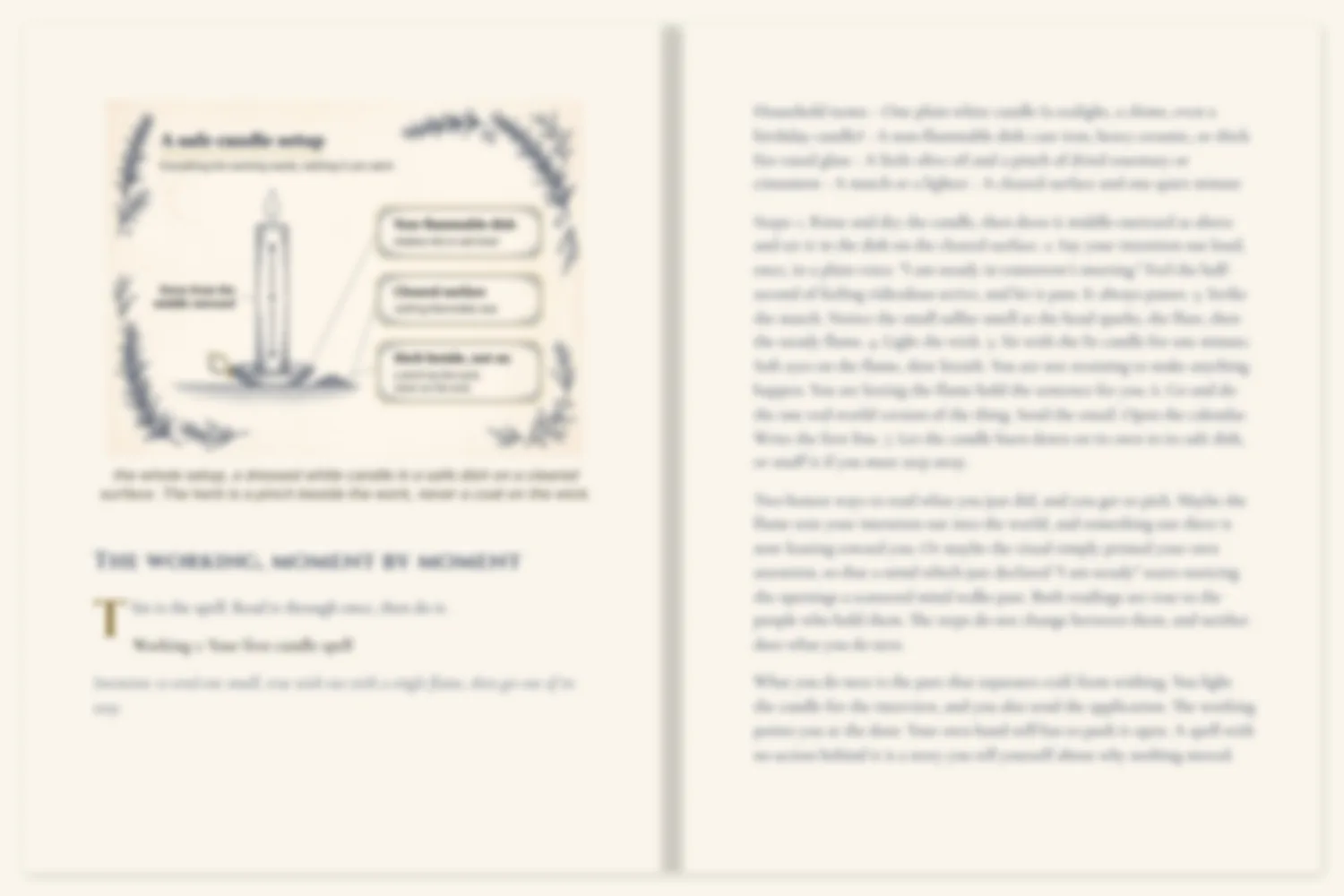
Your first candle spell, walked moment by moment, including the half-second you feel ridiculous.

An interior spread showing the candle-spell setup diagram

This is the chapter most guides pretend to have. Not "candles are associated with fire energy," but the actual walkthrough: what to do with your hands, what to say, what order, what to do when your own voice sounds strange in your quiet kitchen. That half-second of feeling ridiculous is in here too, on purpose, because it happens to nearly everyone and no one warns you.

You'll dress a plain white candle (the chapter shows you how, and why plain white is the tradition's universal key), speak the intention, and learn the release that practitioners sum up as "set it and forget it." The working is paired with one concrete real-world action, because in this guide magic always meets legwork halfway.

Every step sits on an explicit safety rail: the non-flammable dish, the cleared surface, the supervised burn-down. Herbs in this working dress the candle. They are never ingested, here or anywhere in the guide.

On page 41

What the soot left on the candle is telling you. It is information, not a verdict.

An interior spread on reading a candle's burn

The wax pooled strangely. The flame sputtered. The glass went black on one side. Ask the internet what that means and you will receive a dozen dooms, each contradicting the last.

Chapter five closes with the tradition of reading the burn calmly: what practitioners have traditionally taken each sign to suggest, where those readings come from, and, just as important, where the folklore ends.

The frame the guide insists on: a candle's remains are feedback for your next working, never a verdict on you. Once you've read this section, a black-stained jar stops being a small heart attack and becomes a note in your Book of Shadows.

On page 52

Your first protection jar, layered in a washed jam jar, not an etched apothecary bottle.

An interior spread showing the layered protection jar

The protection jar is one of the oldest and most loved workings in folk practice, with a documented ancestor in the historical witch bottle. Chapter six builds yours layer by layer, and explains what each layer is doing there, because a jar you understand is a jar you trust.

The vessel is a washed jam jar from your own recycling. The contents come from your kitchen. The chapter tells you what goes in, in what order, and what practitioners traditionally say each layer holds.

The same chapter covers cleansing a room with smoke, sound, or salt water, and is honest about the sourcing question the feed keeps flattening: why this guide skips white sage and palo santo, whose practices those are, and the open alternatives (garden sage, rosemary, cedar, or a simple bell) that belong to everyone.

On page 60

The shoebox altar: a complete altar that closes, stores flat, and costs nothing.

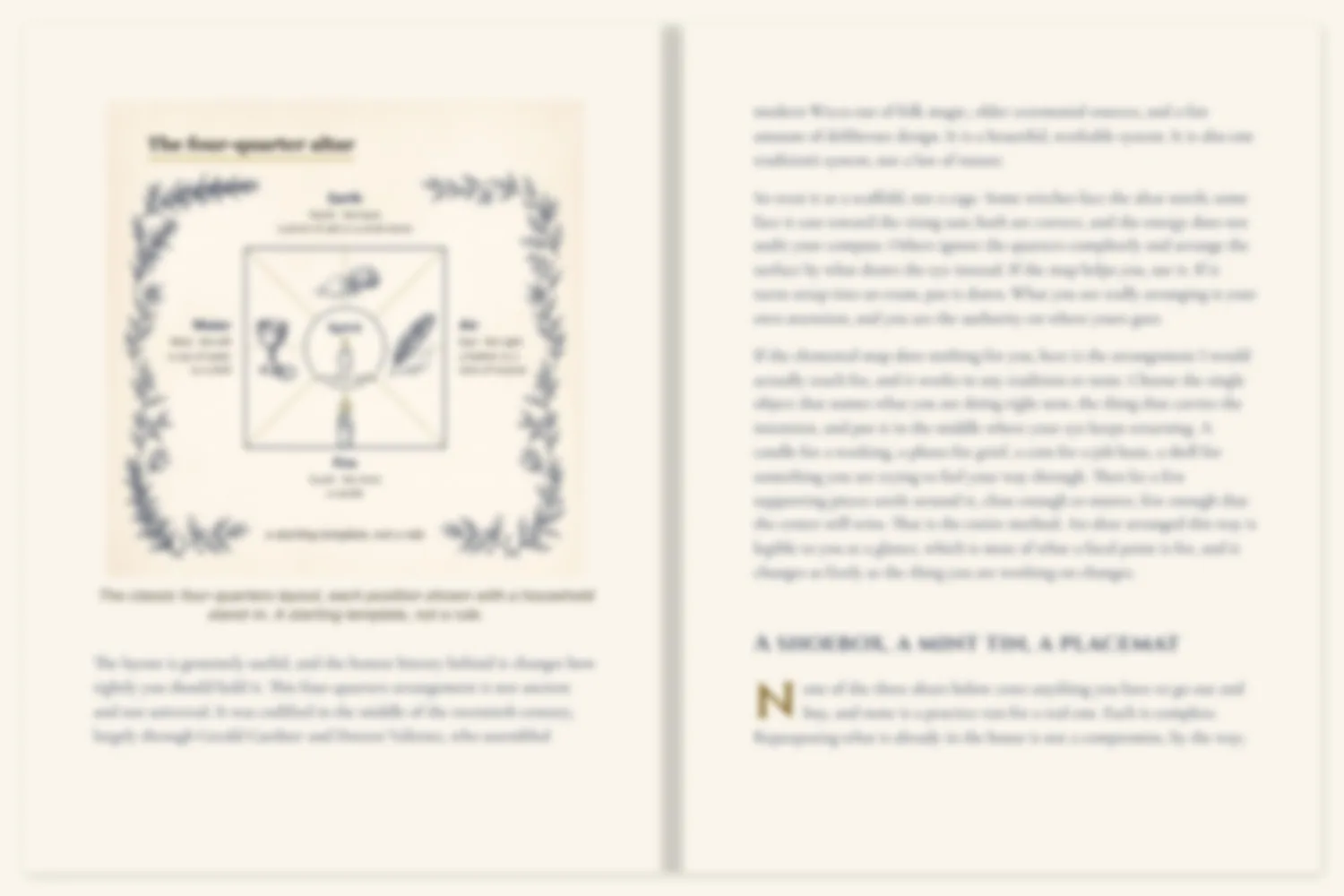
An interior spread showing the four-quarter altar layout diagram

An altar is not furniture. Chapter seven starts there: what an altar is actually for in the craft, a focal point for your attention, and why that job description changes everything about what qualifies.

A repurposed shoebox qualifies. So does a mint tin, or a placemat that only becomes an altar while it's laid out. The chapter gives you the classic four-elements layout as one option among many, then shows discreet and portable versions for shared homes, dorm rooms, and anywhere your practice needs to fold away in ten seconds.

If you have ever postponed starting until you had "somewhere proper," this chapter removes the last excuse, gently.

On page 77

Moon water, made simply and safely, plus the two rules most tutorials skip.

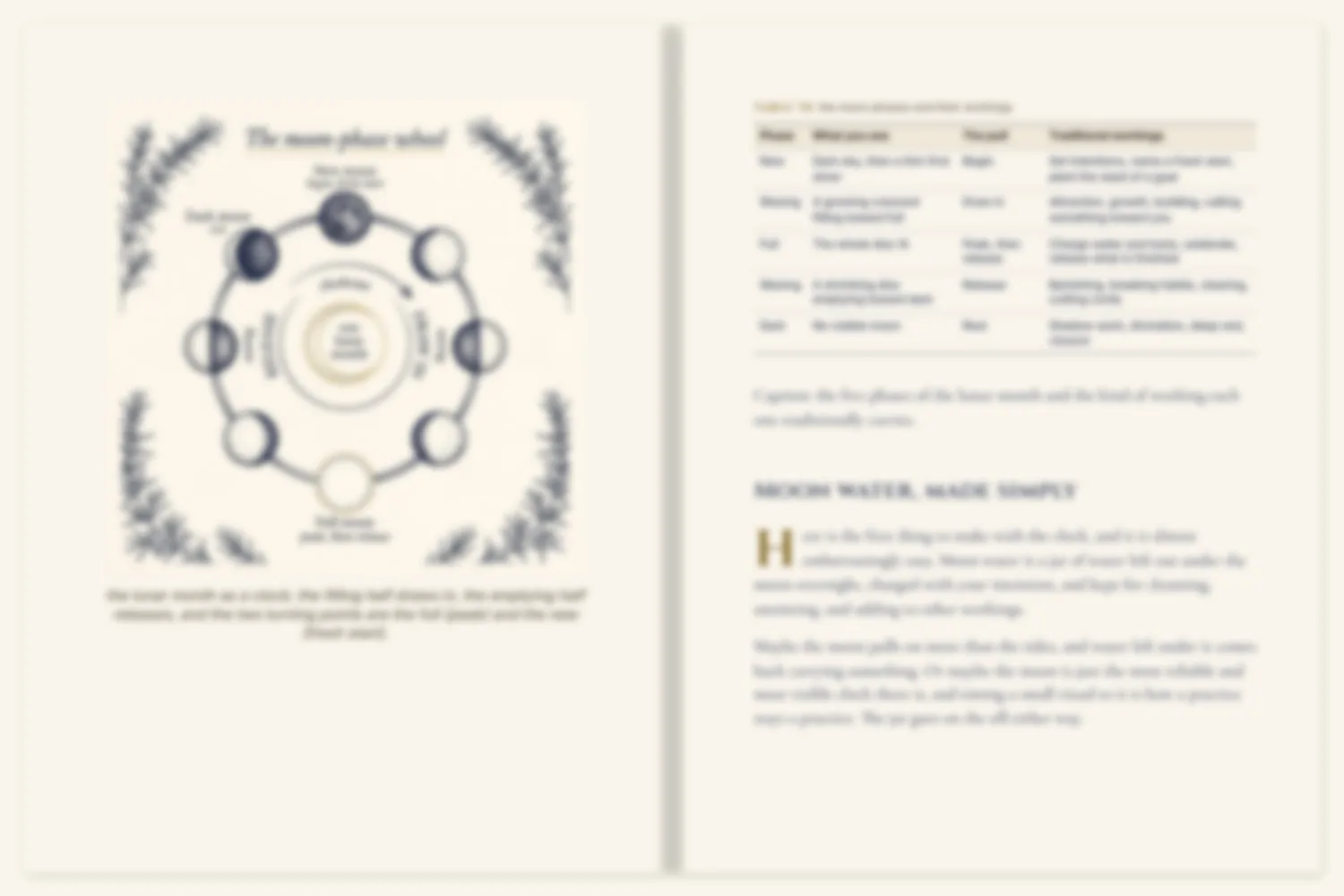
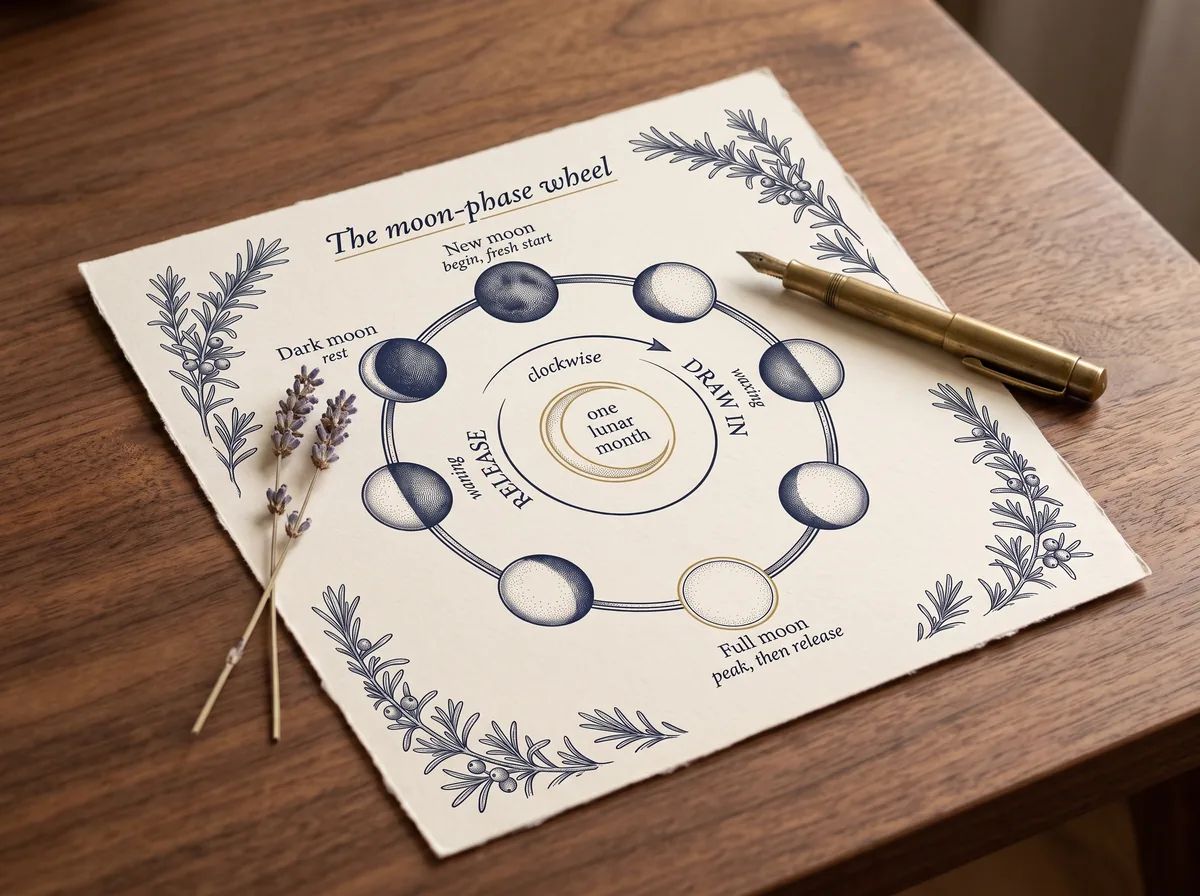
An interior spread showing the moon-phase wheel diagram

Moon water is the craft's easiest win: a jar, a windowsill, one night. Chapter nine gives you the simple version practitioners actually use, when to set it out, what to say over it if you want to say anything at all, and the traditional uses once you have it.

It also states the two safety rules that an alarming number of tutorials leave out. One is about drinking it. The other is about what people drop into the jar. Both take one sentence to follow and are in the guide in plain type.

Around the jar, the chapter teaches the moon itself as a beginner's clock, waxing to draw in, waning to release, and introduces the esbat: the lowest-effort monthly observance in the entire practice.

On page 85

The entire Wheel of the Year, one candle at a time. Every Sabbat has a small version.

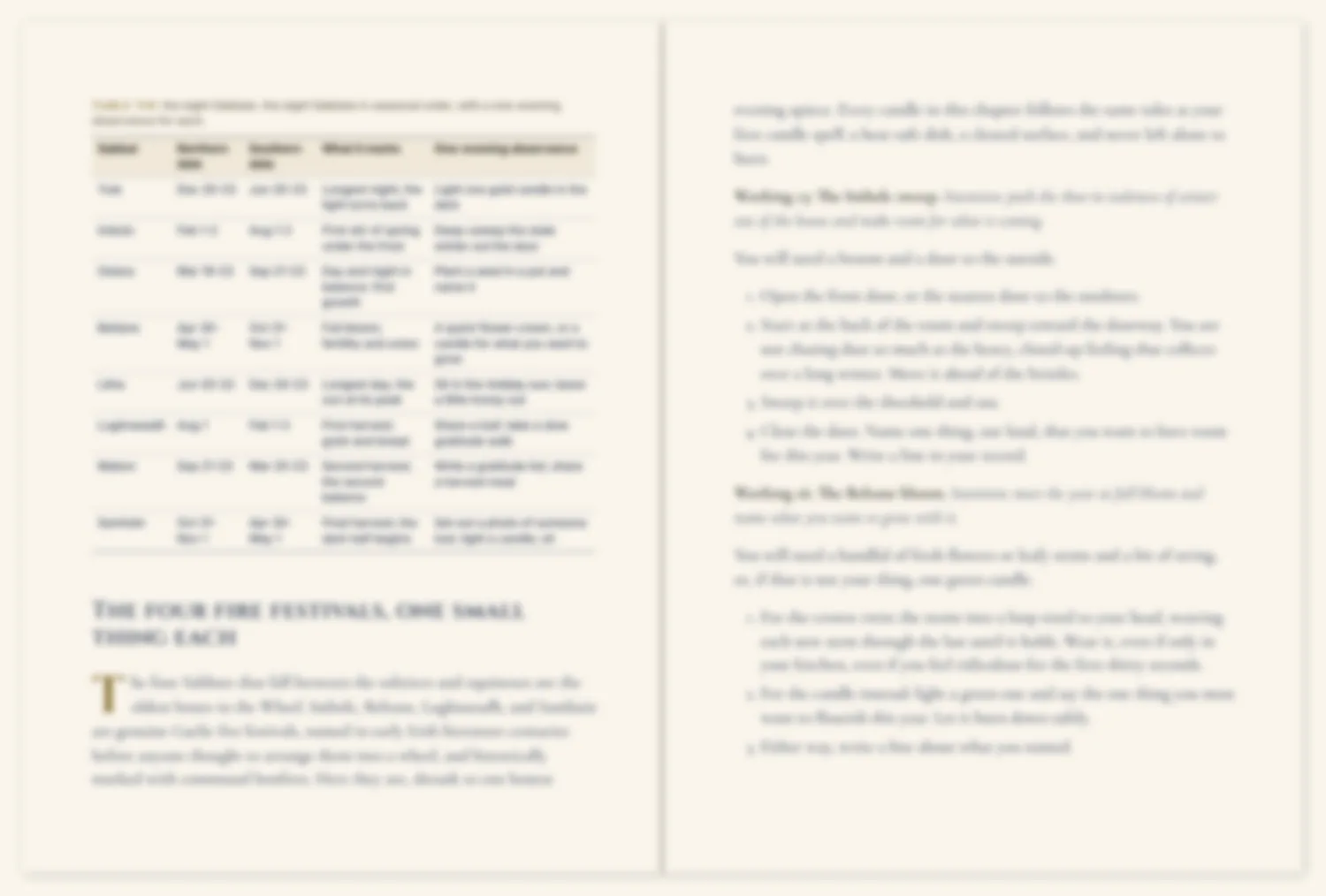
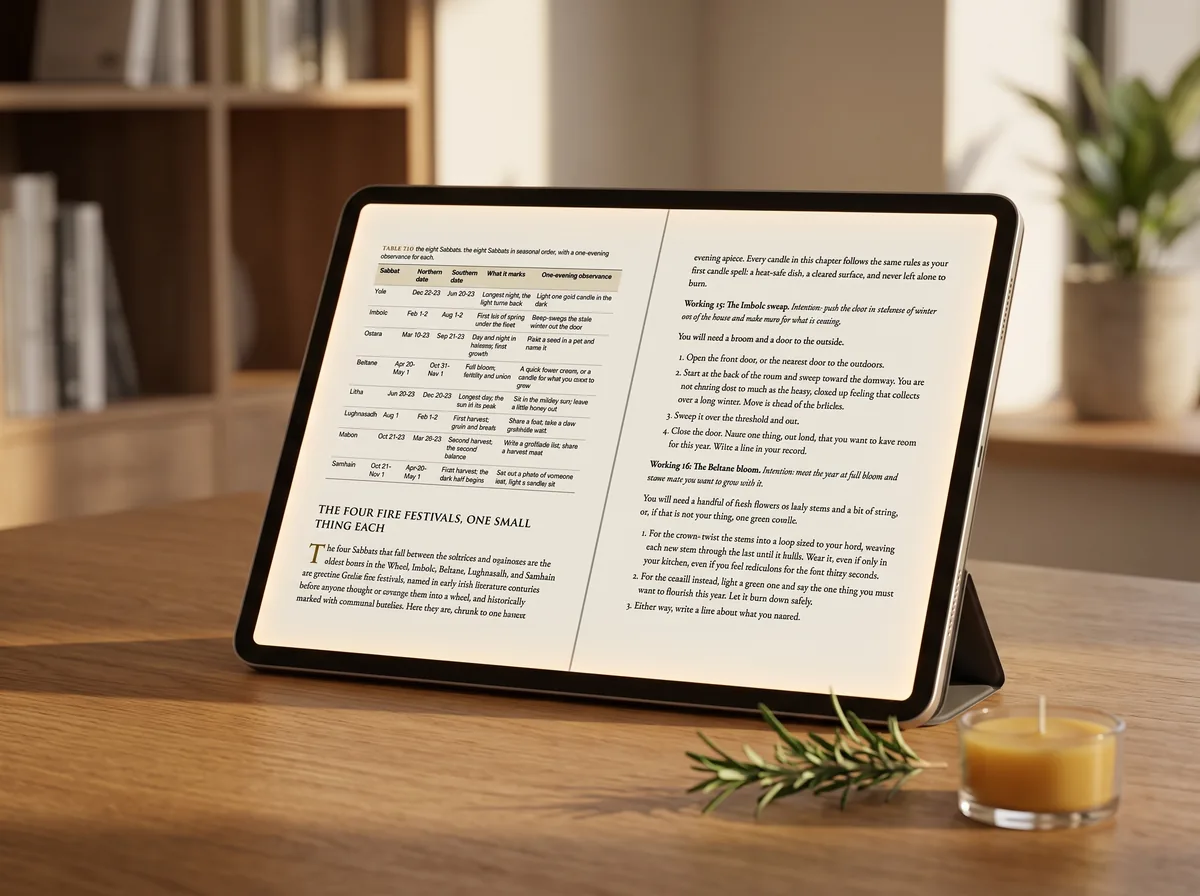
An interior spread showing the Wheel of the Year table

Eight Sabbats sounds like a curriculum. Chapter ten turns it into a single table you can read in a minute: each festival, what it marks, and one beginner-friendly observance for each, sized to an evening. One gold candle on Yule. A seed in a pot on Ostara.

The method is the chapter's real gift: find the next Sabbat on the calendar, do the small version, write one line about it in your record. That's a full year of practice, assembled one modest evening at a time.

The history is handled the way this guide handles all history: the Wheel's documented modern assembly is kept clearly separate from older festival roots, so you know exactly which parts are ancient and which are newer than your grandmother.

On page 88

Casting quietly from the broom closet: a birthday candle in a peach, thirty seconds, and no trace left behind.

An interior spread on discreet broom-closet workings

Some readers can put an altar on the mantel. Some cannot, and the community is clear-eyed about what the broom closet is: a boundary and a survival strategy, not a place of shame. The guide treats it with exactly that seriousness.

Chapter twelve carries a set of workings built for quiet: practice that fits inside an ordinary moment, leaves nothing to find, and costs nothing to abandon mid-step if the door opens. The centerpiece is a complete working performed with a birthday candle stuck in a piece of fruit, thirty seconds, done, and afterward it is just a snack.

If you are practicing where being found out has real consequences, this chapter was written for you, and it never once suggests you owe anyone a reveal.

On page 98

The self-dedication vow: a private line that marks the path as yours. No gatekeeper, no witness, no ceremony required.

An interior spread on the self-dedication vow

There is no membership card for the craft. Still, many solitary practitioners eventually want a moment that marks it: I am doing this, on my own terms, on purpose.

Chapter twelve closes with the self-dedication: what the tradition holds it to be, what it is not (not an initiation, not a rank, not a requirement), and how to shape a private vow in your own words. The chapter gives you the structure and the considerations; the sentence itself can only come from you.

It is the shortest working in the book. Entirely yours.

On page 104

"I did the spell and nothing happened." The honest reason, without the shame.

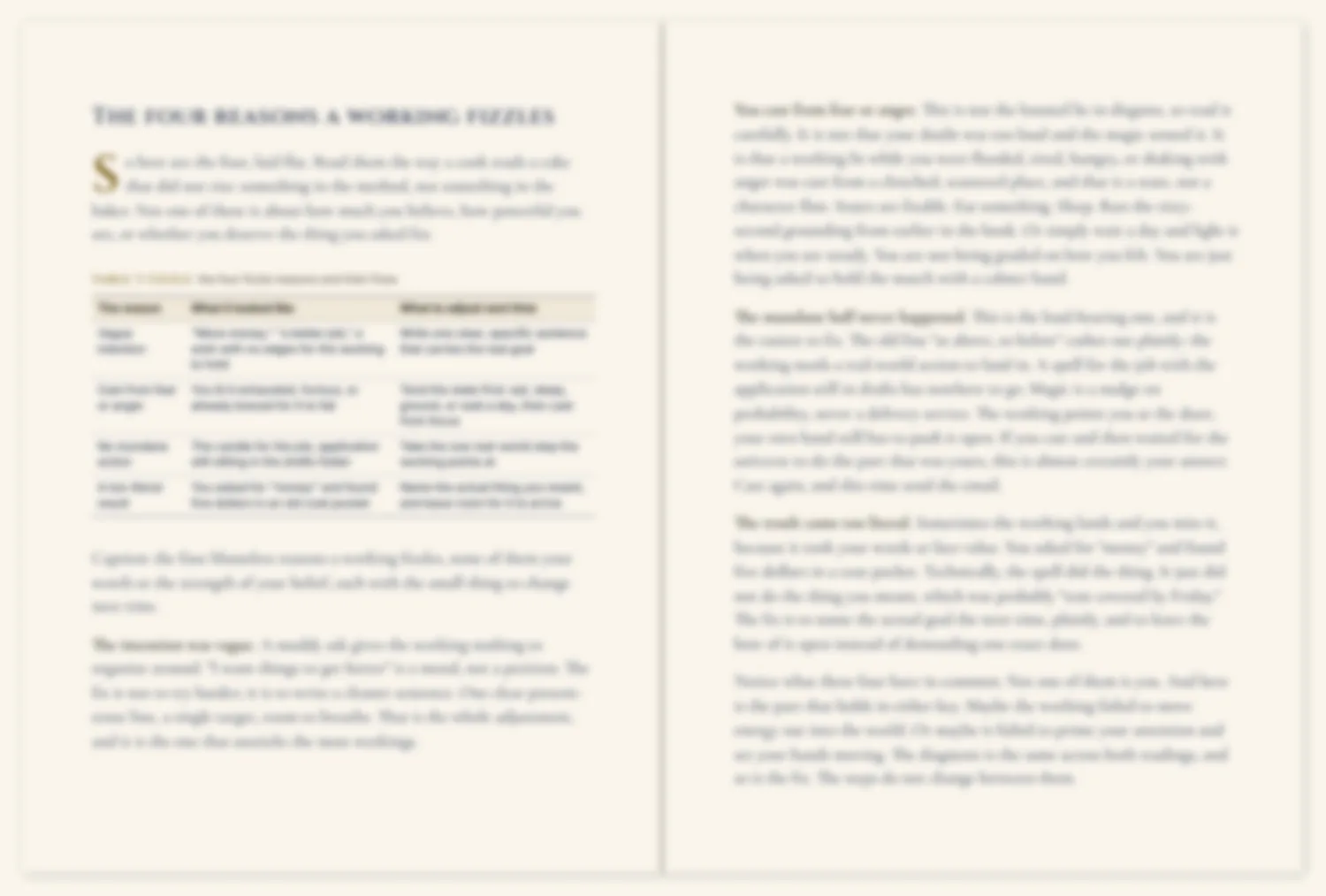
An interior spread on why a spell fizzles

Every practitioner has cast a dud. What happens next is where most beginners quietly quit, because the explanation the internet hands them is a cruelty dressed as wisdom: you didn't believe hard enough.

The final chapter refuses that answer completely. Instead it lays out the boring, fixable reasons workings actually tend to fizzle. There are four of them in the guide, and not one involves your worth, your power, or the strength of your belief. Each comes with what to adjust next time.

Two lines in this chapter are load-bearing for the whole book. A single dud is information, not a verdict. And nothing that has hurt you was ever your failure to manifest otherwise. If you have been carrying either weight, page 104 sets it down.

And that still leaves the rest. You'll also find:

The workings

  • More than 20 complete spells and rituals, every one castable with what you already own, from a honey jar to a cord-and-knot working.
  • The simmer pot that turns one grocery bag into a whole-home working your housemates will simply call "that nice smell."
  • The one-match bay-leaf working: write it, burn it safely, release it. The whole tradition on one small leaf.
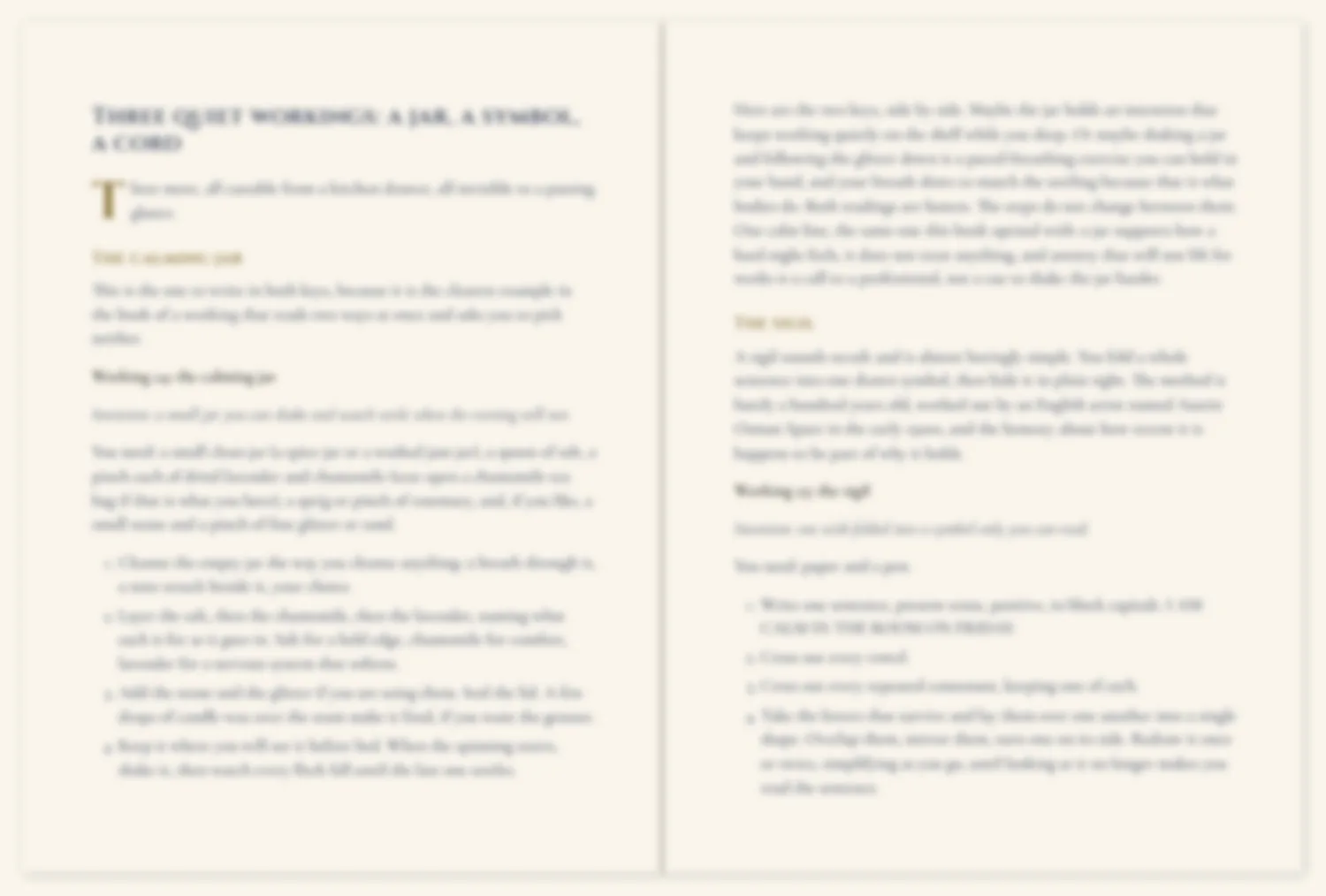
  • A calming jar you can shake, watch, and breathe with, written in both keys: energy work, or a settling ritual you consent to.
  • Sigils, demystified: how practitioners fold a whole sentence into one drawable symbol, and where to hide one in plain sight.

The reference shelf

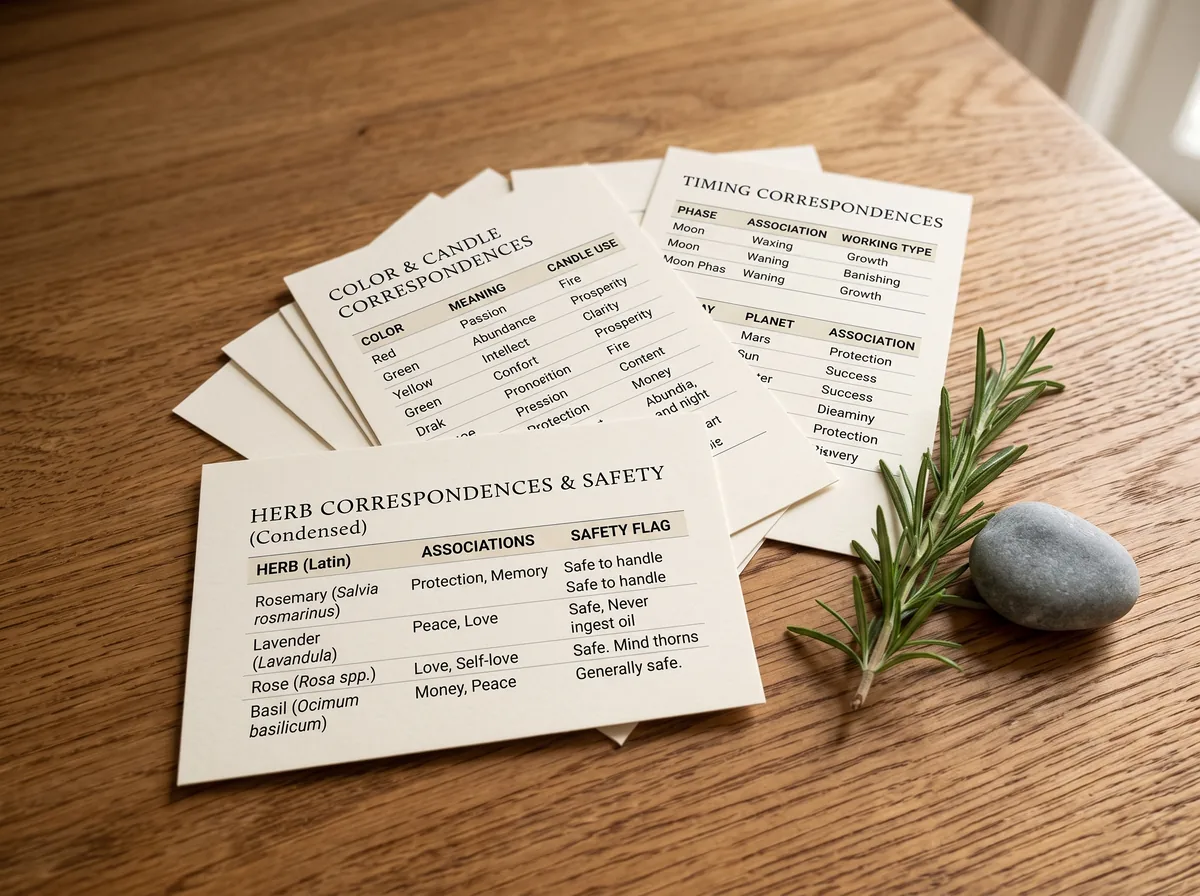
  • All 10 sourced correspondence tables: herbs, colors, candle colors, days of the week, planetary hours, moon phases, elements, crystals, the eight Sabbats, and the full moons of the year.
  • The herb table flags what most correspondence charts don't: common herbs that are toxic to pets or people. Symbolic use only, always.
  • The white-candle rule that ends the "I don't have a green candle" panic forever.
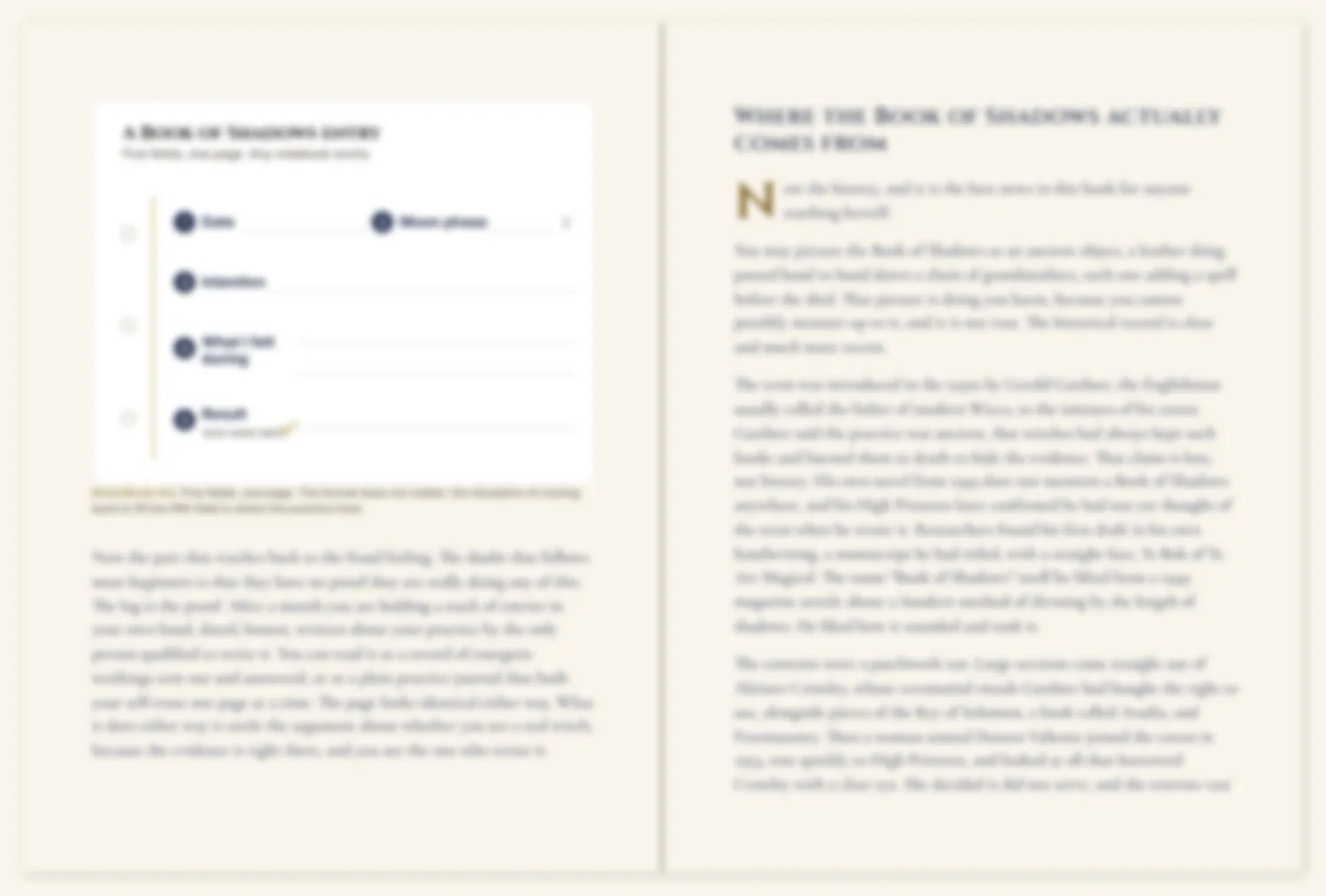
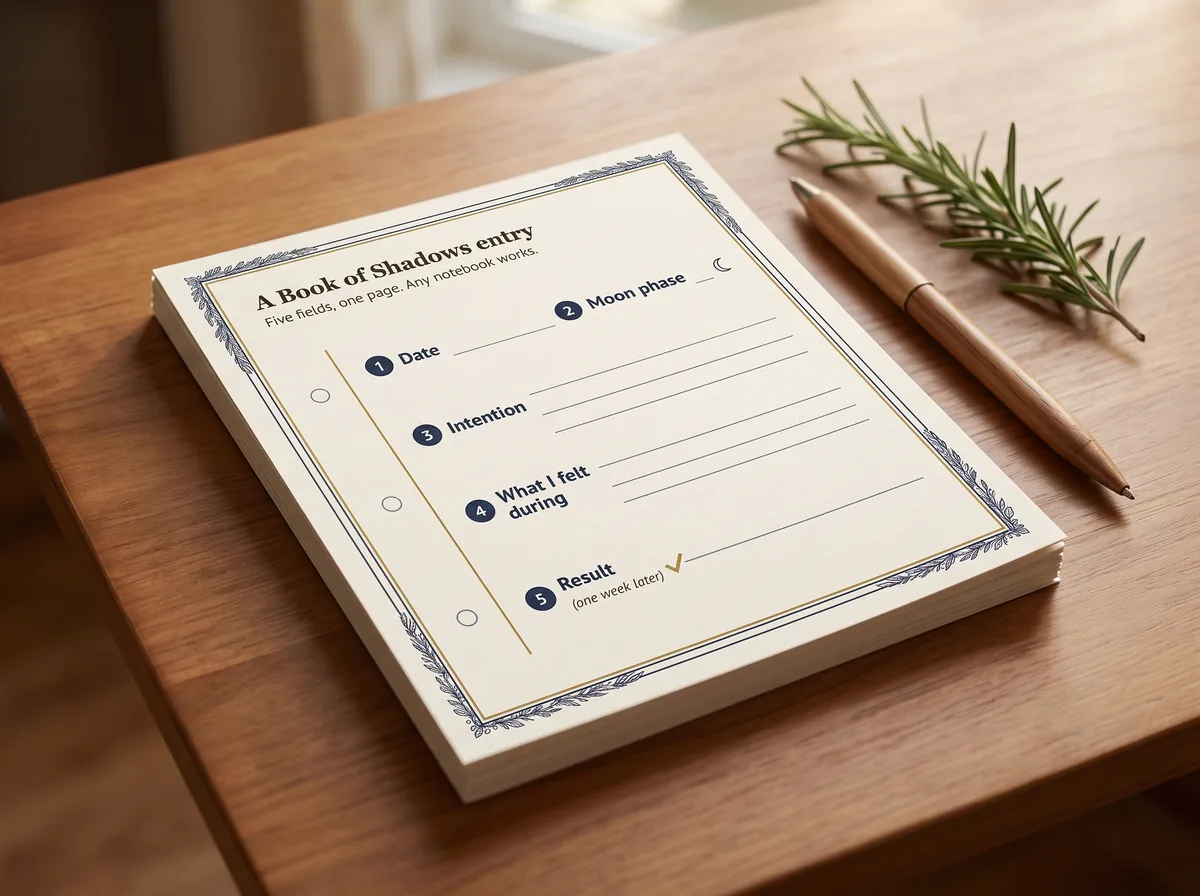
  • The five things worth logging after every working (date, moon, intention, what you felt, the result a week later), and why practitioners who log them stop feeling like frauds.
  • The honest history of the Book of Shadows: far younger than the aesthetic implies, and why that is the best news in the book for a self-taught witch.

The path

  • The type menu, kitchen, green, hedge, sea, secular, eclectic, served as a buffet, not boxes. You never have to pick a lane.
  • Why solitary practice is complete on its own, and not a waiting room for a coven.
  • Which practices are closed, whose they are, and the open alternatives that are fully yours, so you never have to learn this the hard way in a comment section.
  • The 4-week, ten-minutes-a-day starter plan that turns all thirteen chapters into a calendar you can actually keep.
  • 12 printable reference pages: spell log, moon tracker, Book of Shadows starter pages, and quick-reference cards.

But there's more you'll get. Every copy of the guide includes the full printable appendix, three tools you can put on paper tonight. The third one ends the mid-spell page-flip for good:

The Book of Shadows Starter Pack

Blank spell-log pages and starter sheets for your own record, ruled for the five things worth logging so the blank page never stares back. Print as many as your practice needs, forever.

Printable Book of Shadows starter pages

The Moon-Phase Tracker

One page per lunar cycle: mark the phases, note your workings against them, and watch the waxing-and-waning rhythm from chapter nine become second nature instead of another thing to memorize. Tape it inside a cupboard door if your practice is a quiet one.

The printable moon-phase tracker

The Correspondence Quick-Cards

All ten of the guide's sourced tables condensed into print-at-home cards. Keep them at your altar, tucked into your Book of Shadows, or in the kitchen drawer next to the birthday candles. The mid-spell page-flip, eliminated.

Printable correspondence quick-cards

The Grounded Witch is an instant PDF: roughly 120 designed pages of real writing, tables, and labeled diagrams, delivered to you the moment your order goes through.

It reads cleanly on your phone at the bus stop, your tablet in bed, or your laptop with the kettle on. The appendix is built to print at home on ordinary paper. No subscription, no login, no course that drips one lesson a week. You buy a book, you get a book, and it is yours to keep.

And because it lives on your device, it is also the most broom-closet-friendly format there is. No spine on a shelf. Nothing to explain.

The guide open on a tablet

Illustrated throughout

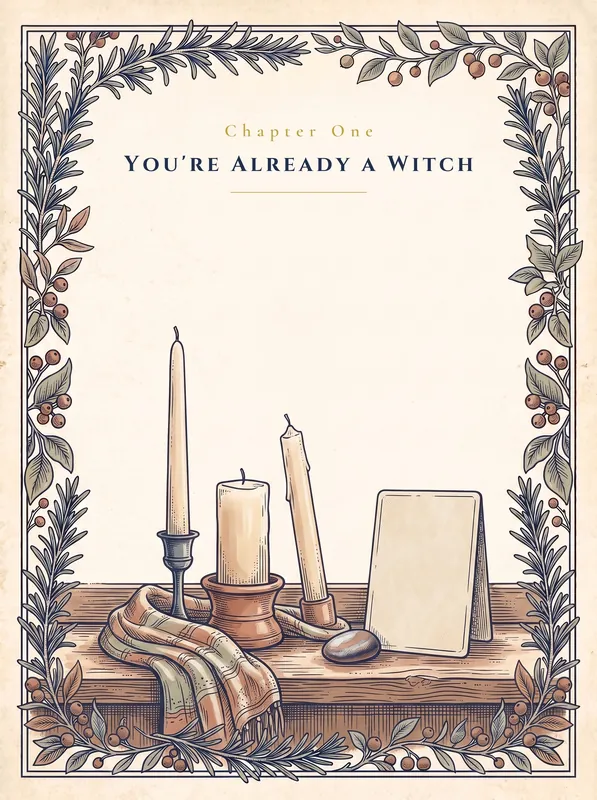
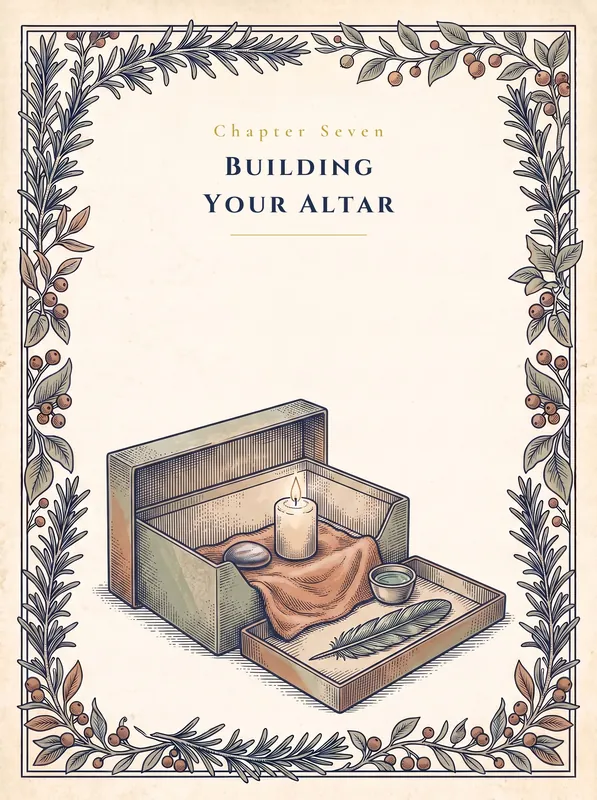
Original art opens every chapter, drawn for this guide, not stock.

Chapter-opener plate: candles and a scarf on a wooden altar
Chapter-opener plate: a shoebox altar with candle, stone, cup, and feather
Chapter-opener plate: rosemary, cinnamon, rose, bay leaf, crystal, and candle
Chapter-opener plate: a seasonal wreath around a small sun
Chapter-opener plate: a wooden tray of stone, crystal, shell, and cloth
Chapter-opener plate: a lit birthday candle set in a piece of fruit

The Grounded Witch

A beginner's spellwork guide · ~120 pages · instant PDF

$14

Get Instant Access

Secure checkout by Stripe

30-day money-back guarantee. One email, full refund, no hoops.

Your download link arrives within minutes.

  • Instant PDF download
  • Secure checkout
  • Money-back guarantee

Everything in your copy

  • 13 chapters in one honest sequence, from "am I even a real witch" to "when a spell doesn't work"
  • 20+ complete spells and rituals, castable with what you already own
  • 10 sourced correspondence tables, belief-framed and safety-flagged
  • All 8 Sabbats of the Wheel of the Year, each with a small first observance
  • The 4-week, ten-minutes-a-day starter plan
  • 12 printable appendix pages: spell log, moon tracker, Book of Shadows starter pages, quick-cards
  • 13 chapters
  • 20+ complete spells
  • 10 correspondence tables
  • All 8 Sabbats
  • ~120 pages
  • 4-week starter plan

4.9/5 · 8 reviews

5/5 · Rigorous but never dense

"You can feel how much research went into every chapter, but it never reads like a textbook. It explains the history and the why without talking down to you or burying you in jargon. I finally understand where these practices actually come from."
Gladys J.

5/5 · It stayed with me

"The writing is genuinely beautiful, which I did not expect from a beginner's guide. A few passages stopped me and I had to sit with them for a minute. It reads like it was written by someone who respects both the Craft and the reader."
Irene C.

4/5 · A breath of fresh air

"So much beginner witchcraft content is either watered down or wrapped in mystery for its own sake. This is neither. It speaks to people with real schedules and real lives, and it treats you like an adult."
Valerie R.

5/5 · No fluff, start to finish

"No filler, no fifty pages before you actually do anything. Every chapter hands you something you can genuinely use, and the spells are laid out so clearly that I never felt lost or unsure whether I was doing it right."
Barbara R.

5/5 · Respectful and grounded

"What struck me most is the respect. It is honest about where traditions come from, careful about what is and is not yours to practice, and it never once feels sensational. A trustworthy place to begin."
Rebecca C.

5/5 · Not just for beginners

"I have been practicing for years and still found lines worth underlining. It is clear enough for a complete beginner and thoughtful enough that more experienced practitioners will take something from it too. That balance is genuinely rare."
Dawn J.

5/5 · Judgment-free from page one

"I came in half-afraid I would be doing everything wrong, and this book never made me feel that way. It meets you exactly where you are, with no gatekeeping and no judgment. The most welcoming introduction to the Craft I could have hoped for."
Lisa R.

5/5 · Honors the roots

"This never pretends witchcraft was invented last year. It honors the history, credits the cultures these practices come from, and still makes it feel alive and usable today. That care is why I trust it."
Kathleen M.

You've seen the whole tour. The one thing this page can't show you is your first week inside the order. Here's the door again.

The Grounded Witch

A beginner's spellwork guide · ~120 pages · instant PDF

$14

Get Instant Access

Secure checkout by Stripe

30-day money-back guarantee. One email, full refund, no hoops.

Your download link arrives within minutes.

Here is the whole policy, in my own words.

Buy the guide. Read it. Run the grounding drill, cast the candle spell, print the moon tracker. Take a full 30 days.

If at any point in those 30 days you decide it isn't for you, for any reason or for no reason at all, email us and we will refund every cent. No forms to fill in, no "can I ask why," no hoops. And the PDF stays on your device. Keep it, and keep anything you've printed from it.

The worst case is that the guide costs you nothing and you walk away with a grounding drill and a moon tracker. I can live with that. The craft never asked you to gamble, and neither will we.

All of the risk is on our side of the table. Whenever you're ready:

The Grounded Witch

A beginner's spellwork guide · ~120 pages · instant PDF

$14

Get Instant Access

Secure checkout by Stripe

30-day money-back guarantee. One email, full refund, no hoops.

Your download link arrives within minutes.