Ethical wildcrafting is the practice of taking wild plants in a way the patch can keep paying out, season after season. For the green witch, it sits at the seam between an animist belief that plants are persons and the ecological math that says one careless summer can empty a hillside for a decade. The rules are short, the math is small, and most of the work is paying attention.
What ethical wildcrafting actually means
Five non-negotiables. You are 100% sure what the plant is. You take no more than one in twenty of a healthy stand. You skip the at-risk species entirely. You check the law of the land you are standing on. You leave the habitat better than you found it. If any of those is shaky, you do not harvest.
You do not need wild land to be a green witch. A pot of rosemary on a sill and the dandelions in the alley are enough to keep a daily practice running, and they sidestep half the ethics underneath. Wildcrafting is one expression of the green path, not the entry fee, and the practice is a relationship, not extraction.
The work itself is small once the framework clicks. You learn one patch deeply, you take less than you think you should, and you give back more than feels symbolic. If you are coming in cold, the beginner walk-through sets the foundation; this is the practitioner version.
The 100% identification rule
If you are not absolutely certain what a plant is, you do not put it in your mouth, in a tea, on your skin, or in a bath sachet. A one percent doubt is a no. Alexis Nikole Nelson, the educator behind @blackforager, names this as her single top "don't die while foraging" rule, and that wording is not melodramatic. Misidentified plants do not give you a stomach ache; they put you in organ failure.
The workflow practitioners actually use:
- Cross-reference leaf shape, stem structure, root system, and flower arrangement. A square stem versus a round stem can be the difference between mint and something you do not want.
- Learn the killer look-alike before you learn the edible.
- Take a clipping home for study under decent light and a real guide before you decide anything.
- Know not only what the plant is, but what it is not.
Field guides beat phone apps
iNaturalist and PictureThis are research-direction tools, not verdicts. They are excellent for sending you down the right rabbit hole, and they are dangerous as a final answer. The canon practitioners still reach for is paper.
- Peterson Field Guides strip the colour and isolate the anatomy, which is what you need when an edible and a poison share a silhouette.
- National Audubon Society Field Guides run real photographs sorted by leaf shape and colour, and are good for first-pass narrowing.
- Newcomb's Wildflower Guide uses a key built on what you can actually see in front of you, and is the gold standard for herbaceous plants.
One regional guide for your bioregion beats three guides for the wrong continent.
Learn the killer look-alike first
The textbook case is Wild Carrot, or Queen Anne's Lace (Daucus carota), and its lookalike Poison Hemlock (Conium maculatum). One is the ancestor of the carrot in your fridge. The other will kill you. The differences are sitting on the plant.
| Feature | Wild Carrot (Queen Anne's Lace) | Poison Hemlock |
|---|---|---|
| Stem | Hairy; green or burgundy | Hollow, hairless, marked with purple splotches |
| Smell | Distinctly carrot | Foul, musty |
| Height | Usually 1 to 3 feet | Up to 10 feet |
| Flower marking | Often a single dark purple dot in the centre of the white umbel | None |
| Status | Edible | Lethal to ingest |
The yew is the other one to keep in mind as a category lesson. The red, fleshy aril (the berry-like wrapper) is technically edible. The seed inside, and every other part of the tree, will kill you. "Edible part of plant" and "edible plant" are not the same sentence.
Where the plant grows matters as much as what it is
Plants are sponges. Roots and leaves pull heavy metals, pesticides, and industrial residue out of the soil and the air, and store them in the tissue you are about to brew into something. A perfectly identified, perfectly healthy dandelion picked next to a four-lane road is a heavy-metal cocktail.
The practitioner's distance rules:
- Stay at least 30 metres (about 100 feet) from busy roads.
- Avoid chemically treated lawns, golf courses, and the runoff edges of agricultural fields.
- Skip the strips beside popular walking paths, where dog traffic concentrates.
- Wash everything in a water-and-vinegar soak, even what looks clean.
The one-in-twenty rule
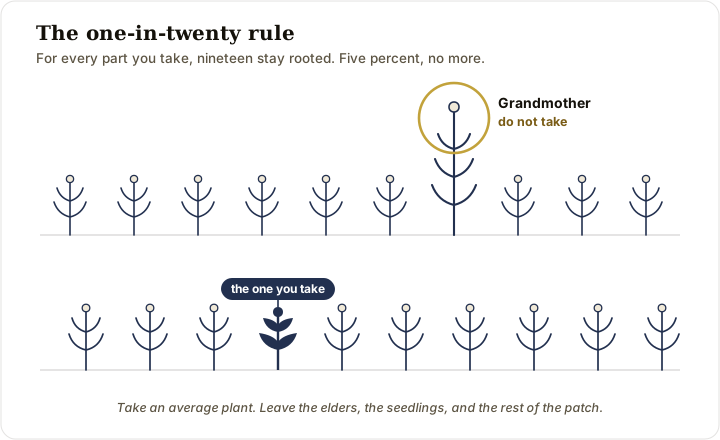
For every part you take, twenty healthy counterparts stay in the ground. Five percent of a stand, no more, and only if the stand is robust.
Some contemporary herbalists allow a one-in-ten rule (10%) for unusually thriving patches. Treat that as a ceiling for exceptional conditions, not a default. The default is twenty.
A few practitioner habits that ride along with the math:
- Leave the grandmothers. The largest, oldest, most vibrant specimens carry the genetics that keep the patch going; take the average plant, not the spectacular one.
- Move around the stand instead of stripping one cluster.
- Make clean cuts with sharp shears rather than ripping; ripped stems invite disease into the surviving plants.
- Never uproot what you can leaf-pick.
The one exception is aggressive non-native invasives. If you are looking at Japanese Knotweed, Garlic Mustard, or (in many North American lawns) the introduced common Dandelion, you can take with both hands. Removing them is a gift to the native ecosystem they are smothering.
The at-risk list: plants to never wildcraft
The single best North American resource on plant conservation status is United Plant Savers, the non-profit founded in 1994 by herbalist Rosemary Gladstar and currently directed by Susan Leopold. They publish and keep current two lists every practitioner should bookmark before they ever set foot in the woods: the At-Risk list and the Critical list. You can read the current versions at unitedplantsavers.org.
If your spell calls for a plant on either list, you buy it organically cultivated, or you use an analog with a similar correspondence. You do not wildcraft it.
The At-Risk plants you already recognise
These are the ones witches reach for most, which is exactly the problem.
- American Ginseng (Panax quinquefolius): native to the deciduous forests of eastern North America; gutted by the commercial root trade.
- Black Cohosh (Actaea racemosa): eastern North America; wild-harvested into trouble by the menopause supplement market.
- Bloodroot (Sanguinaria canadensis): eastern North America; vulnerable to habitat loss and alkaloid extraction.
- Ghost Pipe (Monotropa uniflora): a mycoheterotroph, which means it cannot be cultivated; poached for pain tinctures and not coming back fast.
- Goldenseal (Hydrastis canadensis): hardwood forests of eastern North America; driven near to wild extinction by the supplement aisle.
- White Sage (Salvia apiana): native only to a narrow band of Southern California and Baja California; decimated by the commercial smudge-stick aisle.
White sage deserves a sentence on its own. Smoke cleansing is older than the bundles in the checkout line, and the plant currently being uprooted to fill them is a regional native of a place most of the buyers do not live in. Mugwort, rosemary, garden sage, juniper, cedar, and a clean broom swept across a threshold all do the same energetic job without taking from a stressed wild population. For the longer rundown, see home cleansing.
The Critical list
The Critical list sits one step further. United Plant Savers' position is that nobody should wild-harvest or purchase wildcrafted material of these, with the narrow exception of Indigenous societies with a traditional, historical relationship to the plant.
- Lady's Slipper Orchid (Cypripedium spp.): near-impossible to propagate, poached by collectors.
- Venus Flytrap (Dionaea muscipula): native only to a tiny radius of the Carolinas; poached for the novelty plant trade.
- Sandalwood (Santalum spp.): logged at the genus level for heartwood and essential oil.
- Peyote (Lophophora williamsii): slow-growing, sacred to specific Indigenous traditions, and threatened by land conversion and over-harvest.
That last exception is honest, not a loophole. If a plant is part of a closed tradition you were not raised inside, the answer is no, and the wider conversation lives in closed practices.
| Plant | Native range | Why it's listed | What you do instead |
|---|---|---|---|
| American Ginseng | Eastern North America | Commercial root trade | Organically cultivated ginseng, or a grounding analog |
| Black Cohosh | Eastern North America | Supplement market | Cultivated black cohosh, or vervain for similar magical territory |
| Bloodroot | Eastern North America | Alkaloid extraction | Skip; use a cultivated protective root |
| Ghost Pipe | Temperate Asia and Americas | Cannot be cultivated; poached | Skip entirely |
| Goldenseal | Eastern North American hardwoods | Supplement market | Cultivated goldenseal, or yellow dock as a hardy analog |
| White Sage | Southern California, Baja | Smudge-stick trade | Mugwort, rosemary, garden sage, juniper, cedar |
| Lady's Slipper | Across North America | Collectors; non-propagable | Skip entirely |
| Venus Flytrap | Coastal Carolinas | Novelty trade | Nursery-grown only, ideally not at all |
| Sandalwood | India, Australia, Pacific | Logging | Cedar or cypress as a warm-wood incense |
| Peyote | Chihuahuan Desert | Indigenous closed practice | Not yours to use |
Asking permission and listening for the answer
Sit down with the plant. Say what you want, and what for. Then wait long enough to actually hear an answer.
The pragmatic noes come first, because they are the ones the skeptical reader can verify against the visible world. If the plant is diseased, if it is the only one of its kind in a clearing, if bees are working it right now, if it is in flower and the seed has not set, the answer is no and you already know that. The environment is telling you.
The felt-sense no is what the animist tradition adds on top. A sudden chill across the shoulders. A flat refusal in the chest. A small mental block where the answer should be. In this practice, that counts as a no, and you walk away. Taking anyway reads as spiritual theft in the tradition, and the herb worked under refusal does not tend to perform anyway.
The Honorable Harvest
The most respected modern articulation of what wildcrafting ethics ask of us comes from Dr. Robin Wall Kimmerer, a botanist, professor, and enrolled member of the Citizen Potawatomi Nation. Her book Braiding Sweetgrass is where most green witches now meet the Honorable Harvest, the unwritten Indigenous canon that frames foraging as a covenant of reciprocity rather than extraction.
The tenets, with a practitioner reading on each:
- Introduce yourself. Be accountable as the one who came asking for life.
- Ask permission, and abide by the answer. Including the noes that inconvenience you.
- Never take the first, never take the last. The first-rule habit is the practical safeguard. If you always skip the first plant you see, you cannot accidentally take the last plant in the patch.
- Take only what you need, and never more than half. Half is the absolute ceiling; the one-in-twenty rule above is the working number.
- Harvest with the lightest tool that works. Clean cuts beat ripped stems; sharp shears beat shovels.
- Use everything you take. Wasting the gift dishonours it.
- Share the bounty. Pass some on.
- Give thanks and reciprocate the gift.
The shift the Honorable Harvest asks for is one Kimmerer names directly: stop asking what more we can take, and start asking what the Earth asks of us in return.
Offerings: the witch-litter problem
Most of the offerings popular on witchcraft TikTok actively harm the habitat they are meant to thank. The instinct is good. The execution, in a lot of cases, is ecological vandalism in pretty wrapping.
Offerings to stop leaving outside
- Salt. Salt sterilises soil. It draws water out of root cells by osmotic stress, kills surrounding plants, and stays in the ground long after you are gone. The cleansing salt circle belongs on an altar, indoors, not at the base of a tree.
- Glass jars, wax pours, synthetic ribbons. Spell remnants left in a forest are litter, no matter how charged. Take them home and dispose of them properly. If a working called for burial, bury it on land you own.
- Grapes, onions, garlic. They feel like generous offerings. They are toxic to dogs and to a range of wild mammals, and the local fox or off-leash terrier who finds them is the one who pays.
- Bread, dairy, anything sugary. Either it does not break down where you left it, or it attracts animals that should not be habituated to human food.
The honest move: spell remnants come home with you, get composted, or get returned to soil you can take responsibility for.
Offerings the land actually wants
- A song.
- A spoken thanks, named to the specific plant and place.
- A drop of water from your own bottle.
- A handful of trash picked up on your way back to the car.
- An invasive pulled so a native can come back.
- A scatter of native seed appropriate to the region (verified, not a commercial wildflower mix).
The work is the offering. That is the part of green witchcraft that most quietly bears out in practice: physical reciprocity, the small repeated act of leaving the patch in slightly better shape than you found it, builds a relationship the spellcraft draws on.
| Common offering | Ecological effect | Do instead |
|---|---|---|
| Salt | Sterilises soil, kills nearby roots | Speak a thanks; salt belongs on the indoor altar |
| Glass jar, wax, ribbon | Litters the habitat | Compost spell remnants at home |
| Grapes, onions, garlic | Toxic to local dogs and wildlife | A drop of your drinking water |
| Coins or metal trinkets | Slow metal leaching into soil | Pull a patch of invasives on your way out |
| Bread, milk, sugar | Attracts and habituates wild animals | Scatter region-appropriate native seed |
The legal reality
Every plant growing wild is somebody's legal property. Plants on a roadside, plants in a park, plants in a clearing nobody seems to own: every one of them belongs to a private citizen, a corporation, a municipality, a state, or a federal agency. The legal landscape has three layers worth knowing.
Private land
No permission is trespassing, and the harvest itself is theft. The kind, practitioner version is to ask, in plain language, before you forage anywhere you do not own.
A workable script: "I live nearby and I forage dandelions and plantain. Would you mind if I gathered a small amount from the edge of your yard a few times a year? I would stay clear of anything you have treated, and I would not dig anything up." It is more often yes than no.
Public land
Most municipal, state, and US National Park land prohibits removing plant material. Some regions, including a number of US Forest Service districts and certain state parks, issue seasonal foraging permits for specific species at specific quantities; check the managing agency's own published rules rather than a forum thread. In the UK, Sites of Special Scientific Interest (SSSIs) typically ban picking any vegetation at all. Uprooting (taking the whole root) is often a separate, more serious offence than leaf-picking, even where leaf-picking is tolerated.
The version that holds up everywhere: assume foraging on public land is illegal, then look up the specific rule for the specific patch with the agency that manages it.
Why the law looks the way it does
In North America, the trespass laws that criminalise foraging on public and private land were not written in a vacuum. They tightened sharply after emancipation, in part to shut down subsistence foraging by newly freed Black citizens, whose foraging knowledge was inherited in many cases from Indigenous communities and was a working alternative to the economic trap of sharecropping. The criminalising of "taking from land you do not own" did its job: the knowledge skipped generations in a lot of families.
Alexis Nikole Nelson has done more public work to surface this history than anyone in the contemporary foraging space, and her body of work is the place to follow that thread. For the modern green witch, the takeaway is not guilt; it is that reclaiming this practice has weight, and that pretending the legal landscape is neutral is its own kind of dishonesty.
The urban witch's actual workflow
City sidewalks grow more usable magic than most beginners realise, and urban foraging has its own real rules that the country version does not. Most of it is learning to read what is already there.
Move past plant blindness. The strip of green between the bus stop and the brick wall is not nothing; it is, depending on your block, a thicket of dandelion, plantain, mugwort, mallow, lamb's quarters, and a half-dozen other plants the city is paying somebody to spray.
What to harvest in a city, and what it's for
Three urban heavy-hitters worth knowing, each in folk terms.
- Dandelion (Taraxacum officinale). In folk magic, the dandelion belongs to the sun: resilience, joy, abundance, and (through the deep taproot) grounding. The flower goes into spells for prosperity and quiet courage, the leaf into cleansing, the root into steadying work. Non-toxic to dogs and cats in the yard. Skip any lawn you suspect of weed-and-feed.
- Plantain (Plantago major). Traditionally associated in folk magic with drawing out negative energy, with soothing settling properties, and (in some traditions) carried as an amulet by travellers. Non-toxic to pets. Wash thoroughly: plantain grows where people and dogs walk.
- Mugwort (Artemisia vulgaris). Reached for in this craft for psychic awareness, dream work, and travel protection. Dried mugwort tucked into a dream pillow is a small classic for a reason. Mugwort is toxic to dogs, cats, and horses (it contains thujone), so dried bundles and any oil live in a cupboard the cat cannot open.
The herb-by-herb correspondences live in the herb chart when you want to look up a specific plant.
City contamination rules
Lead is the one. Urban soils across a lot of older neighbourhoods carry historical lead from gasoline, paint, and industrial activity, and lead does not break down. A growing number of city governments now publish soil-lead maps; if yours does, read it before you decide which strip is your dandelion patch.
The rest of the rule set:
- Check the municipal spray schedule for your park system, and avoid treated zones.
- Skip known herbicide-treated parks and golf courses entirely.
- Avoid the high-dog-traffic strips along main paths.
- Wash everything in vinegar water at home, every time.
For a working model of urban foraging done at scale and on the right side of the law, the League of Urban Canners (LUrC) in the Boston, Cambridge, and Somerville area maps and harvests several thousand pounds of fruit a year from urban trees, every harvest under explicit landowner or municipal permission, with the haul tested for soil contamination through a partnership with Wellesley College geosciences. The point is not that you need a four-thousand-pound operation; the point is that a serious urban practice is possible, and someone has already drawn the template.
The windowsill workaround
The windowsill is not the consolation prize for green witches without land. It is, in the modern green witchcraft canon largely articulated by Arin Murphy-Hiscock in The Green Witch and The Green Witch's Garden, the same craft on a smaller circle. The daily act of observing soil moisture, tracking the angle of the sun across the year, and responding to the visible needs of a living being is what green witchcraft actually is. The forage is the side benefit.
Three pots run a daily practice for most witches.
- Rosemary (Rosmarinus officinalis). Protection, purification, memory. The needle-like leaves go into spell jars, into smoke cleansing as a kinder alternative to white sage, into kitchen workings. The fresh plant is non-toxic for pets to brush against; the concentrated essential oil is a different story, and is kept away from cats especially.
- Parsley (Petroselinum crispum). Warding off negative spirits, home protection, and prosperity in folk tradition. Easy to grow, fast to bolt, generous when you keep cutting. Toxic to dogs, cats, and horses in quantity (it contains furanocoumarins, which cause photosensitisation), so the pot does not sit where a cat grazes.
- Lavender (Lavandula angustifolia). Calm, peace, sleep. Sachets under the pillow are a small classic; dried buds go into bath workings and into honeyed offerings on the altar. Lavender is toxic to cats specifically: they lack the UGT1A6 liver enzyme needed to process linalool, and the essential oil is the most dangerous form. The plant on a high sill is fine.
The same three plants run most of a stovetop practice, which is where kitchen witchcraft picks up the thread.
| Plant | Folk use | Where it grows for you | Pet-safety note |
|---|---|---|---|
| Dandelion | Sun energy, resilience, abundance, grounding | Urban / suburban weed, untreated lawns | Non-toxic to dogs and cats |
| Plantain | Drawing out negative energy, soothing, traveller's amulet | Ubiquitous urban weed, lawns, sidewalk cracks | Non-toxic to dogs and cats |
| Mugwort | Psychic awareness, dream work, travel protection | Disturbed urban soils, roadsides | Toxic to dogs, cats, horses (thujone) |
| Rosemary | Protection, purification, memory | Indoor sill, sunny window, outdoor pot | Plant safe around pets; oil is not |
| Parsley | Warding, home protection, prosperity | Indoor sill | Toxic to dogs, cats, horses in quantity |
| Lavender | Calm, sleep, peaceful magic | Sunny outdoor garden, bright sill | Toxic to cats especially |
Folklore, not medicine
Plants in this craft are described in terms of folk tradition, energetic correspondence, and magical practice. They are not described as cures. That is both a legal line and an honest one.
The rewrite a practitioner learns to make on the fly:
- Not "yarrow stops bleeding." Instead: in folk magic, yarrow is associated with energetic boundaries and was historically carried as a protective amulet.
- Not "dandelion root detoxifies the liver." Instead: metaphysically, dandelion is reached for in spells for resilience and overcoming bad odds, and its deep taproot makes it a popular grounding ingredient.
- Not "chamomile cures insomnia." Instead: chamomile is traditionally associated with peaceful sleep, and is a small classic in dream sachets.
The line that earns trust, and the one to keep close: this work supports how you feel, not a diagnosis. If something is physically wrong, please see a doctor too.
A starter reading shelf
The shortlist of writers and organisations that should be doing most of the teaching here, with one line on why a practitioner reaches for them.
- Robin Wall Kimmerer, Braiding Sweetgrass. The Honorable Harvest, the animist frame, and a botanist's grounded prose. Probably the single most important book on this list.
- Alexis Nikole Nelson (@blackforager). Urban foraging, look-alike walkthroughs, and the history this practice sits inside. The best living teacher of practical foraging on the internet.
- Arin Murphy-Hiscock, The Green Witch and The Green Witch's Garden. The modern green path, written for the apartment witch and the windowsill garden.
- United Plant Savers (unitedplantsavers.org). The At-Risk and Critical lists, kept current. Required reading before you wildcraft anything.
- Samuel Thayer, The Forager's Harvest. Rigorous plant identification and preparation; the survivalists and the witches both reach for him.
A wider beginner shelf across the craft sits in the beginner guide.
Where to go next
If the green path is calling, walk it in green witchcraft. If you want to sit with what a plant means before you ever touch one, the herb chart is the place. If your stovetop is your altar, kitchen witchcraft is the same practice in a smaller circle. And if budget is what is making any of this feel out of reach, it isn't: see witchcraft on a budget.