Witchcraft for Beginners: Where to Actually Start
Witchcraft for beginners is a sequence, not a shopping list: four steps, in this order.
Your first four steps
| Step | What you're learning | Why it comes first | The smallest version you can do tonight |
|---|---|---|---|
| 1. Cleanse, ground, protect | Managing your own energy before you move anyone else's | Skip this and the rest gets shaky and draining | Clap into the corners, breathe down into your feet, picture a sphere of light |
| 2. Document in a Book of Shadows | Tracking what you actually do and what happens | Within a year, your journal becomes your most useful book | Open a notebook, write the date, the moon, and one sentence |
| 3. One simple working | Casting a small, clear intention | Real practice replaces the imagined version in your head | Light a white tealight for a clear, small wish |
| 4. Meet a Sabbat | Syncing with the seasonal year | The rhythm carries the practice when motivation doesn't | Whatever festival is next, do the lowest-effort version |
That is the whole curriculum for your first month: clean your own energy first, write things down, cast one small thing, meet the calendar. Spiritual hygiene before spellcraft. A record before correspondences. One clean working before a stacked altar. The tools can wait.
Quick picks: where to go deeper
- Inner work: cleanse with smoke, sound or salt water, ground with the tree-roots drill, ward with a sphere of light.
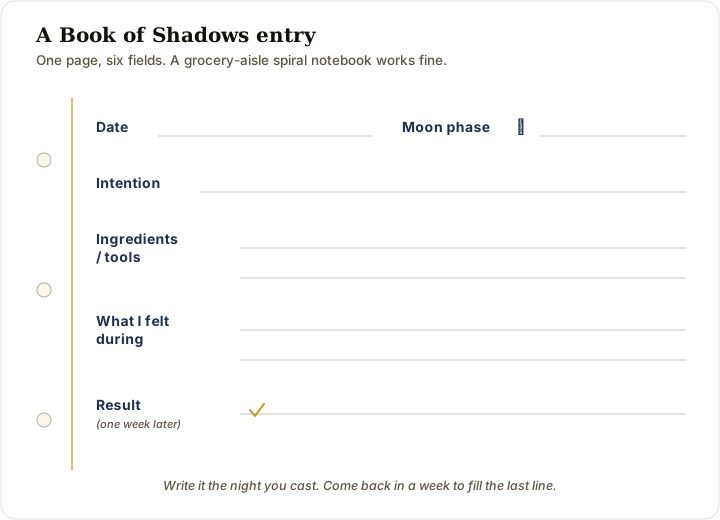
- Book of Shadows: a grocery-aisle notebook, six fields per entry, a look back a week later.
- First candle spell: one white candle, one true sentence, one real-world action.
- First protection jar: salt, rosemary, sage, bay and a folded sentence in a washed jam jar.
- First Sabbat: find the next festival and do the one-line version.
- First month: ten minutes a day, four weeks, one new thing a week.
- Budget swaps: table salt, spice-aisle herbs and tealights do the same job as boutique kits.
Step 1: cleanse, ground, protect (inner work first)
Before you light anything for an outcome, learn to manage the inside of you. Practitioners who skip this part get jumpy results and a tired body, and then quietly conclude that magic doesn't work for them. The real culprit is energetic housekeeping that never happened.
The three skills are simple and stack in this order: clear the room, anchor yourself, set a soft edge around your field. None of it requires anything you don't already own.
Cleansing a space without buying anything
Three methods cover everything you'll need at the start: smoke, sound, and salt water. Smoke can be a stick of incense or a small bundle of garden rosemary; sound is a bell, a singing bowl, or just clapping hard into the corners of the room until the air sounds different to you. Tidying the actual room counts too, and that is not a joke.
My first cleansing was the salt-water spray on a kitchen counter, and I want to walk it because nothing on the internet warned me how anticlimactic it would feel. I filled a thrifted glass mister with warm tap water, dissolved a teaspoon of plain table salt, and stood for a moment with my hand over the lid asking it to wash the room clean. Then I sprayed the counter in light passes, top to bottom, the way you'd wipe it, and wiped after with a paper towel. The kitchen did feel different, the way a room feels after you open a window. That was the whole event.
A first grounding visualization (the tree-roots drill)
Sit with both feet flat. Close your eyes, breathe long and low through the nose into the belly, and picture roots growing out of the soles of your feet, down through the floor, through the building, into the soil. Let them drink. On the in-breath, draw stable, mineral, slow earth-energy up through the roots; on the out-breath, send your jitters down.
Grounded does not feel floaty or blissed-out. It feels settled in the chest, a little heavier in the hips, like someone just turned the volume on the room down two notches. If you finish a working with your heart racing or a metallic taste in your mouth, you skipped this step. The longer drills, including the "Tuning In" sequence and how to close down afterward, live in grounding drills.
Simple protection (warding for a beginner)
In the tradition I work in, protection is a soft edge, not a wall. Picture a sphere of white or warm gold light an arm's length around your body, sealing at the crown and at the soles. Pinch of salt across the threshold of your front door. A small black stone, tourmaline or obsidian, in a coat pocket when you go somewhere draining.
If you read all that as belief, fine; it's belief. If you read it as a psychological cue that tells your nervous system you are inside a boundary, fine; it is also that. Both readings work. More targeted versions live in protection spells and home cleansing.
Ecological honesty: skip white sage and palo santo
Commercial demand has driven illegal harvesting of wild white sage on protected and tribal land, and palo santo carries similar appropriation and sourcing problems. Common garden sage from the grocery store, rosemary from a windowsill pot, cedar, or a clear bell will cleanse a room just as well. More on respectful sourcing in wildcrafting and closed practices.
Step 2: start a Book of Shadows (a notebook will do)
The day you start the energy work is the day you start a magical journal. Cunningham called his the Mirror Book, written before sleep, for his eyes only; the older name is the Book of Shadows, or just a grimoire. The format does not matter. The discipline does.
Write the date. Write the moon phase. Write what you did, what you felt while you did it, and what was going on in your life when you sat down. Then leave space and come back a week later to note what shifted. Within about six months, your own journal will be the most useful book on your shelf, because it is the only one written about you.
A spiral notebook from the grocery aisle is structurally identical to a leather-bound grimoire that costs ninety dollars. Buy the pretty one in a year if you want to; for now, you want low friction so you actually write.
Paper, binder, or digital, pick later
A bound notebook locks you into sequence; a binder lets you reorder; a digital doc is searchable and survives spills. None of those choices is more powerful than the others. The longer comparison lives in journal vs binder.
Step 3: your first simple working
A first spell should be small, clear, and physical, not a six-correspondence Saturday-night ritual. Of all the types of spells, candle magic and a jar spell are the two shapes that have done this job for centuries because they hold focus without overwhelming a new caster.
Pair every working with a real-world action. Light the candle for the interview, and also send the application. The pairing is not a hedge against doubt; it is the actual mechanism.
A first candle spell, walked moment by moment
Pick one small, true intention. Not "abundance," which is too vague to land. Try "I want a calm hour to finish this email," or "I want clarity about whether to text her back."
Take a plain white candle, a tealight is fine, a birthday candle is fine, and wash it under cool tap water to clear whatever it has picked up between the factory and your hands. Dry it. Rub a thumbnail of olive oil along its length from the middle outward to the ends, then roll it in a pinch of crushed dried rosemary for peace, or cinnamon for momentum, whichever fits your sentence. Set it in a small dish of foil or salt so the wax has somewhere to go.
Say the intention out loud. There will be a half-second where you feel ridiculous saying anything out loud in your kitchen, and then it lifts. Strike the match, and notice the smell of the head sparking. Light the wick. Sit with it for a minute, then go do your real-world version of the thing. Let the candle burn down on its own in a safe dish. Cast and release: you don't keep checking on it the way you don't keep checking the oven.
When it has finished, look at what's left. A clean burn with little soot is, in folk reading, a clear flow. White soot is read as quiet help. Heavy black soot or thick wax clumps are read as something resisting, often something inside you, and that is information, not a verdict. Deeper work is in candle magic and more first spells in beginner spells.
A first protection jar, layered honestly
Find a small empty glass jar with a tight lid. A washed jam jar is the right vessel, not an etched apothecary bottle from a witch shop. Cleanse it with smoke or salt water and dry it.
Layer it this way. A finger-thick base of salt at the bottom for the line. A pinch of dried rosemary and a pinch of dried sage for keeping unwanted energy out and easing what is in. A bay leaf for warding. On a scrap of paper, write one short sentence in present tense: this home is a sanctuary, protected from all harm. Fold it toward you three times and drop it in. Close the lid and, if you want a strong seal, drip white or black candle wax around the rim.
The jar lives near the front door, on a high shelf, or under the bed if the door is not yours. When it stops feeling active in a year or two, you bury its contents in soil, give the jar a wash, and start a new one. More structures in spell jars and the older protective form in witch bottle.
When the candle doesn't burn clean
A spell that didn't land almost never "backfires" in the horror-movie sense. The boring real answers, in order: the intention was too vague, the caster cast from fear or anger instead of focus, the corresponding real-world action never happened, or the universe took the request literally in a way the caster didn't mean. The fix is rarely a reversal. It is a clearer sentence and another small working. The diagnostic walk-through is in why spells don't work.
Step 4: meet one Sabbat (sync with the cycles)
The Wheel of the Year is a calendar of eight seasonal festivals that modern practice, across most traditions, observes as the breathing rhythm of the year. You do not need to celebrate all eight to begin. You need to find the next one and meet it small.
| Sabbat | Approx. date (NH) | Approx. date (SH) | A beginner-friendly first observance |
|---|---|---|---|
| Yule | ~Dec 21 | ~Jun 21 | Light a single gold candle on the longest night and welcome the returning sun |
| Imbolc | ~Feb 1 | ~Aug 1 | Deep-clean the house and sweep the stagnant winter out the front door |
| Ostara | ~Mar 21 | ~Sep 21 | Plant a seed in a small pot, name an intention as it goes into the soil |
| Beltane | ~May 1 | ~Nov 1 | Weave a simple flower crown or light a candle for what you want to grow |
| Litha | ~Jun 21 | ~Dec 21 | Sit in the midday sun and leave a small offering of honey or fruit outside |
| Lughnasadh | ~Aug 1 | ~Feb 1 | Bake a loaf of bread and take a slow gratitude walk |
| Mabon | ~Sep 21 | ~Mar 21 | Write a list of what you are grateful for and share a harvest-themed meal |
| Samhain | ~Oct 31 | ~May 1 | Set out a photo of someone you've lost, light a candle, sit with them a while |
The exact next date for your hemisphere is in next sabbat, and the bigger explainer is at wheel of the year.
Pick the next one on the calendar, do the small version
Don't try to invent a ritual. Do the line from the table. One gold candle on Yule. A real broom and ten minutes for Imbolc. A basil seed in a windowsill pot for Ostara. The goal is the felt rhythm under the year, not a performance for an empty room. You can build a more elaborate observance the second time around.
The first month: a realistic weekly cadence
Ten minutes a day, four weeks, no thirty-day-challenge intensity.
| Week | Primary focus | Daily 10-minute practice | The one new thing this week |
|---|---|---|---|
| 1 | Cleanse, ground, protect | Tree-roots breath, sphere of light, three clean breaths | Cleanse one room (sound, smoke, or salt water) |
| 2 | Document and pay attention | Same daily, plus three journal lines before bed | Open the Book of Shadows; record this week's moon |
| 3 | One simple working | Daily, plus one re-read of your journal | Cast one small candle spell or build one protection jar |
| 4 | Meet the cycles | Daily, plus a glance at the calendar | Observe whichever Sabbat or esbat is closest |
If a full moon falls inside the month, the daily wind-down can also be a full-moon observance, which is what an esbat is. More on those in daily practice and esbats.
You don't need the $200 starter kit
The most powerful tool you'll ever own is your own attention, and physical tools are focal points for that attention. The expensive kit on the internet is not bad because it is expensive; it is bad because it sells the lie that you can't begin without it. You can.
The boutique markup on the same herbs you can buy from the spice aisle is real and worth naming. Bay leaves are roughly a dollar fifty at a grocery store; the same packet at a witch shop is often ten to twenty times that. The plant is the same plant.
| What spells call for | Boutique range | Honest budget swap | Why it works just the same |
|---|---|---|---|
| Athame (ritual blade) | $15-$125+ | A fountain pen, a kitchen scissor tip, a knitting needle | The blade only directs; the energy is yours |
| Salt | "Witch" salts at premium | Plain table salt, even fast-food packets | Salt's structure and meaning don't care about packaging |
| Magical herbs | Apothecary-priced | Grocery rosemary, basil, thyme, cinnamon, bay | A dried leaf is a dried leaf |
| Candles | Color-specific pillar candles | White tealights, birthday candles | White holds all frequencies; small spells want small candles |
| Altar | Carved wood altar tables | A repurposed shoebox, a mint tin, a placemat | Sacred space is set by intention, not by furniture |
| Black salt | Bottled at premium | Table salt mixed with fireplace ash or skillet scrapings | You infused it; that's what makes it work |
The fuller version with prices and where to look is in witchcraft on a budget, the why-each-tool conversation is in witch tools, and the honest answer on whether premade kits are ever worth it is in starter kits worth it.
Real things worth spending on, eventually
Spending money on the craft is not the enemy; the lie is. A divination deck whose art genuinely makes you stop will earn its keep, because you'll actually shuffle it. A real beeswax pillar candle for a working that matters to you smells better and burns slower, and that matters when you're sitting with it for an hour. A book by a named author with a real bibliography gives you something the algorithm can't, which matters more now that machine-written spellbooks are crowding the shelves.
The same first-year sequence in one guided PDF is The Grounded Witch: grounding, your first spell, a spell log, moon work, Sabbats, and the questions beginners actually hit.
Save those purchases for after your first month, when you know what you actually do. Then witch starter kit and best witchcraft books are honest places to land.
Practicing quietly if you need to
If you live with family, a religious partner, or a household where any of this isn't safe to do openly, every step above still works. Cleansing a room with claps and an open window is invisible. Grounding looks like sitting on the couch with closed eyes. A protection jar can be a small unmarked one in a drawer. A spell can be cast on a birthday candle stuck in a peach for thirty seconds.
The discreet practice is not a lesser practice. The fuller guide for the in-the-closet stretch is at broom closet witch.
Common beginner worries, answered briefly
"Is this a sin? I was raised religious." For most modern witches, the answer is no, and the longer pastoral version, including how to hold this alongside a faith you still love, is at is witchcraft a sin.
"What if my spell doesn't work?" Usually the intention was vague, the caster was in fear, or there was no real-world action to meet the magic halfway; almost never a curse on you. Diagnostic walkthrough in why spells don't work.
"Am I even doing this right?" There is no governing body to be wrong by, and the doubt itself is a stage of the path, not a disqualification. The fuller answer, with a short reality-check, is at am I a witch.
"Is this real, or am I just performing?" Both, and both are fine. The honest both/and, including the secular-quantum framing and the believing framing side by side, is at is witchcraft real.
Solitary or coven? You can absolutely begin alone
Solo is fully valid, and it is how most new witches today actually start. Until the late 1980s, the assumed unit was the coven, with a High Priest or High Priestess, a lineage, and a probationary period; Scott Cunningham's Wicca: A Guide for the Solitary Practitioner (1988) argued the opposite, and most of the modern landscape has tilted toward solitary practice ever since.
A coven is a serious commitment. Traditional witches sometimes liken joining one to a marriage, and they mean it as a warning, not a metaphor. Never join a group because you are lonely or want a costume; only join one whose people you would already want as your spiritual family. The fuller comparison lives in solitary vs coven.
When you're ready to make it official: dedication vs initiation
Two words that get used as if they meant the same thing, and don't. Initiation is granted by a group into its lineage; you cannot initiate yourself into a tradition that no one has welcomed you into. Self-dedication is a private vow you make to yourself, the universe, and any deities you choose to honor, with no human gatekeeper involved.
Many traditions suggest "a year and a day" of study before either, and that suggestion is good wisdom and not a gate. The simplest self-dedication is the one Cunningham himself called perhaps the best: a quiet evening, a single candle, a small cup of something you like to drink, and a few honest sentences spoken out loud about why you are walking this path. The fuller walk-through is at self-dedication ritual.
You don't have to pick a "type" yet
The labels you have probably already met, in one sentence each, are a starting menu and not boxes you have to fit.
- A kitchen witch treats the stove as the altar and intention as the secret ingredient.
- A green witch is an herbalist and naturalist whose practice runs through plants, gardens, and the wild near her home.
- A hedge witch works the boundary between this world and the otherworld through trance, dream, and journeying.
- A sea witch times her workings to the tides and the moon and works with sea salt, shells, and oceanic deities.
- A cosmic witch times rituals to planetary placements and reads natal charts.
- A secular witch keeps the rituals and reads the magic as psychology and focused belief, with no deities involved.
- An eclectic witch borrows across traditions with care, builds her own practice over time, and refuses to be filed under one label.
Eclectic is an honest default for a beginner, because eclectic is what you are while you are figuring out where the rest of this resonates. The longer self-selection lives in types of witches; each path has its own door at kitchen witchcraft, green witchcraft, hedge witchcraft, sea witchcraft, and secular witchcraft.
What "beginner" actually means (and what it doesn't)
A baby witch is a stage, not a verdict. There is no checklist to qualify and no one to ask permission from. No central authority hands out witch credentials, no lineage will be checked at the door of your own practice, and the aesthetic you saw on TikTok is not the practice underneath it.
I came in the way most of us do: late at night, three tabs deep, comparing myself to a girl on my screen with a forty-crystal grid and feeling like I had missed the entry exam. There is no exam. Most modern practice is solitary, self-paced, and self-taught. You are welcome at the door with kitchen salt and a tealight.
You can hold this work three different ways and all three are honest. You can believe energy and spirits move in the world. You can read the rituals as psychology, where the candle changes you and not the wax. You can come at it as someone leaving a strict religion and need a long time to trust your own hands again. The sequence works in all three keys.
Magic works the way the door does at the post office: you push, and something on the other side pushes back. More on the why in how spells work.
If a quiet voice is already whispering "but am I really one," that voice is normal and the answer is yes, with more in am I a witch and is witchcraft a sin for the religious-fear edition. If the worry is that you only love the look of it, that is also normal and addressed plainly in aesthetic vs practice.
Begin where you are, with what you have, and let the practice grow as you do.
Keep exploring
Browse more guides, or start with the basics of the practice you are curious about.
Browse more guides