Herb Correspondences Chart
Herb correspondences are the magical lore of plants, not medical advice.
The filterable herb chart
The full 62-herb chart below is complete and works without filters.
| Herb (Latin) | Intention | Element | Planet | Form | Folklore notes | Pantry |
|---|---|---|---|---|---|---|
| Rosemary (Salvia rosmarinus) | protection, purification, memory | Fire | Sun | leaf | the all-purpose master herb; a sprig above the door, a pinch in the wash water | Yes |
| Bay Laurel (Laurus nobilis) | wishes, protection, prophecy | Fire | Sun | leaf | write a wish on a leaf, then burn it in a fireproof dish | Yes |
| Angelica (Angelica archangelica) | warding, uncrossing, banishing | Fire | Sun | root | named in old herbals for the archangel's protection | No |
| Mullein (Verbascum thapsus) | courage, banishing nightmares | Fire | Saturn | leaf | dried stalks dipped in tallow were the witch's torch | No |
| Rose (Rosa spp.) | love, self-love, peace | Water | Venus | petal/hip | the queen of love herbs; petals in baths, hips in tea | Yes (hips) |
| Lavender (Lavandula spp.) | peace, sleep, gentle love | Air | Mercury | flower | a sachet under the pillow when a house is tense | Yes |
| Jasmine (Jasminum spp.) | sensual love, prophetic dreams | Water | Moon | flower | night-blooming, lunar-coded, an esbat herb | No |
| Cinnamon (Cinnamomum spp.) | prosperity, speed, success | Fire | Sun | bark/spice | fast and fiery; brushed onto cash or doorways | Yes |
| Peppermint (Mentha piperita) | prosperity, healing, clarity | Fire | Mercury | leaf | a leaf in the wallet against lean times | Yes |
| Alfalfa (Medicago sativa) | pantry prosperity, stability | Earth | Venus | leaf | a sachet in the cupboard with the dry goods | No |
| Garden Sage (Salvia officinalis) | purification, longevity, wisdom | Air | Jupiter | leaf | the sustainable European stand-in for white sage | Yes |
| Lemon Balm (Melissa officinalis) | peace, compassion, lifting grief | Water | Moon | leaf | tea in a low moment; a cool cloth on the chest | Sometimes |
| Lemon peel (Citrus limon) | purification, fresh starts | Water | Moon | fruit/peel | grated into wash water for a quick clearing | Yes |
| Mugwort (Artemisia vulgaris) | dreams, divination, psychic sight | Earth | Moon | leaf | the dream herb; not in pregnancy, not while nursing | No |
| Chamomile (Matricaria chamomilla) | sleep, peace, soft prosperity | Water | Sun | flower | guards against nightmares; gentle, steady money | Yes |
| Anise seed (Pimpinella anisum) | prophetic dreams, clairvoyance | Air | Jupiter | seed | seeds in a dream pillow for clear sight | Yes |
| Patchouli (Pogostemon cablin) | grounding, prosperity, sensual love | Earth | Saturn | leaf/oil | heavy, earthy, deeply anchoring | No |
| Vetiver (Chrysopogon zizanioides) | hex-breaking, money, stability | Earth | Venus | root | a root in the pocket against bad luck | No |
| Comfrey (Symphytum officinale) | safe travel, grounding | Earth | Saturn | root/leaf | tucked into a suitcase before a trip | No |
| Lemongrass (Cymbopogon citratus) | mental clarity, road-opening | Air | Mercury | leaf | cuts heavy emotional weather | Yes |
| Juniper (Juniperus communis) | protection, exorcism, cleansing | Fire | Sun | berry/needle | berries on the altar, needles in the smoke | Sometimes |
| Garlic (Allium sativum) | protection, healing, banishing | Fire | Mars | bulb | a braided string at the door, no nonsense | Yes |
| Frankincense (Boswellia spp.) | consecration, vision, raising the room | Fire | Sun | resin | the temple resin; burned on charcoal | No |
| Myrrh (Commiphora myrrha) | mourning, blessing, sealing a rite | Water | Moon | resin | grief work; pairs traditionally with frankincense | No |
| Dragon's Blood (Daemonorops draco) | power, protection, amplification | Fire | Mars | resin | a spell-booster; adds force to any working | No |
| Sandalwood (Santalum album) | peace, spirit contact, astral work | Water | Moon | wood | smooth, soft, slow-opening | No |
| Copal (Protium copal) | offering, purification | Fire | Sun | resin | the Mesoamerican answer to frankincense | No |
| Benzoin (Styrax benzoin) | purification, prosperity | Air | Sun | resin | sweet, vanilla-edged, a peace-maker | No |
| Basil (Ocimum basilicum) | prosperity, peace, banishing arguments | Fire | Mars | leaf | a pot by the door for money and quiet both | Yes |
| Cedar (Cedrus and Thuja spp.) | longevity, prosperity, protection | Fire | Sun | wood | shavings in the smoke when clearing a new home | No |
| Pine (Pinus spp.) | cleansing, prosperity, healing | Air | Mars | needle/cone | a winter altar staple | Sometimes |
| Thyme (Thymus vulgaris) | courage, faerie work, restful sleep | Water | Venus | leaf | a sprig in the bath to settle the nerves | Yes |
| Vervain (Verbena officinalis) | consecration, peace, blessing | Earth | Venus | leaf/flower | the classic altar-cloth herb | No |
| Yarrow (Achillea millefolium) | courage, love divination, healing | Water | Venus | flower | the old I Ching stalks were yarrow | No |
| Catnip (Nepeta cataria) | cat magic, love, beauty | Water | Venus | leaf | shared with a familiar; tucked into a love sachet | Sometimes |
| Hibiscus (Hibiscus spp.) | love, divination, lust | Water | Venus | flower | a tea before a candle-light reading | Sometimes |
| Heather (Calluna vulgaris) | luck, weather magic, peace | Water | Venus | flower | a wand for blessing rain | No |
| Rue (Ruta graveolens) | protection, breaking jinxes | Fire | Mars/Saturn | leaf | handled with gloves; never eaten | No |
| Wormwood (Artemisia absinthium) | protection, spirit contact, divination | Fire | Mars | leaf | the seer's herb; not for tea, not for drink | No |
| St. John's Wort (Hypericum perforatum) | protection, exorcism, courage | Fire | Sun | flower | gathered at midsummer in the old calendars | No |
| Pennyroyal (Mentha pulegium) | protection (handle with extreme care) | Fire | Mars | leaf | strictly external; an absolute no in pregnancy | No |
| Hyssop (Hyssopus officinalis) | purification, atonement | Fire | Jupiter | leaf | named in old Psalms as a cleansing herb | No |
| Marigold / Calendula (Calendula officinalis) | sun magic, prophetic dreams, joy | Fire | Sun | flower | petals in custards at Beltane, in older recipes | Sometimes |
| Sunflower (Helianthus annuus) | vitality, joy, courage | Fire | Sun | flower/seed | seeds in a pocket for nerve | Yes (seeds) |
| Hazel (Corylus avellana) | wisdom, divination, dowsing rods | Air | Sun | nut/branch | a forked branch for finding water | Yes (nuts) |
| Oak (Quercus spp.) | strength, longevity, prayers | Fire | Sun | wood/acorn | an acorn in a pocket against lightning, in old folklore | No |
| Willow (Salix spp.) | moon work, intuition, grief | Water | Moon | branch/bark | bent into wreaths at a funeral | No |
| Holly (Ilex aquifolium) | protection, winter strength | Fire | Mars | leaf/berry | the Holly King's plant, paired with Yule | No |
| Mistletoe (Viscum album) | protection, fertility | Fire | Sun | leaf | Druid lore; never eaten, never given to a child | No |
| Ivy (Hedera helix) | binding, fidelity, women's mysteries | Water | Saturn | leaf | woven into wreaths for lasting bonds | No |
| Hawthorn (Crataegus spp.) | heart healing, faerie thresholds | Fire | Mars | flower/berry | a Beltane tree; cut with deep care | No |
| Birch (Betula spp.) | new beginnings, blessing of infants | Water | Venus | bark/branch | a besom of birch for sweeping clean | No |
| Rowan (Sorbus aucuparia) | protection against ill-wishing | Fire | Sun | berry/branch | berries on a thread above the door | No |
| Elder (Sambucus nigra) | blessing, protection, transformation | Water | Venus | flower/berry | never burned, out of respect for the Elder Mother | No |
| Clover (Trifolium spp.) | luck, faerie sight | Air | Mercury | leaf | the pressed find in the back of an old book | Yes |
| Dandelion (Taraxacum officinale) | wishes, divination, calling spirits | Air | Jupiter | flower/root | blow the seedhead with a question in mind | Yes |
| Parsley (Petroselinum crispum) | lust, purification, honoring the dead | Air | Mercury | leaf | a Greek funerary herb that became a kitchen one | Yes |
| Dill (Anethum graveolens) | prosperity, protection of children | Fire | Mercury | seed/leaf | a sprig in a baby's room in old European homes | Yes |
| Ginger (Zingiber officinale) | speed, passion, prosperity | Fire | Mars | root | grated into a spell to make it move faster | Yes |
| Oregano (Origanum vulgare) | joy, vitality, letting go | Air | Mercury | leaf | the kitchen-witch's quiet cleanser | Yes |
| Black Pepper (Piper nigrum) | banishing, breaking up stuck energy | Fire | Mars | seed/spice | a pinch across a threshold to send something off | Yes |
| Sea Salt | cleansing, grounding, sealing | Earth | all | mineral | the universal solvent of spellwork | Yes |
Folklore, not pharmacy. The planet column gives the ruler where the older traditions agree, the form column is the part witches usually reach for, and the pantry flag marks what likely sits in your spice rack right now. Search by name, filter by intention, element or planet, or tick "Pantry only".
Each chart of correspondences is one tradition's map, not the only map. Where a book disagrees with another book, both are usually honoring something true inside their own lineage. Write down which version you actually used in your book of shadows, and the chart that matters most starts to be the one you wrote yourself.
Herbs by intention
Protection herbs
Rosemary is the master, the one a practitioner reaches for when only one plant is at hand. The folk practice is generous: smoke for the rooms, sprig above the door, pinch in the wash water, a small bunch tucked under a pillow to fend off bad dreams.
Bay laurel turns intention into a small fire ritual. Write the wish on the leaf, hold it long enough to mean it, drop it into a fireproof dish, and let the leaf burn down. Angelica is the warding root in old European herbals, named for the archangel and carried whole in a pocket against bad luck. Mullein is called the witch's torch because dried stalks dipped in tallow burn slow and steady; the lore that travels with it is about courage and keeping the dark at bay.
Look at the pattern: sharp scents, hard wood or bristle, a history of being burned or hung. Tradition reads herbs of protection as having a kind of defensive geometry. A sprig of rosemary at the door is the most kitchen-magic version of the same gesture, and it counts.
For full workings, more in protection spells and home cleansing.
Love herbs
Rose is the queen, and in this lineage the queen starts with self-love before romance. Petals in the bath, hips in the tea, a single rose on the altar after a rough day. Lavender is the gentler peace-maker, used in old sachets to settle a turbulent house rather than to stoke fresh passion. Jasmine is lunar, night-blooming, and reaches for what is sensual and dreamlike.
A pairing I keep using is rose for the love itself, mullein for the protection around it. When something tender is just starting, give it a guard. The bouquet is the small private fact of how this works.
For the classic sweetening working, more in honey jar spell.
Prosperity herbs
Cinnamon is fast and fiery, the spice traditions reach for when money needs to move. Mint goes in the wallet, on the till, into the rinse water on the bills before they leave the house. Alfalfa is the quiet pantry herb, a sachet against scarcity that lives in the cupboard with the dry goods.
The pattern is deep green or warm spice, fast growth or trade-route history. Light the candle, then send the application too. Magic plus action is how this tends to work; more in magic plus action.
Purification herbs
Garden sage is the European staple for clearing and longevity, easy to grow on a windowsill and easy to find at a grocery store. Lemon and lemon balm are the bright, astringent end of the spectrum: cut through a stagnant week, open a window after an argument, mark a fresh start. Rosemary appears here again because it is a generalist, and one of the gentler honesties of the craft is that very few herbs stay in only one column.
The witch and teacher Mat Auryn points out that the most useful cleansing herbs are usually already in the kitchen: rosemary, thyme, basil, oregano, and sea salt to sprinkle while you clear a space. You do not need to import a thing.
The short version: garden sage is the right tool unless you stand explicitly inside an Indigenous lineage that holds the white sage rite. For the working itself, more in banishing ritual and home cleansing.
Dream and divination herbs
Mugwort is the premier dream herb in the modern tradition, the leaf practitioners reach for when they want to sharpen sight in sleep. It is also famously off the table in pregnancy, while nursing, on certain medications, and for anyone with seizure history. Folklore says yes; biology says check first.
Chamomile is the gentler cousin, a flower for soft sleep that quietly closes the door to bad dreams. Anise seed gets sewn into the same dream pillow for clarity. The pattern is mild and cool, lunar-coded, blooming at the edges of the day; more in moon magic and divination.
Herbs by element
The four classical elements are an older sorting system the craft inherited from Greek philosophy and what physicians used to call humorism, the very old idea that body and mind ran on four temperaments tied to four elements. Modern witchcraft uses the elements as a way to read for imbalance: too much Water (overwhelmed, drowning) calls for Air herbs (logic, lightness, breath). Too much Fire (anger, burnout) reaches for Water (cool, soft, dissolving).
| Element | The mood | Botanical examples | One classic micro-use |
|---|---|---|---|
| Earth | grounding, stability, money | patchouli, vetiver, comfrey, roots and barks, alfalfa | bury at the foot of a tree, or wear in an amulet |
| Air | clarity, communication, freedom | lavender, lemongrass, anise, clover, dandelion fluff | scatter to the wind from a high window |
| Fire | passion, speed, banishing | cinnamon, juniper, garlic, ginger, dragon's blood | burn as offering, incinerate to release |
| Water | feeling, dreams, intuition | rose, jasmine, lemon balm, chamomile, willow | steep in a bath, or release into running water |
Tie this back to where you build the ritual: the four quarters of altar layout and the elements ruling each of the witch tools.
What "herb correspondences" actually means
A correspondence is the link a tradition draws between a physical thing and an intention or energy: rose to love, cinnamon to money, mugwort to dreams. The link is built from resemblance and lore, not biochemistry, which is why two old books can disagree on the same herb and still both be right inside their own lineage.
The system runs on a plant's scent, look, lore, and centuries of folkloric company, not its chemistry, which is why a sprig of kitchen rosemary counts as much as a velvet pouch of dried mugwort from an apothecary. Nothing on a chart belongs to anyone else first. Pick what you have, name what you want, and the door is already open.
All of this is folklore. It is not medical advice, not nutritional advice, and not a substitute for a clinician. If something physical is wrong, please see a doctor too. One real safety note: check every herb you handle for toxicity, allergies, pregnancy and nursing safety, and medication interactions. Folklore meanings live alongside real plant chemistry, and the plant chemistry does not care that you meant well. Magic earns its keep when you pair it with real action, and the chart is no exception to that.
This is the herb-meaning corner of the craft; the broader starting track is witchcraft for beginners.
The logic behind it
The underlying logic in Western witchcraft is what folklorists call sympathetic magic: like calls to like. It is the older name for why rose became love and rosemary became protection. A thorned plant suggests defense; a sweet, soft flower suggests tenderness; a fast-growing herb suggests fast-arriving money. The folklorist James Frazer (writing in The Golden Bough, 1890) named two halves of the same instinct: the Law of Similarity, where like calls to like, and the Law of Contagion, where two things once touching stay linked across distance. The wax-effigy lore around the Egyptian Pharaoh Ramses III, around 1100 BC, is one of the oldest documented examples of the Law of Similarity at work, taken seriously enough that a real trial followed the discovery.
The Doctrine of Signatures, an older Renaissance idea that a plant's shape and color reveal its purpose, is the same instinct read off the body of the plant: a heart-shaped leaf for the heart, a yellow flower for the sun, a thorned stem for defense. It is documented folk philosophy, not pharmacology, and the modern practice treats it as a key, not a code.
The mojo bag (a small flannel pouch holding herbs, roots, and personal concerns) is the Law of Contagion at work in Hoodoo and other African diaspora traditions. That lineage is not borrowable from the outside; the respectful primer is closed practices. For the larger question of why any of this is meant to do anything at all, more in how spells work.
Pantry swaps
You do not need a velvet pouch from an apothecary to start. The kitchen drawer most people already have is, by accident, a witch's cupboard.
| If a spell calls for... | Swap with... |
|---|---|
| any protection herb | rosemary |
| a written-wish burning leaf | bay leaf |
| any fire or money working | cinnamon |
| white sage (every time) | garden sage |
| a prosperity herb | mint, or alfalfa from the salad bar |
| gentle dream work | chamomile |
| a purification spritz | lemon peel, lemon juice |
| a universal cleanser and grounder | sea salt |
The spirit of substitution is the same gesture you would offer an expensive imported herb. Wash the leaf in your hands, name what you want it to do, welcome its energy in. Salt out of the shaker is still salt; rosemary out of the grocery jar is still rosemary. More on the broke-witch tradition in witchcraft on a budget, and on cooking your way into a practice in kitchen witchcraft.
Sourcing ethics in two minutes
Three rules to carry, then route out for the rest.
- The Fraction Rule. Never take more than a quarter to a third of a plant, or of a local stand. The plant has to live; the next forager has to find something; the bees and the deer need the rest.
- Ask, offer, and leave the wrong plants alone. A practitioner approaches the plant, names what they want, listens for a yes or a no (the intuition, the sudden breeze, the bird that lifts off). Then leaves an offering: water, milk, a strand of hair. Never roadside (about thirty metres from a busy road is the older rule of thumb for vehicle exhaust), never on popular footpaths, never endangered species, never roots from a plant that dies without them.
- Time it. Morning after the dew has dried, before the high sun; waxing or full moon for attraction work, waning or dark moon for release. Folklore, framed cleanly, and a cousin of the gardeners' habit of planting by the moon.
The full protocol, including the harder species questions, lives in ethical wildcrafting; the timing tool is the moon phase calendar.
White sage and garden sage
White sage (Salvia apiana) is a plant native to Southern California and Baja, and the ceremony built around it, often called smudging, is a closed Indigenous practice from specific North American nations. Commercial overharvest by non-Indigenous sellers has both stripped wild populations and severed sacred plants from the communities that hold the rite. Buying a white sage bundle off a wellness shelf is the part to walk away from.
Garden sage (Salvia officinalis) is the everywhere-alternative: European, Mediterranean, kitchen-witch friendly, prolific in a windowsill pot, and the herb European folk magic has used for clearing stagnant energy and welcoming wisdom for centuries. It is not a downgrade. It is the right tool for almost everyone reading the chart.
The broader appropriation guide sits at closed practice witchcraft; the actual burning mechanics live at incense and oils; the home-cleansing walk-through is at home cleansing.
Baneful herbs
There is a famous group of "witching herbs" in old European folklore: mandrake, henbane, datura and jimsonweed, belladonna (deadly nightshade), hemlock, foxglove, aconite (also called wolfsbane or monkshood), and yew. They appear in trial records, in folk tales, and in the flying-ointment lore that fascinated 20th-century witches like Gerald Gardner, who (writing in Witchcraft Today, 1954) was already debunking the dramatic versions of those stories.
The honest line on all of them: they are poisonous, several are lethal at small doses, some are dangerous to handle without gloves, and none should be ingested. They are deliberately left off the chart.
For the same magical territory (banishing, severing, hard boundaries), safer stand-ins are black pepper, plenty of salt, garlic, rue (handled with care and never eaten), and rosemary. The folklore context lives in hexes and curses; the working method lives in banishing ritual.
How to actually use these in a spell
Five formats turn the chart into a Tuesday-night practice.
- Sachet. A small square of cotton, three corresponding herbs, an intention named out loud, knotted with a stretch of ribbon. Carry it for a week.
- Dream pillow. Mugwort, chamomile, and lavender stitched into a muslin square and slipped inside the pillowcase. Mind the mugwort cautions.
- Floor wash. Cinnamon and rosemary steeped in hot water, cooled, then mopped from the back of the house toward the front door for drawing in money, or from the front door inward to bless a home you just moved into.
- Bath steep. A handful of rose petals and a sprig of lavender in muslin, dropped into a warm bath. Speak the intention to the water as it fills.
- Candle dressing. Carve the wish into the wax, anoint with a carrier-diluted oil (never raw essential oil on skin), roll the candle in dried herbs, light. The full walk-through is in candle magic, the contained version is in spell jars, and how to layer several at once is in writing your own spell.
Layering with stones, colors, and timing
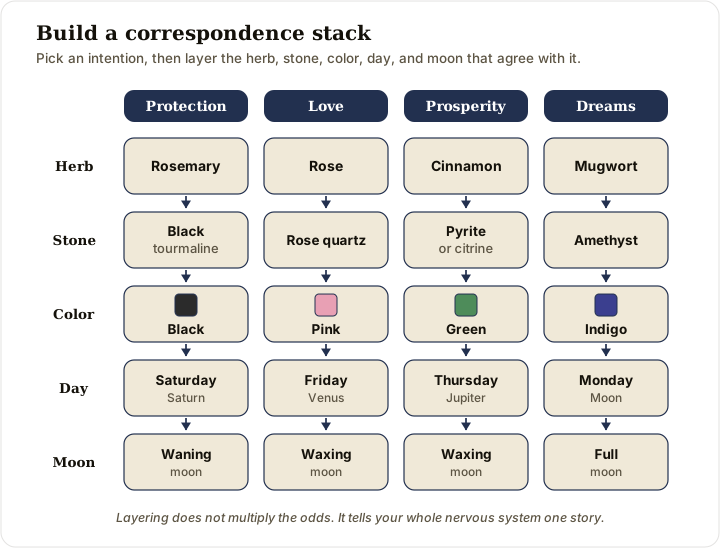
A stack is not a guarantee multiplier. Layering deepens the room; it does not bargain with the universe. The point is that the candle, the cloth, the herb, the stone, the day, and the moon are all telling your nervous system the same story. The story is what the spell rides on.
Stones at crystals, color at color correspondences, days at planetary days, the moon at moon phase calendar.
Storing, drying, and labeling
Dry herbs flat or in small bundles in a cool, dark place out of direct sun. Glass jars are best; cork is fine, snap-lock is fine; clarity matters more than aesthetic. Label every jar with the common name, the Latin name (so you never mistake comfrey for foxglove), where it came from, and the date you put it up.
Then write the same line into your book of shadows with your reason for keeping it. A personal correspondence list, built up over a year of small notes, will outwork any borrowed chart. The plants you actually grew, dried, and used will read differently to you than the names on a page.
Quick FAQ
- Do I have to use fresh herbs? No. Dried is fine, often better for storage, and intention does the heavier lifting. Scott Cunningham's whole solitary tradition runs on dried herbs out of glass jars.
- What if my correspondence list disagrees with another book? Both can be right inside their own lineages. Pick the one that resonates, write down which you used, and let your own practice be the tiebreaker.
- Can I just use what's in my spice rack? Yes. The kitchen-witch path is built on exactly that. Rosemary, cinnamon, bay, salt, garlic, mint, and chamomile make a complete starter kit on most spice shelves.
- Is mugwort safe? Magically the tradition is enthusiastic. Biologically, it depends. Not in pregnancy, not while nursing, not on certain medications, not with seizure history. Check with a clinician before you brew or burn it. The chart is folklore. Medical advice belongs elsewhere.
- Are essential oils the same as the herb? No. An essential oil is the plant concentrated dozens of times over. Never put a raw essential oil on skin; always dilute it in a carrier oil like jojoba or sweet almond; never ingest. More in incense and oils.
- Am I allowed to start with just this list? Yes. You have permission you did not need. More at permission to begin, and if the first try fizzles, why a spell stalled is the gentler debrief.
Start with one jar from your own shelf, and let your practice teach you the rest.
Keep exploring
Browse more guides, or start with the basics of the practice you are curious about.
Browse more guides