What Is Modern Witchcraft? An Honest Starter Guide
On this page
Modern witchcraft is a practice, not a religion: ritual, symbol and natural materials worked with focused intention, which practitioners believe can shape themselves and their world.
The core practices: spells, moon, symbols and divination
Spells sort two ways: by goal, such as protection, love, money or banishing, and by method, such as candle, jar, knot, sigil or spoken charm. Learning the main types of spells makes any recipe you find easier to read and adapt. Protection work is where many witches begin, often a line of salt or a small charm by the front door, and a spell jar, filled, sealed and tucked on a shelf, is the classic set-it-and-forget-it working.
Many witches time their work to the moon. In moon magic, the waxing moon is for drawing things in, the full moon for charging and celebration, the waning moon for release, and the new moon for fresh intentions. It is a rhythm, not a rule: a spell cast on the "wrong" night still counts, and a quick look at a moon phase calendar tells you where tonight sits.
Correspondences are the symbolic associations practitioners give to colors, herbs, stones and days, the shared vocabulary that lets a spell say what it means. In common practice green carries money and growth, pink carries tenderness, and black carries protection and banishing, which is why the candle color matters to so many witches. Treat the color meanings and the herb chart as a starting dictionary, then let your own associations count too.
Divination is the listening half of the craft: practitioners read cards, runes, a pendulum or tea leaves for guidance on a question before or after the work. Tarot is the usual first pick, while a pendulum can be a ring on a thread and suits quick yes-or-no checks. Many witches pull a card before casting to ask whether the timing feels right, then journal what came up. Compare the best divination tools side by side, or browse the wider range of divination methods.
The main paths at a glance
With no central authority, the craft has decentralized into recognizable shapes. Most working witches today are solitary, and most are some flavor of eclectic, mixing what resonates.
| Path | One-line idea | More |
|---|---|---|
| Wiccan | Religious framework, Wheel of the Year, dual deity, Rede. | wicca vs witchcraft |
| Secular | Witchcraft as psychology and focused will, no gods. | secular witchcraft |
| Eclectic | A custom path stitched from many sources. | types of witches |
| Green | Plants, soil, ecology, local flora. | green witchcraft |
| Kitchen / Hearth | Home as sacred space, cooking as ritual. | kitchen witchcraft |
| Hedge | Trance, spirit work, crossing the inner boundary. | hedge witchcraft |
| Sea | Salt water, tides, lunar pull, shells. | sea witchcraft |
| Chaos | Belief as a tool; whatever works, works. | chaos magic |
| Reconstructionist | Celtic, Norse, Hellenic revivals built from primary sources. | recon paths |
Micro-labels keep proliferating on WitchTok (cyber witch, city witch, cottage witch). Take them seriously where they describe a real practice, lightly where they describe a wardrobe.
The Wheel of the Year, in one paragraph
Wicca and many adjacent paths mark eight Sabbats around the agricultural cycle: Samhain, Yule, Imbolc, Ostara, Beltane, Litha, Lughnasadh, and Mabon. Monthly Esbats fall on the moons. Non-Wiccan witches borrow the wheel selectively. Some celebrate everything, some keep two or three that matter, some ignore it entirely. Nobody is checking your calendar. See the full wheel, what's next, and esbats for the lunar side.
What modern witchcraft IS: magic plus action
Magic, in Starhawk's phrase, is the art of changing consciousness at will. Practitioners describe a spell as symbolic action that focuses the will, anchors the intention in the body and the senses, and primes the kind of real-world follow-through that actually moves the outcome.
A small worked example. She wants the job. She lights a yellow candle for clarity, burns a pinch of rosemary, says out loud what she is calling in, and watches the wax pool while she pictures the call coming through. Then she snuffs the candle, sends the application, and follows up two days later. The call comes. That pairing, the inner work plus the outer move, is how this tends to work. Cast and release, then act.
The mechanism gets unpacked in how spells work, and the overlap with manifestation in magic and manifestation.
What a beginner actually needs
The five things that actually start a practice, in order:
- Read one grounded book before you buy anything. Scott Cunningham's Wicca: A Guide for the Solitary Practitioner is the standard solitary starter. Margot Adler's Drawing Down the Moon is the journalistic survey, and the beginner book list has the rest.
- Build a daily grounding-and-centering habit. Five minutes of breath, body-scan, and "feet on the floor" attention. Spells run on a regulated nervous system.
- Gather kitchen-grade tools. A notebook for your Book of Shadows, a plain white candle, a small dish of tap water, a pinch of salt, one culinary herb like rosemary.
- Do one small intention rite. Clear a corner. Light the candle. Say out loud what you are calling in. Picture it landing. Snuff the wick. That is the muscle memory the rest is built on.
- Journal, and pair the work with real-world action. A spell for the job AND the actual application sent the same week is the pattern.
Fire safety: never leave a lit candle unattended, and set it in a heatproof holder on a clear surface.
The full sequence sits in the beginner's path, or the compact baby witch checklist if you want a single screen. The mechanics live in grounding drills, the book of shadows, and a simple altar.
Witchcraft vs. Wicca: the one distinction that fixes everything
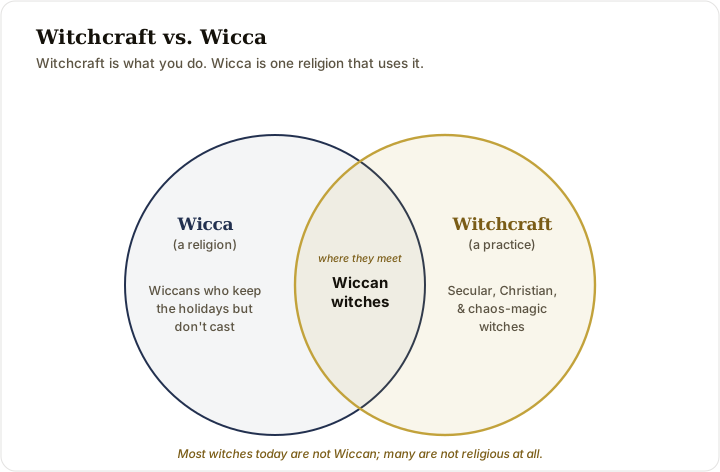
Witchcraft is what you DO. Wicca is what you BELIEVE. Most witches today are not Wiccan, and many are not religious at all.
Witchcraft is an operational practice: light a candle, set an intention, work an herb, cast a circle. Wicca is a specific neo-pagan religion founded in mid-twentieth-century Britain, with a Goddess and a Horned God, eight Sabbats around the agricultural year, monthly moon rites, the Wiccan Rede ("harm none"), and the Threefold Law (what you send out returns to you threefold).
That split produces four overlapping kinds of person, and the labels stay slippery:
- Wiccan witches. Members of the religion who also cast.
- Non-Wiccan witches. Secular, Christian, Jewish, Buddhist, and other practitioners who use the craft without the religion. This is the largest group online.
- Wiccans who don't cast. Keep the holidays and the deities, leave the spellwork alone.
- Witches who reject Wicca entirely. From chaos magicians to folk practitioners to reconstructionists.
Most search results blur all four because Wicca was the loudest neo-pagan religion of the late twentieth century. Pull the two apart in more detail, look at the secular path for a non-religious version, and read the Rede for the ethics.
Is witchcraft a religion?
No. Witchcraft is a methodology, the way meditation or prayer is a methodology. It can sit inside Wicca, inside broader paganism, inside a Christian or Jewish or Buddhist life, or inside no faith at all.
The confusion is historical. Wicca made witchcraft so central to its rituals that the labels fused in public perception. Pulling them apart is the single move that makes the rest of the landscape legible. For the Christian-fear angle, see is witchcraft a sin.
What modern witchcraft is NOT
Three myths worth naming plainly and then walking past.
It is not Satanism. Satan is an Abrahamic figure inside a Christian cosmology. Most witches are not operating in that cosmology at all, so there is nothing there to worship. The accusation is a holdover from the trials.
It is not Hollywood physics. No lightning from fingertips, no levitating broomsticks, no telekinesis. Practitioners say so without flinching.
It is not a substitute for a doctor, a lawyer, or a financial advisor. Inside the belief system, magic is described as stacking the odds or creating openings. It supports how you feel and how you act; it does not replace regulated care. If something physical is wrong, please see a doctor too.
More myth-busting for the rest.
A few short answers people search for next
"Am I a witch?" If you felt the pull strongly enough to read this far, the answer is yes. There is no checklist and no gatekeeper. The longer answer sits in am I a witch.
"Is witchcraft a sin?" Different cosmology. The sin framework belongs to a specific Christian worldview the craft is not operating inside, but that does not make the deconstruction easy, and it is worth taking seriously. See is witchcraft a sin.
"Is witchcraft real?" Both wings of the room are welcome. Skeptics will tell you, truthfully, that ritual changes the person who practices it. Believers will tell you it does more than that. The practice holds either way. More in is witchcraft real.
"Can I be a witch in secret?" Yes, and many are. The broom-closet practice is a long, honored tradition for anyone whose household or workplace makes the open version unsafe. See broom-closet practice.
How many witches are there, actually?
More than the "weird fringe" framing suggests. American surveys have tracked the growth for thirty years.
| Year | Estimate | Source |
|---|---|---|
| 1990 | ~8,000 self-identified Wiccans in the US | American Religious Identification Survey |
| 2001 | ~134,000 Wiccans | ARIS |
| 2008 | ~340,000 Wiccans | ARIS |
| 2014 | ~1 to 1.5 million Americans (0.4%) identifying as Wiccan or Pagan | Pew Research Center |
The line goes up, not in a fad spike. The wider "pagan and witchcraft-adjacent" pool reads larger than "Wiccan" alone. You are joining a real, sustained tradition, not a niche.
Formal lineages worth knowing by name
If a label keeps showing up in the comments under a video and you cannot place it, here are the names. All are initiatory and coven-based, and the vast majority of modern witches do not belong to any of them. The craft is fully available without them.
- Gardnerian. The original Wiccan lineage, founded by Gerald Gardner in mid-twentieth-century England. Secretive, initiatory, traditionally worked skyclad, with a handed-down Book of Shadows.
- Alexandrian. Founded in the 1960s by Alex and Maxine Sanders. Close to Gardnerian in shape, more eclectic, heavier on ceremonial magic; the strictest rules are often optional.
- Seax-Wica. Started by Raymond Buckland in the US in the 1970s, Anglo-Saxon in flavor, honoring Woden and Freya. Notably non-secretive and open to self-initiation.
- Dianic. A feminist, Goddess-only current that grew out of late-twentieth-century activism. Many circles are women-only.
- Feri (Faery). An ecstatic, intense lineage founded by Victor and Cora Anderson, centered on trance and sensual energy.
More in the lineages, the queer-founded traditions and solitary vs coven.
History: a twentieth-century synthesis, not an unbroken ancient line
The version sold by mid-century paperbacks (a secret pagan religion that survived the witch trials underground for a thousand years) is romantic and not what happened. The real history is more interesting.
The cunning folk. Across early-modern Britain and Europe, village healers, charm-workers, and curse-lifters did real folk magic with herbs and Christian prayer. They did not call themselves witches. "Witch" was the accusation thrown at people thought to be working harm.
The trials. Roughly 100,000 people were tried for witchcraft across Europe and colonial America between about 1400 and 1775, with an estimated 40,000 to 60,000 executions. Around 80% were women, but thousands of men were tried and killed too. In England and its American colonies, witches were hanged, not burned. The stake belongs to the continental story.
The "nine million" figure. Popularized in the late twentieth century by feminist authors and early-edition pagan writers, this number is lore, not history. It traces to a flawed 1784 calculation by Gottfried Christian Voigt, amplified a century later. The documented toll was smaller and more complicated.
Margaret Murray's witch-cult. In 1921, Egyptologist Margaret Murray published The Witch-Cult in Western Europe, arguing that the accused had been members of a surviving pre-Christian fertility religion. Historians dismantled her methodology by the 1970s, and the hypothesis is academically discredited. Before it fell, though, it handed Gerald Gardner the romantic blueprint he needed.
Modern Wicca. Britain's 1735 Witchcraft Act was repealed in 1951. Three years later Gerald Gardner published Witchcraft Today and introduced the religion he called Wicca, synthesized from Murray's folklore, ceremonial magic, Freemasonry, and his own invention. Doreen Valiente, his early High Priestess, rewrote much of the liturgy into the lyrical form most witches recognize today, and championed the idea that you do not need a coven to be the real thing. Ronald Hutton's The Triumph of the Moon (1999) is the standard scholarly account.
| Claim | Documented | Lore |
|---|---|---|
| ~40,000 to 60,000 executions across Europe and colonial America | Yes | |
| 9 million women burned in a deliberate gendercide | Yes (1784 miscalculation, popularized later) | |
| Witches in England and its American colonies were hanged, not burned | Yes | |
| An unbroken pre-Christian religion survived the trials in secret | Yes (the Murray hypothesis, discredited) | |
| Wicca was synthesized in mid-twentieth-century Britain by Gardner and Valiente | Yes |
For the colonial-American story, see the Salem trials, and for the inherited grief that history leaves in the body, the witch wound.
The Sephora kit and the marketing-versus-craft split
In August 2018, Sephora and the fragrance brand Pinrose announced a $42 "Starter Witch Kit" containing a tarot deck, a white sage bundle, a rose quartz, and nine perfumes. The backlash was immediate, and the product was pulled within weeks. Witches were furious about the gimmickry. Native writers were furious about the white sage, a sacred plant in several Indigenous traditions and not a stage prop.
The episode is the cleanest snapshot of the tension a modern beginner walks into. The algorithm sells a $200 starter aesthetic. The craft itself needs almost none of it.
None of this is anti-spending. Spending is welcome where it earns its keep, and a deck that fits your hand or a candle made by someone who cares is a real joy. The enemy is the lie (guaranteed results, false necessity, fake reviews), not the seller. You can begin with river stones, kitchen herbs, a notebook, and tap water. You can also buy beautiful tools later because you want them. Both are the craft.
More in the no-cost approach, kits worth the money, aesthetic vs practice, and what to skip.
Begin with what you already have, and let the craft deepen at the pace of your own curiosity.