The Wheel of the Year: All 8 Sabbats Explained
The wheel of the year is the map a lot of witches use to track the seasons: eight festivals, called Sabbats, spaced roughly six weeks apart, telling one continuous story of light and dark across twelve months.
The 8 Sabbats at a Glance
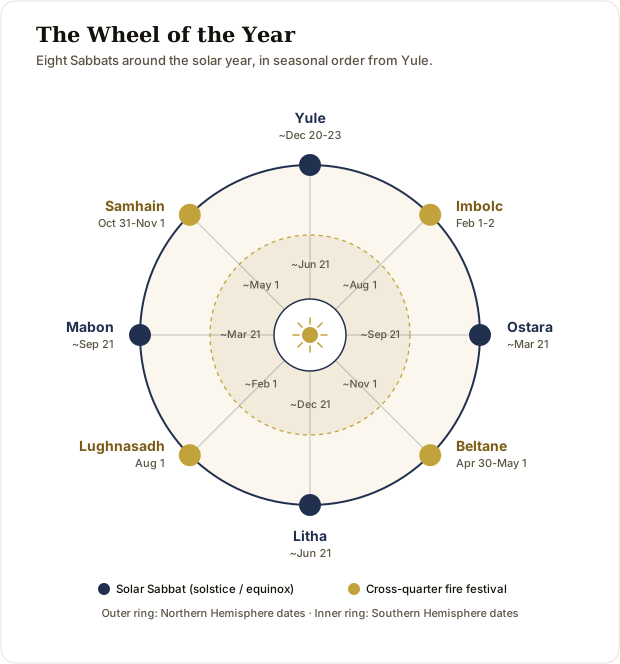
All eight in seasonal order, from the rebirth of the sun at Yule. Each festival links to its own deeper guide.
| Sabbat | Type | NH date | SH date | Astrological point | One-line meaning |
|---|---|---|---|---|---|
| Yule | Solar solstice | ~Dec 20-23 | ~Jun 20-23 | 0° Capricorn / 0° Cancer | Rebirth of the sun on the longest night |
| Imbolc | Cross-quarter fire | Feb 1-2 | Aug 1-2 | 15° Aquarius | The quickening; Brigid's flame |
| Ostara | Solar equinox | ~Mar 21 | ~Sep 21 | 0° Aries | Balance and first green growth |
| Beltane | Cross-quarter fire | Apr 30-May 1 | Oct 31-Nov 1 | 15° Taurus | Fertility and sacred union |
| Litha | Solar solstice | ~Jun 21 | ~Dec 21 | 0° Cancer / 0° Capricorn | The sun's peak; longest day |
| Lughnasadh | Cross-quarter fire | Aug 1 | Feb 1-2 | 15° Leo | First harvest; bread and grain |
| Mabon | Solar equinox | ~Sep 21 | ~Mar 21 | 0° Libra | Second harvest; gratitude |
| Samhain | Cross-quarter fire | Oct 31-Nov 1 | Apr 30-May 1 | 15° Scorpio | Final harvest; the veil thins |
How to Say the Sabbat Names
Four of the names come from Irish, and they are rarely said the way they look:
- Samhain: SOW-in (the first syllable rhymes with "cow"). "SAM-hane" is a spelling pronunciation.
- Imbolc: IM-bolk, or im-OLG, closer to the Irish.
- Beltane: BELL-tayn. The modern Irish name, Bealtaine, is said roughly BYAL-tin-uh.
- Lughnasadh: LOO-nuh-suh, as in the modern Irish Lúnasa.
- Yule: YOOL.
- Ostara, Litha and Mabon: modern names, usually said as they are spelled: oh-STAR-uh, LITH-uh (or LEE-thuh), and MAY-bon (or MAB-on, closer to the Welsh).
Pronunciations vary by region and tradition, and nobody at a sabbat circle is checking.
What Is the Wheel of the Year?
The Wheel of the Year is a modern eight-festival calendar that maps the seasons onto two interwoven cycles: four solar Sabbats (the solstices and equinoxes) and four Celtic fire festivals at the midpoints between them. It took its eight-festival form in Gerald Gardner's Wicca in the 1950s, and the whole calendar flips by six months in the Southern Hemisphere.
Two ancestral cycles, interlocked. The solstices and equinoxes give you four solar pivots, fixed by the Earth's tilt. The four "cross-quarter" fire festivals fall at the midpoints between them, named for the great Gaelic feast days that medieval Irish storytellers already celebrated. Together that is eight Sabbats, roughly one every six weeks.
The dates in this guide are Northern Hemisphere defaults, and the day-and-month answer for the next one always lives at next sabbat.
The 4 Solar Sabbats (Solstices and Equinoxes)
The "Lesser Sabbats," fixed by the Earth's tilt, marking the year's astronomical pivots.
Yule (Winter Solstice)
The longest night and the return of the light. In Wiccan tradition the Great Mother gives birth to the Sun God at the climax of the longest darkness, and the Oak King overthrows the Holly King to rule the waxing year. NH dates land around December 20-23; SH dates around June 20-23. Many of the customs that became modern Christmas (evergreens, wreaths, the burning log) were borrowed from this same midwinter cluster. Full walk-through at the full Yule guide.
Ostara (Spring Equinox)
Day and night in balance, with the scales tipping toward light. Practitioners read it as fierce fertility and new growth; the name comes from the Anglo-Saxon dawn goddess Eostre, and the symbols are eggs and hares, beloved emblems of the season that have gathered around her name since the nineteenth century. Around March 21 in the Northern Hemisphere, around September 21 in the Southern. More at the full Ostara guide.
Litha (Summer Solstice)
The sun's zenith and the longest day. In the Holly King / Oak King mythos the Oak King reigns at his peak here and will be cut down for the rest of the year. Bonfires, protective magic against mischief from the unseen, herbs gathered at their potency. Around June 21 NH, December 21 SH. Full treatment at the full Litha guide.
Mabon (Autumn Equinox)
The second harvest and the second balance point, with the scales now tipping toward dark. Thanksgiving, sharing of bounty, preparation for the dark half of the year. Around September 21 NH, March 21 SH. Continue at the full Mabon guide.
The 4 Cross-Quarter Fire Festivals (The Greater Sabbats)
The "Greater Sabbats," named for the great Gaelic feast days and falling at the midpoints between the solar stations. Beltane above all has long been a night of fire; Scottish records describe Beltane fires on the hills in the eighteenth century. Astrologically each lands when the sun reaches 15° of a fixed sign: Aquarius, Taurus, Leo, Scorpio.
Imbolc (early February / early August SH)
The name comes from Old Irish, usually translated as "in the belly," for the pregnancy of ewes and the return of milk to the agrarian year. The quickening: seeds stirring under snow, the first imperceptible turn toward spring. Mythologically tied to the Celtic goddess Brigid, a triple figure of the hearth fire, the forge, healing, and poetry; the Goddess shifts back into her Maiden aspect here, recovered from giving birth at Yule. Astrologically 15° Aquarius. Continue at the full Imbolc guide.
Beltane (April 30-May 1 NH / October 31-November 1 SH)
Beltane means something close to "bright fire" in Old Celtic, a name long linked in tradition to the god Belenus and the great communal bonfires lit in his honour. Read as the sacred union of the young Horned God with the Earth Goddess in her blooming Mother aspect, with the bloom itself as the evidence. Beltane is also the Samhain mirror: the veil thins, but here it is the Faery gates that open rather than the gates of the dead. Edinburgh's annual Beltane Fire Festival on Calton Hill, founded in 1988, is one of the largest living modern observances. Astrologically 15° Taurus. Continue at the full Beltane guide.
Lughnasadh / Lammas (August 1 NH / early February SH)
The first of three harvest festivals, specifically the grain harvest: cut, threshed, baked into bread. Named for the Celtic sun god Lugh; sometimes called Lammas, from Old English "loaf-mass." The first quiet acknowledgement that the sun's strength has begun to wane even as the year still feels full. Astrologically 15° Leo. In 2026 it opens a month that also carries two eclipses; the August 2026 breakdown maps those dates alongside it. Continue at the full Lughnasadh guide.
Samhain (October 31-November 1 NH / April 30-May 1 SH)
From Old Irish for "Summer's End." The third and final harvest, historically the meat harvest, the last storing-up before frost. In modern practice it is the Witches' New Year and the night the veil is at its absolute thinnest. The image practitioners often use: a heavy curtain between two rooms that becomes sheer for one night, with both rooms still in their places but suddenly able to see each other. In the Wiccan myth cycle the God descends into the Underworld and the Goddess waits in her Crone aspect to give birth to him again at Yule. Astrologically 15° Scorpio. Continue at the full Samhain guide, and gather Samhain altar supplies for the night.
The Southern Hemisphere Flip
Witches in Sydney and witches in Edinburgh use the same eight festivals. The Wheel is earth-based. If the calendar tells you to mourn the death of the sun while jacaranda is blooming outside your window in October Sydney, the whole symbolism falls apart. Southern Hemisphere practitioners invert the full cycle by six months so the festivals land in their actual season. Yule moves to June, Samhain to late April, Beltane to the eve of October 31, Imbolc to August. Same eight Sabbats, same theology, dates that match the ground.
| Northern Hemisphere | Southern Hemisphere |
|---|---|
| Yule ~ Dec 20-23 | Yule ~ Jun 20-23 |
| Imbolc Feb 1-2 | Imbolc Aug 1-2 |
| Ostara ~ Mar 21 | Ostara ~ Sep 21 |
| Beltane Apr 30 - May 1 | Beltane Oct 31 - Nov 1 |
| Litha ~ Jun 21 | Litha ~ Dec 21 |
| Lughnasadh Aug 1 | Lughnasadh Feb 1-2 |
| Mabon ~ Sep 21 | Mabon ~ Mar 21 |
| Samhain Oct 31 - Nov 1 | Samhain Apr 30 - May 1 |
Working the Wheel Without Overthinking It
You do not need to observe all eight to count as a witch practising the year. Plenty of solitary witches mark two or three, let the rest pass, and still feel held by the cycle. Pick the one closest to now (the next sabbat tool will tell you) and start there.
What "working" it actually looks like, in practice: a candle lit on the right evening. The seasonal food cooked and eaten with attention. A walk taken in whatever weather the festival is actually about, with your eyes open to what the land is doing. A page in your book of shadows for what you noticed. That is enough. The Wheel rewards small consistent attention more than it rewards big elaborate rituals once a year, and skipping a Sabbat does not break anything; the seasons come back around.
Fire safety: never leave a lit candle unattended, and set it in a heatproof holder on a clear surface.
There is no checklist, no permission needed, and the witches you admire online are not doing more than this on most of them.
Sabbats vs. Esbats: Solar Rhythm vs. Lunar Rhythm
The Wheel covers the solar half of the calendar. The lunar half is the Esbats: usually full-moon working nights, sometimes dark-moon ones, and there are twelve or thirteen of them in a year against the eight Sabbats. The word esbat comes from Old French s'esbattre, "to play" or "to gather," which says a lot about the tone.
| Feature | Sabbats | Esbats |
|---|---|---|
| Celestial anchor | Sun (solstices, equinoxes, cross-quarter midpoints) | Moon (usually the full moon, sometimes the dark moon) |
| Frequency | 8 per year | 12-13 per year |
| Theological focus | The macrocosmic cycle of the Sun-God and Earth-Goddess | Drawing down the power of the Goddess as the Moon |
| Ritual purpose | Celebration, feasting, gratitude, seasonal storytelling | Practical magic, spellwork, divination, healing, training |
Full treatment of the lunar side lives at esbats, and the working pieces are at moon magic and the moon phase calendar.
How the Wheel Tells a Story
In Wiccan and Neo-Pagan mythos the eight Sabbats form one continuous narrative: the light is born at Yule, stirs awake at Imbolc, comes into balance at Ostara, joins with the earth at Beltane, peaks at Litha, is cut down for the first harvest at Lughnasadh, is honoured in gratitude at Mabon, and is laid to rest at Samhain so it can be born again at Yule. The Goddess moves through Maiden, Mother, Crone alongside it. Whether you take this as literal divinity, as an archetypal map for your own seasons of grief and bloom, or as a structured way to pay attention to the year, the shape holds.
Where the Wheel Actually Came From
The eight-spoke Wheel as you see it on every witchy blog and bullet journal is roughly seventy years old. It was synthesised in 1950s Britain from older Celtic and Germanic pieces, in the same window of time that gave us modern Wicca itself.
England repealed its Witchcraft Act in 1951, removing the legal risk of speaking publicly about magical practice. Gerald Gardner published Witchcraft Today in 1954 and went on to assemble what is now called Gardnerian Wicca. His coven first kept the four Celtic fire festivals, then added the Druidic solar stations over the 1950s. In early 1958 its members asked for all eight to be observed as equals, and Gardner agreed: that is how the eight-Sabbat year came into being (Ronald Hutton, "Modern Pagan Festivals", Folklore, 2008). His friend Ross Nichols, a Celtic scholar, carried the same eight-festival pattern into the Order of Bards, Ovates, and Druids, which he founded in 1964. In the 1970s the American Wiccan Aidan Kelly assigned the Germanic and Welsh-flavoured names that everyone now uses for the solar four: Litha, Ostara, Mabon. Starhawk's The Spiral Dance (1979) and Janet and Stewart Farrar's Eight Sabbats for Witches (1981) carried the structure out to a much wider audience.
The historian Ronald Hutton walked the receipts in his 1999 study The Triumph of the Moon (Oxford University Press), and his finding is the one most working practitioners now quote: modern Pagan witchcraft is a genuine, vibrant new religious movement that draws on real historical materials, not an unbroken hidden lineage from pre-Christian Europe.
The two cycles it merged
- The Lesser Sabbats (solar stations). Anglo-Saxon and Germanic in flavour, fixed astronomically: Yule, Ostara, Litha, Mabon.
- The Greater Sabbats (cross-quarter fire festivals). Named for the great Gaelic feast days, falling at the midpoints between the solar stations: Imbolc, Beltane, Lughnasadh, Samhain.
How the modern Wheel came together
- The modern record: Gardner's coven settling on all eight festivals as equals in 1958, and Nichols carrying the pattern into Druidry from 1964; the 1951 repeal; Witchcraft Today in 1954; Kelly's naming work in the 1970s; the academic record laid out by Hutton.
- Older roots: there were absolutely older seasonal festivals to draw on, and many components are genuinely ancient. Some practitioners also hold to an older, unbroken lineage of the craft. The eight-spoke wheel itself took its current shape in the twentieth century.
A real practice made from old pieces is still a real practice.
The Wheel Now: Climate Shifts and Global Practice
The original synthesis was tuned to a small island in the North Atlantic. The agrarian year it describes is roughly British: snow at Yule, lambing at Imbolc, harvest weather you can plan a fire by in August. That calendar is becoming a less reliable description of where most of its practitioners actually live, and modern Pagans have started talking openly about an "Anthropocene Wheel" that re-anchors the festivals to local ecology rather than imported British seasons. What is blooming, what is calving, what is dying. Honouring lost species at Mabon. Naming heatwaves as part of Litha rather than a glitch.
Digital and global covens are pushing in the same direction: when your circle spans four time zones and both hemispheres, the dates stop being the point and the archetype becomes the shared ground. The Wheel is durable because it can hold this. Adaptation has always been the actual tradition.
Where to Go Next
- Find the next celebration: next sabbat.
- Start a practice: beginner's path or the baby witch starting points.
- The lunar side: esbats and full moon work.
- Path-level context: wicca vs witchcraft and the wider craft overview.
Keep exploring
Browse more guides, or start with the basics of the practice you are curious about.
Browse more guides