Shadow Work Journal Prompts (A Gentle Starter Set)
Shadow work journal prompts are most useful when they are short, specific, and sequenced so you can stop at any tier and still have done real work. The set below is paced from light to deeper, the way I learned to use them after a year of starting too hard, closing the book scared, and not opening it again for weeks. You do not need a fancy notebook, a moon phase, or a teacher's permission. A pen, ten quiet minutes, and one question is the whole entry fee.
Shadow work journal prompts, paced gently
Pick ONE prompt per sitting. Write until you feel a clean stopping point, then close the book. Tier 1 is observable and recent. Tier 4 is the part most people skip. You can stop at any tier and still have done the work.
If you want the method underneath the questions, the method itself sits next door. If you want a notebook to hold these entries alongside your spells, your book of shadows is where they go.
Before you start: the not-therapy line
Shadow work is self-inquiry with a candle nearby. It is not therapy, it does not diagnose anything, and it is not a substitute for licensed care. If a prompt opens something heavy, put the pen down, drink water, and call a professional you trust. Your safety is the highest magic, and protecting it is also part of the practice.
How to use these prompts
A small container makes the work safer and more honest. The protocol is short on purpose.
- One prompt per session. Not a checklist sweep. A question handled well beats five rushed.
- Set a timer for 15 to 20 minutes. The container is what lets you go a little deeper without falling in.
- Write longhand if you can. The friction slows the ego down enough for something true to surface.
- Close the loop. A small grounding act before you stand up: drink a glass of water, wash your hands, light a candle and snuff it, step outside for one cold breath. More on this in grounding.
- Date the entry. Patterns only show up across weeks, and the date is what lets you see them.
Tier 1: Daily triggers and pet peeves (start here)
This is the safest door. Everything is recent, observable, and low stakes. You are not excavating childhood yet; you are just noticing what tugs at you in a normal week.
- The anatomy of anger. What single emotion did I feel most strongly today? If I trace it backward, when was the first time in my life I remember feeling it?
- The mirror of irritation. What are my biggest pet peeves in other people? Arrogance, laziness, lying, neediness, name them honestly. Now, where do I quietly do those exact things, or secretly wish I had the freedom to?
- The overreaction. When was the last time my reaction was much bigger than the event? What was actually being triggered underneath the surface trigger?
- The small refusal. What did I say no to this week with my body, even while my mouth said yes? What did the no know?
- The afternoon mood. What time of day did my mood drop today? What was I doing, or avoiding, in the half hour before it dropped?
The Jungian frame here is simple: what irritates us most in others is often what we have refused to look at in ourselves. That is not a verdict, it is a map.
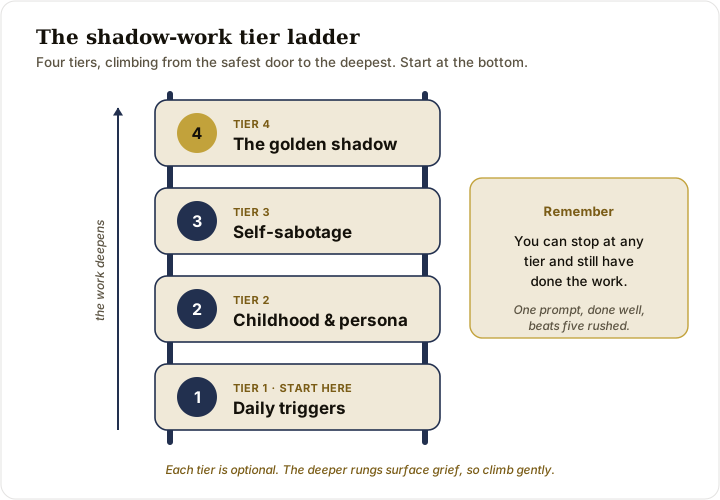
Tier 2: Childhood and the persona
Carl Jung divided the psyche into parts, including the persona (the acceptable mask) and the shadow (everything the persona could not afford to be). This tier is not about big traumas. It is about the small moments that taught you which parts of you were welcome.
- The lost self. Describe your personality before you were seven. Which of those traits do you still carry, and which did you bury? Why did you feel you had to hide them?
- The construction of the mask. What traits do I lead with when I meet new people? What am I trying to make sure they do not see?
- The echoes of conditioning. Name one emotion (anger, sadness, neediness, joy, ambition) you were told was "too much" growing up. How does that old rule still show up in your adult relationships?
- The favorite child. What did the adults in your life praise you for? What happened to the parts of you that did not earn the praise?
Write softly here. If a memory feels bigger than the prompt, that is the signal to slow down or stop, not push.
Tier 3: Self-sabotage and limiting patterns
This tier asks why the rut feels safe. The answer is almost always that the rut is protecting something. Find the hidden reward, and the pattern usually loosens on its own.
- The comfort of the rut. Name a pattern you repeat (toxic relationships, procrastination, burnout, scrolling until you cry). What is the hidden reward? What does staying in the cycle let you avoid?
- The shield of perfectionism. In what ways do I use being smart, productive, or competent as armor against feeling something I do not want to feel?
- The inner critic. If the harsh voice in my head had a face and a name, what would it look like? Whose voice from my past does it actually sound like?
- The cost ledger. What has this pattern cost me already, in time, sleep, relationships, money, self-respect? Write the cost in numbers if you can.
Observation, not judgment. You are not on trial in your own journal. If what surfaces is a flat belief about what is possible for you, that one has a method of its own.
Tier 4: The golden shadow (the part most people skip)
The shadow is not only the rejected ugly. It is also the rejected gold: the confidence, the talent, the bigness, the wanting, all the things you were taught to dim so you would not outshine someone or be asked to be responsible for that much light. The shadow-work writer Kelly-Ann Maddox names this the golden shadow, and in my own practice it has hit harder than any of the dark prompts. The dark prompts surface shame. The golden prompts surface grief. Grief is heavier, and it deserves a softer hand.
- The sting of envy as a map. Who do I deeply envy? Forget shame about the envy for a minute and follow it: what specific freedom, talent, or life do they have that I have refused to want out loud?
- The deflection of praise. What kind of compliment do I rush to downplay every time? "Oh it was nothing." "I got lucky." What positive trait am I afraid to own?
- The grief of the unlived life. When I tell myself "I could never be a confident person" or "I am just not creative," where in my body do I feel the small ache that follows? What does the ache know about what is still alive in there?
- The anonymous persona. If I moved to a city where nobody knew me and there were zero social consequences, what would I wear, how would I spend my Saturdays, and what would I start doing within a month?
- A letter from the gold. Let the buried part of you write you a letter tonight. Why has it been quiet so long? What does it want to do with you next?
If the golden tier makes you cry, that is the work, not a failure of the work.
Pair the prompt with a card
If you read tarot or oracle, the cards make a gentle side door into the prompt. Pull one card for the question's theme and let the image broaden it, not answer it. In tarot tradition, the Moon card sits with Pisces and points down into the unconscious, which makes it a natural pairing for any of these prompts; it does not mean anything supernatural is happening, it means the image gives your mind a shape to dream against. More on this in divination practice.
When to pause (signs to put the book down)
These are body cues, not a symptom list. If you notice any of them, close the journal, ground, and consider whether the next prompt is for tomorrow or for a professional.
- A racing heart that does not settle within a few minutes of closing the book.
- Intrusive memory loops that keep replaying after you stop writing.
- Dissociation: the room feels far away, or you feel far from yourself.
- The urge to write past your timer into territory that scares you.
If two or more of these show up in a session, that is the signal to put the book down and reach for a licensed therapist for the heavier material. The prompts will still be here next week.
A printable take-away (one prompt per week)
A slow cadence beats a sprint here. If you want a starter month, the table below sequences one prompt per week, one tier at a time, with a small closing act to seal each session.
| Week | Tier | Sample prompt | Suggested closing act |
|---|---|---|---|
| 1 | Tier 1: Daily triggers | The mirror of irritation: what pet peeve do I quietly do? | Wash hands in cool water |
| 2 | Tier 2: Childhood and persona | The lost self: who was I before age seven? | Light a white candle, snuff it after one breath |
| 3 | Tier 3: Self-sabotage | The comfort of the rut: what reward does the pattern give me? | Drink a full glass of water |
| 4 | Tier 4: Golden shadow | A letter from the gold: what does my buried part want to say? | Step outside, name three things you can hear |
Suggestion, not rule. You can spend a month inside Tier 1 if Tier 1 is what is alive right now.
Where this fits in the larger practice
Prompts are a tool. The method that gives them context is shadow work proper, and if you want the why and the how underneath these questions, the method itself is the next read.
The notebook that holds these entries is the same notebook that holds your spells, your moon notes, and your kitchen recipes for tea that helped you sleep. If you have not started one yet, your book of shadows is the place. If the cycle of the moon interests you as a pacing tool, moon work gives the calendar, and if anxiety is what brought you to the prompts in the first place, wellbeing rituals is a softer adjacent door.
You can start tonight. One prompt, a borrowed notebook, fifteen minutes, a glass of water at the end. That is already the practice.
Keep exploring
Browse more guides, or start with the basics of the practice you are curious about.
Browse more guides