Book of Shadows: How to Start Yours (and Why)
A Book of Shadows is your personal practice notebook: spells, rituals, correspondences, and your honest notes on what worked and what quietly didn't. You don't need a leather-bound tome, a wax seal, or a single fancy pen to start one. A spiral notebook from the kitchen drawer and ten minutes tonight will do it.
How to start tonight (without freezing)
- Walk to whatever drawer has the spiral notebook in it. Open it.
- On the first page, write: This is the Book of Shadows of [your name], begun on [tonight's date].
- Skip a page. Pick one section. Just one. Maybe it's a single herb you have in the cupboard, with a few lines on what you use it for. Maybe it's the moon phase tonight, with one sentence on what you want to call in this cycle. Maybe it's one spell you've been thinking about, logged in the spell-log skeleton below with the outcome column left blank for now.
- Close the book.
That is a Book of Shadows. The next thirty years are just more entries. If you don't want to spend a cent on this, witchcraft on a budget is full of doors in. The aesthetic grimoires on your feed are beautiful, and they are also the single biggest reason new witches freeze before they ever write a word. Fill the rest at your own pace; none of it is a standard to live up to.
What to put on the first page
The first page does real psychological work. It marks the threshold between an ordinary notebook and the one you treat as practice. Three traditional elements, none of them mandatory, all of them quick.
Your declaration of ownership
A single line naming the book as yours and the day it began. The traditional template runs something like:
This is the Book of Shadows of [your name, or a magical name if you've taken one], begun on [the date].
That's the whole thing. If a magical name doesn't feel earned yet, use your given name. You can rewrite the page later when the name comes. Books get rebegun all the time.
Your ethics line
Many witches write the Wiccan Rede on the second page: An it harm none, do what ye will. It's a one-line moral anchor that meets your eye every time you open the book. If you're Wiccan or Wiccan-adjacent, it fits cleanly. If you're not, write a personal ethic instead, in your own words, in one sentence. Practice from love, not fear. Cause no harm I wouldn't willingly receive. Magic plus consent, always. The wording is yours. The point is to set the tone before the spellwork starts. More on the original line in the Rede.
A protection or privacy line
Historically this had teeth: cunning folk lived under the 1735 Witchcraft Act in England and, earlier, under conditions where being identified as a witch carried real legal and social cost. Today, mostly, it's a psychological boundary. A short verse asking that the contents be shielded from anyone who would use the knowledge badly, or a plain warning that the book is private, both work. This book is private. Read no further uninvited. Five words on a page, and the book starts to feel like yours.
Paper or digital: pick the one you'll actually use
Pick the format you'll actually open. Vibes lose to use every time.
| Format | Tactility | Privacy | Editing | Searchability |
|---|---|---|---|---|
| Bound notebook | High | Low (physical hiding only) | Almost none | Manual flipping |
| Three-ring binder | High | Low | Excellent (unclip, replace, reorder) | Manual, with tabs |
| Notion | Low (typed) | High (password, biometrics) | Infinite, with relational databases | Instant keyword search |
| GoodNotes (iPad + Pencil) | Medium-high | High | Excellent | OCR on handwriting |
| Google Docs / Word / Evernote | Low | High | Infinite | Instant |
If you want paper
The bound notebook is the romantic answer. An embossed hardcover, a stitched leather book, even a black composition book from the drugstore. The format forces chronology: the book becomes a linear timeline of your practice, and many witches lean into a scrapbook style with pressed leaves, tarot photocopies, candle stubs taped to the page. The risk is blank-page anxiety. An expensive book with thirty empty pages and one nervous spell on page one is a recipe for closing it and not opening it again.
The three-ring binder is the unromantic answer and the one I quietly recommend to most beginners. You can add pages, pull them out, rearrange sections as your practice grows, and discard a ruined page without grief. It is the kindest format for perfectionists, because there is no permanent ruining. If you want to compare the two side by side, journal vs binder vs digital goes deeper. If you've decided you want the nicer object, journals worth buying is your stop.
If you want digital
A few honest notes on the named options, because the landscape changed sharply in the last two years.
- Google Docs. Free, cross-platform, no-frills. A perfectly respectable starting place. Lacks the indexing you'll want once your archive crosses a few hundred entries.
- Microsoft Word. Industry-standard formatting, works offline. Ideal if you like linear, heavily formatted documents and dislike the cloud.
- Notion. Modular, supports relational databases (link your herb page directly to every spell that uses rosemary), free for solo use, but the free plan caps at 1,000 blocks the moment you add a second person. The Plus plan runs around $10 a month if billed annually. The setup curve is real; the payoff for analytical witches is huge. Anti-use case: anyone who wants offline-first or handwriting.
- GoodNotes. The hybrid choice if you have an iPad and an Apple Pencil. You handwrite, you get OCR search, you sync to the cloud. The free tier caps at three notebooks. The Essential tier is roughly $11.99 a year; Pro about $35.99 a year. Closest thing to a real handwritten Book of Shadows that is also searchable.
- Evernote. Used to be the obvious pick for clipping articles and OCR-searching handwriting. The 2026 price hikes under new ownership (Bending Spoons) have made it a hard sell. Free tier is now drastically limited; paid tiers start around $99 a year. Worth knowing before you migrate years of notes onto a platform you may want to leave.
Most witches I trust end up hybrid: a digital file for messy drafting and research-dumping, a physical book for the rituals that have settled. If discretion matters, a password-locked digital file is the cleanest answer for the broom closet. Do check what any app you pick does with the contents, because anything that syncs to a cloud or bolts on AI features turns intimate spiritual writing into someone else's stored data.
Two ways to organize it: structured or freeform
Two philosophies, both valid. Most beginners eventually combine them.
Structured (table of contents, tabs, reserved page counts)
You plan sections up front. Thirty pages reserved for tarot spreads, twenty for herbal correspondences, ten for dream logs, with an index at the front of the book or tabbed dividers in a binder. The reward is speed: mid-ritual you can flip to candle correspondences in five seconds. The risk is rigidity. You will absolutely run out of pages in the section you guessed would be smallest.
Freeform (chronological, retroactive index)
You write what you're studying that day, in order, without categories. To keep the book usable, leave the first five pages blank for a table of contents you build retroactively, and use colored sticky tabs to code topics as they emerge (blue for water work, green for herbalism, purple for moon nights). The reward is freedom and momentum. The risk is the year-three problem: by the time you have three hundred pages, finding the spell you cast last May becomes an archaeological dig.
A third option most beginners land on: hybrid
A bound book for finished rituals you want to keep, and a binder or digital file for everything still in draft. The drafting space is messy and forgiving. The finished book is clean and curated. Almost everyone I know who's kept a practice for a decade lands here without planning to.
What to actually put inside (a beginner's blueprint)
The first rule: only what genuinely interests you. The Book of Shadows is not for thoughtless filler copied off Pinterest to make the pages look fuller. If you have zero interest in astrology, do not force astrology in. If herbalism is your love, half the book can be herbs. The book is a mirror of the practice you actually have, not the one you think you should have.
Foundational theory and beliefs
A few pages near the front for the philosophical bones: your ethics line, any deity or spirit you work with (epithets, mythology, offerings they like, your personal prayers), and your honest working model of why your magic works. Sympathetic? Psychological? Both? Naming this for yourself early saves a lot of doubt later. More in deity work and how spells work.
Correspondences and reference charts
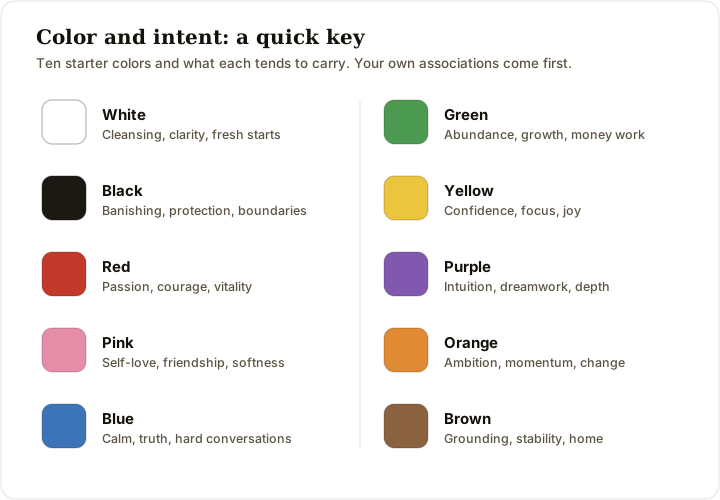
The temptation is to copy out a hundred herbs and fifty crystals you don't own. Resist it. Start with five kitchen herbs you actually use (rosemary, basil, lavender, bay, sage will more than cover you), the crystals already in your house, a one-page color and candle quick-reference, and a small chart of planetary days and lunar phases. The chart that gets used is the one you wrote because you needed it. The deeper versions live in herb correspondences, crystals, the color chart, and planetary days.
The Wheel of the Year and esbats
One page per sabbat: the date, what the holiday means, what you did this year and what you want to do next year. Esbat notes on full moons in a separate short section. After three or four years this becomes the single most rewarding part of the book, because you can read what you did at Samhain in 2024 and see your own arc. Full breakdown at the Wheel and esbats; quick spreads at Samhain, Yule, and Beltane.
Spell logs (the part most beginners skip)
This is the move that turns a notebook into a practice. Every spell gets a page, with this skeleton:
- Date
- Lunar phase
- Ingredients used
- Words spoken (the actual incantation, or a paraphrase if you improvised)
- Your emotional state going in
- The outcome you intended
Then, this is the load-bearing part, you come back to that page in a week, or three weeks, or two months, and you write down what actually happened. Not what you wished happened. What happened. Over a year, this log will teach you more about your own craft than any book on the shelf, because you'll see your patterns: which conditions you cast in well, which words actually felt true on your tongue, which intentions you set when you were really just venting. For a manifestation-specific log, the manifestation journal gives that subset a dedicated structure. The structure is in writing a spell; the diagnostic for the cast that landed flat is why a spell may not have worked.
For a ready-made version of that structure, The Grounded Witch includes a simple beginner spell-log format alongside the practices it tracks.
Divination and dream logs
Tarot and rune entries with the question, the cards or stones pulled, and the real-world follow-up a few weeks later. Scrying notes if you scry. A dream journal kept on the nightstand, written in the first three minutes of waking, because dreams evaporate by minute four. More in divination methods and scrying.
Shadow work
Keep this as one section among many, not the whole book. The term comes from Carl Jung, who wrote about the parts of the self we repress because they were unwelcome at the dinner table growing up. Shadow work is the practice of bringing those parts into conscious awareness, on the page, without shame. It overlaps neatly with what the psychologist James Pennebaker called "expressive writing": writing continuously about hard emotional material for fifteen or twenty minutes a session, in research consistently linked to improvements in mood and physical health. Treat the section as journaling with a particular focus, not a special witchy genre. Full treatment in shadow work and a set of prompts when you want a way in.
Consecrating the book (only if you want to)
This step is optional. Skip it without guilt if it isn't your register. In witchcraft practice, consecration isn't a sentience switch flipped on a notebook. It's psychological anchoring: a deliberate ritual that changes how you relate to the object so that every time you open it, your hands know what kind of attention you're bringing. Two methods from the tradition, both gentle.
The four elements blessing
I do this one in a quiet hour, usually a Sunday morning, with the book on a clean cloth and four small things gathered. A pinch of salt. A stick of incense. A candle. A small bowl of water (moon water if I have it, tap water if I don't, and the magic isn't lessened by that).
Earth first. Take a pinch of salt and rub it lightly on the cover, just enough that you can feel the grit move under your thumb. I consecrate you with Earth. May you be grounded and steadfast. Brush the salt off when you're done.
Air next. Light the incense (frankincense, rosemary, or sage are traditional, and any incense you actually like works). Pass the book through the rising smoke, both sides of the cover, slowly enough that the smoke clings for a second. I consecrate you with Air. May you inspire clarity and wisdom.
Fire third. Light the candle. Hold the book above the flame, not against it (the first time I did this I came close to scorching a corner of a cover I loved, so: above). I consecrate you with Fire. May you ignite passion and creativity.
Water last. Dip your fingertips and sprinkle a few drops across the cover. I consecrate you with Water. May you flow with peace and intuition.
Hold the book up at the end if you work with a deity or the divine in any form, and dedicate it. If you don't, just close the cover with both hands flat on it for a beat. Notice the difference in how the book feels in your hands. That difference is the point. If you want to make your own water for next time, moon water is the simple version, and candle work goes deeper on the fire step. A minute of grounding before you start is never wasted.
The full-moon blessing
The quieter ritual. Light a white candle. Pass the book once through incense smoke. Set the book on a windowsill where the full moon can reach it, or take it outside if you can. Stand with your palms turned up toward the moon for a slow minute, then turn and lay both palms flat on the cover. A short line, spoken or silent: I bless you, an instrument of wisdom, that you may guide my practice with clarity and care.
That's the whole rite. It works well for witches who prefer their consecrations passive and slow rather than active and elemental. More in moon magic basics and full moon esbats.
What a Book of Shadows actually is (and isn't)
Any format counts as a Book of Shadows. A plain three-ring binder counts. A Google Doc counts.
It is not an ancient family heirloom. It is not a sentient object that hums when you open it. It is not a finished thing you buy on Etsy and then live up to. The whole concept is, by witchcraft's standards, fairly new: it was named and shaped in the 1950s, inside modern Wicca, and the honesty about that is part of the point.
What the book gives you, in plain terms, is a place to think on the page. A place to record what you tried, what felt true, and what you want to come back to in October when the year turns. It is your laboratory notebook, your altar reference, and a little of your diary, in one binding. If you've been waiting for a sign that you're allowed to begin, this is it. If you feel the pull, you're already a witch. The book is just where you start writing it down. New to all this? Start with the beginner's path and circle back.
Book of Shadows vs grimoire vs journal
These three words get used interchangeably online, and the conflation is what makes new witches panic about which one they're "supposed" to keep. The distinction is actually clean.
A grimoire is an impersonal textbook of magical instruction. Roots go back to ancient Mesopotamian incantations on clay tablets and surface again in the medieval and Renaissance manuscripts of ceremonial magicians. A grimoire is meant to be read by any capable practitioner, and it contains formulas, conjurations, and correspondence tables, not feelings.
A journal is a mundane diary. Mood, weather, what you ate, who annoyed you on the bus.
A Book of Shadows is the hybrid: a grimoire's instructional bones (spells, rituals, correspondences) wrapped around a journal's honesty (what your hands shook like during the first cleansing, what the candle did, whether the call came two days after you cast and sent the application). If a grimoire is a cookbook, and a journal is the diary of a Tuesday, a Book of Shadows is the recipe with your handwritten margin note that says less salt, more rosemary, ate this the night I forgave my mother.
| Grimoire | Journal | Book of Shadows | |
|---|---|---|---|
| Primary function | Reference textbook | Personal life record | Living practice archive |
| Point of view | Impersonal, universal | Personal, subjective | Personal synthesis of theory and lived result |
| Historical origin | Ancient (Mesopotamia onward) | As old as writing | Mid-20th century, modern Wicca |
| Content | Formulas, correspondences, ritual instructions | Mood, events, daily life | Ritual instructions plus your reflections on doing them |
| Intended audience | Any practitioner | The author only | The author (sometimes a lineage) |
Where the Book of Shadows actually came from (1950s, not ancient)
This is where the trust starts. The Book of Shadows is a modern Neo-pagan creation, not a relic of medieval covens. Gerald Gardner, the man widely credited with founding modern Wicca, introduced the term to his Bricket Wood coven in the 1950s. He claimed it was an ancient tradition, that witches had always kept such books and burned them at death to protect the cult. That story is lore.
The documented history is more interesting. Gardner's 1949 novel High Magic's Aid contains no mention of a "Book of Shadows" at all; his High Priestess Doreen Valiente later confirmed he had not yet coined the term when he wrote it. The phrase itself was lifted from a 1949 article in a magazine called The Occult Observer, where a writer named Bashir described a Sanskrit divination treatise based on the length of shadows. Gardner liked the sound of it and took it.
The early text was patchwork. Large sections came from Aleister Crowley's Magick in Theory and Practice (Gardner had bought a charter from Crowley in 1946), from the Key of Solomon, from Charles Godfrey Leland's Aradia, and from Freemasonry rituals. Doreen Valiente, who joined the coven in 1953 and quickly became High Priestess, recognized how much of it was Crowley and how much of a problem his reputation was. So she rewrote vast stretches of it, replacing him with her own poetry. The historian Ronald Hutton credits her with up to half of the eventual content. Her "Charge of the Goddess" is still one of the most quoted pieces of modern Wiccan liturgy, and it's hers.
None of this makes the Book of Shadows fake. It makes it human, and recent, and authored, and that is more useful than a pretty origin myth. The bones of the practice work because writing down your practice works, not because a chain of secret grandmothers passed you a book. If you want the wider history that frames all of this, the difference between Wicca and witchcraft is the next door over.
From coven oath-book to solitary, eclectic, yours
In its first form, the Book of Shadows was a single coven manual. The High Priestess kept it. Initiates were allowed to copy it by hand during initiation but forbidden from altering the core rituals or showing it to outsiders. The point was orthodoxy: one text, faithfully transmitted.
That model cracked open in the seventies and eighties. The Farrars published Eight Sabbats for Witches, partly to push back against garbled pirated copies of the Gardnerian text already circulating. Scott Cunningham wrote Wicca: A Guide for the Solitary Practitioner and aimed it squarely at the witch with no coven, no lineage, and no one to initiate her. Today most practitioners are solitary or eclectic, and the Book of Shadows is no longer an oath-bound manual you copy under supervision. It is a living document you build from the ground up.
Which is to say: there is no checklist. No tradition is gatekeeping yours. You don't need permission from a coven, a high priestess, a book, or an algorithm. If you're a solitary practitioner, the question of whether you're a witch gets answered by you, with a pen.
When the dog chews it, or you fill it, or you outgrow it
A few quiet reassurances, because the book becomes precious and precious things attract anxiety.
The dog will chew it. Puppies are gonna puppy. A spilled tea is not desecration. Rebind the intact pages, paste salvageable ones into a fresh book, treat the reconstruction as its own small ritual, and keep going. Guilt is not part of the spec.
You will fill it. Begin a second volume. Number them on the spine. Many witches keep a "current" working book and a shelf of finished ones; the older volumes become reference texts to your own past practice.
You will outgrow it. The you who began the book is not the you who's holding it three years later. Earlier pages will read as cringy and naive. That is exactly what they're supposed to read like. Do not rewrite them. The arc is the point.
And about the old "burn it on death" rule: that came from a specific historical fear of leaving incriminating evidence, and most modern witches have set it aside. Many of us plan to leave our books to friends, to fellow practitioners, to the next generation if they're curious. The knowledge is too hard-won to ash by default.
If you want the next two reads: a daily practice gives you years of spell-log entries to fill, and if you've decided you want the nicer object on the shelf, journals worth buying sorts the real options from the marketing.
Keep exploring
Browse more guides, or start with the basics of the practice you are curious about.
Browse more guides