Shadow Work for Beginners: A Gentle Starting Point
You do not need a dark moon or a teacher to begin shadow work for beginners, the slow practice of meeting the parts of yourself you were taught to hide with more curiosity than shame. It is self-reflection, not therapy, and it starts with one honest question and a cheap notebook.
How to start: a small, repeatable loop
- Pick a 20-minute window, not a weekend. Pacing is the practice.
- Make a small container. A candle, a closed door, a glass of water within reach. That is enough.
- Pick ONE prompt. One. A starter handful sits further down this page.
- Write by hand for the full window. Do not edit. Do not reread. Move the pen.
- Close cleanly. Use the closing protocol before you stand up.
This is a loop you can actually run on a Tuesday night. Not a weekend retreat. Not a marathon.
The urge, every single time, is to do "one more prompt." In my own practice that urge is almost always the urge to bypass the one I just answered, because the answer was uncomfortable and I want to chase a cleaner one. Resist it. The loop is short on purpose.
The hard line: shadow work is not therapy
This one matters, so it gets said plainly and once: shadow work is for self-reflection and spiritual growth. It does not treat trauma, diagnosed mental health conditions, or crisis. Unpaced, unguided digging can flood a person, dissociate them, or destabilize a life that was holding together fine on the surface.
If a prompt opens something larger than the prompt, stop. Close the session cleanly (use the closing protocol) and call a professional. Working with a therapist is itself shadow work, and treating it as a sign of skill rather than weakness is one of the more grown-up moves a practitioner can make. If you are in immediate crisis, please contact your local emergency services or a national crisis line such as those listed by the U.S. National Institute of Mental Health.
This boundary is not a warning sticker so we can move on. It is the practice. The witches who do this work for decades pace themselves, and the ones who get hurt almost always didn't.
The trigger-as-teacher method
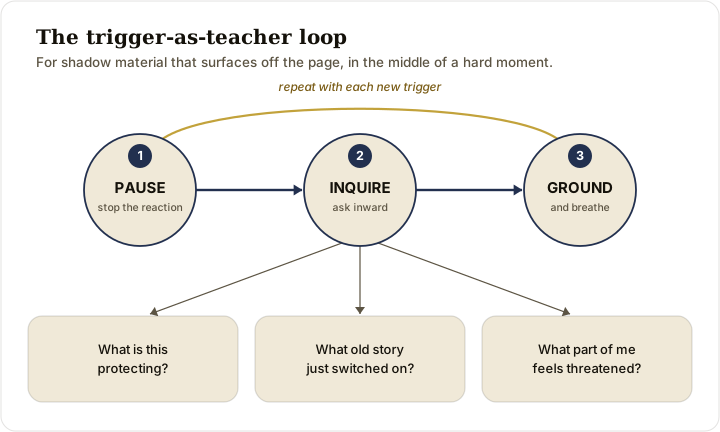
Most shadow material does not surface during a planned session. It surfaces at 4pm on a Wednesday when somebody's good news lands wrong, or when a comment from a parent reopens a door you thought was closed. The trigger-as-teacher method is the on-the-go version of the practice for those moments.
Three beats:
- Pause the magick. Don't cast, don't post, don't text. The reactive spell can wait. So can the reactive paragraph in the group chat.
- Inquire inward. Ask: what is this protecting? What old story just got switched on? What part of me feels threatened right now?
- Breathe and ground. Treat the trigger as a map, not an attack.
Here is what that looked like for me, once, in detail. A friend got a piece of good news, the kind I had been quietly working toward myself for two years. The jealousy was instant and physical, hot in the throat. The first witchy impulse was awful: a binding, dressed up as protection. I sat down on the kitchen floor instead, because the kitchen floor is grounding in a literal sense and I couldn't trust myself to stand. I asked the three questions. The jealousy was not really about her. It was an eight-year-old's certainty that good things were a fixed pile and someone else getting one meant I would be left behind. Naming that did not make the jealousy vanish. It made it small enough to hold. I texted her congratulations, badly, and then I cried for about ten minutes about something that had nothing to do with her.
The trigger gave me a map. The reactive spell would have given me a mess. For the body side of the same drill, see grounding.
Beginner journaling prompts (a starter handful)
Five honest places to begin. Pick one per session. Not five.
- Childhood obsessions. Name five intense fixations from ages eight to twelve, the specific kind: a book you reread, a place you couldn't stop drawing, an aesthetic you organized your room around. What did the child actually want from each one? How would she view the life you're living right now?
- Disproportionate triggers. Pick a moment today when an emotion was bigger than the event that caused it. Trace it back. When was the first time you remember feeling exactly that way?
- The mirror of others. List traits you instantly admire in other people. Then traits you instantly judge. For each, the harder question: where does that trait live in you, in what form?
- Suppressed magic. Name one belief you carry about yourself that you hate. Where did it originally come from? Is it possible the "flaw" was once a misunderstood gift or a protective mechanism that outlived its job?
- Honoring the difficult. Name a fear you're holding right now. How would you treat it if it were a frightened part of you, not evidence of brokenness?
After you write, ask "why?" of your own answers until you reach something that doesn't have a "why" behind it, only weight. Then pick one move: accept the thing on the page out loud, release it by burning the page in a safe bowl, or rephrase the supposed flaw as a vow you'd actually keep.
The full prompt set is linked at the end. The journal it goes in is your book of shadows.
The closing protocol: boxing the shadow
If a session opens something larger than expected and a therapist isn't in the room, this is how to close cleanly so you can carry the rest of your day.
- Speak to the feeling out loud. "I see you, I hear you, and your pain is valid. We can't process this right now."
- Visualize a heavy wooden box. Place the memory, the trigger, and the raw emotion inside. Lock it.
- Change your physical state. Blow out the candle. Drink a full glass of cold water. Eat something dense, the heavier the better. Walk outside for two minutes.
- Say a clear close. "This work is paused. I am safe in the present. I'll return with the right support."
Practical note from doing this badly the first few times: store the journal somewhere other than next to your bed for the night. The body reads proximity, and it would rather not.
"No tea, no shadow": pace and self-compassion
The rule that holds the whole practice together: if you're going to look at the ugliest parts of yourself, you have to treat yourself as kindly as the work is harsh. The witches who say "no tea, no shadow" mean it plainly. No comfort, no excavation.
Concrete cues that have held up in my practice and in everyone's I trust:
- Rest counts as ritual. A nap after a hard session is part of the session.
- A real bath, with the phone in another room, is worth more than the second journal entry you were going to force.
- Don't numb the discomfort with drink or doomscroll. Postponed material always comes back, and it comes back uglier.
- One prompt, not ten. Always.
This work is a lifelong rhythm, not a weekend project. Treating it that way is how you stay in it for years instead of two months.
When to time the work (and when to skip the timing)
Traditional witch timing pairs introspective work with the waning moon, the dark moon, and the new moon, and with the dark half of the wheel, especially around Samhain and Yule. There's a real logic there; the body and the calendar both quiet down, and quieter is what you want.
The honest version: the best night for shadow work is the night you'll actually do it. A Tuesday afternoon when you're calm and well-fed will outperform a "perfect" dark moon when you're already wrung out from a long week. Use the timing if it helps; ignore it if it becomes the excuse you use to put the practice off.
If the moon angle interests you, there's more on it in moon timing; for the seasonal frame, Samhain and Yule are the natural windows.
Dark-deity guides, framed as tradition
Witches who go deep often work with figures like Hecate, Lilith, or the Morrigan during shadow work. In practitioner tradition, these are threshold figures: guardians of crossroads, underworlds, repressed power, sovereignty. They are not "evil," and they are not required, and they are not a starter move.
Deity work is its own discipline, with its own pacing and its own etiquette. Before reaching for a name in a moment of intensity, read working with deities. The work is patient; so is the relationship.
Two starter rituals (only when you're ready)
The journaling loop and the trigger method will carry most of a first year of practice. When you want a ritual frame, these are the two that beginners can actually hold without drowning. Run them after you've already done a few rounds of the journaling loop, not before.
| Feature | Mirror work | Internal cord-cutting |
|---|---|---|
| Primary use | Dismantling low self-esteem; facing projection; building radical self-acceptance | Severing attachment to a habit, looped thought, or outgrown identity |
| Tools | A mirror (any will do), one candle, a dim room, a dark cloth to cover after | Two candles, a length of string or cord, scissors, a fireproof bowl |
| Focus | Confrontation and integration | Release and boundary |
| Intensity | High; sustained, uncomfortable eye contact with yourself | Moderate; visceral and cathartic, with immediate closure |
Mirror work, briefly
Five to ten minutes, dim room, a single candle, your own eyes in the glass. Relax your face on purpose; the urge to perform a face will be strong. Ask, out loud or in your head: What part of me am I refusing to see? What part am I afraid to become? Hold the gaze. Notice what rises without breaking eye contact to look at it.
Close by placing a hand over your heart and saying something true. I accept all that I am, both the shadow and the light is the traditional line; any sentence that doesn't make you wince will do. Cleanse the mirror with smoke or salt water, cover it with a dark cloth, and step away.
The first two minutes will feel ridiculous. Around the fourth, the face in the glass stops being yours in the social sense and becomes honest. That is the point. Do not push past ten minutes the first time, no matter how steady you feel; the comedown shows up later than you'd expect. The mirror and candle live with the rest of your altar tools on your altar setup.
Internal cord-cutting, briefly
Set two candles a short distance apart. One is you, today. The other is the pattern, belief, or identity you've outgrown. Tie a string between them. Light both. Name what the pattern protected you from, name the gratitude you owe it for that protection, then name the boundary going forward. Cut the cord with scissors. Burn the cut cord in the fireproof bowl.
A firm caveat that gets ignored constantly: do not cut cords on living people you actually share a life with. Co-parents, partners, family members you see weekly. That is not a ritual question; that is a conversation, often with a different professional. Use cord-cutting for the internal patterns it was meant for.
Reading that earns your trust
A short list, honest about who each book is for and who it isn't.
- Carl Jung, Aion (1948). The rigorous source for the original shadow framework. Dense, academic, and not a beginner read; reach for it when you want the clinical spine under everything else.
- Connie Zweig, PhD, Meeting the Shadow. The cleanest bridge between depth psychology and spiritual practice. Frames integration as coming into "right relationship" with the dark rather than eliminating it. Good for a thoughtful, non-witch-curious reader.
- Kelly-Ann Maddox, Rebel Witch and Witch in Darkness. Modern witchcraft as resilience through real grief, real mental-health storms, and the messes that don't fit the aesthetic. Not for readers who want "love and light" only.
- Raven Digitalis, Shadow Magick Spellbook (Llewellyn). Lunar-aligned spellwork with the steady reminder that the magic needs real-world follow-up to land. Generous, flexible, beginner-accessible.
- Laura Tempest Zakroff, Anatomy of a Witch. For readers who already feel that the shadow lives somewhere in the body, not only in the head. Less right for purely cerebral practice.
If you want a broader beginner shelf, the wider list is at the beginner reading list, and there's a buyer's-eye view at choosing a witchcraft book.
What shadow work actually is (and what it isn't)
Shadow work is a tool for self-reflection and spiritual growth. It is not therapy, it is not a treatment, and it is not a quick fix. The witches who keep at it tend to describe it the same way: a lifelong rhythm of noticing what you flinch from in yourself, and letting it have a seat at the table instead of locking it in the basement.
The shadow, in this sense, is the catch-all name for everything in you that did not make it past childhood inspection. The rage you weren't allowed to show. The wanting you were told was too much. The loud, weird, brilliant parts that got smoothed off so you could be liked. None of it disappears when it gets pushed down; it just runs the show from underneath.
The practice itself is simple, even when the material isn't. You make a small container. You ask a real question. You write or sit with what comes up. You close cleanly. You rest. Then you do it again next week, or next month, when the next thread surfaces.
If that sounds underwhelming after the way shadow work gets talked about online, good. The drama is the part that gets people hurt.
Where the idea comes from: Jung, briefly and honestly
The word "shadow" in this context comes from Carl Jung, the Swiss psychiatrist who built analytical psychology in the early and mid 20th century. In Jung's frame, the person you present to the world is a thin top layer; underneath it sits a much larger unconscious, and the shadow is the part of that unconscious where the ego files everything it has rejected, repressed, or never let itself develop. He laid the strict version of this out in his 1948 book Aion: Researches into the Phenomenology of the Self.
Two of his points are the ones worth carrying into a witch's practice.
The first is that the shadow is not inherently evil, even when it feels that way. Yes, it holds rage and envy and selfishness. It also holds creativity, playfulness, vulnerability, sensuality, and ambition, all the bright traits that got punished or unseen. Jungians sometimes call this the "golden shadow," the unlived life stored alongside the ugly stuff.
The second is projection. When you refuse to see a trait in yourself, you tend to see it loudly, with disproportionate heat, in other people. The friend who reads as needy. The coworker who reads as arrogant. The acquaintance whose confidence makes you want to climb the walls. Jung's argument is that the heat is the signal: that the trait lives in you too, in some form you haven't met yet.
Held as a psychological framework rather than a fact about souls, this is the model the witchcraft world has been working with for the last few decades.
Why witches took it on
In modern witchcraft, shadow work shows up almost everywhere because it does the one thing "love and light" spirituality refuses to do: it lets you keep your anger. Suppressing the shadow splits a practitioner's energy in half, and most witches figure out pretty quickly that the half they were told to swallow is also the half that powers their craft.
Reclaiming is the move. The emotions polite culture asks women and femmes to apologize for stop being flaws and start being fuel:
- Anger becomes boundary and ward.
- Fear becomes intuition and a safety signal.
- Desire becomes the compass that points at what's actually worth manifesting.
- Grief becomes depth, and spellwork done from depth tends to hold.
There is a whole reclamation narrative behind why this lands so hard for women who were raised in shame-heavy traditions, often called the witch wound.
The golden shadow: the part nobody warns you about
The half of shadow work that beginners almost always skip is the bright half. It is much easier, somehow, to journal about your worst impulses than to admit you have shelved a real talent because being good at it would mean being seen.
The golden shadow is the loud laugh you flattened to keep the peace. The artist you stopped being at fourteen. The leader you talked yourself out of in every room. The sensual self that got reframed as embarrassing. These parts are not gone. They are filed next to the rage, and they pull at you in the same indirect way.
A small lived test: notice the people you envy hardest. Not generally; specifically. The friend whose career you can't watch without your stomach knotting. The stranger online whose ease around her own body makes you scroll past quickly. That heat is almost always pointing at a gift you've shelved, not a flaw you should fix. Sit with that long enough and the envy starts to thaw into something more useful, which is grief for a version of yourself you've been avoiding.
Where this work goes next
Two natural next steps after you've run the loop once.
When you want more questions to write into, go to the starter prompts. When the same old wound keeps surfacing under different masks, the longer reclamation read is the witch wound.
One last permission line, because it matters: you can stop. You can pace. You can put the journal down for a month and come back. The shadow is not going anywhere, and you do not have to meet all of it this season to be doing the work.
Keep exploring
Browse more guides, or start with the basics of the practice you are curious about.
Browse more guides