Sigil Magic: How to Make and Charge a Sigil
Sigil magic is the cleanest piece of beginner spellwork I know: no altar, no lineage, no shopping list, just a sentence, a scrap of paper, and a willingness to stop thinking about it. The method asks for a pen and ten quiet minutes. Treat sigil magic as a symbolic and psychological practice, not as a replacement for a doctor, a therapist, an accountant, or a lawyer; sigils support how you move through a situation, they do not stand in for the people trained to help you with it.
What sigil magic actually is
A sigil is an original symbol you build from your own desire, then "charge" and forget on purpose. The forgetting is not a mood. It is the method. The conscious mind cannot sabotage a wish it no longer recognises.
That is the whole trick, and almost every mistake new practitioners make is a version of skipping it.
In practice, a sigil is a small abstract glyph you draw yourself. It encodes one specific intention in a shape your analytical brain can no longer read as a sentence. You charge it (a quiet word for a small altered state), release it, and let the symbol do its work below the surface while you get on with your life.
Frame it as applied psychology and you will get further than most people who try to muscle it.
How sigil magic works (the two-step trick)
Two steps carry the entire method: encode the intent so your ego cannot argue with it, then release attachment so it can sink in. Everything else (the candles, the music, the moon phase) is decoration around those two moves.
Austin Osman Spare, the English artist who quietly invented this style of practice in the early 1900s, summed up the second step in a line practitioners still quote: "to ask is to be denied." The harder you grip a wish, the louder the part of you that doubts it gets. That gripping is what chaos magicians call the "lust of result," and the whole sigil method is engineered to defuse it.
Encode the intent
When you translate a clearly worded sentence into an abstract glyph, the linguistic meaning gets stripped away. You no longer "read" your desire when you look at the symbol; you just see a shape. The thinking-self that would normally arch an eyebrow and remind you why you do not deserve the thing does not recognise the request. It lets the package through.
Release attachment
This is the load-bearing rule. If you keep checking whether the sigil "worked," you pull the original wording back into conscious view, and the doubt comes with it. Drawing the sigil is the easy part. Letting go of it is where the practice lives. The cleaner your forgetting, the cleaner the working.
Where this practice comes from (honest history)
Sigil magic, in the form most witches use today, is not ancient. It is a modern synthesis of art, psychology, and occult experiment, less than 120 years old, and the honesty about that is part of what makes it trustworthy.
The grandfather of the method is Austin Osman Spare (1886-1956), an Edwardian English artist and draughtsman who broke from the elaborate ceremonial magic of his contemporaries. In his 1913 chapbook The Book of Pleasure, Spare called sigils "monograms of thought," a way of giving form to desire so it could pass into the subconscious without the conscious mind sounding the alarm.
His techniques sat in obscurity for decades until Peter J. Carroll and Ray Sherwin revived them in the late 1970s as the founding methods of chaos magic. Carroll's 1987 Liber Null & Psychonaut stripped magic down to its psychological mechanics. Phil Hine's Condensed Chaos (1995) translated the whole thing into plain English for people who did not want to join anything.
Then Grant Morrison, the Scottish comics writer, stretched the idea across time. They coined the term hypersigil for a sustained work of art (a comic, a record, a novel) that encodes an intention over months or years. Their series The Invisibles was, by their own account, a six-year hypersigil aimed at their own life. For a quieter, non-celebrity version, Aidan Wachter's Weaving Fate (2020) walks through a long-form journal practice he calls the "Black Book," which is the format most solitary witches will actually use.
More on the worldview behind all this in chaos magic.
Before you start: write the intent
Most failed sigils were doomed at the sentence, not at the symbol.
Write one clear, positive, present-tense statement of what you want. Specific. Single-pointed. In your own normal voice. If your sentence is muddy, your sigil will be muddy.
The bad-versus-good rewrite practitioners learn first:
- Skip: I will not be anxious in interviews.
- Use: I am calm and confident in interviews.
The subconscious works in images, not in grammar, and it tends to ignore "no" and "not." Tell it what you want it to walk toward, not what you want it to avoid; otherwise you have just drawn a sigil for anxiety in interviews.
Pair the sigil with action in the world. The candle for the job, and also send the application. The sigil for the calm conversation, and also pick up the phone. The pattern that bears out, again and again, is magic plus action; the symbol moves something internally and your hands move something externally, and the two meet in the result.
One quiet boundary: if the thing you want is medical, financial, or legal, a sigil is a support, not a substitute. Draw the sigil for steadiness and also book the appointment.
Three ways to design a sigil
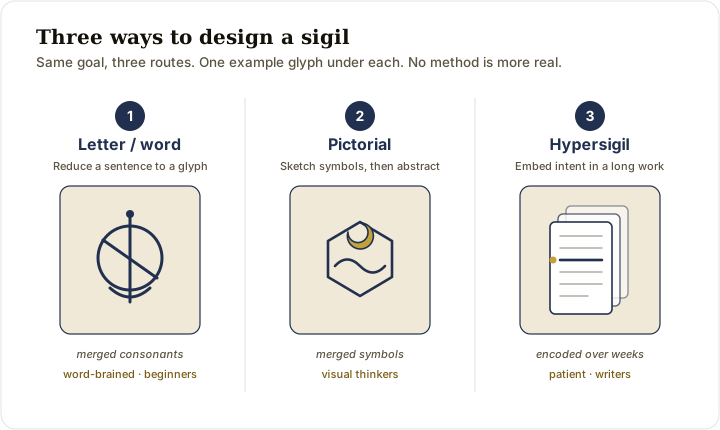
There are three reliable design methods. Pick whichever fits how your brain works; no method is more "real" than the others, and the only honest test is whether the finished glyph stops looking like your sentence when you look at it.
| Method | How it works | Best for | Tools needed | Time |
|---|---|---|---|---|
| Letter / word | Reduce a sentence to consonants and merge them into a glyph | Word-brained people; total beginners | Paper, pen | 10-20 min |
| Pictorial | Sketch literal symbols of the goal, then abstract them | Visual thinkers; people who freeze at letters | Paper, pencil | 15-30 min |
| Hypersigil | Embed the intent in a long-form creative work over weeks | Patient practitioners; writers, artists | A journal or document | Weeks to months |
1. Letter / word method (the classic)
This is Spare's original move, polished by Carroll. It works because it turns your desire into a small puzzle, which is exactly the kind of task the analytical brain happily distracts itself with.
Walk it stage by stage:
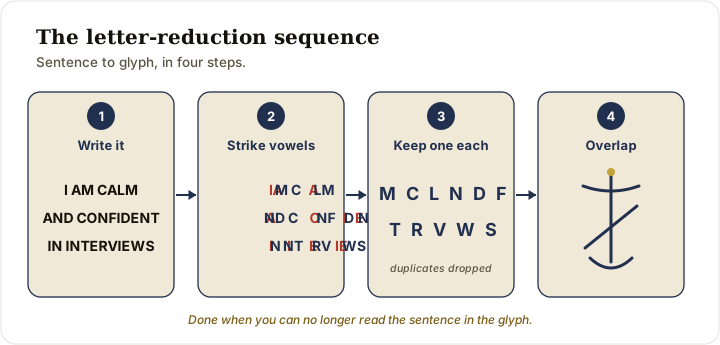
- Write the present-tense sentence. Block capitals, one line. I AM CALM AND CONFIDENT IN INTERVIEWS.
- Strike the vowels. Cross out every A, E, I, O, U. Vowels carry most of the phonetic weight of a word; lose them and the sentence stops sounding like a sentence.
- Strike the duplicate consonants. Keep one of each remaining letter. Cross the rest out.
- Combine what is left into a single shape. Overlap. Mirror. Rotate. Let an M become a sideways E. Let a T share its stem with an L. There is no right answer; you are looking for a glyph that feels like one object, not a row of letters.
- Redraw it clean. The first version always looks like a frog hit by a car. Redraw it once or twice, simplifying as you go, until it feels a little mysterious and you can no longer read your sentence in it.
The first time I did this I sat for a long minute hating the messy version on the page, convinced I had broken it. The redraw is the part nobody tells you about, and it is where the symbol stops being a leftover from a sentence and starts being a shape in its own right. You will know you are done because looking at it will not make you think the words.
If freehand combination makes you freeze, try the sigil wheel: draw a circle, write the alphabet around its rim, then connect your remaining letters in order with straight lines. The web of lines inside the circle is your sigil. It is mechanical and slightly less personal, and it works.
2. Pictorial method (for visual thinkers)
If you think in pictures rather than words, skip language entirely.
Hold the core feeling of the goal in mind, not the sentence. Sketch the literal images that come up. For tranquility, that might be a wave, a shield, a moon. For a steady income, a hand holding coins, a sheaf of wheat, an open door. Be obvious; nobody is grading you.
Then abstract each drawing into its simplest geometric component. The wave becomes a single curve. The shield becomes a hexagon. The hand becomes a cup-shape. The moon becomes a thin arc. Combine those shapes into one merged emblem.
The pictorial method tends to work better for readers who already dream in images, who think in colour, or who have a visual-arts brain. It is also kinder to anyone for whom written language carries a lot of stress, because there is no sentence to fight with.
3. The hypersigil / chaos-magic approach (long-form)
The hypersigil is the slow version. Instead of one glyph, you encode the intent into a sustained creative work over weeks or months: a private journal, an ongoing piece of fiction, a blog, a playlist, a sketchbook.
The mechanic Morrison and Wachter both lean on is the micro-macro link: the protagonist of the writing is, by quiet agreement with yourself, you. Same name, or same first initial. Same memories. Same job. You then write that protagonist living the life you want, step by step. The character finds the home, takes the new role, walks away from the old story, mends the friendship. You return to the document daily or weekly. The encoding happens by accumulation, not by ritual.
Wachter's "Black Book" is the realistic on-ramp: a single dedicated journal you write in by hand, narrating the trajectory you want. Morrison's Invisibles is the public-art version, and almost nobody needs to go that far.
This is the highest-effort method. It is also the one that quietly changes people the most, because the act of writing yourself somewhere new for six months turns out to be hard to undo. Probably not your first sigil. Worth knowing it is there. More on the worldview this comes from in chaos magic.
How to charge a sigil (the three kinds of gnosis)
"Charging" is a misleading word. There is no battery. A charge is a small window in which your analytical mind goes quiet long enough for the symbol to slip past it. Carroll named three routes into that window. None of them is more powerful than the others; the dramatic ones are not "real magic" and the quiet ones are not cheating.
| Route | How you get there | Examples | Best for |
|---|---|---|---|
| Inhibitory | Reduce stimulus until the mind goes still | Long meditation, breath holds, fasting, sensory reduction | Quiet practitioners; people with steady focus |
| Excitatory | Overload stimulus until the mind blanks | Drumming, dancing, chanting, hyperventilation, sexual climax | High-energy practitioners; group settings |
| Indifferent | Let habituation do the work | Sigil as lock screen, drawn on the hand, stuck to a mirror | Beginners; busy lives; broom-closet practitioners |
Inhibitory gnosis (silence the mind)
The quiet route, and the one most people underestimate. You bore the analytical mind into silence: long sitting meditation, slow breath, breath holds to the involuntary gasp, fasting, a dark room, headphones. The point is not asceticism; the point is that when the internal chatter finally stops, you have a clean second.
Spare's extreme historical version was the "Death Posture," a deliberately awkward stance held until physical exhaustion forced a mental blank. You do not need to do this. You need to find your own way to a real moment of stillness, and at that moment, look at the sigil. Let your eyes rest on it. Let it imprint without trying to interpret it.
Excitatory gnosis (overwhelm the mind)
The loud route. Drumming, hard rhythmic dance, chanting until your throat tires, hyperventilation, the moment of sexual climax. The mechanism is the same: at full sensory overload, the analytical brain briefly stops doing colour commentary, and the sigil flashes through.
At the peak, picture the sigil in your mind's eye for a single second. Then collapse, sit down, let the body wind back down. The sigil does not need to linger in your mind; you want the flash, not the brood.
One boundary: "extreme" does not mean "unsafe." You set your own threshold. Breath holds and exertion are not appropriate for every body, and the practice is not less effective if you choose the gentler version. Honest practitioners pick the route their body actually permits.
Indifferent vacuity (the lazy method that actually works)
Most of the beginner witches I know quietly default to this one, and they are right to.
Render your finished sigil somewhere you will see it constantly but casually. The lock screen of your phone. A small drawing on the inside of your wrist in skin-safe pen. A sticky note on the bathroom mirror. A doodle in the corner of your work notebook.
The first day, your eye snags on it every time. The second day, less. By the end of the week, your brain has filed it as background noise and stopped consciously registering it. That is the moment the sigil does its work: when you have stopped noticing it, your conscious mind has stopped guarding the door, and the symbol slips through on its own. The boredom is the method.
I have had more honest results from sigils on my lock screen than from any candle-lit version. Make of that what you will.
Activating and releasing the sigil
The closing move is a clean separation between you and the symbol.
Destroy the physical sigil. Burn it in a fireproof bowl. Dissolve a water-soluble version in a bowl of water. Tear it small and bury it in soil or compost. Pick whichever method feels final to you; the elemental flavour matters less than the act of watching it go.
Then pivot immediately to something mundane. Cook dinner. Wash the dishes. Walk the dog. Scroll something stupid. This is not anti-climactic, it is the working. The mental gear-change from "I just did a thing" to "now I am chopping onions" is the start of the forgetting, and the forgetting is what you came for.
For ongoing intentions like steady focus, general confidence, or a calm household mood, there is a permanent-sigil variant: instead of destroying the symbol, you tuck it somewhere half-hidden where you will not stare at it. The back of a drawer. Behind a framed picture. Carved small into the underside of a candle holder or the back of an altar shelf. Out of sight, doing quiet work.
This is "cast and release" in plain practice. The work is to let it go.
When you remember the sigil anyway (troubleshooting)
Every honest practitioner has botched a sigil by thinking about it. The two failure modes show up again and again, and both have a clean fix. A wider read on what tends to trip up new spellwork lives at why spells don't work.
You can't stop thinking about it
The "lust of result" problem. You finish the working, and within an hour you are checking inside yourself to see if you feel different yet. This is normal. It is also the exact thing that undoes the encoding.
The protocol that actually works: notice the thought without making a thing of it. Do not chastise yourself. Do not "release" it with effort, that is just more thinking about it. Pivot hard into a task that takes your attention: a phone call, a video, a recipe with too many steps, a walk somewhere unfamiliar. The thought passes. The first few sigils are the hardest; this gets easier with practice, because you start to trust that the forgetting really is the method.
You realise the wording was wrong (the abort)
Sometimes you charge a sigil and only afterwards spot that you phrased it as a negation, or aimed it at the wrong thing, or no longer want what you asked for. You can cleanly cancel it.
If the original is destroyed, redraw it on a fresh piece of paper. Look at it. Out loud, in your normal voice, sever the link: I sever my psychological link to this intent. This working is cancelled. Then destroy the new copy with the explicit intention of cancellation, not activation. Burn it, tear it, scrub it out. The point is the deliberate counter-directive; you are not asking the universe for forgiveness, you are telling your own subconscious to drop the thread.
Write a new, better sentence the next day. Sigils are cheap; do not waste a week protecting a bad one.
Why sigil magic sidesteps appropriation
Sigil magic has one quietly excellent feature for modern, eclectic practitioners: it is structurally hard to appropriate, as long as you follow its own rules.
The whole point of the method is that the symbol comes from your own letters, your own imagery, your own psyche. Borrowing somebody else's glyph defeats the mechanism, because your subconscious did not do the encoding; you have just copied a stranger's homework, and the part of the practice that was supposed to slip past your ego has not happened.
A quick distinction. Open practices are ones any respectful adult can learn and use. Closed practices belong to specific communities and require either being born into the culture or being formally initiated by authorised members of it. A veve in Haitian Vodou, a bindrune in some reconstructionist Heathen traditions, a yantra in tantric Hindu practice, sacred symbols from Indigenous American ceremonies: these are not aesthetic resources for outsiders, and copying them into a sigil is both an appropriation problem and a magical own-goal.
You do not need them. That is the cleanest way to think about this. A practitioner who trusts their own creative authority does not need to borrow somebody else's holy alphabet to get a working sigil. Use your letters, your shapes, your own pen. The longer guide on what counts as a closed practice lives at closed practices.
A first sigil you can do tonight
Try it now, with whatever paper is closest.
Write one sentence at the top of a page, in capital letters, present tense, positive. Keep it small and specific. I AM CALM IN THE INTERVIEW ON FRIDAY. I SLEEP EASILY THIS WEEK. MY HOME FEELS SAFE TO ME. One thing only.
Strike the vowels. Strike the duplicate consonants. Look at what is left. Take a clean second piece of paper and combine those letters into a single shape: overlap them, mirror them, lay one across another. Do not worry about beauty. Redraw it once. Redraw it again. Stop when looking at it does not make you mouth the sentence.
There is a small good moment in here that I want you to watch for: the moment the letters stop reading as letters. It comes around the second redraw. The shape goes from "a thing made of an N and an F" to "a thing." That is the encoding working, in real time, in your own hand.
Photograph the finished glyph. Set the photo as your lock screen, or stick the paper on the bathroom mirror. Then put the original out of sight. Get on with your evening.
Three to five days from now, when you have stopped really seeing it, take the original off the mirror, burn it in the sink or tear it up small and put it in the compost, and immediately go do something completely unrelated. The working is done. Do not check in on it. If you remember it next week, smile, and let the thought pass.
That is the whole practice, start to finish, with nothing on the shopping list.
Where to go next
The worldview and theory behind this practice live in chaos magic. The broader question of how spells work sits one step out, and the general template for building any working from scratch is at how to write a spell. If you want a gentler on-ramp before another sigil, try a few beginner spells that ask even less of you. For a mark that guards you or your home, start with protection sigils.
Keep exploring
Browse more guides, or start with the basics of the practice you are curious about.
Browse more guides