How to Write Your Own Spell (With a Template)
On this page
If you have ever wondered how to write a spell instead of pulling one off the internet, the honest news is that you already have everything you need: a clear want, a few household objects, and a few minutes of focused attention. There is no checklist to clear and no fancy tool to buy first. A scrap of paper and a birthday candle is enough; the framework is what makes the spell actually yours.
TL;DR. A spell is intent + correspondences + timing + words + action + raised energy + grounding, written in the present tense and released without checking. Learn the seven parts, fill in the template, and you can write your own from here on.
What a Spell Actually Is (Before You Write One)
A spell is a focused little ritual that does two things at once: it programs an intention into the part of your mind that runs you, and it points your follow-up action at a target. In this practice, the herbs, candle, color, and words are treated as anchors for your focus, not as switches on the physical world. They give your mind something specific to hold so it stops drifting.
The other half is the part most pages quietly skip. The candle lit for the job and the application sent in the same week are how this tends to work; one without the other rarely does. Magic plus action, every time.
If you want to understand the deeper why under all of this, more in how spells work. For now, the seven parts.
The Anatomy of a Working: The Seven Parts
Every spell you write fills these seven slots. Once you can name them, you can build endlessly. Memorize the row order and the rest becomes substitution.
| Part | What it does | A simple example |
|---|---|---|
| Intent | Names the singular goal | "I am held by steady, well-paid work." |
| Correspondences | Symbolic items that anchor focus | Green candle, basil, a coin |
| Timing | Borrows a matching natural rhythm | Thursday, waxing moon |
| Incantation | The spoken or whispered words | A four-line rhyme you wrote |
| Action | The physical gesture | Dress and light the candle, burn the paper |
| Energy raise + release | Builds the charge and lets it go | Chant to a peak, blow the candle out |
| Grounding | Returns you to ordinary mind | Bread, water, hands on the floor |
1. Intent: One Sentence, Distilled
The intent is the singular, unambiguous goal of the working, written as one sentence. Broad wishes scatter the energy, and your subconscious does best with a directive it can repeat back to itself without confusion.
"I want my life to be better" is not a spell, it is a sigh. Sharpen it: "I attract a stable job that pays my rent and respects my time." Now the rest of the spell knows what it is for.
The test: if you cannot say the intent in one breath, keep cutting until you can. The version that fits in one breath is the version your nervous system will believe.
2. Correspondences: Symbolic Amplifiers
Correspondences are the physical items, herbs, colors, crystals, kitchen staples, chosen because they symbolically match the intent. In tradition, this is the "as above, so below" principle: the small thing in your hand mirrors the big thing you are reaching for, and that mirror helps your mind hold the picture steady.
For a prosperity working, a witch might lay a green candle, dried basil, and a coin from her pocket. Green for growth, basil for money historically, the coin for the literal cash. Three small mirrors of the same idea, stacked so the brain cannot miss the pattern.
Missing the "right" ingredient is never a reason to skip the spell. A plain white candle stands in for any color, clear quartz subs for any crystal, and the rosemary from your kitchen rack covers most protective herbs. Look up matches in herb correspondences and color when you want options, but begin with what is already on your shelf.
3. Timing: Borrow the Sky's Rhythm
Timing is amplification, not a requirement. The waxing moon is traditionally used for drawing in (money, love, opportunity, health) and the waning moon for releasing (debt, habits, fear, a stuck connection). Days of the week carry their old planetary rulers: Thursday belongs to Jupiter for abundance and expansion, Friday to Venus for love and harmony, Saturday to Saturn for binding, banishing, and endings.
A good spell cast at the "wrong" time will still work. A confused spell cast at the "right" time will still flop. Timing tilts the table a little; clarity carries the rest.
When the timing matters to you, day of the week and the moon phase are the two quick lookups.
4. Incantation: The Words
The incantation is whatever you are going to say aloud (or under your breath) while you work. Prose, a rhymed couplet, or a short repeated mantra; pick the form you will actually speak without flinching. If you cannot say it without smirking, the spell will not believe you.
Rhyme is popular because the cadence carries you past the doubting part of the brain; you stop editing and start meaning it. Read your draft aloud while you write it. If your tongue trips, the line is wrong, not your mouth. Rewrite until it falls out cleanly.
5. Action: The Kinetic Engine
The action is the physical thing your hands do: lighting, carving, knotting, stirring, anointing, burying, burning the paper. The body is the bridge between thought and the world, and movement is what keeps the analytical mind from talking you out of it mid-cast.
Simple beats elaborate, every time. One clean gesture done with full attention outperforms a six-step choreography you are anxiously trying to remember.
6. Raise and Release the Energy
This is the part most beginners skip and then wonder why nothing landed. You raise the energy by feeding the working with focus: a quickening chant, a drumbeat, a sustained breath, a vivid visualization, the deliberate recall of a hot, charged emotion. You can feel the peak; the chest tightens, the room narrows, the words start meaning themselves.
Then you release, decisively. Blow the candle out. Drop the tool. Throw the paper in the water. The release is a snap, not a fade. If you trail off, the energy stays in the room with you instead of going to the goal.
7. Grounding: Land the Plane
Grounding is the closing move that returns you to ordinary life. Palms flat on the floor, a piece of bread or a square of chocolate, washing your hands, a short walk around the block. Anything heavy, mundane, and bodily.
Skip it and you stay jittery for the rest of the afternoon while the spell stays half-cast in your nervous system. More in grounding drills.
Write in the Present Tense (The Wording Rule That Changes Everything)
Write every line of your spell as if the thing is already true. The subconscious mind is famously literal; future tense ("I will get the job") keeps the outcome perpetually future, and negative tense ("I don't want to be broke") makes your brain rehearse the word "broke" until that is the loudest thing in the room.
The fix is grammatical, not mystical. Present tense, positive phrasing, "I am" or "I have." Speak as if the reality is already underway.
| Don't write | Write instead |
|---|---|
| "I hope I stop feeling so tired." | "My body is steady, rested, and strong." |
| "I will find a new job." | "I am held by work that pays me well and uses my real skills." |
| "Make him text me back." | "I am met by people who answer me clearly and on time." |
| "Please don't let this lease fall through." | "This home is mine; the paperwork moves smoothly to me." |
Notice the third rewrite. Targeting a specific named person tends to break the spell, because the working ends up in a tug-of-war with their free will instead of pointed at the underlying outcome you actually want. Rewrite to the desire under the desire: a loving, committed partner who chooses you, not the named target who has not been answering. The energy goes where it can move.
Some witches close every incantation with a safety clause: "with harm to none" or "for the good of all." Use it if it gives you peace; skip it if it feels tacked on. More on the broader ethics in the rede.
Drafting Order: Six Steps Before You Light Anything
The pre-write is part of the magic, not a warm-up. Sit somewhere quiet, open a notebook, and move through these in order before any candle gets lit:
- Free-write the desire in plain language until one clear sentence falls out.
- Pick the day of the week and the moon phase that match it.
- Pull correspondences from what you already own, not what you would have to buy.
- Draft the incantation and read it aloud until it lands without a flinch.
- Choreograph the physical action, sentence by sentence, so your hands know what they are doing.
- Memorize it well enough to perform without checking the page.
Six small decisions, made before the match is struck, do more for a spell than any expensive ingredient.
The Fill-in-the-Blank Spell Template
Copy this into your Book of Shadows and use it for every spell you build from now on. Seven lines, one per part of the anatomy.
INTENT
My intention, in the present tense, is ____________________________________.

TIMING
I will cast this on ____________ during the ____________ moon,
to align with ____________________________________.

CORRESPONDENCES
I will use ____________, ____________, and ____________ to anchor it.

ACTION
I will physically ____________________________________ while speaking.

INCANTATION
As I do, I will say: ____________________________________
                     ____________________________________.

ENERGY + RELEASE
I will raise the energy by ____________________________________
and release it by ____________________________________.

GROUNDING
Afterward I will ____________________________________ to return to the day.
A Worked Example
Here is the template filled in for a steady-income working, a common first spell.
INTENT
My intention, in the present tense, is: I am held by steady,
well-paid work that respects my time.

TIMING
I will cast this on Thursday during the waxing moon,
to align with Jupiter's expansion and the moon drawing in.

CORRESPONDENCES
I will use a green candle, a pinch of basil, and a single coin
to anchor it.

ACTION
I will dress the candle with a drop of olive oil from base to wick,
sprinkle basil around its base, set the coin in front of it,
and light it.

INCANTATION
As I do, I will say: "Green for growth and coin for hand,
                     steady work, by my command.
                     Doors that fit me open wide,
                     I am held; I am supplied."

ENERGY + RELEASE
I will raise the energy by repeating the rhyme faster and louder
until my chest tightens, and release it by blowing the candle
out in one breath.

GROUNDING
Afterward I will eat a slice of buttered bread and walk around
the block to return to the day.
Notice how unfancy that is. No ninety-dollar crystal, no twelve-step choreography. One candle, one pinch of dried basil, one coin, four lines, one breath out. The framework is doing the heavy lifting; the ingredients are just witnesses.
Stacking and Balancing Your Correspondences
Once you can build the seven-part spell, the next move is layering inside the correspondences slot. Stacking is using several ingredients that all point at the same intent: garlic, black pepper, rosemary, and salt together for protection make a compounded mirror. Each adds the same idea in a slightly different tongue, and the picture sharpens.
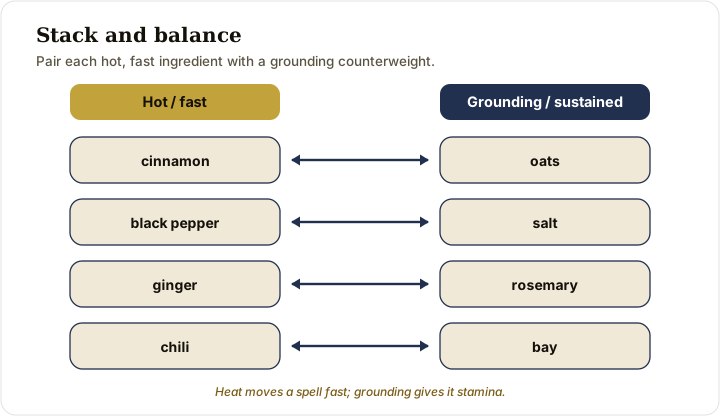
Balancing is the counterweight. Stacking only hot, fast ingredients (cinnamon, ginger, hot pepper) tends to burn the working hot and short. Adding a grounding ingredient (oats, salt, rosemary) gives the spell stamina. A good prosperity jar uses cinnamon for speed and oats for the long haul, so the money does not arrive in one chaotic burst and vanish.
Full lookups live in the herb chart when you want to plan a stack on paper before you walk to the cabinet.
The Two Beginner Mistakes That Sink Spells
It is almost never the wrong herb. It is almost always one of these two.
Overcomplication
The aesthetic feed has convinced a generation of new witches that a working needs eighty-dollar moldavite, a twelve-step choreography, and a soundtrack. Then they spend the whole ritual anxiety-checking whether the third clockwise stir was supposed to be counterclockwise, and the focus that was supposed to power the spell goes into worry instead.
Cognitive load kills focus. A scrap of paper, a birthday candle from the drawer, and a clear sentence will outperform a disorganized expensive production every time. If your budget is tight, that is not a limitation; it is an advantage. More in witchcraft on a budget.
Lust for Result
This is the spell-killer with a name in older occult writing: the "lust for result." It is what happens when you cast a spell and then spend the next three weeks refreshing your inbox, checking your bank, scanning for signs, and worrying it didn't take.
The frequency of wanting is the frequency of lacking. If you cast for money and then live in poverty-panic for a month, the dominant emotional state your magic is amplifying is the panic, not the wealth. The spell does what you keep telling it to do.
The fix is the oldest rule in the kit: set it and forget it. Cast, release, walk away, and live as if it is already moving toward you. A watched pot never boils, and the yips happen the second a thrower starts thinking about the throw. Detachment is not indifference; it is trust with its hands off the wheel.
After the Cast: How to Tell If It's Working
Results show up as shifted probability, not fireworks. More callbacks instead of fewer. A sharper interview. A friend who happens to mention an opening. A small mindset shift you did not engineer, like waking up less anxious about money for the first time in months.
The conventional timeline most witches give a spell is one lunar cycle, roughly twenty-eight days, before reassessing. Long enough for opportunities to actually surface; short enough that you are not waiting forever on a working that quietly missed.
If nothing has moved in a cycle, the next move is to rewrite the intent for sharper language, not recast the same script louder. A flat spell almost always traces back to a fuzzy sentence in the intent slot. Deeper diagnostics in why didn't my spell work.
A Few Extras the Books Won't Mention
Small things that quietly change how a spell feels in your hands.
Write your incantation in your own handwriting, slowly, not typed. The slower pace settles the intent into the page; typing is too quick for the words to mean themselves yet. The act of writing is already the first half of casting.
Cast slightly hungry. Not starving, just before a meal rather than after. A full body is a sleepy body, and attention is the actual fuel. This one is small and consistent; try it for a week and notice the difference in how sharp the focus runs.
Pick a release that has a clean snap to it. A blown-out candle, a tool firmly dropped, a lid clapped shut, a book slammed closed. The "fire and forget" needs a body to land in, and a soft trail-off leaves the energy hanging in the room with you.
The morning after, write down what you noticed in the day, the dream, the body. Not "did it work yet" but the small textures: a strange thought on the walk, a song that surfaced, a person who came to mind. This is the only way to learn what your specific craft sounds like, and a year of these notes is more useful than any other book.
Where to Take This Next
You now have the construction set. The next reading is whichever direction you need.
Finished spells to study the shape of, before you build more of your own, are in beginner spells. The mechanism under the hood is in how spells actually work. If your first build is going to be a candle, walk it stage by stage in candle magic; if it is going to live in a jar instead, spell jars.
The home your template, your worked examples, and your morning-after notes all live in is the Book of Shadows. Open one tonight and copy the seven blanks in. The first spell that goes on the next page will be yours.
Keep exploring
Browse more guides, or start with the basics of the practice you are curious about.
Browse more guides