Candle Magic for Beginners: Colors, Steps, Safety
Candle magic is one of the first types of spell a baby witch tries: in the practice, one flame focuses one intention.
A simple candle spell
- Gather and ground. This small release spell is the one I would put in your hands first. You need one black chime candle (a birthday candle on a saucer works in a pinch), a heatproof holder (cast iron or heavy ceramic), a small slip of paper, a pen, a pin, a lighter, an optional pinch of dried lavender and a quiet room. Sit down. Three slow breaths in, three slower out. If you want a container, scatter a thin ring of fine salt around the base of the holder. That is the whole circle; anything more elaborate is in how to cast a circle.
- Write the petition. One concise line, no hedging. I release the fear of inadequacy. Not "I want to maybe try to be a little less afraid." Fold the paper twice, away from your body each time, and tuck it under the holder.
- Prep the candle. With the pin, carve a single word from the base up toward the wick: Surrender, Release or Let go, whichever you can stand to read aloud. Rub a film of oil from the middle out to both ends, the banishing direction. Dust a few grains of lavender along the wax. A pinch, not a coating.
- Light it and look. Soft eyes on the flame; yogic practice calls this kind of gazing trataka, one of the quiet places where traditions overlap. Say your line out loud once: I leave this in the past, and I make space for peace. Then stop talking and let the candle do its job.
- Close it out. A chime burns out in about an hour. If you can sit with it the whole time, do; that is the cleanest version of the working. If you cannot, snuff it (do not blow) and restate the line when you relight. When it ends, tear the petition into small pieces and dispose of it the banishing way.
Fire safety: never leave a lit candle unattended, keep the herb to a few grains well away from the wick, and burn it in a heatproof holder on a clear surface. The full rules are in fire safety.
What tends to happen: a small, specific relief, not fireworks. By the next morning, the thing you wrote down has usually loosened its grip half a turn. That is the work. More starter rituals live in beginner spells, and grounding and centering covers the body side of getting into the right state. If this is your first real working, The Grounded Witch walks the first candle spell with grounding, fire safety, recordkeeping, and what to do if it falls flat.
Candle magic quick picks
- Candle type: a chime for one sitting, a taper for standard ritual, a 7-day vigil for long-haul work.
- Candle color: white stands in for any color; black banishes, green grows, pink softens, blue calms.
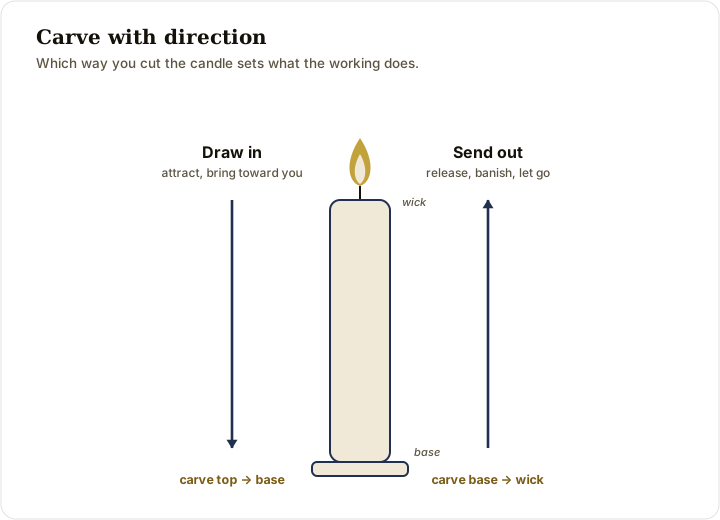
- Carving: top down to draw something in, base up to send it out.
- Dressing: a film of kitchen base oil and a pinch of herb, never a coat.
- Flame and wax: rule out drafts and wick problems before you read a sign.
- Disposal: keep drawing-work remains close; get banishing-work remains off your property.
What you actually need
You probably have most of this already.
- One candle (a $1 chime is fine; so is a stub of an old taper)
- A heatproof holder: cast iron, heavy ceramic, or thick fire-rated glass
- Something to carve with: a pin, a toothpick, or a ritual knife if you have one
- A lighter or matches
- A base oil: olive, almond, or jojoba from the kitchen will do
- A tiny pinch of one dried herb, if you want one
- A small slip of paper and a pen for a petition
- A snuffer (or a spoon laid over the flame)
Not required: a starter kit, a labeled "ritual oil," a crystal grid, an altar cloth, an athame from an occult shop. Buy any of those when you genuinely want them, not because the algorithm told you a real witch has one. A broke-witch starting point lives in witchcraft on a budget, and the wider toolkit is in witch tools.
Choose the right candle type
Pick a candle whose burn time matches how long you want to sit with the intention. A short feeling wants a chime; a long, slow shift wants a 7-day.
| Candle type | Typical burn time | Best for | Watch out for |
|---|---|---|---|
| Chime (spell) | 1 to 2 hours | A single sitting, start to finish; first spells | Burns hot and fast; needs a stable holder |
| Tealight / votive | 3 to 10 hours | Quiet altar work; supporting candles | Votives need a holder that contains the melted pool |
| Taper | 8 to 12 hours | Standard ritual work; deity candles | Tapers do not carve well; tip-heavy in cheap holders |
| Pillar | 30 to 60+ hours | Ongoing slow work; household peace | Big wax volume; tunnels if the wick is undersized |
| 7-day vigil (novena) | 7 to 9 days | Sustained intentions; long-haul work | The highest fire-risk category by a wide margin |
| Figural | Varies | Sympathetic work where shape matches intent | Thin limbs collapse and drip; treat as fire-risk |
There is a real debate inside the tradition about 7-day candles. Some lineages hold that a vigil candle should never be extinguished once lit; the unbroken flame is the point. Many modern practitioners (myself included) segment the burn for safety: snuff it when you leave the house or sleep, restate the intention out loud when you relight, and call that an honest compromise. A house fire ends the working faster than a paused flame does.
For a candle to actually buy, honest candle picks is the buying guide I would hand a friend; for the wax-type tradeoffs (and why most cheap candles burn so weirdly) see beeswax vs paraffin vs soy. For moon-timed work, moon magic covers the rhythm.
Candle colors at a glance
The fuller cross-tradition chart lives in color correspondences. White substitutes for any color: a plain white candle is the universal stand-in when you cannot get the "right" one. And your personal association beats the chart. If orange has always meant courage to you because of a coat your grandmother wore, your courage candle is orange.
| Color | Common associations | Typical use |
|---|---|---|
| White | Purity, peace, clarity, fresh starts | Cleansing a space, seeking clarity, substituting for any color |
| Black | Banishing, protection, absorbing, boundaries | Releasing grief, breaking a habit, holding a boundary |
| Red | Passion, courage, vitality, drive | Working up nerve, lighting a creative fire, romantic warmth |
| Pink | Compassion, self-love, friendship, softness | Self-acceptance, mending a friendship, gentle love |
| Blue | Calm, communication, truth, patience | Sleep, hard conversations, calming a spiral |
| Green | Abundance, growth, renewal, prosperity | Money work paired with action, growth, steady fortune |
| Yellow | Intellect, confidence, joy, mental agility | Study, creative blocks, lifting a low mood |
| Purple | Intuition, spiritual depth, inner power | Meditation, dreamwork, sitting with the harder questions |
| Orange | Ambition, adaptability, stimulation | Restarting a stalled project, adapting fast, playful energy |
| Brown | Grounding, stability, endurance, animals | Settling into the body, home steadiness, honoring pets |
These are reflective tools. A green candle does not deposit money. A blue candle does not treat a clinical anxiety disorder. If something physical or psychiatric is wrong, please see a doctor too. The candle supports how you move through your life; it does not replace the people trained to help.
Carve the candle: direction matters
A pin, a toothpick, or the tip of an athame all work. What you carve is small: a single word, a name, a date, a sigil. The direction is the rule:
- Drawing in (attracting a job, a friendship, a feeling): carve from the top, near the wick, down toward the base.
- Sending out (releasing a habit, banishing a fear, ending a pattern): carve from the base up toward the wick.
Two named techniques are there to grow into later. Loading is carving a small cavity in the base, packing it with a pinch of herb or a folded petition, and sealing it shut with melted wax. Butting is cutting off the original wick, flipping the candle upside down, and exposing a new wick at the new tip; you will see it in traditional Hoodoo banishing work. Sigil-carving deepens in sigil magic, and how to write a spell covers the language side.
Dress the candle: oil, then a pinch of herb
Dressing is where the candle stops being a candle and starts being yours.
Pick the oil. A plain base oil (olive, almond, jojoba) is genuinely enough; it has been enough for cunning folk for centuries. A purpose-blended ritual oil (a Road Opener, a Money Drawing) is a lovely option if you want one, and shops that blend honestly are worth supporting.
Anoint with direction. To draw in, oil from the wick down to the middle of the candle, then from the base up to the middle: everything moves inward. To send out, oil from the middle outward to both ends: everything moves away. Say the intention quietly as you do it. Your hands are doing the work, your voice is sealing it.
Add a pinch, not a coat, of herb. Grind it fine in a mortar (or under the back of a spoon on a chopping board), and sprinkle a few grains onto the oiled wax or roll the candle lightly through them. Cinnamon shows up a lot in fast or money work because herbalists treat it as a "hot," circulation-stirring spice that speeds things along. Lavender shows up in calming work because it contains linalool, a compound with documented sedative properties; for the science-leaning witch, that is a real handle to hold onto.
Less is more. Overdressing a candle does not amplify the spell. It builds a fire hazard out of dried plant matter and oil. A few grains, kept well away from the wick, is the whole job.
For a 7-day glass-encased candle, the method changes because the wax is sealed in. Poke three small holes through the top of the wax with a chopstick or skewer. Drop a few drops of oil into the holes. Sprinkle the tiniest pinch of herb on the surface. Swirl the jar clockwise to blend. Do not flood it. A floating layer of oil over a sealed wax surface is exactly how the jars that end up on r/witchcraft "what went wrong" posts ignite.
For sourcing the plant matter, herb correspondences covers what to reach for, and ethical wildcrafting covers how to gather it without harm.
Fire safety: the part that separates a practice from an incident
This is physical-world safety, not belief, and I am firm about it because the social-media version of candle magic is genuinely setting people's altars on fire.
Overdressing is the number one hazard. Herbs, twine wraps, large flower petals, and thick oil layers act as secondary wicks. A candle that should burn quietly turns into a torch when the melted wax reaches the dressing and the whole surface lights at once. If you cannot see the wax surface for the herb, you are at risk.
Glass-encased candles crack. Thermal shock and off-center wicks are the main culprits. The wick drifts toward one wall of the jar, the glass heats unevenly, and it splits, bursts, or shatters and throws hot wax. Use jars rated for high heat. If the wick drifts off-center or the glass becomes too hot to touch, snuff the candle.
Holders matter. Cast iron, heavy ceramic, or thick fire-rated glass only. Not wood, not plastic, not a thin votive cup balanced on a paperback. The holder is the last line of defense.
The water or sand buffer trick. When you are burning a dressed candle, put half an inch of water (or a layer of fine sand) at the bottom of a wide fireproof dish under the candle. Any falling ember or flaming herb fragment lands in the water or sand and goes out. It is a small habit that has saved a lot of altars.
Crystals do not go in the wax or against the flame. Many stones contain microscopic moisture or air pockets. Heat them fast enough and the stone can fracture or pop violently. Place crystals near the working if you want, not inside it.
Snuff, do not blow. Tradition says blowing insults the fire element; safety says blowing splatters molten wax and sometimes flaming herb fragments. For once, the tradition and the fire marshal agree.
Never leave a candle unattended. This is the cardinal rule. If you must walk away, snuff it. If you are doing a 7-day vigil and your lineage truly does not allow extinguishing, the candle goes in a stripped, bare, fireproof space: the center of an empty porcelain bathtub, or a heavy cast-iron cauldron with nothing else in it. No paper, no fabric, no books in reach.
If a candle does ignite something: never pour water onto a wax fire. The water sinks under the wax, vaporizes, and throws burning wax everywhere. Keep a small box of baking soda, a fire blanket, or a small extinguisher within arm's reach of your altar. The cost is twenty dollars and the peace of mind is real.
Read the flame, without overreading it
Rule out drafts, wick length, and wax quality first. Most "signs" are physics, and this is where new witches spook themselves needlessly.
- Tall, steady flame: energy moving cleanly. The working has room.
- Small, struggling flame: resistance somewhere, or your own energy is low. Worth pausing to check both.
- Flickering with no draft: something is stirring around the intention. Note the moment.
- Dancing high flame: intense activity. Often read as the working "biting."
- Heavy smoking: a muddied working. Often (honestly) over-dressing or a bad wick.
- Self-extinguishes early: worth a pause. Could be a draft. Could be the working asking you to revisit it.
Reading your own internal signals lives in develop clair senses.
Read the wax: a beginner's ceromancy
Reading the cooled remains of a candle is called ceromancy. Wick centering, wax type, and a draft from the window account for most "signs," so read in context and with humility.
| Wax pattern | Common reading | Honest caveat |
|---|---|---|
| Pooling or flowing toward you | Drawing the working in | Good for attraction work; awkward sign in a banishing |
| Flowing away from you | Sending the working out | What you want in banishing; check the surface is level |
| Flow to the left | Past or residue | Traditional, not universal; hold it lightly |
| Flow to the right | Forward, incoming | Same caveat; the cloth tilt matters |
| Tall clinging walls, lots of unburned wax | Unfinished energy, blocks | Far more often a wick-size problem |
| Petition ash that flies up | Released cleanly | Drafts cause this too |
| Petition ash that stays heavy and dark | Still clinging | Damp paper does this; check the obvious first |
For other ways to ask a question, a pendulum and runes are sibling practices in the wider family of divination methods.
Dispose of the remains
Disposal follows intention. If you want to call off a working rather than finish it, start with how to undo a spell instead.
- Drawing or attracting work (love, money, protection coming toward you): keep the remains close. Bury the cooled wax in your front or back yard, or gently re-melt the wax in a tin and shape it into a small charm (a heart, a coin, a seal) to keep on the altar.
- Banishing or releasing work (a habit, a grief, a connection): get the remains off your property. Bury them at a crossroads, drop them into moving water (a river or a stream, not a stagnant pond), throw them into an outdoor fire, or put them in a public trash can well away from your home.
- The eco-honest bit: only natural waxes (beeswax, pure soy) and organic herbs are safe to bury or compost. Paraffin, glittered candles, and synthetic dyes go in the bin. This is craft, not a free pass to put petroleum products in the soil.
How candle magic works
Candle magic focuses an intention through a single flame: you choose a candle, carve and dress it on purpose, light it, watch it, and read what it leaves behind. The candle is the tool, your attention is the engine, and your real-life follow-through closes the loop. Madame Pamita, who wrote The Book of Candle Magic, is blunt that the magic lives in your focus and will, not in the wax. Three things are happening at once when you sit in front of a lit candle with a stated intention.
Your nervous system settles and your attention narrows. Lighting a single flame with one clear sentence in mind is a focusing ritual. It lowers the noise, and it primes you to notice the small openings (a job posting, a person across the room, a number you should call) that a scattered mind misses. Whether you call that priming or magic is up to you.
The elements line up around the act. In the Wiccan and broader Neopagan reading, a candle is a small model of the world: the solid wax is earth, the melt is water, the smoke is air, the flame is fire, and your stated intention is the spirit that sets the rest in motion. You are not summoning anything from outside the room. You are arranging what is already here.
The working only pays out if you move. "Magic plus action" is the line. The candle is the prayer; the application, the email, the boundary, the appointment is the legwork. Light the green candle for the job. Also send the application. More on the wider mechanism in how spells work and magic plus action.
What candle magic will and will not do
It will give a structured, repeatable place to put a feeling. It will sharpen focus and lower noise. It will pair beautifully with one concrete real-world action. It will, often, leave you feeling clearer than when you sat down.
It will not deposit money in your account, change someone else's mind, or work overnight. Anyone promising a thunderclap, a guaranteed outcome, or a fix that needs nothing from you is selling you the feeling, not the craft. When a working falls flat, or a flame has you genuinely worried, why spells don't work is the troubleshooting page.
Where candle colors and wax reading come from
Raymond Buckland's Practical Candleburning Rituals is the book that standardized a lot of the modern English-language color palette, and the white-as-substitute rule is one of his.
Ceromancy takes its name from the Greek keros (wax) and manteia (divination). Threads of it show up in Druidic folk practice, Greco-Roman household divination, Hoodoo rootwork, and Slavic customs like the Polish Andrzejki festival on St. Andrew's Eve, where molten wax was poured through a key into water and the shadows of the cooled shape were read for the year ahead. It is old, it is widespread, and it is still useful.
Light one candle with full attention, and the rest of the craft will build from that flame.
Keep exploring
Browse more guides, or start with the basics of the practice you are curious about.
Browse more guides