How to Develop Your Clair-Senses (Beginner Drills)
On this page
Learning how to develop your clair-senses is less about waking a hidden gift and more about noticing four input channels you already use, then giving them low-stakes reps until you can trust what comes through. You don't have to be "gifted." Modern practice treats clairvoyance, clairsentience, clairaudience, and claircognizance as trainable faculties, and the work is mostly quieting the static so subtler signals can register. One honest line before we start: this is personal spiritual practice, a way of paying attention. It isn't a diagnosis, and it isn't a substitute for psychiatric care.
How to develop your clair-senses (the short answer)
Treat the clairs as four channels you already use (seeing, feeling, hearing, knowing) and train them with short daily drills, paired with a grounded check that tells intuition from anxiety.
Train one channel at a time, in situations where being wrong costs nothing. Keep the sessions short and consistent. Close down when you finish so the volume knob isn't stuck on loud in the supermarket queue. That is the whole shape of the work.
What the clair-senses actually are
"Clair" is just the French word for clear. The four clairs are a heuristic for sorting how subtle information reaches you, not a hierarchy and not a checklist. The terminology spread in the mid-nineteenth century through modern Spiritualism, then got formalised by the Theosophical Society around figures like Helena Blavatsky and Charles Leadbeater, whose 1899 book Clairvoyance described an "inner eye" tuning into vibrations beyond the physical senses.
Most people lead with one channel the way they lead with a learning style. The others come online with practice. Mat Auryn frames the weaker clairs as "noirs," dormant rather than absent, and the practice is simply use.
Clairvoyance (clear seeing)
Clairvoyance is almost always internal. Not a ghost across the kitchen, but a mind's-eye image, a brief inner movie, or a symbol that lands sideways and means something. Practitioners tie it to the third eye, the Ajna centre on the brow.
Because it speaks in symbols, the work is partly building a personal lexicon. The blooming flower you keep seeing when you tune into your sister might mean "growth" to you and "wedding" to someone else. Write down the symbol, write down what happened, and you'll learn your own dictionary inside a few months.
Clairsentience (clear feeling)
Clairsentience is the most common channel and usually the baseline most people share. It's the gut feeling, the chest tightening when you walk into a room where two people just argued, the inexplicable goosebumps when someone is telling the truth. In tradition it sits with the heart and solar plexus.
The catch with clairsentience is that you absorb. Clairsentients often pick up other people's emotions and mistake them for their own. Half of training this channel is learning to ask, every time, is this mine? The intuition-vs-anxiety differential is largely a clairsentient's tool.
Clairaudience (clear hearing)
Clairaudience is almost never a booming voice from above. It's a quiet internal voice, usually short, neutral, and a little detached from your normal inner monologue. A single word. A name. "Wait." "Take the other route." In tradition it's linked to the throat.
One honest line, because it matters: the calm, brief, kind nudge is one thing. Voices that are harsh, commanding, tormenting, or telling you to harm yourself or anyone else are not a clair waking up. That belongs with a clinician, not a candle.
Claircognizance (clear knowing)
Claircognizance is sudden knowing without any sensory wrapper. No picture, no feeling, no voice. You just know. Practitioners describe it as a "download," a whole file landing in your head in a second.
It's the hardest channel to trust because there's nothing to point at. You only get to validate it in hindsight, when you find yourself saying something wise you didn't know you knew, or insisting on a decision that turns out, weeks later, to have been the right one. Logging hits is what builds the trust.
The four clairs at a glance
| Clair | How it shows up | Common somatic marker | What it is NOT |
|---|---|---|---|
| Clairvoyance | Inner image, brief mental "movie," symbol | A flicker behind closed eyes, third-eye pressure | Hallucinating ghosts in the room |
| Clairsentience | Felt sense, mood-shift, gut pull | Stomach drop, chest open or tight, skin tingle | Random anxiety with no source |
| Clairaudience | Short inner word or phrase, calm tone | Faint internal "voice" off to one side | Harsh commands, tormenting voices |
| Claircognizance | Sudden, unargued knowing | Quiet certainty, no body cue at all | A logical conclusion you just worked out |
The one foundation: a quiet enough mind
None of this works if your inner radio is set to scream. Meditation isn't a religious add-on here, it's the load-bearing prerequisite, the way you lower the dial from busy beta toward the receptive alpha and theta states modern psychic-development teachers describe. Frame it however you like: clearing static on a radio dial, or just letting the surface of a glass of water stop rippling so you can see through it.
Two-minute version: sit, slow the breath, let thoughts pass without chasing them. Auryn calls the wandering "monkey mind" and points out that noticing it and returning to the breath is the workout, not a failure of it.
For deeper energy stability, shield drills, and the roots-to-the-earth foundation, route to grounding and centering. For calming rituals aimed at wellbeing rather than psychic prep, witchcraft for anxiety is the gentler door.
Three beginner drills to wake the clairs up
Consistency beats duration. Five minutes most days will get you further in three months than a four-hour session once. Low stakes is the second rule: the inner skeptic stays quiet when nothing is riding on whether you're right, and that's exactly when the channels open.
Drill 1: the everyday prediction (claircognizance and clairsentience)
Christopher Penczak's principle: weave the drills into things you were going to do anyway.
- The elevator test. Standing at a bank of lifts, breathe, ask which doors will open first, and notice your answer before they ding.
- The caller test. When your phone buzzes, pause before you look. Who is it? Don't reason it out, just feel the first impression.
- The shuffle test. Before you hit play on a randomised playlist, ask for the genre, the artist, or the specific song.
- The mailbox test. Walking out to the post, picture what's in there. Bills, a magazine, a personal letter, nothing at all.
If you're wrong, nothing happens. If you're right, this is the bit that matters: log the felt signature that came with the hit. Did it land as a flat knowing? A quick image? A pull in the stomach? You're not training accuracy first, you're learning what your accuracy feels like in your body.
Drill 2: the seven balloons (clairvoyance)
This one trains the inner screen to hold a clear image without rushing or fading. Most beginners are surprised at how hard it is.
- Sit comfortably, close your eyes, drop into a light meditative state and ground.
- Picture yourself standing in an open field, holding seven balloons, one in each colour of the rainbow: red, orange, yellow, green, blue, indigo, violet.
- Open your hand and release the red one. Watch it float up into the sky.
- Hold the image until the balloon completely disappears from view. Not "I think it's gone," actually watch it shrink to a dot and vanish.
- Only then release the orange. Continue through all seven.
The mind will try to skip ahead, or the colours will go washy. That's the work. You're strengthening the same neurological and energetic pathway that has to hold steady when a spontaneous vision actually lands later on.
Drill 3: object psychometry (multi-sensory)
Psychometry, a term coined by the physiologist Joseph Buchanan in 1842 from the Greek for "soul-measure," is reading what an object has soaked up. It's a great beginner drill because you get immediate, external validation from a partner.
You need: someone willing to hand you a small personal object they wear often. A watch, a ring, a well-loved keyring. Metal worn against the skin tends to hold a stronger imprint.
- Settle into a light meditative state. Rub your palms together briskly to wake the energy centres there.
- Let your partner place the object in your cupped hands. Close your eyes.
- Narrate everything that comes up, out loud, without filtering. A colour. A smell. A snatch of word. A mood. A landscape.
- Resist the urge to interpret. Don't say "you went to the beach last summer," say "I'm seeing turquoise and tasting salt."
- After a few minutes, your partner tells you what landed and what didn't.
It works because you genuinely don't know anything, so your analytical mind has nothing to reconstruct from. The first time someone confirms an impression you couldn't have guessed, the confidence shift is real.
Drill matrix
| Drill | Primary clair | Time per session | What counts as a win |
|---|---|---|---|
| Everyday prediction | Claircognizance, clairsentience | 30 seconds, several times daily | Naming the felt signature of a hit, even if the hit was wrong |
| Seven balloons | Clairvoyance | 10-15 minutes | Holding one balloon image until it fully disappears before releasing the next |
| Object psychometry | All four | 15-20 minutes with a partner | One or two impressions the partner can confirm |
Sensing the aura (the white-wall method)
The realistic target is not the multicoloured halo from a stock-photo Pinterest board. It's the etheric layer, the densest one, sitting just off the skin as a faint greyish-blue or milky-white haze a few millimetres to an inch out. That's the layer that bears out for most people first. The colour layers come later.
Researchers like Barbara Brennan and the older Kirlian-photography work treat auric vision as a perceptual skill rather than a hallucination, and the drill is built around the actual biology of your eyes. Central vision (cone cells) is built for sharp detail in bright light. Peripheral vision (rod cells) picks up subtler, dimmer signals. Stare directly at something and you filter the subtle out. Soften the gaze and look past, and the rods get their say.
The setup
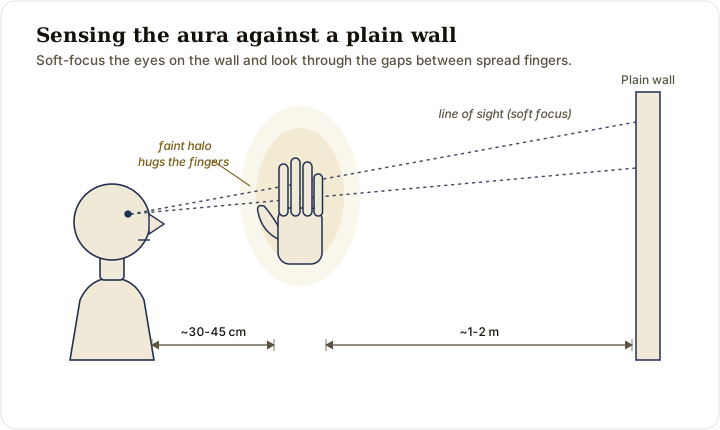
- Light. Soft and diffuse. No harsh overheads, no direct sun, no deep shadows.
- Background. A plain white or cream wall. Patterns and bright colours will fight you and shift the colour you think you're seeing.
- Position. Sit or stand one to two metres from the wall.
Why the fuss with the setup: every variable you don't control will give your analytical mind a reason to dismiss what you saw. Strip those out and the first faint outline becomes hard to argue with.
The drill, step by step
- Hold one hand up about 30 to 45 centimetres from your face, fingers spread slightly, palm or back against the wall.
- Look through the gaps between your fingers. Focus your actual line of sight on the wall behind your hand, not on the hand itself.
- Consciously relax the small muscles around your eyes. Let the focus soften and blur a touch.
- Keep your central focus on the wall and shift your mental attention to the periphery, specifically to the edges of your skin.
- Hold the soft gaze for 60 to 90 seconds without forcing a blink or chasing the image.
- Slowly move the hand. Watch for a translucent outline that trails the movement.
Most people see something faint within a few sessions: a thin, milky outline hugging the fingers, often described as the heat-shimmer that rises off a hot road. Ten to fifteen minutes a day for a few weeks makes it consistent. Once it's steady on your own hand, graduate to plants (oddly easy), then to a pet, then to a willing human partner where the coloured layers start to show.
Intuition or anxiety? a grounded differential
Both intuition and anxiety can sit in the stomach. Both can say don't. Mixing them up is the most common reason new practitioners either freeze on every decision or stop trusting the channel altogether.
The psychiatrist Antonio Damasio's somatic marker hypothesis offers a useful frame: the brain delivers bodily cues, built from huge stores of past experience, to nudge you toward or away from a choice before your conscious mind catches up. That's a real mechanism for what intuition feels like from the inside. Anxiety has its own mechanism, run mostly by the amygdala scanning for threat and looping on what-if. They feel similar in the first second. They feel completely different in the next thirty.
A boundary line: this is a navigation tool, not a clinical screen. If anxiety is persistent, intrusive, or running your life, that belongs with a therapist or a doctor. The pause-button test is for sorting an ordinary moment, not for diagnosing yourself.
The five tells, side by side
| Domain | Anxiety | Intuition |
|---|---|---|
| Emotional tone | Frantic, chaotic, heavily attached to outcome | Calm, emotionally detached, oddly peaceful |
| Urgency | High; demands immediate fear-driven action | Low; delivers the message steadily, no panic |
| Temporal focus | Fixated on future projections or past trauma | Locked in the present moment, just states what is |
| Physical sensation | Harsh: racing heart, tight chest, nausea, sweat | Subtle: tingling, gentle pull, expansive ease |
| Cognitive loop | Argumentative, repetitive, fluctuates with mood | Quiet, persistent, the same nudge every time you check |
The "pause button" test
When you can't tell, do this:
- Physically step away from the situation. Different room, ideally outside.
- Slow your breath. Three long exhales is enough to start.
- Write the thought down in plain language. "I have a bad feeling about signing this."
- Let five to ten minutes pass.
Anxiety will shift. It will argue with logic, get bigger, get smaller, attach to a different worry, then circle back. Intuition stays steady. The same quiet sentence is still there when you come back to the page, unchanged by your reasoning. Judith Orloff's mantra for the in-between is worth borrowing: May I be free of worry. May I stay in Now.
When the feeling is not yours
For clairsentients, half the false alarms aren't anxiety at all. You walked into a room and picked up what was already there. The test is simple: leave the room. If the heavy feeling fades within minutes once you're physically away from the person or place, you absorbed it. If it stays steady regardless of where you are, it's either your own state or a real intuitive flag worth listening to.
One honest line: this is not a permission slip to override real warning signs in real relationships by deciding you're "just empathing." If the same person keeps making your body brace, that's information, not noise.
Closing down: the part most beginners skip
Leaving the channels wide open in daily life is what burns people out. Psychic fatigue, empathic overload, mood whiplash when you walk through a busy shop, fogginess after a session that lingers for days. You don't want to slam the doors shut. You want to pull the radius back into your body when you're done practising.
The shutter visualisation
At the end of any drill, bring your attention to each main energy centre in turn (crown, brow, throat, heart, solar plexus, sacral, root). At each one, visualise something physical closing in: a camera shutter, the metal flaps of a vegetable steamer, a flower folding its petals. Pull the radiating light inward until it rests inside you as a contained sphere. It's a small ritual and it takes about ninety seconds.
Coming back into the body
Physical re-entry tasks shift you from the receptive theta/alpha state back to ordinary waking beta. Two minutes of mundane is the point.
- Eat something dense. A biscuit, a piece of bread, a square of dark chocolate.
- Drink a hot cup of tea.
- Walk barefoot on grass or carpet.
- Do the dishes, fold a towel, sweep a step.
Skip this and you'll feel scattered for the rest of the day and wonder why. For the standalone protective bubble and the cord-to-earth visualisation, both belong in grounding drills. In passing: in crystal practice, hematite and smoky quartz are the classic dark grounding stones, kept near the root or feet; tektite gets used as a defensive shield around the auric field.
How to practise this without burning out
A small weekly shape works better than a daily-everything plan. Try this for a month:
- Most weekdays: two minutes of quiet breath plus one micro-prediction (the lift, the caller, the shuffle).
- Twice a week: one longer drill. Pick one: balloons, psychometry, or the aura wall. Don't try to do all three in a session.
- Every time: close down. Shutter visualisation, snack, tea, done.
- Once a week: read back your notes for thirty seconds. Look for patterns in your hits, not for grades.
The honest failure mode here is chasing hits instead of logging signatures. If you're keeping score on whether you got the elevator right, you've already drifted from the work. Track the feel of being right, the felt signature in your body. That's what becomes reliable.
What "progress" actually looks like
Six weeks in, the change is usually small and specific. You notice which channel lights up first for you. You start to recognise the body-sense of your own calm certainty as something distinct from your worry. You reach for the channels a little less, and trust what they give you a little more when you do. That's it. That's progress. Anyone selling you a faster arc is selling.
A few honest cautions
Doctor not waiter:
- Harsh, commanding, or tormenting voices are not clairaudience waking up. See a clinician.
- Persistent intrusive thoughts that don't ease with the pause-button test are not intuition.
- Panic that won't downshift, dissociation, or losing time during practice are flags to stop, ground, and talk to a professional.
- Frequent migraine, vision changes, or new neurological symptoms during third-eye or aura work belong with a doctor first, your practice second.
Belief framing once: this is personal spiritual practice, not a diagnostic instrument. Pair it with real medicine when real medicine is what the moment calls for. Then come back to the candle.
Where to take this next
If the grounding and shields feel wobbly, do that first; it's the floor everything else stands on. If the channels feel awake and the question is what to use them for, the divination silo is the natural next door.
Start with grounding and shielding, then move into divination methods for the full overview, or jump straight to a tool: the pendulum for yes/no clarity, scrying for vision work that builds straight on top of clairvoyance. If you're still finding the shape of a daily practice, the beginner's path is the gentler frame around all of it.
Keep exploring
Browse more guides, or start with the basics of the practice you are curious about.
Browse more guides