Divination Methods: How to Choose Your First One
The honest secret about divination methods is that they all do the same quiet job in different clothes: they slow you down enough to hear what you already half-know, then they hand you a symbol vivid enough to pin language to it. You do not need a checklist of tools, an inherited gift, or anyone's blessing to start. Pick one that fits how your mind already works, sit with it for a few weeks, and leave the rest on the shelf.
Divination Methods, Compared (Start Here)
Seven methods are worth knowing as a beginner: tarot, oracle cards, runes, pendulum, scrying, tasseography (tea leaves), ceromancy (wax), and bibliomancy (a book). Choose one based on how you actually take in the world, not on what looks beautiful on someone else's altar.
| Method | Primary sense | Structure | Best for | Cost to start | Go deeper |
|---|---|---|---|---|---|
| Tarot | Visual, illustrative | High (78 cards, four suits) | Narrative mapping, structural thinking | Around $20 to $40 for a deck | choose a deck |
| Oracle | Visual, artist-led | Low (no fixed system) | Mood and reflection | Around $20 to $50 | choose a deck |
| Runes | Tactile and abstract | Moderate (24 staves) | Life-theme reflection | Around $15 to $40, or DIY for free | read runes |
| Pendulum | Kinesthetic | Low (yes or no) | Narrowing options | Around $10 to $30 | use a pendulum |
| Scrying | Visual, trance state | Very low | Bypassing the chatter | Free to about $40 | how to scry |
| Tasseography | Visual pattern | Low | Daily, kitchen-table practice | Price of loose tea | kitchen craft |
| Ceromancy | Visual and kinetic | Low | Pairing with candle work | One candle | candle magic |
| Bibliomancy | Cognitive, language | Moderate | Lateral insight | A book you already own | a journal |
If you are brand new and want the broader on-ramp first, getting started is a calmer place to begin.
What Divination Actually Is (and Isn't)
In reflective practice, divination is a way of asking a sincere question and noticing what surfaces, not a way of reading a fixed script. The future is treated as a probability shaped by present choice; a reading "worked" when it leaves you steadier and clearer, not when it predicted an event.
The cards, runes, and wax shapes are doing one thing: catching what your unconscious already suspects. Tradition calls this many names. Modern practitioners tend to call it a mirror.
Closer to the mechanism: how spells tend to work.
Ask Open-Ended Questions, Not Yes or No Ones
The single biggest upgrade in a beginner's practice is rephrasing the question.
- "Will I get this job?" becomes "What do I need to understand about this opportunity?"
- "Does he love me?" becomes "What is the truth I am not letting myself see here?"
- "Should I move?" becomes "What small step would support me in this decision?"
A closed question pins the tool down to a verdict. An open one gives your own judgment room to breathe back into the answer.
Intuition vs. Anxiety: the Honest Caveat
Intuition is quiet, stable, and brief. It arrives without much narration and tends to nudge you toward a wise, slightly inconvenient action. Anxiety is loud, urgent, and built out of "what if": it loops, it spirals, and it reads catastrophe into every ambiguous symbol.
If a reading drops you into panic, that is fear bending the lens, not a message from the deck. Put the cards down, breathe, walk outside, come back tomorrow. None of this replaces mental-health care. If something heavier is going on, please talk to a real person about it too.
For settling the body before a reading: simple grounding drills. For the wider context: witchcraft for anxiety.
The Seven Beginner Methods at a Glance
Tarot owns the visual, high-structure end. Bibliomancy owns the language-only, no-cost end. The other five sit between them, each with its own friction.
Tarot and Oracle Cards: Visual, Structured, Story-Driven
Tarot is the big system: 78 cards split into the Major Arcana (overarching themes) and the Minor Arcana (four suits of daily life). Oracle decks are the loose cousin: any number of cards, any theme, the artist's vision is the structure. Raven Digitalis's The Empath's Oracle is a good example of the looser, image-led style.
Best for someone who thinks in stories and wants a map: the suits, positions, and archetypes give you scaffolding to lean on. The friction is volume; 78 distinct cards is a lot to grow into, and beginners often freeze.
Specific card meanings are their own study, well covered in dedicated beginner guides. For where to start: beginner books and how to choose a deck.
Runes: Tactile, Abstract, Earth-Toned
The Elder Futhark is a set of twenty-four characters that started as a Germanic phonetic alphabet and ended up as a divination system. The word rune itself once meant secret, mystery, or whispered counsel; the Norse myth has Odin earning them through nine nights of self-sacrifice on the world tree.
Best for tactile thinkers and people who like minimalism. You shake the bag, pull a stone, feel its weight, and read the concept it carries. The friction is exactly the opposite of tarot: there is no illustrated scene to read off the surface, so you have to learn the twenty-four meanings until they live in your hands. Lisa Chamberlain's Runes for Beginners is the standard low-friction primer.
For the meanings, the casting cloth, and the three-rune spread: how to read runes. For the older folk cousin: witch's runes.
Pendulums: Kinetic, Binary, Fast
A pendulum is a weight on a chain. It comes out of dowsing, the old practice of finding water or buried metal with a forked stick, and it has migrated indoors as a small device for asking yes-or-no questions.
The mechanism is worth naming honestly. The chain moves because of the ideomotor response: tiny, unconscious muscle tremors in your hand, triggered by what your body already knows about the question. Practitioners frame this as the unconscious or the higher self moving through the body; the physical effect is well documented either way.
Best for narrow, specific decisions, or for narrowing a long list of options down. The limit is real: a pendulum cannot tell you why something is true, only that your unconscious is leaning. Most experienced readers I know pair it with another method when the question runs deeper than yes or no.
Full setup, calibration, and the questions to actually ask: how to use a pendulum.
Scrying: Visual, Trance-State, Slow
Scrying is the art of staring softly into a featureless surface (a black mirror, a crystal sphere, a candle flame, a bowl of dark water) until images begin to surface. The lineage is ancient and global: Egyptian priests, Mesopotamian seers, and the cunning folk of early modern Europe all used some version.
The mechanism is pareidolia plus a light trance. The brain, deprived of normal visual input, starts projecting its own imagery onto the blank surface. What you "see" is your own unconscious throwing pictures at you, which is the point.
Best for anyone who already drifts into daydream easily. The friction is patience: in my own practice, the first twenty to thirty minutes are mostly the rolling grey fog that scryers have written about for centuries. Then the surface seems to dim, and shapes start. Beginners often quit before that turn.
The cheapest entry by far is a dark ceramic bowl of distilled water on a candlelit table; you can start tonight. The how-to (the soft gaze, the lighting, the maintenance of a black mirror): how to scry.
Tasseography: Domestic, Sensory, Daily
Tasseography, sometimes called tasseomancy, is the reading of tea leaves. It has been practiced in different forms by Buddhist monks, Bedouin readers, Romani diviners, and the British and Irish parlor tradition that brought it to most English-language guides.
Mechanically, it is a domestic Rorschach. You brew, you drink, you swirl, you invert the cup onto its saucer, and you read the shapes the wet leaves leave behind. Pareidolia again, married to the mindfulness of actually slowing down enough to brew a cup.
Best for daily, low-stakes reflection and for anyone already on the kitchen-witch wavelength. One mechanical note that will save you a wasted evening: you must use loose-leaf tea, not bags. Bag fannings are too fine and collapse into a dark, unreadable sludge instead of the distinct clusters you need to read.
Caroline Dow's Tea Leaf Reading for Beginners and Sasha Fenton's Tea Cup Reading are the two short, lived-in guides most often recommended. For the wider kitchen path: kitchen witchcraft, or fold it into a daily practice.
Ceromancy: Fiery, Fluid, Transmutative
Ceromancy is divination by wax. Two flavors: drip melted wax into a bowl of cool water and read the shapes that solidify, or burn a candle through and read the burn pattern and the remnants in the dish.
The first time I poured beeswax into cold water for a question about leaving a job, the wax pulled itself into something that looked exactly like a door with a key in it. I felt my whole chest unclench; I had been waiting for permission to apply elsewhere, and the wax had found a way to give it to me before my conscious mind would let me say it out loud.
Best for anyone who already loves candle work, or anyone who finds quiet practice too quiet. The friction is fire safety and the wax itself. Beeswax is the right call here: its high melting point flash-freezes the moment it hits cool water and you get sharp, three-dimensional shapes. Soy melts and cools too slowly and tends to produce flat blobs you cannot read.
Madame Pamita's The Book of Candle Magic is the warm, practical reference for both the candle work and the reading. For the wider technique: candle magic. For the wax question: wax types compared.
Bibliomancy: Textual, Lateral, Free
Bibliomancy is the practice of opening a book at random, pointing at a line, and reading it as the answer. A folk method from at least the late sixteenth century used a Bible and a key bound into the binding as a kind of pendulum; today people use poetry collections, novels, dictionaries, and even old field guides.
The mechanism is synchronicity plus the brain's stubborn meaning-making. Given any sentence at all, your mind will reach for the relevance.
Best for language-driven thinkers and for the days when other methods feel like too much. It is also free. The one trick is to use a book you have not memorized: if you know exactly where your favorite passage lives, the conscious ego will steer you there and the magic collapses into projection. A thrifted poetry anthology you have never read works beautifully.
Catch what surfaces in a book of shadows.
How to Choose Your First Method
Choose by how you already move through the world, not by what looks most aesthetic in someone else's reel.
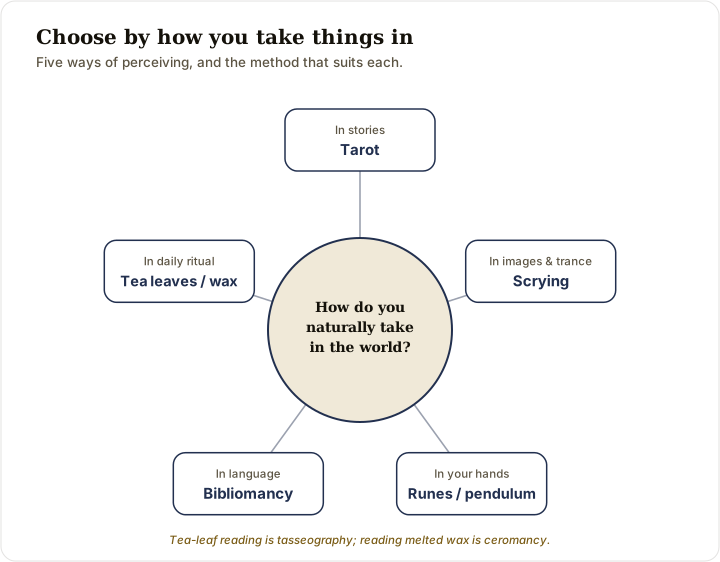
If You're Visual and Like Structure
Tarot. The 78-card system is a feature, not a bug, for people who like maps and frameworks. You will spend the first year learning the shape, and then the shape will start reading you back.
For where to start: beginner books and choosing a deck.
If You're Tactile and Earth-Leaning
Runes for theme-mapping, pendulum for decisions. Runes reward the reader who likes to hold things and lay things out. Pendulums reward the reader who wants a clean answer fast.
For how-to: read runes and use a pendulum.
If You Daydream Easily
Scrying, tasseography, or ceromancy. If you already lose minutes staring at clouds or candlelight, your nervous system already does the trance work the other methods have to teach.
For technique: how to scry.
If You Think in Language
Bibliomancy. The cheapest possible entry into divination, and the one most under-recommended in beginner guides.
If You Have No Money
Water scrying costs the price of a thrifted ceramic bowl. Bibliomancy costs nothing, since you almost certainly own a book. Tasseography costs the price of loose-leaf tea. None of this requires a $60 crystal sphere or a $40 boxed deck to begin. For the wider stance: witchcraft on a budget.
A Simple First Practice (Any Method)
The same five-step shape carries every method on the list. Use it for your first month.
- Isolate one question. Small, grounded, open-ended. "What do I need to see about this week?" works.
- Settle the body. Three slow breaths. Write the question on paper.
- Engage the tool. One card, one rune, one pendulum swing, one wax shape, one passage.
- Notice before naming. Write what you actually see and feel before you open a guidebook or search a meaning.
- Ground the magic. Pick one real action you will take today, however small, based on the reflection.
The fifth step is where most practice quietly succeeds or fails. A reading that ends in a small, honest action is a reading that did its job.
For the body part: grounding. For the journal part: a journal.
What to Skip (Honest Notes)
Three quiet warnings.
Don't buy seven decks before you have sat with one. The most common beginner trap is shiny-object syndrome: a tarot deck, an oracle deck, a rune set, a pendulum, a crystal ball, and no actual literacy with any of them. Pick one, give it eight weeks of honest evenings, then decide.
Skip teabag tasseography. The mechanics do not work; bag fannings make a flat sludge instead of readable shapes. Loose-leaf or nothing.
Skip paraffin candles for ceromancy and any indoor candle work. Burning paraffin releases volatile organic compounds (benzene and toluene among them) into the air of a small room, and the wax remnants are non-biodegradable. Beeswax burns cleanly and produces the sharp shapes you actually want to read; pure soy is a fine alternative. For the broader comparison: wax types compared. For more on what is not worth your money: supplies to skip.
On Sourcing Your Tools
The crystal market has a quietly ugly back end. Crystals destined for pendulums, scrying spheres, and starter kits often come from unregulated mines in the Democratic Republic of Congo, Madagascar, and Myanmar, where extraction has been linked to documented human-rights and ecological harms. Reporting on the trade in mainstream press is worth reading before your next purchase.
Two practical alternatives. Lab-grown crystals (the hydrothermal-growth process produces real quartz under heat and pressure, structurally identical to mined material) carry a fraction of the impact. Secondhand and thrifted tools carry none at all; a good black mirror is a thrifted picture frame and a can of matte black spray paint, and a scrying bowl is a dark ceramic bowl from a charity shop.
For more on the broader ethics: ethical sourcing. For the crystal angle: crystals for witchcraft.
Where to Go Next
If you are leaning toward a tactile method, the deep-dives are the pendulum, the runes, the older folk cousin witch's runes, and Irish ogham staves. If you would rather read the body than a tool, palm reading needs nothing but your own hands. If you are leaning toward trance and image, start with scrying. If you want a calmer on-ramp before you commit to anything, the beginner guide is the right next stop, and a small book of shadows to catch what surfaces will quietly carry the rest of the practice.
Keep exploring
Browse more guides, or start with the basics of the practice you are curious about.
Browse more guides