How to Use a Pendulum: A Beginner's Step-by-Step
Learning how to use a pendulum takes a weighted ring on a chain and one clear question. There is no spirit you have to summon to make it move. The swing is real, the practice is real, and the mechanism is grounded enough that a skeptic and a believer can sit at the same table and both get something honest out of it.
What a pendulum actually does
A pendulum is a weighted point on a chain that translates the subconscious into a swing. You program a yes, a no, and a maybe, you ask a clean binary question, and you read the answer in the motion that arrives.
The grounded mechanism is the ideomotor effect: tiny, involuntary muscle movements in your fingers, set off by your own thoughts and expectations, amplified by the lever of the chain into a visible swing. The Victorian physiologist William Carpenter named it in the 1850s, and it is the same effect that drives Ouija planchettes and dowsing rods. The pendulum does not invent information; it makes the information that is already moving under the surface of your hand large enough for you to see.
That framing does not flatten the craft. In practice, the pendulum behaves like a subconscious mirror: a way past the loop of pros-and-cons your conscious mind is stuck on. Believing practitioners read the swing as guidance from the higher self, spirits, or the energy around the question. Skeptical practitioners read it as their own buried knowing made visible. The method that follows works either way, which is part of why it has lasted.
The four moves are the same for everyone: choose, cleanse, program, ask. More on where this sits beside cards and runes in divination methods.
What you need to start tonight
Almost nothing.
- A pendulum, or a heavy ring (a wedding band, a sterling silver fashion ring) on a fine chain or a piece of string
- A quiet, flat surface and a chair where your feet reach the floor
- One clear question, written down if it helps
- Optional: a pen and a notebook to log what swings came up for what
A $30 crystal teardrop is a real joy if you want one, and there is nothing wrong with buying a beautiful tool. It just is not the price of entry. The dollar-tree-witch version (a ring, a chain, a kitchen table) gives an identical result on the first night.
The one physical thing that does matter is balance. A pendulum that is too light gets jostled by your breath or a draft and produces nervy, unreadable swings. A pendulum that is too heavy fatigues your arm within a minute, and tired muscles dull the ideomotor response that makes the whole thing work. Aim for something that feels substantial in the hand without pulling the wrist down. A teardrop or clearly pointed shape is worth picking if you ever plan to use a board.
If you want a setup that costs you nothing, a budget approach covers the wider craft the same way. If you want to shop on real merit, the tools roundup is honest about what is worth the spend.
Choose a pendulum: crystal, metal, or wood
Three categories, each genuinely good at different things.
Crystal pendulums are popular because crystal practice has a vocabulary for them. Clear quartz is the standard neutral beginner pick, easy to program and not pre-loaded with a particular mood. Amethyst is reached for when the question is about intuition, dreaming, or spiritual direction. Rose quartz is reached for around relationship and self-worth questions. They do chip if dropped, and they take more upkeep, but the specificity is what people love.
Metal pendulums are the lowest-maintenance honest choice for a beginner. Brass is light, durable, and conducts a swing cleanly. Copper is heavier and more responsive, which some practitioners like for slower, more deliberate work. Stainless steel will outlive you, never tarnishes, and stays energetically neutral, which is exactly what you want if you are still learning what your own baseline feels like. Metals do not absorb the ambient of the room the way porous stones are believed to, so you can mostly skip the cleansing schedule.
Wooden pendulums carved from oak, ash, or pine are light, grounding, and easy on the wrist for long sessions. Oak is associated with strength and authority in folk tradition and tends to feel decisive in the hand. Ash is lighter and is reached for when the question is layered. Pine is the softest of the three and pleasant for self-reflection work. Wood needs almost no upkeep beyond keeping it dry.
Entry crystal and metal pendulums tend to start around $10, with specialty pieces (orgonite, intricate geometric metal, faceted gemstones) running toward $30 and up. None of that is necessary for the method.
| Material | Durability | Cleansing needs | Beginner suitability | What it's reached for |
|---|---|---|---|---|
| Clear quartz | Moderate (chips) | Frequent | Good | Neutral all-purpose, easy to program |
| Amethyst | Moderate | Frequent (no direct sun) | Good | Intuition, dreaming, spiritual questions |
| Rose quartz | Moderate | Frequent | Good | Relationships, self-worth, emotional questions |
| Brass | Very high | Low | Excellent | Clean general dowsing, board work |
| Copper | Very high | Low | Excellent | Slower, more deliberate responses |
| Stainless steel | Very high | Very low | Excellent | Truly neutral, low maintenance |
| Oak | High | Very low | Excellent | Decisive, foundational questions |
| Ash | High | Very low | Excellent | Layered or complex questions |
| Pine | Moderate | Very low | Excellent | Gentle, reflective sessions |
If you want the stone meanings in more depth before choosing, crystal basics covers the correspondences.
Cleanse it before the first session
In crystal and tool practice, objects are believed to hold a residue of the intentions, moods, and ambient stress around them; cleansing resets that field so the next session starts clean. The honest secondary gain (and it is the larger one for most beginners) is that the physical act of cleansing functions as a small mindfulness ritual: it ends the rest of your day and starts the practice.
Five methods that work, pick what suits the tool:
- Smoke. Pass the pendulum through the smoke of sage, cedar, palo santo, or a stick of incense. Visualize the residue lifting with the smoke.
- Moonlight. Leave it on a windowsill overnight under a full or near-full moon. Gentle, passive, no risk to any material.
- Morning sun. A few hours of soft early sun resets the tool. Avoid direct sun for amethyst and fluorite, which fade and lose their color in UV.
- Sound. A singing bowl, a pair of tingsha, or a tuning fork held near the pendulum disrupts the energetic baseline and resets it.
- Dry brown rice. Bury the pendulum in a bowl of rice for 24 hours, then discard the rice (the tradition is that it has absorbed what came out).
Salt and running water work for hard, non-porous crystals like clear quartz, but they are the single most-skipped honest detail in beginner guides. Some materials are damaged or made dangerous by water.
Do not get these wet:
- Selenite. It is a water-soluble gypsum that will literally dissolve.
- Malachite. Contains copper carbonate, which can leach a toxic residue when soaked.
- Lapis lazuli. Porous, often inclusive of pyrite, which oxidizes and rusts on contact with water.
- Most wooden pendulums. Warping and staining.
- Most metal pendulums. Tarnish and corrosion at the chain links.
When in doubt, default to smoke, moonlight, or sound; they are safe across every material on this list.
More on this kind of upkeep in cleansing your space, and the wider menu of methods in banishing and clearing.
Program the pendulum's language
This is the load-bearing step. Most "broken" pendulums are unprogrammed pendulums: the swing has no universal meaning until you give it one. Without this, your subconscious does not know which physical pathway to use for affirmative versus negative, and what you get back is noise.
The first time I did this on my own pendulum, the chain warmed slightly between my fingers before anything moved, and the yes-swing arrived a full beat later than I expected. The lag is normal. Wait for it.
Settle into posture
Sit with your feet flat on the floor. Hold the top of the chain or the fob between the thumb and forefinger of your dominant hand, with about two to three inches of chain hanging free. Rest your elbow on the table if your arm tires; otherwise hold it lightly out from the body. Open your non-dominant hand palm-up, an inch or so under the point of the pendulum.
Drop your shoulders. The single thing that bears out over hundreds of sessions: tension in the wrist and forearm kills the response. A clenched hand cannot transmit the micro-movements that are the entire mechanism. You want loose, not floppy.
Grounding first helps. A minute of slow breathing into the floor is enough; grounding before a reading has a longer drill if you want one.
Set "yes" first, then verify
Still the pendulum with your free hand. When it is completely motionless, say (aloud or silently), "Please show me yes."
Wait. Watch.
A movement will emerge. It might be front-to-back, side-to-side, a clockwise circle, or a counter-clockwise one. Whatever arrives is the right yes for you. Do not override it because some guide online said yes is supposed to be clockwise. The whole point of programming is that the language is personal.
Lock it in with a question you know is true: "Is my name [your name]?" The same motion should come back. If it does, your yes is set.
Set "no," then "maybe / rephrase"
Stop the swing again with your free hand. Ask, "Please show me no." A distinctly different motion will arrive. Verify with a known false: "Do I have ten children?" (assuming you do not). Lock it in.
Stop the swing one more time. Ask, "Please show me maybe, or rephrase the question." This usually comes through softer than the first two: a diagonal wobble, a hesitant ellipse, or a small unsure circle. That softness is the tell. My maybe looked visibly less decided than my yes and no, and if yours does not, your conscious mind is probably over-driving the answer. Reset, breathe, try again.
Recheck before every future session
Open every later session with a 30-second confirmation. "Show me yes. Show me no." Your baseline shifts with mood, sleep, and how grounded you are that day, and the recheck tells you whether the connection is live before you ask anything that matters.
Ask a clean question
Most failed pendulum sessions are failed questions, not failed tools. Three rules, each with a real before and after.
Keep it binary. A pendulum without a board only speaks in yes, no, and maybe. So:
- Before: "What should I do about my career?"
- After: "Is taking the offer at [Company] in my highest good right now?"
Strip the leading desire out. If your question is shaped like a wish, your conscious mind will overpower the tiny ideomotor signal and hand you back what you already wanted to hear.
- Before: "Shouldn't I take this job?"
- After: "Would accepting this job serve my long-term wellbeing?"
Be specific and grounded. Vague, opinion-shaped questions return vague, mushy swings.
- Before: "Should I move?"
- After: "Would moving to [city] within the next six months support my growth?"
And the rule that has borne out for me repeatedly: if the swing stays sluggish, or you keep getting maybe, put the tool down for the day. That is not a failure. It is the practice telling you the question is unripe or you are too wound up to read it cleanly. Come back tomorrow.
For the questions a pendulum cannot answer (the wider self-knowledge ones), shadow work journal prompts are the better tool.
What the pendulum should never be asked
Not for medical diagnosis. Not for financial decisions. Not for legal advice.
The failure mode is simple: a reader notices a worrying symptom, asks "is this serious?", the pendulum reflects the wished-for no, the doctor visit gets pushed to next month. The pendulum did exactly what it does (mirrored a subconscious preference), and a real problem went unseen. That is the unethical use of the tool, and the honest practitioners I respect are uniform about this.
Use a pendulum for self-knowledge questions: which option feels aligned, where am I avoiding, what am I actually leaning toward. Use a doctor, a financial advisor, or a lawyer for the questions those professions exist to answer. The pendulum supports how you feel about a decision; it does not make the decision for you.
Use a board or chart for non-binary answers
When yes, no, and maybe are not enough, a pendulum board widens the vocabulary. The board is a flat surface (wood, heavy cardstock, cloth) printed with answer fields, and the pendulum becomes a pointer instead of a binary speaker.
Two shapes, both originating in 19th-century European dowsing:
Half-circle (semi-circle) board. The most beginner-friendly layout. Options are arranged in an arc, like a speedometer or wedges of a pizza. You hold the pendulum over a hinge point at the bottom center of the straight edge, and the swing builds outward into one wedge.
Full-circle board. Options radiate 360 degrees from a center dot. You hold the pendulum over the dead center. These hold more information (a full alphabet for spelling, percentages, chakras), but they are harder to read, because a straight swing crosses two opposite answers at once.
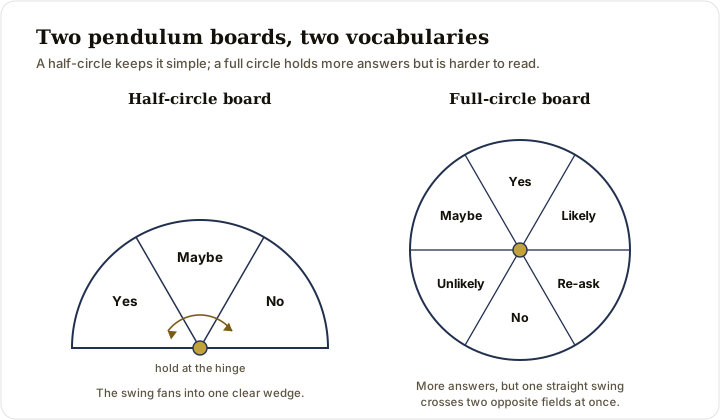
To use either: board flat on a steady table, sit up straight, feet flat, elbow rested on the table, wrist arched so the point hangs half an inch to an inch above the surface. Ask the question. The ideomotor response will build a small swing into a clear directional one over a few seconds.
A useful layered session goes: yes/no first ("is this topic open to look at today?"), then a percentage board ("how aligned is this option, roughly?"), then a letter or chakra board for specifics. The honest caveat on letter boards: when the motion strings out nonsense or starts spelling vaguely sinister words, that is your signal to stop, not to lean in. Letter work amplifies the ideomotor effect into territory where your own pareidolia takes over fast.
The wider toolkit (cards, runes, scrying) sits at divination methods.
Store it so the next session starts clean
End the session with a small grounding gesture: touch the point of the pendulum to the palm of your free hand, or tap it once on the table. That signals to the subconscious that the working is closed and stops any lingering motion. It is a small move and it does more work than it looks like.
Storage options that protect both the physical tool and (in tradition) its energetic baseline:
- A small silk, velvet, or natural cotton pouch
- A wooden box, dark and neutral
- A pouch with a small self-cleansing stone tucked in: citrine, carnelian, or amethyst, each believed to keep a passive reset going between uses
- A flat selenite plate or a selenite bowl, the closest thing to a zero-maintenance storage method in crystal practice
Do not toss it in a junk drawer. A pendulum that gets handled by other people, knotted up with old jewelry, or rolled around loose tends to come back to your next session feeling muddied, and even on the most secular reading, it is a small object with a sensitive chain that breaks if you treat it like a key.
When the chain breaks
A snapped chain or a shattered crystal is often read in tradition as a closed cycle, not an emergency. The tool finished what it was here for. Broken crystals can be returned to the earth, buried in a garden or under a tree that means something to you. Metals and wood can be respectfully repurposed or recycled. A line of gratitude, and you are free to choose a new tool. Nothing is broken about you.
Troubleshooting: when the swing won't settle
Quick fixes for the five things that go wrong first.
- Sluggish swing. You are ungrounded or tired. Three slow breaths, feet to the floor, recheck yes/no.
- Erratic wobble. Your question is multi-part. Break it down into one yes/no at a time.
- Always yes, or always no. You are leading the pendulum. Reset with the verifiable truth ("is my name X?") and a known false ("do I have ten children?") to confirm the language is still distinct.
- Tool feels "off" after a heavy session. Cleanse it. Smoke or sound is enough; you do not need a full ritual.
- Nothing at all today. Close the session. Tomorrow is fine. Forcing it teaches your subconscious that the practice is something to push through, which is the opposite of what you want.
For the longer arc (building the intuition the pendulum is reading), grounding drills and developing the clair senses are the next steps.
Is the pendulum "real"?
The honest answer is yes, in both directions.
The documented mechanism is the ideomotor effect: subconscious thoughts produce micro-movements in the hand, amplified by the chain into a visible swing. Carpenter named it in the 1850s. A 2017 study from Jay Olson and colleagues used signal-detection theory to test whether pendulums improved accuracy on a visual detection task versus conscious verbal guessing. Overall accuracy was similar between the two methods (around 57% verbal versus 53% pendulum), but pendulum users showed measurably less response bias, and people higher in transliminality (a sensitivity to subtle internal stimuli) performed better with the tool than without it. The pendulum did not give them information from outside; it gave them access to information they already had, with less interference from the part of the brain that overthinks.
That does not flatten the craft. It explains why the craft works.
Whether you read the swing as your subconscious, your higher self, a spirit, or all three at once, the tool does the same useful thing: it routes around the loop your conscious mind is stuck in, and shows you what is already moving underneath. A mirror is enough. More on the wider question at is witchcraft real.
Hold the chain lightly, ask plainly, and let the swing be one voice among the several you already trust.
Keep exploring
Browse more guides, or start with the basics of the practice you are curious about.
Browse more guides