How to Choose Your First Divination Deck
The right first divination deck is the one you will actually shuffle. Not the one a TikTok ranks highest, not the one a famous reader uses, not the prettiest box on the shelf. The one your hands will keep reaching for on a Tuesday night when you are tired and just want to ask one question. You do not need a witchy pedigree, a teacher's blessing, or a particular astrological chart to own a deck. If the pull is there, the pull is enough.
Across this whole guide, divination is reflection, meditation, and a quiet way to hear your own thinking back to you, not prediction and not advice. For specific decks I will actually put my name behind, I keep those in our deck picks so this page can stay focused on how to choose.
The short answer on choosing a divination deck
Choose tarot if you want a fixed 78-card framework you can transfer between decks; choose an oracle if you want a gentler, free-form prompt. In either case look for art you actually like, 300 to 350 GSM cardstock, a linen finish, a printed guidebook (not a QR code), and standard 2.75 by 4.75 inch sizing.
Tarot vs oracle: which structure fits how you learn
Tarot and oracle both use cards for reflection, but they are built on opposite philosophies. Tarot is a fixed system of 78 cards, 22 Major Arcana for the big life themes and 56 Minor Arcana across four suits for the day-to-day. Once you know that system you can pick up almost any standard tarot deck and read it. Oracle decks throw the rulebook out: any card count (commonly 30 to 60), any theme, any structure the creator wants. Each oracle is its own little world.
So this is not which deck is "more witchy." It is which way you actually learn.
| Feature | Tarot | Oracle |
|---|---|---|
| Card count | 78 (22 Majors + 56 Minors) | Variable, often 30 to 60 |
| Structure | Fixed: suits, numerology, archetypes | Fluid: whatever the creator built |
| Learning curve | Steeper at first, then transfers everywhere | Gentle, mostly self-explanatory |
| Cross-deck fluency | High; learn one, read most | Low; each deck is its own logic |
Card meanings and spreads live in the tarot section, not here, so you can stay focused on the buying decision. If you are still deciding between cards at all and a pendulum or a set of runes is in the running, swing through other divination methods first.
Pick tarot if you like a system
If you are the person who loves a framework, who likes a study deck on the bedside table, who already enjoys the idea of learning the four suits the way you learned the periodic table, tarot will reward you. The investment pays compound interest: that effort transfers to every other RWS-tradition deck you ever own.
Pick oracle if you want gentle prompts
If memorising 78 archetypes makes you want to lie down, oracle is yours. You pull a card, you read the keyword, you sit with the image. The trade-off is real: when you eventually buy a second oracle, you are starting from scratch with its logic. Lunar oracles in the Moonology vein are a popular bridge format, since the moon cycle gives a tiny bit of predictable structure to lean on while the messages stay accessible.
A note on starting with two
A common path is one structured RWS-style tarot plus one gentle oracle, with the oracle pulled at the end as a "summary" card after the tarot spread. It is not a rule, just a workable rhythm a lot of readers fall into. If you are still building a basic kit around the deck, new to the craft covers what actually belongs in the starter pile.
RWS vs Marseille vs Thoth vs themed art
Within tarot there are three classic visual lineages, and they sit at very different difficulty levels for a first deck.
The Tarot de Marseille comes out of a 15th-century European card tradition. Its Minor Arcana are non-scenic "pip" cards: four cups in a row, eight swords arranged geometrically, no story scenes to read off. Beautiful and historically deep, but if you are an image-reader, the minors give you very little to work with.
The Thoth Tarot is the Aleister Crowley and Lady Frieda Harris deck, painted in the 1940s. It is dense with Egyptian, astrological, and Kabbalistic symbolism layered into nearly every card. Spectacular as art, notoriously rough as a first deck, because to read it well you really need the companion book and a willingness to study esoteric systems.
The Rider-Waite-Smith was illustrated by Pamela Colman Smith and first published in 1909. Smith did what no one had done before in a mass-published deck: she put full narrative scenes on all 56 Minor Arcana. Suddenly the Five of Cups was not five chalices in a grid, it was a cloaked figure mourning over three spilled cups while two stand upright behind them. That single design choice is why almost every modern beginner deck descends from this lineage. The symbolism leans heavily Christian and Western esoteric in places, and that history is worth knowing; it is also part of why the study materials around RWS are so absurdly abundant.
Why most beginners start in the RWS lineage
Nearly every guidebook, app, course, and YouTube walk-through written in the last hundred years uses RWS imagery as its reference. Pick an RWS-tradition deck and the entire study library is unlocked. That practical advantage is the whole reason for the recommendation, not any claim that the deck is more "real."
"Start with the art" is also a real answer
If Pamela Colman Smith's primary colours and 1909 line work do not make you want to shuffle, you will not shuffle. A deck that lives in a drawer teaches nothing. A themed deck that keeps the RWS structure (78 cards, the same four suits, scenic minors) but updates the art to botanical, gothic, minimalist, queer, modern illustration, whatever pulls your eye, is a fully valid first deck. The RWS lineage is what makes every guidebook on the internet still apply to it.
When a themed deck is actually a different system
Watch for the trap: some decks marketed as "tarot" rename the suits, drop or rearrange Majors, or quietly follow Thoth structure rather than RWS. They are lovely as art, but RWS-trained meanings will not map cleanly when you try to study from them. Before you buy, check the card list against the standard 78 (Major Arcana 0 to 21; Wands, Cups, Swords, Pentacles, Ace through Ten plus Page, Knight, Queen, King). If the list does not match, that is fine, just go in eyes open about what you are learning. Still on the fence about cards at all? Other divination methods is the wider menu.
The anatomy of a deck: cardstock, core, finish, size
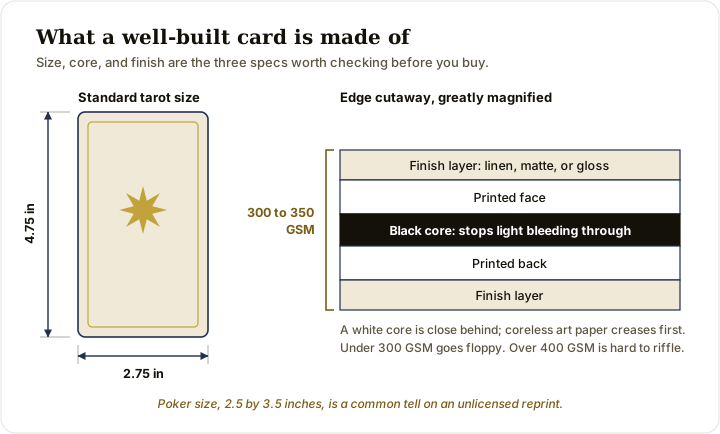
Three specs on the back of the box decide how the deck feels in your hands for the next decade. GSM is grams per square meter, the measure of how dense and heavy the paper is. The core is the inner opaque layer sandwiched between the printed front and back. The finish is the outer coating, the layer that decides whether the cards glide off each other or stick together.
| GSM band | Feel in hand | Shuffle | Who it suits |
|---|---|---|---|
| Under 300 (250-270) | Thin, flexible, floppy | Easy but creases fast | Almost no one; usually a cost-cut |
| 300 to 350 | Substantial, with a snap | Riffles comfortably | Most beginners and daily readers |
| 350 to 400+ | Hefty, premium, stiff | Hard to riffle; overhand shuffle only | Collectors, indie luxury editions |
GSM: aim for 300 to 350
Under 300 GSM is where you find the flimsy art-paper decks that crease within a month of daily use. The 300 to 350 band is the commercial sweet spot: rigid enough to give you that satisfying snap when you cut, flexible enough to let you bridge a riffle without bending the corners. Anything pushing 400 is gorgeous as an object, but most people quietly retire those to a shelf and end up reading from something thinner.
Black core vs white core vs coreless
A black core is the casino-grade build: an opaque layer that blocks light, hides the back artwork from showing through, and adds that distinct snap. White core is durable too, just slightly less opaque. Coreless or basic art paper is the cheapest construction and the first to crease at the edges. If the listing mentions a black core at 330 or so GSM, that is the dependable workhorse build.
Linen finish beats matte and gloss for shuffling
Linen finish is a subtle cross-hatched texture pressed into the surface; the tiny air pockets between cards make for a buttery glide and the best resistance to edge wear. Matte feels soft and reads with no glare, which is lovely for reading by candlelight, although heavy "soft-touch" or rose-petal finishes can get tacky and make cards stick in blocks. Glossy makes colour pop on day one but reflects overhead light and gets sticky as it picks up finger oils.
Standard sizing and why it matters for small hands
Standard tarot dimensions are 2.75 by 4.75 inches, taller and narrower than a standard poker card (2.5 by 3.5 inches). Oracle decks often go slightly larger, around 3.5 by 5 inches, since they carry fewer cards and can afford the room. If you have small hands, lean toward the 300 end of the GSM range and pick a linen finish; a 350 GSM full-size deck with a matte finish is the single hardest combination to riffle-shuffle.
Authenticity at a glance: the QR-code-instead-of-guidebook test
Approach authenticity as a buying lens, not a witch-hunt. Most listings on most platforms are genuine; the issue is a deceptive subset of unlicensed reprints that mostly cluster on third-party marketplace sellers. There is one fast test that catches almost all of them.
Authentic tarot and oracle decks almost always ship with a printed guidebook. That can be a small stapled "Little White Book", a full-colour softcover, or for premium editions a hardcover companion volume. What it is not, almost ever from a real publisher, is a QR code on the box that "links to the PDF guide." Beyond the obvious (you bought a deck and got handed a download link to a pirated PDF), security agencies have flagged "quishing", QR phishing, where scanned codes redirect to credential-stealing sites or trigger a malware download. If the listing says "scan QR code for instructions" or "PDF guidebook included," treat it as a no.
A handful of other quiet tells line up alongside that one:
- Box construction. Legitimate decks from publishers like US Games, Llewellyn, or Hay House, and most successful Kickstarter indies, come in sturdy two-piece rigid boxes or magnetic-closure book boxes. Reprints almost always use a thin cardboard tuck box, the kind a deck of playing cards comes in.
- Dimensions. A "tarot deck" listed at 2.5 by 3.5 inches has been shrunk to poker size to save on cardstock and printing plates. Real tarot is 2.75 by 4.75.
- Print quality. Reprints are usually rescanned from a finished deck rather than printed from the original digital files, so colours look faded or muddy and the line work sits very slightly out of register.
- Listing titles. Keyword soup like "Mysterious Tarot Future Telling Card", "English Board Game", or "Family Party Fate Board" is how unlicensed reprints surface in marketplace search.
Every legitimate publisher in this category makes products worth buying; the goal here is to recognise the deceptive copy, not to write off the category. For the wider pattern across decks, kits, candles, and crystals, see what to avoid.
Budget: what authentic decks actually cost
Knowing the real price band is the simplest defence against a "too good to be true" listing.
| Tier | Typical price | What you actually get | Good fit for |
|---|---|---|---|
| Mass-market standard | $18 to $25 | Original or radiant RWS, 300-350 GSM, paper guidebook, tuck or tin | Most first-time buyers |
| Recolour or specialty | $40 to $60 | Updated palette, upgraded finish, often a rigid box | Readers who want the classic with better art |
| Indie premium | $50 to $80 | Heavy 350+ GSM, linen finish, magnetic box, full art book | Repeat buyers, gift-grade decks |
A standard mass-market RWS lands roughly $18 to $25, and that is a completely legitimate first deck; nobody needs to spend $80 to start. Recoloured or specialty-finish editions of classic decks usually run $40 to $60. Premium indie decks with heavy 350+ GSM stock, linen finish, and a rigid magnetic box commonly fall in the $50 to $80 range. A "must-have" sold-out indie deck listed at $5 to $10 is almost never the real deck. Spending more is welcome where the merits actually warrant it, the same way a beautiful candle is welcome on the altar; the lie is the only enemy here, not the price tag.
Where to actually buy
Buy from the publisher direct, from the artist direct (especially for Kickstarter indies), or from a known bookseller. Marketplace third-party sellers are where unlicensed reprints concentrate, so the listing alone is not enough; check who is shipping it.
A note on AI-generated decks
This is worth covering not as a moral indictment but as a buying consideration, because it is changing what is on shelves right now. Practitioner communities have pushed back hard on the rise of AI-generated tarot and oracle decks for three repeating reasons. The first is intellectual property: image models train on copyrighted artwork without the original artists' consent, and the same independent illustrators already losing income to overseas reprints are the ones being scraped. The second is craft: the speed that lets a deck be assembled in a few weeks tends to skip the iterated symbolic intent that long-form deck-making usually involves; a real deck is the residue of someone's years of study, not a prompt log. The third is footprint: the compute required to run generative image models sits uneasily with the earth-conscious ethos many readers come in with.
You get to make this call on your own ground. If a listing's art reads as algorithm-generated and the creator does not say so, that is information you are allowed to use. The wider pattern of supplies built to look real and not be lives in what to avoid.
The five-minute checklist before you click buy
- Tarot (78-card system) or oracle (free-form prompts), based on the learning style you actually have.
- RWS-tradition art (classic or themed) if you want the biggest study library; another lineage only if you know what you are signing up for.
- 300 to 350 GSM, black or white core, linen finish.
- Standard 2.75 by 4.75 inches for tarot; printed guidebook included, not a QR code.
- Price sits in the legit band for the tier; sturdy box; bought from the publisher, the artist, or a known bookseller.
If all five line up, you are looking at a real deck that will hold up to years of shuffling. That is the entire job here.
What to read next
Once the choosing is settled, pair this with our honest deck picks for specific decks worth your money. If cards versus pendulum versus runes is still an open question, start with other divination methods for the wider menu or the head-to-head at pendulum vs runes. And if a first deck is part of a bigger pile you are assembling, witch starter kit and witchcraft for beginners cover the rest of the kit and the practice it sits inside.
Keep exploring
Browse more guides, or start with the basics of the practice you are curious about.
Browse more guides