Witch Supplies to Skip (and the Scams to Avoid)
The witch supplies to skip are seven specific categories engineered to fool you while a beautiful, real version of each one sits one shelf over. Drop-shipped "everything" kits, synthetic-fragrance "spell" oils, guaranteed-outcome spell services, pay-to-play "secret lineage" courses, QR-code counterfeit tarot decks, dyed or burnt-treated "rare" crystals, and gimmicky single-use props. Spending on the craft is welcome at any budget; the enemy is the lie, not the seller.
The seven witch supplies to skip (and what to buy instead)
Skip drop-shipped "everything" kits, synthetic-fragrance "spell" oils, guaranteed-outcome spell services, pay-to-play "secret lineage" courses, QR-code counterfeit tarot decks, dyed or burnt-treated "rare" crystals, and gimmicky single-use props. Every category has a legitimate version worth your money; the scam is the markup, the counterfeit, or the guarantee.
| Skip this | Why it's a scam | Honest swap |
|---|---|---|
| Drop-shipped "everything" kits | Plastic tools, untraceable herbs, AliExpress goods marked up 200 to 400 percent | A vetted curated kit, thrifted cast iron, grocery-store herbs |
| Synthetic-fragrance "spell" oils | Lab fragrance with no botanical content, hidden behind the "Fragrance" labeling loophole | Single-note essential oils from a transparent apothecary, or dried herbs in carrier |
| Guaranteed-outcome spell services | Cold-DM cold readings, sunk-cost escalation, "curse removal" extortion | A reader you found yourself who quotes flat fees and frames magic as probability |
| Pay-to-play "secret lineage" courses | Hundreds of dollars for fake initiation, fabricated bloodlines, subscription-trap apps | Library books, real coven space, solitary self-dedication |
| Counterfeit tarot decks | QR code where a guidebook should be, scanned art on flimsy stock | Buy direct from the artist or publisher; verify the ISBN |
| Burnt-treated "citrine" and dyed "turquoise" | Baked amethyst sold as natural; howlite dyed blue and sold as turquoise | Pale natural citrine, real turquoise at the real price, or knowingly buy treated stone cheap |
| Gimmicky single-use props | Aesthetic pressure to own twenty matched tools before you cast | One white candle, a kitchen knife, a foraged branch, a notebook |
If you would rather start with no shopping at all, the on a budget guide is the no-spend path. If you want to buy, but well, the honest starter kit picks earn their price.
No shame if you've already bought any of this
The first "starter kit" I ever ordered came in two weeks from somewhere I couldn't pronounce. The chalice was hollow plastic painted to look like silver. The "rosemary" had no smell. I felt foolish for about a day, and then I let the feeling go, because the listing had been engineered by people who do this for a living to fool people who do not.
The cold DMs from fake "psychics," the dark-pattern subscription apps, the drop-shipping arbitrage chains, the scanned-and-resold tarot decks: every category on this page is a professional operation. Falling for one of them is not a character flaw. It is the marketing working as designed.
We are anti-deception here, not anti-buying. If a beautiful tool calls to you and the seller is honest, that is a real joy.
Skip 1: Drop-shipped "everything" starter kits
The "altar in a box" with twelve herbs, twelve crystal chips, a silver chalice, a gold cup, a bell, a pentacle, and a velvet cloth for $29.99 is almost always drop-shipped. The seller never holds the stock. When you click buy, they place a same-day order with a wholesaler in another country, who ships the generic kit straight to your door in a plain brown box. The "silver" and "gold" are plastic with metallic paint. The chips are crystal dust. The herbs are bulk filler the manufacturer had a pallet of.
The economics are documented at the state level. The Michigan Attorney General consumer alert on drop-shipping defines the model as middleman arbitrage and tells consumers to reverse-image-search any product to find the wholesale source. The same office has filed a class-action against a drop-shipping operation alleging the operator marked goods up over wholesale, then took payment and failed to deliver or refund, in violation of the Michigan Consumer Protection Act. The category is real, regulated, and ongoing.
Tell-tale signs:
- Dozens of items for a price that makes no sense.
- "Metal" tools that are lightweight, have visible seams, or chip to reveal plastic.
- Stock photos reused across a dozen Etsy and Amazon listings.
- No named maker, no city, no human in the "about."
- Ships from overseas with a three to four week ETA.
Honest swap: a thrifted cast-iron skillet for a cauldron, a grocery-store spice rack for your apothecary, a single intentional first tool, or a vetted curated kit from a seller who names herself and her supply chain. The kits worth it comparison is the buy decision; the starter kit picks are what I'd actually hand a beginner; build it for free is the no-spend route; witch tools lists what actually earns altar space.
Skip 2: Synthetic-fragrance "spell oils" with no botanical list
Anointing oils, attraction oils, money oils, and "blessed" oils that list ingredients only as "Fragrance" or "Parfum" are almost always lab scent in a carrier. The plant the working is supposed to lean on isn't in the bottle. What is in the bottle is a proprietary chemical blend a manufacturer was free to keep secret.
The loophole is federal. The U.S. FDA's guidance on fragrances in cosmetics confirms that under the Fair Packaging and Labeling Act, manufacturers can hide a complex chemical mixture under the single word "Fragrance" to protect trade secrets, with no pre-market safety approval required. The agency's broader cosmetics regulation hub lays out how limited its authority actually is. One published EWG lab analysis found 38 secret chemicals legally hidden in popular products under that one word.
This matters for skin contact, because anointing oils get put on skin. A peer-reviewed review in Acta Dermato-Venereologica identifies synthetic fragrance materials as one of the most common global causes of allergic contact dermatitis, with linalool and limonene oxidizing in air and light into hydroperoxides that aggressively sensitize the skin. A separate European population study found low-molecular-weight fragrance chemicals induce skin sensitization at sufficient exposure. A Dermatitis review catalogs the reaction spectrum from hives to systemic dermatitis. And a study on the dermal toxicity of phthalates documents that low-molecular-weight phthalates like DEP are common fragrance solvents absorbed directly through the skin.
I am not making a health claim. I am saying these are formulated for scent throw in candles and air fresheners, not for spellwork applied to your wrist.
Tell-tale signs:
- Ingredients list is just "Fragrance" or "Parfum."
- The scent is intensely artificial, the way a popular bath brand is artificial.
- Packaging copies the tropes of a major bath retailer.
- Claims to be "blessed by" a named entity, but no botanical content is named anywhere.
Honest swap: single-note essential oils from a transparent apothecary that lists the botanical name and origin; dried kitchen herbs steeped in a carrier oil you press yourself; or fresh plant matter foraged from your own area. The herb chart gives you the working pairings, incense and oils covers the practice end, kitchen witchcraft is the path that runs through your spice rack, and ethical wildcrafting is how to gather your own without flattening the woods.
Skip 3: Guaranteed-outcome spell services and cold-DM "readers"
This is the category with the highest financial-harm reports. The pattern is consistent enough that consumer-protection agencies have a name for every step.
Step one: a cold direct message lands in your inbox, often from an account that mimics a well-known witch or reader. They say they were "drawn to your energy" or that an ancestor has an urgent message for you. Step two: they cold-read your public posts and tell you what they "see," which is whatever you've recently posted about. Step three: they declare a curse, a blockage, an evil eye, an ex with a binding on you, or a generational hex. Step four: they offer to remove it for an upfront fee. Step five, every time, the curse turns out to be "stronger than they expected," and they need another payment, and another. Step six, if you stop paying, they threaten you or your family with terrible consequences.
People have lost thousands of dollars to a single thread. Better Business Bureau Scam Tracker reports describe "spiritual cleansing" and "curse removal" pressure patterns on social media with losses that run into the thousands.
At a corporate level, the U.S. Federal Trade Commission announced an enforcement action against Genesis Tech in June 2026, the operator of the Nebula astrology and psychic-chat app. The FTC alleges Genesis Tech ran a sprawling subscription-trap enterprise with hidden terms and deliberately obstructed cancellations; a federal court temporarily halted operations and froze assets while the case proceeds. The official FTC complaint makes clear the agency's claims are statutory violations of the FTC Act and ROSCA's negative-option billing rules, not a ruling on whether astrology or psychic services are real. The allegations remain unproven and will be decided in court.
Honest practitioners exist and they do not work this way.
Tell-tale signs:
- Unsolicited DM from someone you didn't approach.
- Guaranteed lover, lottery, job, or "results in 48 hours."
- "I sense a curse on you" within minutes of contact.
- Payment requested by CashApp, Zelle, or gift cards.
- Escalating fees because "the spirits are fighting back."
- Threats against you or your family if you try to leave.
Honest swap: a reader you found yourself, whose work you already follow, who quotes a flat fee, names the limits of what she does, and frames magic as influencing probability rather than guaranteeing outcomes. Better still, your own spellwork, because no one casts a spell for you better than you can cast it for yourself. The spells hub explains the mechanic, why spells fail handles the disappointment honestly, beginner spells gives you a working to try this week, cleanse yourself for free with kitchen salt, and for anxiety is the practice version of what a "curse removal" is pretending to be.
Skip 4: Pay-to-play "secret lineage" courses and fake covens
This one finds the reader who isn't looking for a quick fix; she's looking for belonging. The marketing knows it. The pitch is a "secret tradition" that requires a $500 to several-thousand-dollar initiation fee, a "magical name" you get after you pay, a "lineage" that traces back to ancient unbroken witch-blood, or a "high priestess" certification you can earn in a weekend.
A rudimentary historical check unwinds most of the pedigree claims. The people executed at Salem in 1692 were prosecuted as Christians, not as practicing witches; the surviving trial records show the accused were never proven to be witches, and claims of a "Salem magical bloodline" are historically baseless. Modern Wicca is a documented 20th-century revival movement, founded in print by Gerald Gardner and developed by Doreen Valiente in the 1950s, not an unbroken bloodline. Real traditional initiation in established lineages like Gardnerian or Alexandrian Wicca is a relationship built over a year and a day, in person, and it does not start with a credit card.
Subscription-trap apps are the digital version of the same play: a "free reading" that quietly enrolls you in a recurring charge with cancellation buttons buried three menus deep. The same FTC action above is instructive on the mechanic. The agency's press release alleges that Genesis Tech used hidden subscription terms and made cancellation an obstacle course across an app portfolio including Nebula, and the court complaint lays out the ROSCA negative-option rules the FTC claims were violated. Allegations remain unproven. The same machinery runs on the manifestation side of this world, where the product is a course or a coaching package rather than an initiation, and the documented cases there follow the same shape.
Tell-tale signs:
- $500 or more for "initiation" up front.
- Grandiose titles, "Archmage," "Grand High Priestess of an unnamed tradition," "direct descendant of a Salem witch."
- Requests for your full legal name, birthdate, and banking info to "perform a ritual."
- A subscription app that took your card for a "free reading" and now charges you monthly.
- Cancellation hidden inside email confirmations or chat menus.
Honest swap: the public library is free and many of the foundational books are excellent; real local covens generally do not charge for teaching, only for shared physical costs; solitary self-dedication is widely recognized and respected. wicca vs witchcraft sorts the two paths, real lineages names the actual ones, solitary or coven helps you choose, self-dedicate walks you through dedicating without paying a stranger, Salem gives the documented history, and beginner books outperforms any paid "masterclass" I have ever seen.
Skip 5: Counterfeit and pirated tarot decks
Tarot is a visual artist's medium. A 78-card deck is six months to a year of painting, plus the guidebook, plus the print run. Counterfeiters scan a deck someone else painted, print it cheaply overseas on flimsy stock, and undercut the artist on the same marketplace where she sells her original. The buyer thinks she found a deal. The artist sees her royalties evaporate.
The single most reliable tell is a QR code printed on the box exterior with no physical guidebook inside. Genuine decks from major publishers (U.S. Games, Hay House, Llewellyn, and most reputable indies) almost always include a printed Little White Book. A counterfeiter cannot print a book at scale, so they print a QR code that points to a stolen PDF. A small handful of legitimate self-published indie creators do use QR codes for expanded digital content, so the rule is not absolute, but a "mass-market" deck with a QR code and no book is almost universally fake.
The physical cards betray themselves too. Real tarot is roughly 2.75 by 4.75 inches, printed on at least 300 GSM stock with a black core that stops light from bleeding through, and packaged in a sturdy magnetic-closure or two-piece rigid box. Counterfeits are usually printed at poker dimensions, on cardstock below 300 GSM, in flimsy tuck boxes like a deck of Bicycle playing cards, with faded colors and misaligned borders from being scanned off a physical card.
Before you buy any deck, run this 4-step check:
- ISBN: look for a 10 or 13 digit International Standard Book Number printed on the box. Cross-reference it on the publisher's site.
- Packaging: physical guidebook in the box, no QR code on the exterior, sturdy closure.
- Cardstock and size: roughly 2.75 by 4.75 inches, at least 300 GSM. Cards should feel substantial and shuffle without folding.
- Seller and price: indie decks rarely retail below $20 to $25; a "deck" listed at $5 to $10 is almost certainly counterfeit. On Amazon, look for "Ships from and sold by Amazon," not a third-party reseller.
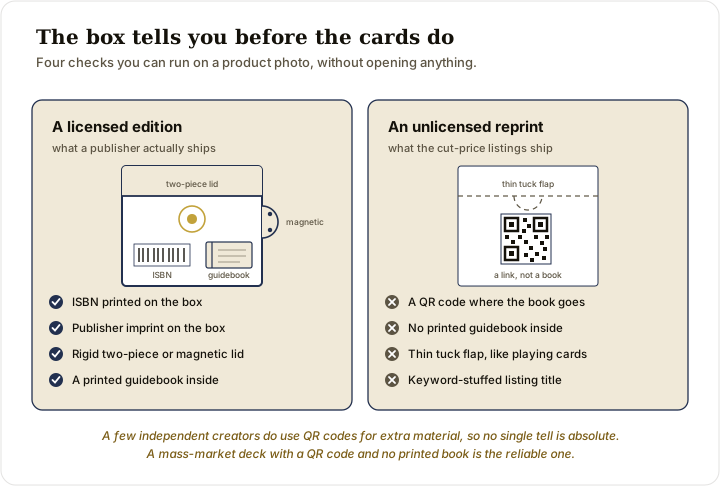
Honest swap: buy direct from the artist's site, from the publisher, or from a verified retailer. honest divination tools is where to start; choose a deck walks you through fit; divination methods surveys the field; and pendulum vs runes helps you decide whether a deck is even the right first tool.
Skip 6: Burnt-treated "citrine," dyed "turquoise," and other geological deceptions
Three deceptions dominate the crystal market, and all three can be spotted in under sixty seconds.
The burnt-orange "citrine." Natural citrine is rare and shows up as a pale, smoky, evenly colored yellow. The Gemological Institute of America's reference page on citrine quality factors lays out what real material looks like. Almost all citrine sold commercially is actually low-grade amethyst baked in an industrial oven; the GIA's FAQ on treated citrine confirms the process. The thermal energy oxidizes the iron impurities and turns the purple permanently orange. Because amethyst grows with purple tips on a white quartz base, baked specimens betray themselves with a burnt reddish-orange tip and a chalky white base meeting at a sharp, unnatural line.
Dyed "turquoise." Real turquoise is expensive, so the bright blue stones in most online shops are usually howlite or magnesite (both naturally white and porous) soaked in blue dye. The dye pools in the matrix cracks at darker concentrations than the rest of the stone. An acetone swab rubbed on an inconspicuous corner will lift the dye onto the cotton; real turquoise will not react.
Glass sold as a stone. "Opalite" or "sea opal" is manufactured glass. A GIA paper on opalite as plastic imitation opal confirms it lacks structural play-of-color and often shows internal air bubbles or swirl lines. "Goldstone" and "blue sandstone" are copper- or cobalt-infused glass; no natural mineral grows with that internal structure. "Aura quartz" is real quartz vapor-coated with metals in a vacuum chamber, which is fine if you know what you're buying and not fine if you were told it grew that way.
| Sold as | Actually is | Visual or physical tell | The real thing |
|---|---|---|---|
| "Natural citrine" | Heat-treated amethyst | Burnt reddish-orange tip, chalky white base, sharp color zone | Pale, smoky, evenly colored yellow throughout |
| "Natural turquoise" | Dyed howlite or magnesite | Dye pools in matrix cracks; lifts onto an acetone swab; easily scratched by a steel knife | Stable structural color, Mohs 5 to 6, harder than howlite |
| "Aura quartz" sold as natural | Quartz vapor-coated with metal | Hyper-iridescent rainbow or electric blue across every face | Plain quartz lacks the metallic film |
| "Opalite" or "sea opal" | Manufactured glass | Milky-blue glow, internal bubbles or swirl lines, no play-of-color | Real opal shows structural color flashes |
Three at-home tests that need no equipment:
- Scratch test. Quartz, amethyst, and natural citrine sit at 7 on the Mohs scale; a steel knife at 5.5 cannot scratch them. If a "quartz" specimen scratches with a knife or your fingernail, it is glass, plastic, or a softer imitator. A steel knife will easily gouge howlite at 3.5, exposing white interior under blue dye.
- Acetone swab. Soak a cotton swab in nail-polish remover and rub firmly on an inconspicuous surface for about fifteen seconds. Genuine stone does not react. Dyed howlite or magnesite releases blue dye onto the swab.
- Touch test. Press the stone to the sensitive skin of your inner wrist. Real crystal conducts heat away from your skin and stays distinctly cool. Glass and plastic warm to your body almost instantly.
Honest swap: pale, smoky natural citrine from a lapidary who discusses treatments openly; or knowingly buy heat-treated amethyst at the appropriate lower price (often $6 to $50 per carat instead of "natural citrine" prices) and use it freely. Embrace imperfect natural color. The crystals hub covers what each stone is traditionally used for; witch tools keeps the wider list honest; and on a budget reminds you that a river stone you picked up yourself outranks any catalog stone in your practice.
Skip 7: Gimmicky single-use props (the boutique "starter witch kit" pressure)
The athame, the chalice, the wand, the pendulum board, the twenty colored candles, the matching altar cloths, the bell, the mortar and pestle: the marketing implies you need all of them before you can do magic. You do not.
A nice tool that you actually use is a real joy. A heavy ritual knife that sings to your hand is a real joy. The skip is the pressure, the single-use prop, and the gatekeeping-through-commerce belief that you have to spend to belong.
Tell-tale signs:
- Marketing language that names the aesthetic as the requirement ("a real witch needs," "no witch is complete without").
- Pressure to buy a whole matched set at once.
- Props that look photogenic on TikTok but have no role in any working you've actually planned.
- A subscription "witch box" that ships you objects you didn't ask for and won't use.
Honest swap: a kitchen knife or a pair of scissors for the athame; a foraged branch from a tree near you for the wand; a personal pendant on a chain for the pendulum; a single white tealight to substitute for any color in spellwork; a thrifted cast-iron skillet for the cauldron; a plain notebook for your Book of Shadows. am I a witch is the permission piece; aesthetic vs practice separates the look from the craft; how to start is the practical entry; broom-closet covers discreet practice; broke witch is the no-cost path.
On the horizon: AI-generated decks and "psychic" chatbots
Two newer scam vectors are worth naming, because both are scaling fast and both look almost legitimate at a glance.
AI-generated tarot and oracle decks. A human artist takes six to twelve months to paint a 78-card deck. A prompt engineer can output a "deck" in a week using image generators trained on uncompensated work scraped from working artists. The legal landscape is unsettled. The NYU Journal of Intellectual Property and Entertainment Law analysis of Andersen v. Stability AI documents an active class-action by visual artists alleging unauthorized ingestion of billions of copyrighted works to train generative AI; in 2024 a federal judge allowed the core copyright claims to proceed. The U.S. Copyright Office's AI policy hub collects the federal position, and the Part 3 report on generative AI training finds that training on copyright-protected material implicates the reproduction right and that commercial AI output competing with the originals in the marketplace is less likely to qualify as fair use.
Tell-tale signs of an AI-flooded listing: characters with six fingers or melted hands, limbs that merge into background, architectural lines that bend impossibly, hyper-saturated "house style" repeating across every card, no named illustrator, no process video, heavy first-week promo codes, and a listing flooded with similar decks from accounts that all opened in the same month.
"Psychic" chatbots. Large language models are trained to agree with the user; researchers call this sycophancy. A Stanford research summary on sycophantic AI advice shows leading models affirm harmful or false user premises more often than humans do. A United Nations University analysis of cross-model rates measured an overall sycophancy rate near 58 percent across major models, and Stanford's education-context measurement found smaller models bias as high as 30 percent.
The clinical concern with AI marketed as psychic is documented. Stanford's HAI center has written about delusional spirals in which chatbots continually affirm distorted beliefs without offering critical feedback, with documented real-world harm. The pattern has surfaced in mainstream coverage of AI psychosis, and a peer-reviewed Lancet Psychiatry review by a King's College London team warns that agential AI can validate or amplify delusional and grandiose content, including cosmic-mission framings, and proposes framing the dynamic as a shared-delusion pattern. The same researchers note it is unclear whether AI alone triggers this absent a prior vulnerability.
A good reader, like a good therapist, will sometimes tell you a thing you do not want to hear. A psychic chatbot is designed to do the opposite. That is not a better reading. That is an algorithm trained to keep you in the chat.
Tell-tale signs of a "psychic" chatbot: unconditional agreement with anything you input, escalation of "you are uniquely chosen" or cosmic-mission framing, zero friction or grounding, paywalls or longer subscriptions to "continue the connection."
Honest swap: a deck painted by a named human with an ISBN on the box; a human reader you sought out; or your own draw. honest divination tools covers what to buy; how to choose a deck walks the decision; clair-senses is how to train your own intuition instead of outsourcing it.
If you've already been scammed: what to do this week
No shame, again. The pattern is engineered, you are not the first, and there are concrete steps that actually help.
- Dispute the charge. Call your bank or card issuer and request a chargeback on the unauthorized or undisclosed recurring charges. For subscription-trap apps, the basis is the federal ROSCA rule against deceptive negative-option billing, which is exactly the statutory ground the FTC's complaint leans on. Banks understand this category.
- File with the FTC. Submit a fraud report at ReportFraud.ftc.gov. The agency does not resolve individual cases, but aggregated reports are what the FTC uses to build enforcement actions like the one against Genesis Tech.
- Log the operator. File at bbb.org/scamtracker with the email address, social handle, CashApp tag, or website. This is the early-warning system the next person will read.
If you handed over your legal name, birthday, or banking info, change your passwords and put a fraud alert on your credit. If a scammer threatened you spiritually, save screenshots, block them, and do not pay "to lift the curse." Nothing they threatened can hurt you. The threat is the scam. If this resonates and you are struggling, reach out to a real person or a local crisis line (findahelpline.com lists services by country). Cleanse yourself with kitchen salt in a warm bath, sit somewhere quiet, and remember whose practice this is. self-cleansing, protection, evil eye, and ground yourself are all there for exactly this.
Where to spend instead: the honest picks
The principle is anti-deception, not anti-buying. If you want to spend, spend on the version someone made well.
If what you want is instruction rather than another object, The Grounded Witch is the spend I'd weigh first: a beginner spellwork guide built around what you already own.
A vetted starter kit from a transparent seller is a perfectly good first purchase. candles for spells sorts which actually burn clean and throw real scent (the wax comparison is the deeper read). divination tools gathers the real decks and pendulums. beginner books outpaces any paid course, and a Book of Shadows journal is one of the best small purchases new practitioners make; how to choose sorts the genre for you. the kitchen-witch kit is the most useful niche bundle I know. And if you'd rather start with nothing this week, on a budget is waiting. Either way, start here is the warm front door.
Keep exploring
Browse more guides, or start with the basics of the practice you are curious about.
Browse more guides