What Is Paganism? Pagan vs Wiccan vs Druid
If you came here asking what is paganism, you're probably trying to put a single shape onto something that doesn't have one. It's a category, not a creed, and the people inside it disagree about almost everything except that the world is alive and worth loving. You don't need a checklist to be curious about it, and you don't need to pick a path before you understand the map.
So, what is paganism?
Paganism is an umbrella term for modern earth-centered, polytheistic, and animistic spiritual paths, including Wicca, Druidry, Heathenry, reconstructionist traditions like Hellenism and Kemetism, and freely blended eclectic practice. They draw on the pre-Christian religions of Europe, North Africa, and the Near East. It's a category, not a single religion.
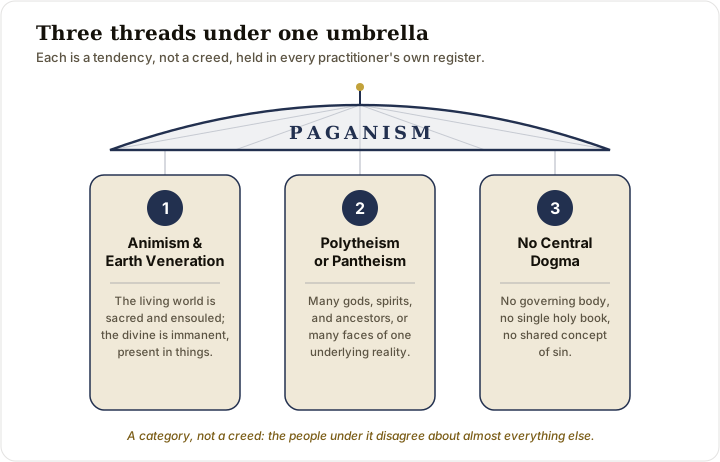
Three threads tend to run through nearly all of it:
- Animism and earth veneration. The natural world is treated as sacred and ensouled.
- Polytheism or pantheism. Many deities, nature spirits, and ancestors, sometimes seen as distinct beings, sometimes as faces of one underlying reality.
- No central dogma. No governing body, no single holy book, no universal concept of sin.
The word "modern" is doing real work here. What most people mean by paganism today is more precisely Neopaganism, a 20th-century revival, not an unbroken line back to the ancients. That honesty matters.
If you arrived because you're trying to untangle religion from craft (witchcraft as a practice, paganism as a worldview), that split has its own page in wicca vs witchcraft.
Where the word comes from (and why it stopped being an insult)
The word "pagan" has had three lives: a plain Latin descriptor, a Christian slur, and a 1960s reclaimed identity.
From paganus to "country dweller"
The English "pagan" comes from the Latin paganus, originally a country dweller or villager, from pagus, a rural district marked off by boundary stones. As Christianity spread through the Roman Empire after Constantine in the 4th century, it took hold first in the cities. Rural populations, further from the political pressure of the urban centers, held onto older polytheistic and animistic practices much longer. Paganus drifted into shorthand for "the religion of the peasantry."
There's a parallel reading worth knowing. In Roman military slang, a paganus was a civilian, a non-combatant. Early Christians liked to style themselves as miles Christi, soldiers of Christ, armored up for a spiritual fight. By that frame, anyone not baptized into the army was just a civilian.
A small aside that helps the picture: the word "heathen" walked the same road, from a Germanic root meaning "heath dweller," someone living out on the wild, uncultivated heath.
From slur to exonym
Through the Middle Ages and well into the modern era, "pagan" and "heathen" were exonyms, the labels outsiders apply rather than names a group chooses for itself. Carried along with them were connotations of hedonism, irreligion, and savagery. Ancient Greeks, Romans, and Celts never sat down and called themselves pagans; Christians called them that.
That's worth holding for a second. For most of its life, "pagan" was an othering word, doing the work of pushing whole peoples and their gods out of the room.
The 1960s reclamation
The word turned again in the late 1960s and 1970s. Romanticism, ecological awareness, and feminist spirituality were braiding together, and small groups started taking the slur and wearing it on purpose. The Church of All Worlds, founded by Oberon Zell-Ravenheart in 1967, and publications like Green Egg began using "Pagan" and "Neo-Pagan" as proud self-descriptors. The pejorative became a banner.
This is a genuine reclamation, not the recovery of an unbroken ancient lineage. The historian Ronald Hutton, in The Triumph of the Moon, walks this trajectory in detail, framing modern Pagan witchcraft as a real new religious movement rooted in 19th-century Romanticism and Victorian ceremonial magic rather than a survival from antiquity. The honesty about that origin story is part of why you can trust the rest.
What modern pagans tend to share
Across all the disagreements, three commitments come up over and over. Each is a tendency, not a creed, and practitioners hold them in their own register.
Animism and earth veneration
The natural world is treated as sacred and ensouled. The divine is held to be immanent, present within the world, rather than purely transcendent and separate from it. A river, a stand of trees, a stone, a season can each be approached as a kind of presence rather than just a resource. For many people this is the doorway in: an ache for a relationship with the living world that the surrounding culture doesn't have language for.
Polytheism or pantheism
Most pagan traditions recognize many divine beings: gods of named pantheons, nature spirits, ancestors, household guardians, spirits of place. How those beings are understood varies. Hard polytheists hold the gods as genuinely distinct persons. Soft polytheists or pantheists tend to see them as faces of one underlying reality. Some pagans are nontheistic and treat the gods as living symbols. The umbrella holds all of that without arguing the metaphysics.
No central dogma, no single book
There's no governing body, no universal scripture, no shared concept of sin. The emphasis falls on personal experience, on sovereignty, and on practice over orthodox belief. For readers coming out of high-control religious backgrounds, this is often the thing that lets the shoulders drop. There is no one keeping a ledger on you.
The major paths under the umbrella
Under the umbrella, traditions sit on a spectrum. At one end are strict historical reconstructions (Heathenry, Hellenism, Kemetism, Religio Romana, Rodnovery) that lean hard on archaeology and surviving texts. At the other end is eclectic practice, which blends freely from many sources based on what genuinely works for the practitioner. Most paths sit somewhere along that line.
| Path | Core theology | Primary ritual focus | When the modern form emerged |
|---|---|---|---|
| Wicca | Dualistic Goddess and Horned God, nature-venerating | Esbats (moon cycles), Sabbats (the Wheel of the Year), circle work | Mid-20th-century England |
| Druidry | Pantheistic, animistic, tied to land spirits | Bardic arts, philosophy, outdoor grove ritual | Modern form: 1964 onward (with 18th-19th-c. roots) |
| Heathenry | Polytheistic Norse and Germanic pantheon | Blót offerings, community oaths, ancestral honor | 1970s |
| Reconstructionist | Polytheistic, specific to region (Greek, Egyptian, Roman, Slavic) | Historical orthopraxy, daily home shrine devotions | Late 20th century |
| Eclectic | Intuitive, individual, syncretic | Personalized blends of magic, divination, and pantheons | Late 20th century, North American counterculture |
Wicca
Wicca is the most publicly visible of the modern pagan paths and the one whose ritual architecture quietly shaped much of the rest. It came into the open in mid-20th-century England after the 1951 repeal of the 1735 Witchcraft Act, an antiquated law that had made claiming magical powers illegal. With that legal pressure lifted, Gerald Gardner published Witchcraft Today in 1954 and The Meaning of Witchcraft in 1959. He worked closely with his High Priestess Doreen Valiente, often called the Mother of Modern Witchcraft, who rewrote much of the early ritual material and authored the "Charge of the Goddess," still the principal devotional text of Wiccan spirituality.
Theologically, traditional Wicca is dualistic: a Goddess associated with the moon, the earth, and fertility, and a Horned God associated with the sun, the wild, and the harvest. Ritual structure tends to involve casting a circle, invoking the four classical elements, and observing two overlapping calendars: Esbats (the moon cycles) and the eight Sabbats of the Wheel of the Year.
About the history: Gardner claimed he'd been initiated by a surviving coven of ancient witches in the New Forest. Historians, Hutton in particular, now widely view that as an invented tradition. What Gardner actually did was synthesize a creative, undogmatic nature religion out of folklore, Freemasonry, and ceremonial magic. That makes Wicca a genuine new religious movement, not an ancient survival, and naming that openly is more interesting than the older lineage claim ever was.
For more on the religion-versus-craft split, see wicca vs witchcraft; for the family of lineages (Gardnerian, Alexandrian, Dianic, Eclectic), see wiccan traditions; for the calendar, the wheel of the year; for the central rite, drawing down the moon; for the ethics, the wiccan rede.
Druidry
Modern Druidry is less a magical religion than a philosophical and ecological path inspired by the priestly caste of the ancient Celtic tribes. Isaac Bonewits offered a useful three-phase frame for it. Paleo-Pagan Druidry is the original pre-Christian Celtic priesthood. Meso-Pagan Druidry is the 18th- and 19th-century Romantic revival, often blended with Christianity and Freemasonry. Neo-Pagan Druidry is the contemporary movement working to strip the Christian overlay and return to polytheistic, animistic ground.
In practice, modern Druids tend to emphasize reverence for nature, the bardic arts (poetry, music, storytelling), and ritual conducted outdoors in groves rather than indoor temples. Two organizations anchor much of the contemporary scene. The Order of Bards, Ovates and Druids (OBOD), founded by Ross Nichols in the UK in 1964, is philosophical and ecumenical, structured around three grades of study and open to members of varied religious backgrounds, including Christian Druids. Ár nDraíocht Féin (ADF), founded by Bonewits in the US in 1983, is strictly Neopagan and reconstructionist, with a strong emphasis on scholarly rigor.
This is also why "are all Druids pagans?" doesn't have a clean yes. A Christian Druid lineage genuinely exists, and Druidry sits a little astride the umbrella's edge. For the deeper branch detail, see celtic and norse paths.
Heathenry (Ásatrú)
Heathenry, which formalized as a movement in the 1970s, revives the religion of the Norse and Germanic peoples: Odin, Thor, Freyja, Tyr, the wider Aesir and Vanir. It differs sharply from Wicca in method. Heathens lean on textual sources like the Eddas, on archaeology, and on anthropological work to reconstruct authentic ancient worldviews rather than building intuitively. The central ritual is the blót, an offering of food, drink, or mead to the gods, to wights (local land spirits), or to the ancestors. Community, ancestry, and personal honor matter as much as theology.
Heathenry carries a real socio-political schism that a curious reader needs to know about. Universalist or inclusive Heathens, including groups like the Alliance for Inclusive Heathenry, hold that the Norse gods can call anyone to their worship regardless of background. Folkish sects, promoted by figures like Stephen McNallen and his concept of "metagenetics," argue that Heathenry is intrinsically tied to a "biologically distinct" Northern European race; their symbols have been openly co-opted by far-right groups. Tribalists try a middle path through formal cultural adoption rather than genetics. The scholar Jefferson Calico has done some of the most careful ethnographic work on these tensions inside American Heathenry. If you're stepping into the Heathen world, do yourself the kindness of knowing which kindred you're walking into.
For the branch deep-dive, see norse paganism.
Other reconstructionist paths
Beyond Heathenry, the reconstructionist impulse has built several other paths worth knowing by name.
- Hellenism revives the religion of ancient Greece, with worship of the Olympian and chthonic gods through reconstructed festivals and household devotion. It sits as a sibling tradition to the others.
- Kemetism revives ancient Egyptian religion. Its central principle is Ma'at, the goddess and the concept of truth, justice, balance, and cosmic order, symbolized by an ostrich feather. The deities (Netjeru) include Ra, Amun, Isis, Osiris, Thoth, Sekhmet, Bastet, Hathor, Set, Ptah, and Anubis. Daily practice often centers on a home shrine, where statues are awakened, purified, and offered water, bread, beer, or wine. The movement splits between strict reconstructionists, syncretic Greco-Egyptian practitioners, and the more structured Kemetic Orthodoxy.
- Religio Romana reconstructs the religion of ancient Rome and is highly orthopraxic, meaning correct action matters more than internal belief. Its guiding principles are Pax deorum (maintaining peace with the gods) and Mos maiorum (the custom of the ancestors), and its mechanism is Do ut des, "I give so that you might give." Practitioners maintain a lararium, a household altar, honoring the lares, penates, and genii loci, with daily offerings of wine, milk, or honey. Organizations like Nova Roma reconstruct civic festivals alongside the private household rites.
- Rodnovery, the Slavic Native Faith, centers a pantheistic supreme principle called Rod, expressed through more than thirty deities including Perun, Veles, Mokosh, and Svarog. Its primary symbol is the kolovrat, a solar wheel. Major festivals include Kupala, Koledo, and Maslenitsa. It draws on archaeology, folklore, and (sometimes contested) texts like the Book of Veles.
What unites these is method. Reconstructionists define themselves partly in contrast to eclectic and Wiccan practice, prioritizing what can be historically attested.
Eclectic paganism
Eclectic paganism is the most widely practiced form in North America. Its defining ethos is that personal experience supersedes inherited orthodoxy: the practitioner is the ultimate arbiter of what belongs in the practice. A typical eclectic might keep an altar for a Greek goddess, observe Celtic seasonal markers, read tarot, and work with herbs from her own region, weaving these strands into something coherent for her.
The reality of eclectic paganism is most visible at pan-Pagan public gatherings, most notably Pagan Pride Day. Launched in San Francisco in 1992 and typically held around Mabon (the Autumn Equinox), these decentralized festivals bring Wiccans, Druids, Heathens, and Eclectics into the same physical space for shared public ritual, food drives, and community education. If you ever wondered what a working pagan ecosystem actually looks like, it looks like a field of people who disagree about theology sharing bread and a drum circle.
For adjacent witchcraft styles that often overlap with eclectic practice, see types of witches.
Pagan vs Wiccan vs Druid vs Witch (the four words people mix up)
These four words sit at different levels rather than in opposition. Once you see the levels, the confusion mostly dissolves.
| Term | Category | Plain definition | Relationship to paganism |
|---|---|---|---|
| Paganism | Meta-religion | The umbrella for earth-centered, polytheistic, animistic spiritualities | The overarching category |
| Wicca | Specific religion | A mystery religion centered on the Goddess, the Horned God, and the Wheel of the Year | A path under the umbrella; all Wiccans are pagans, not all pagans are Wiccans |
| Druidry | Philosophy / religion | A path centered on Celtic nature reverence, bardic arts, and ecological balance | Mostly pagan, with a minority Christian Druid lineage |
| Witchcraft | Practice / craft | Folk practice: herbalism, spellcraft, divination, ritual | Distinct from religion; practiced by pagans, atheists, Christians, and others |
Pagan vs Wiccan
This is the most common conflation, and the relationship is strictly hierarchical. Paganism is the umbrella. Wicca is one specific religion under it, with a Gardner-rooted ritual structure, a dualistic Goddess and Horned God theology, and the eight-fold Wheel of the Year. All Wiccans are pagans by definition. Most pagans are not Wiccans. A Hellenist, a Heathen, or a Religio Romana practitioner is fully pagan and would firmly decline the label "Wiccan" because they don't share its theology, its ritual structure, or its lineage.
For the three-way comparison with witchcraft layered on top, see wicca vs witchcraft.
Pagan vs Druid
Most modern Druids are pagans, but not all. A real Christian Druid lineage exists, often associated with OBOD's openness and with Celtic Orthodox currents, where Druidry is treated as a philosophical and ecological adjunct to Christian faith rather than as its own religion. So Druidry straddles the umbrella's edge rather than sitting cleanly inside it. Asking a Druid which side of that line they're on is the polite question.
Pagan vs Witch
This is the one to get clearest. Paganism is a religion, a worldview about the divine, the world, and the relationship between them. Witchcraft is a craft: herbalism, spellwork, divination, folk practice. A person can be one, both, or neither. Secular witches, atheist witches, and Christian witches all exist and practice folk magic without taking on pagan polytheism. Plenty of pagans, especially traditional Hellenists and reconstructionist Heathens, don't practice witchcraft at all, viewing it as irrelevant to the historic veneration of their gods.
For the religion-versus-craft deep-dive, see religion vs craft. For craft without religion, secular witchcraft. For another nonreligious magical path, chaos magic.
A few myths to clear out
A handful of stubborn pop-culture pictures get in the way. Worth naming and setting aside.
Pagans don't worship Satan
Satan is an Abrahamic figure, native to the Judeo-Christian-Islamic story of the world. Pagan theology operates outside that story entirely; there's no role for a fallen angel of the Christian cosmology in a Heathen blót or a Kemetic shrine. LaVeyan Satanism, founded by Anton LaVey through the Church of Satan in 1966, is a separate movement again: an atheistic philosophy that uses Satan as a literary archetype for defiance and individualism, not as a literal deity. Three different things, often mashed together by people who haven't looked at any of them.
No human or animal sacrifice
The horror-film image (think The Wicker Man or Midsommar) is fiction doing what fiction does. Modern pagan offerings are food, drink, and words: bread, mead, wine, water, herbs, poetry. The point of an offering is reciprocity, not violence.
Magic isn't Harry Potter
In pagan and witchcraft contexts, magic is treated as focused intent, ritual, symbolic action, and inner change paired with outward action. It looks more like prayer plus craft than special effects. She lit the candle for the new job, and she also sent the application; the call came two days later. That pairing, magic plus action, is how the work tends to actually move. For the mechanism in more detail, see how spells work.
Is paganism for you?
If you're drawn to the natural world as sacred, to many gods or none at all, to ritual that's yours to shape, you're already in the conversation. There's no membership card. Reconstructionists go deep into one historical pantheon; eclectics weave from many; some pagans practice witchcraft daily, plenty don't touch it.
It also helps to know where you sit on the belief question, and to know all the positions are welcome here. Some pagans hold these gods, spirits, and energies as literal beings acting on the world. Others approach the same practices as something that changes the practitioner: the ritual is real because it does real work on you, regardless of what's metaphysically true behind it. The umbrella covers both, and most working practitioners hold a little of each on different days.
If you need to hear it: curiosity is enough. You don't need a tradition, a teacher, or a kit to begin reading, sitting with the season, or paying attention to your own pull.
Take it at your own pace, and let the path show itself the way the seasons do.
Keep exploring
Browse more guides, or start with the basics of the practice you are curious about.
Browse more guides