Self-Dedication Ritual for the Solitary Witch
A self-dedication ritual is something you can do tonight, alone, with a candle from the drawer, a pinch of table salt, a bowl of tap water, and a teaspoon of olive oil. It is a vow spoken out loud to yourself, to whatever divinity you recognise, and to the path you have already half-decided to walk.
What a self-dedication ritual actually is
A self-dedication is a spoken vow you make to yourself, to whatever divinity you recognise, and to the craft you are choosing. It is a devotional commitment, not a supernatural contract, and the dossier of practitioner consensus is unanimous on this point: it will not unlock powers, it will not bind you forever, and it will not crown you a "real" witch in the eyes of anyone who was not already willing to call you one.
What it does do is mark the threshold. There is something in the brain that needs a before and an after, a deliberate small ceremony that says I have chosen this, on purpose, with witnesses (even if the only witness is the wall and a candle). That is the work the rite is doing.
Two more things. First, you do not need permission to perform one, and you do not need a checklist to be ready. Second, the choice between practising alone and joining a group is a different question; if you are still weighing it, that lives in solitary or coven, and the wider starter sequence sits at begin the craft.
Dedication versus coven initiation: what's the difference
Coven initiation is entrance into a lineaged group. It is conferred by a High Priest or Priestess, it carries oath-bound material, and traditional practitioners often describe the bond it creates as closer to marriage than to friendship. You are joining a body of people, taking on their structure, and gaining access to teachings that have been passed teacher to student.
Self-dedication is a vow claimed internally. You speak it to your inner self, to the deities you recognise (or none, if you are a secular practitioner), and to the wider mystery. No human authority is required, because none is being entered into.
| Feature | Coven initiation | Solitary self-dedication |
|---|---|---|
| Primary commitment | The coven, its lineage, and shared deities | Your inner self, chosen deities, and the universe |
| Authority | Conferred by a High Priest or Priestess | Claimed internally by the practitioner |
| Social dynamic | Highly collaborative; group trust and oaths | Independent; self-accountability is the spine |
| Structure | Defined by the specific tradition's rules | Eclectic, adaptable, personalised |
A useful piece of news: a self-dedication does not disqualify you from a coven later. If you eventually decide a lineaged tradition is the right home, you start as a novice in their structure and take their oaths fresh; those new oaths layer over your personal vow, they do not erase it. Most groups understand a prior self-dedication as preparation, not as competition.
Why the solitary path is valid (and how Cunningham changed it)
Until the late 1980s, traditionalists held that real Wicca required coven initiation and that solitary practice was a contradiction in terms. The argument was that the energy and the mysteries could only be raised in a group, with people who had taken the same oaths.
In 1988, Scott Cunningham published Wicca: A Guide for the Solitary Practitioner and argued, with quiet authority, that a self-dedication was no less powerful than a coven rite. He printed methods many considered inner-court material, faced real backlash for it (death threats included), and changed the religion. Sociologists Helen A. Berger and James R. Lewis later quantified what that change had done: in their study The Pagan Census Revisited, published in 2010, surveys indicated that roughly four out of every five Pagan respondents identified as solitary practitioners. The solitary path is now the mainstream of modern witchcraft, not the exception.
Honest history matters here for a reason. Modern Wicca is a twentieth-century synthesis, founded as a public religion by Gerald Gardner with his Witchcraft Today in 1954 and grown by people writing in the open since. That is documented. The pre-Christian unbroken lineage some books promise is lore. The honesty is part of why the rest of what we say can be trusted.
The year-and-a-day custom: where it comes from and what to do with it
The "year and a day" is the traditional probationary period before a formal commitment to the craft, and it has older roots than the religion that adopted it. The phrase derives partly from a pre-Christian Celtic lunar calendar of thirteen twenty-eight-day months, plus one intercalary day to reconcile the count with the solar year. It echoes English common-law waiting periods around marriages, apprenticeships, and binding contracts, which the religion's English founders would have known in their bones. In lore it is also the length of time the goddess Cerridwen was said to have stirred her cauldron of inspiration, though that one belongs in the folklore drawer.
What the year is really for, in practice, is the cycle. It guarantees you have walked the whole Wheel of the Year, felt all eight Sabbats with your own feet on the same patch of ground, and noticed which festivals lit you up and which left you cold. You cannot get that from books in a fortnight.
For a solitary, the year of study usually looks like this:
- Reading widely (one foundational text, one path-specific text, one history that disagrees with the other two).
- A quiet daily practice of breath, sit, and notice.
- A running journal of what you tried, what worked, what felt like nothing. That journal becomes your Book of Shadows.
- One full turn through the Sabbats, marked however you can (a candle, a meal, a walk).
Is the year-and-a-day required?
No. Especially not for a solitary. It is a pacing tool, not a gate.
If you have felt the pull for months and you have been quietly reading and lighting candles, you are ready and you do not need anyone's permission to say so out loud. If this is your first week, give it a season at least so the vow has weight; a rite performed on Tuesday because of a TikTok on Monday is rarely the one you remember in five years.
When to do it: timing that actually matters
Pick a moment with meaning. The most common picks are the New Moon or the waxing crescent, for the obvious symbolism of beginnings and growing light; the timing of the moon phase calendar makes this easy to plan. Many practitioners choose a Sabbat instead. Imbolc, at the start of February, carries the energy of first light and first stirring under frozen ground, which suits a beginning. Samhain, at the end of October and traditionally called the Witches' New Year, has the threshold flavour for those drawn to it.
The dates are not the only options. A birthday works. The anniversary of leaving a framework that hurt you works. So does the unremarkable Wednesday on which you finally admitted to yourself that you wanted to do this. The point of timing is meaning, not magic.
What you actually need (the household-items list)
Everything for a self-dedication ritual is probably already in your kitchen. The whole list:
| Item | Household swap | Why it's there |
|---|---|---|
| White candle | A four-inch chime, a tealight, or a plain taper from the cupboard | Light, attention, the visible mark of intention |
| Salt | A pinch of table salt in a saucer | The element of earth; grounding, presence |
| Water | Tap water in a small bowl, held with attention before you start | The element of water; cleansing, flow |
| Oil | A teaspoon of kitchen olive oil | A medium for anointing the body |
That is the rite. If you happen to have a fractionated coconut base with a single drop of frankincense it is a lovely upgrade, not a requirement; if you are working through a tight month, the olive oil from the supermarket is spiritually identical and I have used it more often than not. The deeper budget version of the practice is at low-cost practice; tool basics live at witch tools; a steady altar setup is a separate decision you can make later.
Optional additions, only if they already mean something to you: a stone you have carried for a while, a flower you cut from outside that afternoon, an item of clothing you own that fits the occasion. Nothing bought specifically for the rite, unless buying it is itself the threshold.
The five-step ritual
These five steps are a structured template, not a script. Read them through once, then adapt every line to fit the room you are actually in and the words that actually come out of your mouth. The structure is here so a beginner does not freeze; the meaning is yours.
Step 1: Prepare yourself and the space
Clean the room. Not deep-clean: clear the surface you will use, put away the laundry you have been avoiding, run a cloth over the table. The physical reset signals a psychological one, and the body believes what the body sees.
Then bathe or shower. The point is not occult purity, it is the small honest experience of washing the day off your skin before you do something that matters. Plain water is enough; a pinch of salt and a sprig of rosemary in the bath if you happen to have them. Put on something you have chosen on purpose, even if it is just the t-shirt that makes you feel like yourself. Wearing a colour with meaning is plenty (deep green for growth, black for grounding, white for first light); the colour correspondences chart has more if you want it. Phone on silent, door closed, the part of the house that you can control quiet.
Step 2: Set the sacred space
Put the four items on a flat surface. A coffee table works. So does the floor, the kitchen island, a wide windowsill. Arrange them however looks right to you: most people put the candle at the back, the salt and water either side, the oil at the front where your hand will reach.
If casting a circle is part of your practice, cast it now; the how-to is at cast a circle. If it is not, simply stand barefoot, palms turned down at your sides, and feel the floor through your feet for one slow minute. That small physical act of putting the bowl, the salt, the oil, and the candle in front of you and noticing where your weight sits will settle the body before the words start. Skipping this step is the most common reason the rite feels like nothing; the grounding and centering drills will help if your nervous system is the loud kind.
Step 3: Speak the vow
Strike the match. The sulphur catches and the smell is immediately different from the rest of your week; that small olfactory shift is part of why the rite works on the brain. Light the wick. Watch the flame settle.
Then look at it and say the words out loud. A reliable starting vow, adapt freely:
"I dedicate myself to the path of the craft. I am a child of the earth and the starry heavens. I ask for wisdom, for guidance, and for the discipline to learn the old ways, in alignment with my highest good."
Better yours than borrowed. If you have written your own words in the days leading up to this, use them. If you have not, the lines above are a perfectly serviceable scaffold for tonight, and you can write your own for the re-dedication next year.
One thing nobody warns you about: speaking ritual words aloud in a quiet room feels strange the first time. Your voice will sound thinner than you expect, and you will become very aware that the only other listener is whatever is listening. That strangeness is the point. Stay in it.
Step 4: Anoint yourself
Dip a fingertip into the oil. There should be just enough on the pad of your finger to leave a small wet mark, not a slick. Touch it to your skin at five points, saying one short line at each. The oil is warm where the candle is closest to it and the smell stays with you for an hour after.
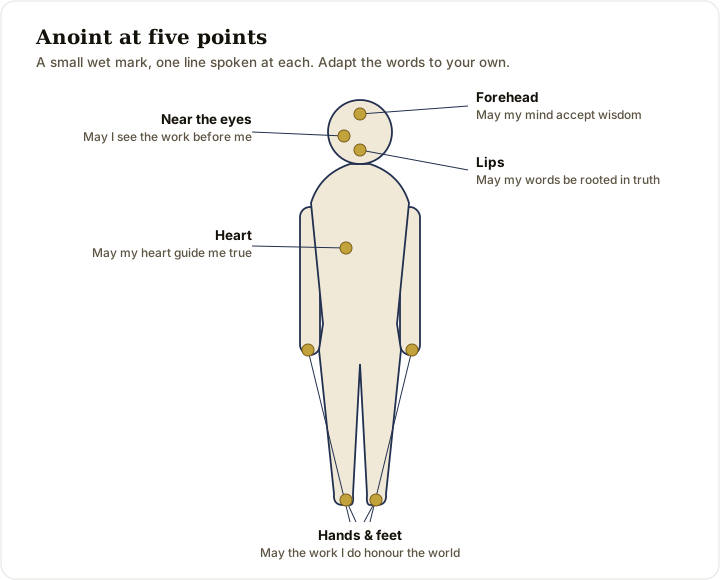
- Forehead. "May my mind accept wisdom and be open to learn."
- Near the eyes, just at the cheekbone where you can feel the small ridge. "May I see clearly the work before me."
- Lips. "May the words I speak be rooted in truth."
- The hollow at the centre of the chest, over the sternum. "May my heart guide me true."
- The backs of both hands and the tops of both feet. "May the work I do honour the world."
This step is the somatic one. The vow stops being a thought and starts being something the body has been touched with. Practitioners who skip the anointing because it feels theatrical almost always come back to it after a year of practice; the body needs the body's part.
Step 5: Ground, thank, close, and write it down
Sit for a minute or two with the candle still burning. Notice what your hands want to do. Notice the temperature of your face. Notice the smell of the oil sitting just under your collarbones.
Then thank, in this order, whatever you invited: the earth under the house, the divine as you understand it, your own inner self. Out loud is better than silent. Snuff the candle, do not blow it out (the small folk-superstition has practical roots: a snuffer cuts the flame cleanly without scattering the wax). Or, if you have the time and a safe holder, let it burn down on its own.
Now write it down. Date, place, the exact words you used, what you felt during, what you noticed after, what your hands did, what surprised you. This entry is your spiritual baseline. In a year, when you re-read it, you will see how far the practice has moved you and it will matter more than you can currently picture. Where to keep it lives in Book of Shadows; if the ritual leaves you wired rather than settled, the drills at grounding will bring you back to the floor.
Optional ways to make it yours
Small additions that cost nothing and tend to stick:
- A magical name. Many practitioners choose one for the rite, sometimes private, sometimes shared. It does not have to be permanent; the name you choose at twenty-two is often not the name you carry at thirty, and that is correct. Pick what feels true tonight. A list of sourced craft names can get you started.
- A personal sigil. Reduce the vow to a single hand-drawn symbol and use it as your phone's lock screen. It is discreet, free, and you will see it forty times a day for the next year. The how-to lives at sigil magic.
- One small daily action. Stir your morning tea clockwise for a week and remember the vow each time. Light the same candle for ten minutes before bed. The point of dedication is that it leaks into the mundane; this is how it leaks.
If your household does not know about your practice, this is the place to think about it. The discreet adaptations at broom closet witch are written for the reader doing all of this in a shared house, and the deeper minimalist approach lives at witchcraft on a budget.
What dedication will not do (anti-hype, said warmly)
It will not unlock powers. There are no powers to unlock; what dedication does is name the relationship you already have with your own attention, and that is more interesting in the long run.
It will not bind you forever. You can pause. You can walk away. You can come back in three years and write another vow that fits the person you have become. The path does not punish you for changing; the entire tradition is people who changed.
It will not fix a hard week on its own. Magic in this tradition is paired with action. You light the candle for the job and you also send the application; you make the protection bottle and you also change the locks. That pairing is how the work actually moves. If your spell-shaped attention is doing the heavy lifting and your hands are not, the troubleshooting at why spells don't work is honest about where the gap usually is. And if the fraud-fear ("am I doing it right, am I even allowed") is the loudest voice in the room tonight, the answer lives at am I a witch.
One firm line, said once: this is spiritual practice, not medical, financial, or legal advice. If something physical, financial, or legal is wrong, please see the right professional too.
Re-dedication: doing it again on purpose
Most solitary practitioners re-dedicate annually. Samhain and Imbolc are the common picks for it, but the date matters less than the deliberateness.
A re-dedication is not a do-over because the first one "failed." It is a renewal because you are a different person twelve months in than you were the night you struck that first match. The vow you wrote at twenty-three will not quite fit at twenty-four, and writing the new one out loud is how the practice keeps pace with you.
If you later want a coven
This is the question that worries beginners more than it should. A self-dedication does not lock you out of a future group, and it does not put you in conflict with any reputable coven's oaths.
If you eventually decide a group is the right home, you begin as a novice in their structure and you take their oaths fresh. Those oaths layer over your personal vow without erasing it. Most teachers read a prior self-dedication as preparation, not as competition; structurally it is closer to bringing reading experience to a new degree than it is to changing religion. The structural decision itself lives at solitary or coven, and the lineage map is at wiccan traditions.
Where to go from here
If you have dedicated tonight, the next sensible reads pick up where this leaves off. The wider starter sequence is at beginner's path. The small everyday practice that keeps the vow alive sits at daily practice. The cycle you have just committed to walking is mapped at Wheel of the Year. And the notebook you open after the candle goes out is the one detailed at Book of Shadows; that is where the practice actually lives, one entry at a time.
For one ordered path for the year after the vow, The Grounded Witch is paced for the solitary beginner working with what's already in the house.
Keep exploring
Browse more guides, or start with the basics of the practice you are curious about.
Browse more guides