Wicca vs Witchcraft: What's the Real Difference?
Wicca vs witchcraft is the question that trips almost every newcomer, and the cleanest answer is that Wicca is a religion and witchcraft is a practice. One asks you to believe specific things about specific deities. The other asks only that you light the candle and mean it. You do not have to choose either to begin, and "I practice witchcraft, I am not Wiccan" is a complete sentence.
Wicca vs witchcraft, in one breath
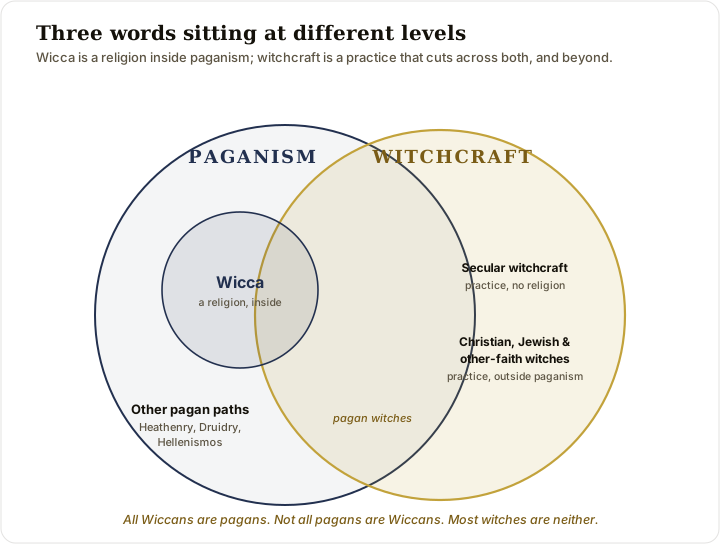
Wicca is a specific religion, a mid-20th-century mystery faith founded by Gerald Gardner in 1954 and shaped liturgically by his High Priestess Doreen Valiente. Witchcraft is a practice (spellwork, herbs, candles, knot work, divination, the deliberate use of intent and symbol) that anyone of any faith, or none, can do. Paganism is the wider umbrella that holds Wicca and many other earth-based religions.
All Wiccans are pagans. Not all pagans are Wiccans. Most witches are neither.
Permission first, because the labels get heavy fast: you do not have to pick one to start. A river stone on a windowsill, a kitchen candle lit with intention, a glass of rainwater left under the moon, any of these open the door without asking you to sign onto a pantheon or a tradition. The labels can come later, or never.
The three-way distinction at a glance
The fastest way through the confusion is a side-by-side. Read the rows, not the headlines.
| Paganism | Wicca | Witchcraft | |
|---|---|---|---|
| What it is | Umbrella term for many religions | A specific religion | A practice or methodology |
| Core belief or method | Non-Abrahamic, earth-based, often polytheistic | Duotheism (Horned God, Triple Goddess), nature reverence, the Wheel of the Year | Spellwork, herbs, candles, energy, intent paired with action |
| Founders or origin | Ancient roots, revived in many forms 19th-21st c. | Gerald Gardner, 1954; Doreen Valiente shaped the liturgy | No founder; folk practice in nearly every culture |
| Ethics | Varies wildly by tradition | The Wiccan Rede ("an it harm none"); the Threefold Law (contested) | Whatever the practitioner's own ethics are |
| Need it to do magic? | No, prayer and offering count | Magic is woven in, but worship comes first | This IS the magic |
All Wiccans are pagans. Not all pagans are Wiccans. And a witch can be any of the above, or none of them.
Paganism is the umbrella
Paganism is a category, not a faith. It covers a broad range of religions outside the Abrahamic three (Judaism, Christianity, Islam), most of them polytheistic, animistic, or rooted in nature.
The word itself comes from the Latin paganus, which meant something like "villager" or "rustic." When Christianity spread through the Roman Empire in the fourth century, the term got applied to the rural people who kept the old gods. The label was an insult once. Most people who use it now have reclaimed it.
Under that umbrella you find Wicca, yes, but also Hellenismos (the revival of Greek religion), Heathenry and Ásatrú (Norse and Germanic), Kemetism (Egyptian), Druidry, Celtic Reconstructionism, and many more. A pagan can worship her gods with prayer and offering and never cast a spell in her life. More in what paganism is and the recon paths primer at Celtic and Norse paths.
Wicca is a specific religion
Wicca is not "old witchcraft." It is a modern mystery religion, publicly introduced in 1954 by Gerald Gardner, a retired British civil servant, in his book Witchcraft Today. His High Priestess Doreen Valiente did much of the heavy lifting that turned his raw material into the poetic, structured liturgy Wiccans still use, including the Charge of the Goddess.
Gardner believed he had been initiated into a surviving coven of an unbroken pre-Christian "Old Religion," drawing heavily on anthropologist Margaret Murray's witch-cult hypothesis. Historians have since taken that theory apart fairly thoroughly. Wicca is a 20th-century synthesis, shaped by Gardner from older esoteric materials, ceremonial magic, folklore, and the Romantic imagination. That honesty about its history is part of why you can trust the rest. A religion that is sixty years old is still a religion.
At its core, Wicca holds a duotheistic theology: a Horned God of the wild and the hunt, and a Triple Goddess seen as Maiden, Mother, and Crone (mirrored in the waxing, full, and waning moon). Practice runs on the Wheel of the Year (eight Sabbats marking the solar and seasonal turn) and Esbats (smaller rites at the full or new moon).
Traditional Gardnerian and Alexandrian Wicca are initiatory mystery schools where you are formally brought into a lineage by a coven. Eclectic Wicca, which exploded in the 1970s and 80s, opened the door to solitary practice and self-dedication. The lineages and how they differ get their own treatment in Wiccan traditions; the calendar lives at the Wheel of the Year; the full-moon rite at drawing down the moon.
What Wiccans believe, in plain terms
- Duotheism. In Wiccan practice, divinity is held as a complementary pair: the Horned God and the Triple Goddess (Maiden, Mother, Crone). Many Wiccans also hold these as faces of one ultimate, unknowable source.
- Nature is sacred. The divine is immanent, present in the body and the land, not separate from either.
- The Wheel of the Year is the calendar. Eight Sabbats mark the year; Esbats mark the moon.
- Circle work is the temple. A cast circle is the working space; no building is required.
- Initiation, or self-dedication. Traditional lines initiate through a coven. Eclectic Wiccans often mark their commitment with a self-dedication ritual of their own.
Wiccan ethics, briefly
Two ideas come up over and over. The first is the Wiccan Rede, usually quoted as "an it harm none, do what ye will." Read as a moral compass rather than a commandment, it puts personal autonomy first and asks you to consider the harm in what you do (including to yourself). The second is the Threefold Law, the belief that energy you send out returns to you three times over.
Both are 20th-century constructs, not ancient law. The Rede's familiar couplet was first spoken publicly by Doreen Valiente in 1964. The Threefold Law first appeared in a 1949 Gardner novel as instruction about coven kindness, then got expanded into a universal karmic principle by later teachers. Not all Wiccans even accept the Threefold Law, and a growing number of traditional and secular witches reject it outright as a "witchcraft without teeth." The full sourcing and the debate live in the Wiccan Rede.
Witchcraft is a practice, not a religion
Witchcraft is a methodology. Candles, herbs, knots, jars, divination, moon water, sigils, the deliberate use of intent and symbol to nudge change in the world (always paired with action in the world). It carries no founder, no central text, no required deity. Folk magic of this shape shows up in nearly every human culture that has ever existed.
Because witchcraft is a practice rather than a religion, it fits inside whatever worldview you bring to it.
- A Wiccan witch casts within a religious frame, treating the circle as worship and the spell as communion with her gods.
- A Christian or Jewish witch keeps her faith and adds a folk-magic practice (herbal charms, candle work, prayer beads, ancestor veneration). This is genuinely ancient territory; cunning folk in Christian Europe were doing some version of this for centuries.
- A secular witch treats the work as psychology, ritual, and intention. There is no deity in the room and no claim that one is needed. The change happens in her, and in what she does next.
The first time I lit a candle for a job I wanted, I expected a thunderclap. What I got was a small, quiet shift: I sat down, I finished the application I had been avoiding, I hit send. The call came a week and a half later. The candle did not get me the job. Neither did I, exactly. The honest read is that one made the other possible, and that is how this tends to come together for most people. Spellwork is the inner movement that lets the outer movement happen. More on the mechanics at how spells work, the non-theistic path at secular witchcraft, and the wider map at types of witches.
So can a witch be Wiccan? Can a Wiccan be a witch?
This is the question most people actually came with, even when they typed something else.
- Is a Wiccan also a witch? Usually yes. Most Wiccans incorporate spellwork into their religion and would call themselves witches as a matter of course.
- Does a witch have to be Wiccan? No. A witch can be Wiccan, but does not have to be.
- What else can a witch be? Christian, Jewish, Buddhist, atheist, agnostic, pagan-but-not-Wiccan, or simply not interested in a frame. All of these are real and common.
- Is a pagan a witch? Not automatically. A pagan can worship her gods with prayer and offering, attend her tradition's seasonal rites, and never work a spell in her life.
- So why does everyone use the words interchangeably? Partly because Gardner himself did. He called his religion "the Witch-cult" and "Witchcraft," which welded the two terms together in the public mind for decades. The serious practitioner community has spent the last forty years pulling them apart again.
Which one (if any) actually fits you?
No checklist. Just three honest sketches; see if you recognise yourself.
"I want a full religion. Deities I can build a relationship with, a calendar that shapes my year, an ethics system, ritual structure I can lean on." That description fits Wicca, or another pagan path. Start with Wicca for beginners for the practical first year, the Wiccan traditions to see whether an eclectic solitary path or an initiatory lineage feels right, and the Wheel of the Year for the calendar.
"I want the practice. Candles, herbs, jars, moon work, divination. I do not want to sign onto a religion to get there." That is witchcraft, often called secular witchcraft when held without any deity. Begin with how to begin and beginner spells.
If that's you, The Grounded Witch is our grounded beginner spellwork guide: candles, herbs, moon work, records, and no required religion.
"I already have a faith I love and I want to add folk magic to it." That works too. Witchcraft has been practiced inside Christian, Jewish, and other folk traditions for centuries; cunning folk are the documented English example. You bring the theology; the practice meets you there.
You can start with what you have. A kitchen candle, river stones, rainwater on a windowsill under the full moon. The label can come in a year, or in ten, or never. Plenty of practitioners who have been at this for decades still refuse one, and they are no less witches for it. More on the permission question at am I a witch, the Christian-fear question at is witchcraft a sin, and the lowest-cost starting point at witchcraft on a budget.
A note on honest history
Two things worth saying plainly.
Wicca is a 20th-century religion. Gardner believed he was reviving an unbroken Old Religion. The historical record disagrees: it is a modern synthesis shaped by him from older materials. Wicca being modern does not make it less real. Christianity was new once too. It just makes the story honest, and an honest story is the one worth practising inside.
"Witch" as a label has a long and often violent history. The victims of the early modern European witch trials were overwhelmingly orthodox Christians caught in panic, denunciation, and torture, not members of an underground pagan religion. The often-repeated "nine million" figure from older sources is a debunked exaggeration; historians put the documented toll at tens of thousands, which is still a horror that deserves accurate telling. More on the American chapter at the Salem witch trials, and on reclaiming the word at the witch wound.
Whichever name fits you, the practice you build with care is the one that counts.
Keep exploring
Browse more guides, or start with the basics of the practice you are curious about.
Browse more guides