Types of Witches: Find the Path That Fits You
The types of witches you'll meet in books and on your feed are descriptive labels, not assignments, and you do not need to pick one to be a real witch. They name what a practice tends to focus on (the moon, the kitchen, the tides, the woods, the stars), and most witches sit comfortably in two or three at once. If a label helps you find your shelf of books and your people, use it. If it starts to feel like a uniform, drop it.
What these labels actually are
Types of witches are descriptive emphases, not membership cards. They describe where a practitioner spends her time and energy, not what she's allowed to do or who she's allowed to be.
Most of these labels are recent. They emerged from solitary, self-taught practice in the late twentieth century, when witches working outside covens needed plain words for what they were already doing. Nobody hands them out. There is no checklist and no initiation gate between you and any of them.
If you came here cold, the broader picture of the modern craft sits a level up from this. These labels are the rooms inside that house.
The eleven main types at a glance
Most modern guides settle on the same eleven. Here they are with what each one centers on, where she tends to practice, and one author whose book is a clean place to start.
| Type | Centers on | Where she tends to practice | A book to start with |
|---|---|---|---|
| Cottage | The home as sanctuary | Indoors, every room | Ellen Dugan, Cottage Witchery |
| Kitchen | Cooking, the hearth, edible plants | The stove, the spice rack | Skye Alexander, The Kitchen Witch |
| Garden | Soil, planting cycles, local plants | The yard, balcony, windowbox | Ellen Dugan, Garden Witchery |
| Green | Wild plants, foraging, folk herbalism | Forests, parks, riverbanks | Arin Murphy-Hiscock, The Green Witch |
| Hedge | Trance work, dream, the spirit world | Quiet rooms, the dream state | Rae Beth, Hedge Witch |
| Sea | Tides, salt, maritime folk magic | Coastlines, bowls of saltwater | Sandra Kynes, Sea Magic |
| Cosmic | Planets, transits, eclipses, stars | Anywhere with a sky | Susan Demeter, Cosmic Witch |
| Lunar | The phases of the moon | Anywhere she can see the moon | Jesamyn Angelica, Llewellyn's Complete Book of the Moon |
| Storm | Weather, wind, rain, thunder | Outdoors before and after storms | Debra L. Burris, Weather Magic |
| Eclectic | A custom mix from many traditions | Wherever the practice goes | Deborah Blake, The Eclectic Witch's Book of Shadows |
| Secular | Ritual as psychology, no deities | Anywhere with a candle | M. Rivers, The Quantum Witch |
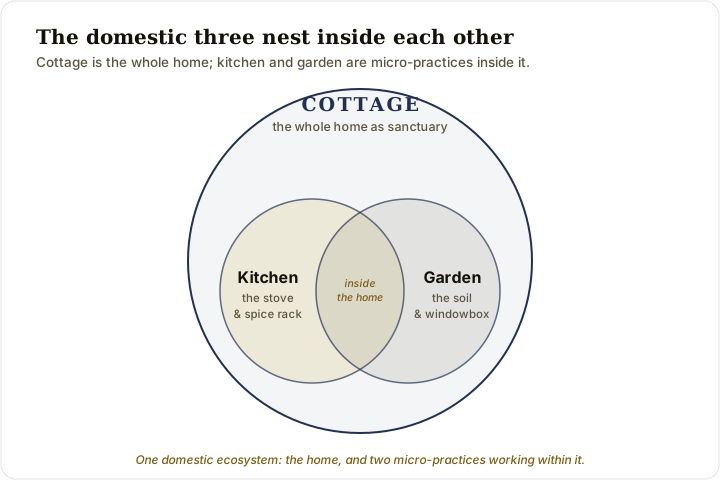
Three of the eleven (cottage, kitchen, garden) nest inside each other. Cottage is the whole home; kitchen and garden are micro-practices working inside it.
How to read these labels (you can be more than one)
A single witch can be a sea witch standing on the coast, a kitchen witch at the stove, and an eclectic witch with her tarot deck out, all in one weekend. The labels describe what she's doing right now, not the box she lives in.
This is the modern frame: personal gnosis, the knowledge you build through direct experience, replaced the old reliance on coven initiation as the only valid gate. The thing it costs is the certainty of a uniform. The thing it gives back is permission to grow.
Each path has its own deep how-to elsewhere on the site.
The domestic three: cottage, kitchen, garden
Cottage, kitchen, and garden form a single domestic ecosystem. Cottage governs the whole home as sanctuary; kitchen is the stove-and-spice-rack micro-practice inside it; garden is the soil-and-windowbox micro-practice on the other side of the door.
Cottage witch
In cottage practice, the home itself is the spell. Mundane chores (sweeping, washing the floor, hanging a charm in the window, simmering a pot on the stove) are reframed as protective ritual for the house and the people inside it.
The lineage is European hearth folklore. The original "kitchen witch" was not even a person; it was a Scandinavian or German poppet hung over the hearth to keep roasts from burning and ill humor out of the room.
The first floor wash I committed to was rosemary and lemon peel steeped strong, then mixed into the mop water. Mopping from the back of the house out toward the front door felt theatrical the first time and obvious by the fourth.
If you already notice when a room "feels off" and fix it without naming what you're doing, this path is largely a matter of saying it out loud. The home-cleansing how-to lives at home cleansing.
Kitchen witch
Kitchen witchcraft uses the stove as the altar. Edible ingredients, cookware, fire, and a single clear intention held while the pot moves.
In kitchen practice, ingredients carry meaning through the old folk-medicine Doctrine of Signatures (formalized by Paracelsus, in which a plant's appearance hints at its purpose): onions for protection because their layers read as shields, basil for prosperity because it carries hot Mars energy. The historical lineage runs through midwives and village herbalists who did most of their work at the hearth, which is partly why the witch silhouette is what it is.
The smallest version of the practice is to stir clockwise into your soup or tea while holding one specific intention, then eat or drink it. The intention goes wherever the food goes.
For the full path, kitchen witchcraft takes it from "intentional stirring" to a working practice.
Garden witch
Garden witchcraft works with whatever already thrives in your soil. The practice is local on purpose: you plant by moon phase, tend the same patch through the year, harvest, and talk to what you've planted.
In garden lore, begonias carry a "guard dog" energy, grown male and female flowers on the same stem, and read as a small symbol of balance at a property line. Lilacs go in for sweetness and welcoming. None of this requires a yard; balcony pots and windowboxes work.
A practical part of the path is grounding through the labor itself, weeding and tilling read as the body's version of meditation, with stress quietly draining into the soil while the hands do their thing. The broader botanical practice (foraging, wild plants, the world past the garden gate) lives in the green path.
The natural and liminal: green and hedge
Green witch
Green witchcraft is folk herbalism with the boundary pushed past the garden gate. Forest, foraging, wild botanicals, stones, gems, oils, a daily relationship with whatever land you actually have access to.
Its roots are in the rural "wise women" who held the medicine of their villages before professional medicine arrived. The practice tends toward intuitive over ceremonial, slow over flashy, and most green witches I know would rather be on a damp trail than at a fancy altar.
Worth flagging early on this path: white sage and palo santo are heavily over-harvested for the metaphysical market, and white sage in particular is sacred to specific Indigenous communities who consider its use a closed practice. Garden rosemary, mugwort, or pine resin do the same cleansing job without that cost. More on which traditions are open and which are closed lives in closed practices, and foraging ethics in ethical wildcrafting.
The full how-to is at the green path.
Hedge witch
Hedge witchcraft is the work of the threshold. The name comes from the Old High German hagazussa and the Anglo-Saxon hægtesse, both meaning "hedge-rider". Historically a hedge marked the boundary between the village and the wild forest; in hedge practice, the hedge stands for the boundary between the everyday world and the spirit world. The modern term was popularized by Rae Beth in her 1990 book Hedge Witch.
A practitioner "rides the hedge" through trance work and dream, often with rhythmic drumming, dim light, or the smoke of mugwort. The state is closer to a deep guided meditation than to sleep, and what's sought there depends on the witch: ancestors, guides, a clearer answer to a knotted question.
For the believing reader, this is genuine contact with another world. For the science-leaning reader, ritual-induced trance reorganizes how you process what you already know, which is a smaller claim and just as useful. Both readers tend to leave the cushion saying the same thing: something shifted.
Full how-to at hedge witchcraft. Always learn grounding first.
The elemental and celestial: sea, cosmic, lunar, storm
Sea witch
Sea witchcraft is water work. Tides, salt, shells, driftwood, ethically collected seawater. You do not have to live near the coast; a bowl of water with sea salt stands in, and plenty of sea witches practice landlocked.
The lineage is maritime folk magic, the protective charms of sailors' wives and coastal communities, threaded with marine-goddess devotion (Isis as Stella Maris, "star of the sea" and protector of ships, is a common touchstone). Modern sea witches tend to fold ecological stewardship into the practice; the ocean cannot really be loved and littered in at the same time.
A common entry ritual is the "ocean breath": long audible inhales and exhales timed to imagined waves, until internal weather starts to match the rhythm.
Full path at sea witchcraft.
Cosmic witch
Cosmic witchcraft times its work to the sky. Planetary transits, retrogrades, eclipses, meteor showers. The lineage is astronomy and astrology, which were one discipline for most of human history.
In cosmic practice, you schedule communication-heavy magic for favorable Mercury aspects, leave a jar of water out under a meteor shower to make "star water" the way a lunar witch makes moon water, and learn your own birth chart so you know which energies you're already swimming in. A first step is to find your sun, moon and rising signs.
Crystals show up heavily on this path, which is where a clear-eyed warning earns its keep. The crystal supply chain is largely unregulated and some of it is genuinely exploitative; a small, honestly sourced handful beats a haul, and a single stone you actually use is worth more than a drawer full you don't.
Start with timing at planetary days and moon phases.
Lunar witch
Lunar witchcraft aligns to the moon and only the moon. New Moon for setting intentions, Full Moon for peak work and manifestation, Dark Moon for banishing and inward time. Each phase has its own job.
The un-glamorous core of the practice is a lunar journal: a notebook where you write moods, dreams, energy, and any intuitive flashes against the phase. After about three months, mine started showing me that my worst sleep clustered around the dark moon, which I had not noticed without writing it down.
If you already track your cycle or your sleep against the moon without thinking about it, you are most of the way into this practice already.
The how-to lives at moon spellwork, with moon water as the gentlest entry ritual and full-moon rites for the ceremonial side.
Storm witch (weather witch)
Storm witchcraft works with weather that's already happening. The historical lineage is the tempestarii, individuals in Late Antiquity and the early Middle Ages believed to summon or calm storms, and the sailors' "wind knots", knotted cords sold to ships that could be loosened for a breeze or a gale.
In modern practice, storm witches do not claim to control the weather. They ride the energy of a storm that's already there for protection work, for clearing, for the kind of magic that wants raw force behind it.
A common method is to set a non-metallic bowl out to catch rainwater, collected after the worst of a storm rather than during it, then use the water later for scrying or for rituals that need a sudden push. Cloud-reading (the older word is aeromancy) functions as a slow, attentive form of divination.
Real lightning is real. Set the bowl out on a porch, not in an open field, and never under a tree.
The methodological two: eclectic and secular
Eclectic witch
Eclectic witchcraft describes a how, not a what. The practitioner builds her own framework from many traditions: tarot beside Celtic mythology, lunar work woven into kitchen magic, runes next to a deity she has a real relationship with.
The word comes from the Greek eklektikos, meaning "selective". The path rose with the late-twentieth-century shift away from strict initiatory covens; most modern solitary practice has some eclectic flavor in it whether or not the witch uses the word.
The honest line on this path: eclectic does not mean anything goes. Closed practices (Hoodoo, Brujería, specific Indigenous ceremonies, Romani magic) are not on the menu for outsiders, no matter how well a deck of cards goes with them. The longer treatment lives in closed practices.
The natural home for the eclectic witch is a book of shadows, where the customized framework gets written down.
Secular witch
Secular witchcraft strips the craft of gods and spirits and keeps the ritual. The practitioner uses candles, herbs, tarot, and incantation as psychological tools: focused intention, placebo, the catharsis of symbolic action.
In secular practice, tarot becomes a prompt for exploring Jungian archetypes (the universal figures Carl Jung argued live in everyone's unconscious) rather than a divinatory message from outside. M. Rivers' The Quantum Witch leans on quantum-physics metaphors (the observer effect, the way the act of measuring shifts what's measured) to talk about ritual without invoking spirits at all.
The common entry ritual is small and clean: write a limiting belief on a slip of paper, light a candle, burn the slip in the flame. The fire does not contain literal magic and the practitioner knows that. The release is still real, because she is real and the ritual organizes what her brain was already doing.
Full path at secular witchcraft. The epistemology question this often raises lives at is witchcraft real.
The tail labels you'll see online
Algorithm-driven feeds, especially TikTok, have splintered the eleven types into hundreds of micro-labels: cottagecore witch, lunar baby, swamp witch, faerie witch, dark academia witch, baby kitchen witch with a familiar. Practitioners half-joke about "digital oracle" sorting because the for-you page assigns you to a label by visual aesthetic faster than you'd sort yourself.
Familiars (the animal companion, traditionally a cat but variously a dog, a snake, a hare, or a crow) sit in this tail too. Some witches have one. Some don't. There is no rule.
These labels earn their keep when they help you find your people and your books. They get thin when the aesthetic becomes the whole practice, when the candle is only ever lit on camera. The difference between the look and the work is the subject of aesthetic vs practice.
A quick gut check
A short shortcut, not a quiz.
| If this is already true of you | A path likely fits |
|---|---|
| You keep herbs on the windowsill and stir your tea with intention | Kitchen |
| You feel calmer the second you put your hands in soil | Garden |
| You notice when a room "feels off" and fix it | Cottage |
| You'd rather be in a forest than anywhere else | Green |
| Your dreams are vivid and feel like instructions | Hedge |
| You feel different at the coast | Sea |
| You check your transits before making plans | Cosmic |
| You track your moods against the moon | Lunar |
| Storms make you feel more yourself, not less | Storm |
| You're already mixing tarot, rune, and herb without apology | Eclectic |
| You don't believe in spirits but you love the ritual | Secular |
Most readers land on two or three. That is normal, and it doesn't need resolving.
Other doors in the same house
A few questions that come up the moment a reader starts looking at these labels live at their own pages.
- For the "how do I actually start" question, witchcraft for beginners is the how-to.
- For the "am I allowed to call myself this" question, am I a witch is the door.
- For a starter list that isn't a Sephora-style witch kit, the baby witch checklist is honest.
- For the religion-versus-practice distinction (Wicca is a religion, witchcraft is a practice, the two overlap but aren't the same), wicca vs witchcraft is short and clear.
- For the non-theistic deep dive, secular witchcraft picks up where the section above leaves off.
Where to begin if you're brand new
Most readers land here because they're not sure they're allowed. You are. The cheapest entry I can name is a notebook and a single candle, and the next cheapest is a free walk in whatever piece of nature is closest to you. The river stones in your pocket on the way home count. The herbs on your spice rack count.
If money is the held breath behind the question, witchcraft on a budget is the kindest next read. Otherwise, start here for the becoming-a-witch how-to, and let the labels above stay loose around you while you grow into whatever shape your practice wants to take.
Keep exploring
Browse more guides, or start with the basics of the practice you are curious about.
Browse more guides