How to Read Runes: An Elder Futhark Beginner's Guide
Learning how to read runes takes a paper set you made in ten minutes and a question you actually care about. The runes most people mean are the Elder Futhark, a 24-character Germanic alphabet that modern practitioners read as a tool for reflection and guidance, not as fortune-telling.
The single-rune daily pull (start here)
- Ask one open question. Out loud or in your head. Keep it simple.
- Reach into the bag without looking. Let your fingers settle on one rune.
- Pull it. Lay it face-up on the cloth in the orientation it came out.
- Read it. Traditional meaning first, then your gut. Note the orientation if the rune is asymmetrical (see merkstave, below).
- Write it down. A line in your book of shadows: rune pulled, question, one sentence about what actually happened that day. Two months of this and you will know the runes by feel.
Frame this as a belief practice. The runes do not predict a fixed future; in this tradition they show the energies in play and the likely trajectory if nothing shifts. Pair every reading with an action in the world (magic plus action).
How to actually do a reading
The shift from theory to practice is mostly a shift in posture. Reading runes is receptive work, not extraction. You are not interrogating the bag for an answer; you are quieting enough to notice what is already there. This sits inside the larger map of divination methods, and the underlying skill (relaxed attention, trusting the first impression) is the same one a pendulum or a tarot deck asks for.
Setting up (cloth, bag, and the question)
- A casting cloth. Any plain natural fabric, dark enough that the runes stand out. It gives your eye a clean field and sets a small boundary that says "this is the work now."
- A drawstring bag of natural fibre. Cotton, linen, or silk. The bag is the runes' home between sessions.
- A candle if it helps you focus. Optional. Not magical infrastructure, just a cue.
- One clear question. Not "tell me everything." Something like "what is at the root of this conflict?" or "what energy do I most need today?"
Put the runes in the bag, hold the bag in both hands, and shuffle the stones with your fingers while you sit with the question. The tactile mixing is most of the work; that pause is what drops you into the receptive state where the reading happens.
The three-rune Norns layout
This is the foundational spread, traditionally tied to the three Norns, the Norse weavers of fate: Urd (what has been), Verdandi (what is becoming), Skuld (what is owed). Lay three runes left to right in one motion.
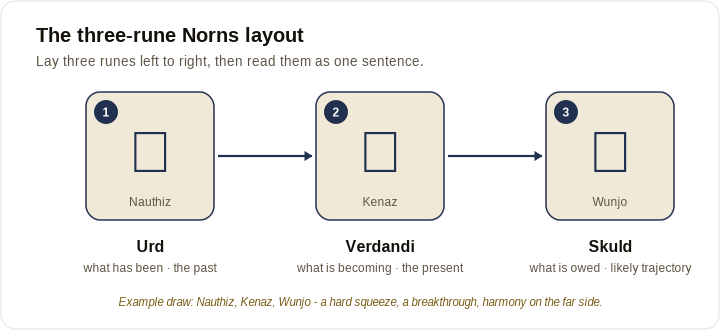
- Left (Urd, past): the influences and choices that built the current situation.
- Centre (Verdandi, present): the active energy right now, what is alive in the question.
- Right (Skuld, likely trajectory): the logical result if nothing shifts. Not destiny. The current momentum.
Read the three as a sentence. Worked example: Nauthiz, Kenaz, Wunjo would tell the story of a hard squeeze that you have been sitting in, a sudden insight or skill breaking through, and fellowship or harmony on the other side of it. Same three in reverse (Wunjo, Kenaz, Nauthiz) would tell a very different story.
Merkstave (reading reversed runes)
Merkstave means "dark stick," a rune that lands inverted. Eight runes are geometrically symmetrical and cannot be reversed: Gebo, Hagalaz, Isa, Jera, Eihwaz, Sowilo, Ingwaz, Dagaz. For the other sixteen, an upside-down draw traditionally means the rune's energy is blocked, delayed, internalised, or coming through its shadow side. Not "the opposite." An inverted Fehu is not poverty; it is wealth that has stalled, or grasping, or fear around money.
Some readers ignore reversals entirely and read by context and intuition, and that is a legitimate choice with a long modern tradition behind it. Try both for a few weeks and see which gives you readings you can actually use. Either method is right if it is consistent.
Closing the reading and storing the set
A short verbal or mental thank-you closes the session. In belief terms it severs the energetic link of that reading; in practical terms it tells your brain the work is finished. Gather the runes back into the bag. Many practitioners wrap the bag inside the folded casting cloth and tuck the bundle in a quiet spot away from busy household traffic. The set is not fragile, but treating it like it matters is part of why it keeps mattering.
The 24 runes and their three aettir
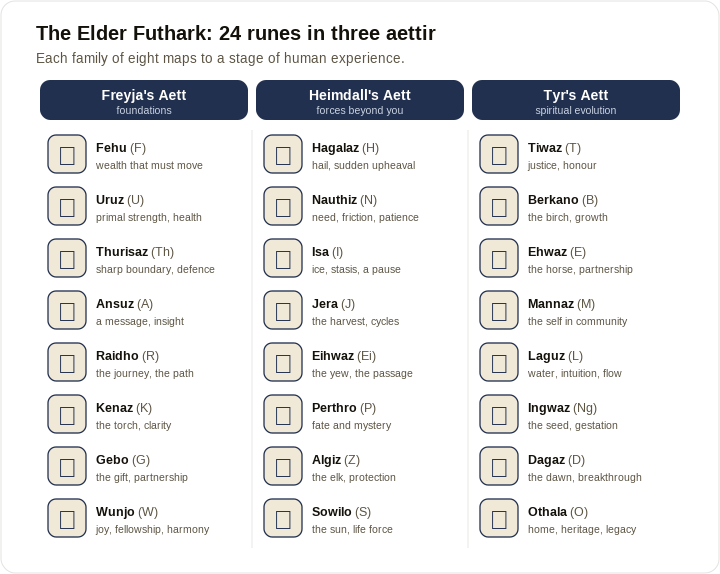
The 24 runes are traditionally grouped into three families of eight, called aettir (singular aett, meaning "family" or "generation"). Each aett is associated with a deity and a stage of human experience: foundations under Freyja, the forces bigger than you under Heimdall, and spiritual evolution under Tyr. These meanings are conceptual archetypes, not fixed dictionary entries. You interpret them through your own intuition and through the context of the question.
Freyja's Aett (Fehu through Wunjo)
The foundations: survival, conflict, communication, community. These are the runes of being a person with a body in a world.
- Fehu (F), Wealth: circulating prosperity, abundance that must move to stay alive. Money hoarded stagnates; money used multiplies.
- Uruz (U), the Aurochs: primal strength, health, raw endurance, the body's own resilience.
- Thurisaz (Th), the Thorn: reactive force, a necessary defence, a sharp boundary. Caution and protection.
- Ansuz (A), Odin's Breath: a message arriving, sudden insight, wise counsel, speaking your truth.
- Raidho (R), the Journey: movement, rhythm, the discipline of staying on your path.
- Kenaz (K), the Torch: illumination, craft, the controlled fire of the forge. Light into a dark question.
- Gebo (G), the Gift: partnership, exchange, the mutual bond a real gift creates.
- Wunjo (W), Joy: fellowship, harmony, the quiet pleasure on the other side of struggle.
A practitioner aside: when a reader comes to runes during a money-fear stretch or a starting-over moment, Fehu, Nauthiz, and Raidho show up a lot. That is not the runes "knowing" your situation. It is your subconscious pulling the symbols that already match the shape of what you are carrying, which is exactly what divination is supposed to do.
Heimdall's Aett (Hagalaz through Sowilo)
The forces bigger than you. Nature, fate, the parts of life you cannot direct. The first half of this aett is hard and the back half is the way through.
- Hagalaz (H), Hail: disruption, sudden upheaval, the storm that clears the field for new growth.
- Nauthiz (N), Need: restriction, friction, the patience that scarcity teaches. The pressure that sparks invention.
- Isa (I), Ice: stasis, a held breath, the warning to wait. Cold clarity.
- Jera (J), the Year: the harvest, cycles, fruit from work already done. You cannot rush this one.
- Eihwaz (Ei), the Yew: transition, the world tree, the necessary passage through difficulty.
- Perthro (P), the Dice Cup: fate, mystery, the unknowable, a leap of faith.
- Algiz (Z), the Elk: spiritual protection, antennae up, defence and divine connection at once.
- Sowilo (S), the Sun: life force, victory, the warmth that melts the ice. Pure energy.
These are the runes that often come up during a hard stretch. They are not telling you to brace; they are telling you the shape of the season.
Tyr's Aett (Tiwaz through Othala)
The spiritual evolution aett. Self, partnership, intuition, breakthrough, legacy.
- Tiwaz (T), Justice: the spiritual warrior, honour, the willingness to sacrifice for what is right.
- Berkano (B), the Birch: divine feminine, gentle growth, sanctuary, healing.
- Ehwaz (E), the Horse: deep partnership, trust, two beings moving as one.
- Mannaz (M), Humanity: the self in community, intellect, shared human nature.
- Laguz (L), Water: intuition, the subconscious, emotional flow, going around rather than through.
- Ingwaz (Ng), the Seed: internal gestation completing, potential about to break ground.
- Dagaz (D), the Dawn: breakthrough, the bridging of opposites, sudden clarity.
- Othala (O), the Home: heritage, ancestry, the lasting legacy you build and pass down.
One flag here. Othala, Tiwaz, Algiz, and Sowilo have been appropriated by hate groups, and a modified "Winged Othala" form is a known white-nationalist symbol. The plain runes are innocent, but it is worth knowing before you tattoo one on your arm.
Choosing or making your set
A free paper set works for your first reading tonight. Cut twenty-four squares of cardstock, ink the runes on with a Sharpie, and you have a working set. Beautiful tools are a real joy if you want them, and a hand-carved wooden set or a pouch of river-stones you painted yourself often feels more alive than anything you can buy.
Historically attested materials are wood (ash, oak, yew) and stone. Wood is light and makes a satisfying clack when cast; stone has grounding weight. Modern commercial sets are often semi-precious crystals like amethyst or rose quartz, which is fine, but there is no historical precedent for crystal runes. They are a contemporary aesthetic choice, not a tradition. Buy them because they are beautiful, not because they are "real." If you would rather cast small found objects than carved staves, building and reading a charm set works on the same throw-and-read idea.
Making your own (a stage-by-stage walk-through)
The first set I made was on flat river stones I collected one autumn, and the second was wood rounds cut from a fallen ash branch. The ash smelled like sweet smoke when the wood-burner touched it, which I did not expect, and the smell is now part of what those runes mean to me. That kind of imprint is what making your own buys you.
- Gather twenty-four similar pieces. Wood rounds from a single branch, river stones of roughly matching size, clay tiles you cut yourself. Aim for consistency in feel rather than perfection.
- Plan the layout first on paper. Draw each rune at the size your blanks will fit. Some are simple straight lines and some (Eihwaz, Ingwaz) trip people up because of where the diagonals meet. Practising on paper saves you a ruined blank.
- Inscribe. Wood-burning tool or engraving bit for wood. A rotary tool with a diamond burr or durable paint for stone. A permanent paint pen works on anything if you have nothing else.
- Do a test piece. Burn or paint one rune on a scrap of the same material first. The look of Fehu on dark oak is not the look of Fehu on pale birch, and you want to know before piece eleven.
- Optional: paint the lines red. Many traditions paint the carved grooves with red pigment as a binding ritual, symbolising life force or blood. It is a quiet, meditative step. Skip it if it does not feel right.
- Lay the finished set out together. Look at all twenty-four. Adjust any that read wrong at a glance. Then bag them.
The blank 25th rune: a manufacturing accident, not a tradition
Commercial sets sometimes come with twenty-five stones, one of them blank. The blank rune entered the modern market in 1982 with Ralph Blum's The Book of Runes. The publisher's ceramic mold was a 5x5 grid because that was cheaper than a 4x6 grid, which left an extra blank tile. Blum retroactively assigned it to Odin and called it the rune of wyrd, the unknowable.
The historical objection is that Odin sacrificed himself on the world tree Yggdrasil specifically to gain the knowledge of the runes. Calling a blank tile "Odin's rune of the unknowable" reverses the myth. Most traditionalists set the blank aside and work with the historically attested twenty-four. If you bought a 25-stone set you did not do anything wrong; you just have a souvenir from a printing decision.
Cleansing and consecrating a new set
In belief practice, this resets the energetic feel of a set, especially one that has passed through many hands at a shop. Pick one method.
- Smoke: pass each rune through the smoke of juniper, mugwort, or your incense of choice.
- Salt water: dab each with salt water (skip this on bare wood, which will warp).
- Earth: bury the bag overnight in a bowl of earth or salt.
- Moonlight: leave them out under a full moon. See the moon phase calendar for when the next one falls.
Then hold the runes cupped in both hands, picture a clear white light running through them, and quietly state an intention: that this set will speak honestly and that you will listen.
A hard note: runes and hate groups
This is non-negotiable to know before you wear a rune publicly or post about your practice. In the 1930s and 1940s the Nazi Party aggressively co-opted ancient Germanic symbols to construct their "Aryan" mythology. The Schutzstaffel (SS) used runes on their uniforms and regalia. That appropriation did not end in 1945. White nationalist and neo-Nazi groups continue to use runic symbols today, and the Anti-Defamation League's Hate on Display database tracks the specific forms.
The ones to know:
- The Winged Othala. Othala (ᛟ) modified with serif "feet" or wings at the bottom. Designed by the SS and currently used by neo-Nazi groups. The plain rune is fine; the winged version is not.
- Double Sowilo. Two Sowilo runes side by side, the SS insignia. Avoid this pairing as a design choice.
- Tiwaz and Algiz. Both are heavily used by white supremacists as "martial Aryan strength" and "life rune" symbols. The plain runes belong to everyone; the contexts where they appear matter.
The runes themselves are innocent. Inclusive Heathenry is actively reclaiming them. You can practise this craft honourably; you just have to know what flags the symbols also fly under so you can plant your own clearly.
Declaration 127 (where to plant your flag)
Modern Heathenry split openly over this. On one side is folkism, the white-nationalist claim that Norse spirituality is tied to genetics and that only people of European descent can practise it. On the other is inclusive or universalist Heathenry, which holds that the gods welcome everyone. The most prominent folkish organisation in the United States, the Asatru Folk Assembly, has been designated a hate group by civil rights organisations.
In August 2016, after blatantly discriminatory statements from the AFA against non-white and LGBTQ+ practitioners, a blog called Huginn's Heathen Hof authored Declaration 127. The name comes from verse 127 of the Hávamál, the Sayings of the High One attributed to Odin: "When you see misdeeds, speak out against them, and give your enemies no frith." Signatories pledge never to associate or do business with folkish organisations and affirm that the Norse deities celebrate diversity. By 2022 more than 180 organisations across 20 nations had signed. Stewardship transferred in 2024 to The Troth, the largest international inclusive Heathen body.
The plain version for you: the gods of this tradition celebrate diversity, the runes do too, and you belong here on every count.
Authors and books to lean on (and one to skip for now)
Honest opinions, short list.
- Diana L. Paxson, Taking Up the Runes. The gold standard of modern inclusive runic practice. Rigorous on history and generous on ritual.
- Stephen Pollington, Rudiments of Runelore. If you want unadorned historical accuracy without esoteric overlay, this is the book. Dense and worth it.
- Dr Jackson Crawford. Old Norse specialist whose translations of the Poetic Edda and lectures give you a reliable cultural and linguistic baseline.
One author to skip as a beginner: Edred Thorsson, the pen name of Stephen Flowers, whose Futhark: A Handbook of Rune Magic is historically influential but whose organisational ties have put him outside the inclusive community. The first three names above will serve you better while you are finding your feet.
What the runes actually are (and what they aren't)
The word rune comes from Proto-Germanic runo, "secret" or "whisper." The runes were an alphabet used by Germanic and Norse peoples across Scandinavia, Britain, and continental Europe, carved into stone, wood, bone, and metal. The Elder Futhark is the oldest of these alphabets, 24 characters in use from roughly the 2nd to the 8th centuries CE. The name "Futhark" is not mystical; it is an acronym from the first six runes, F-U-Th-A-R-K.
The Roman historian Tacitus, writing around 98 CE in Germania, described Germanic priests cutting strips from a fruit-bearing tree, carving "different signs" on them, casting them onto a white cloth, and reading three at a time. That sounds exactly like modern rune casting, but there is an honest gap: the oldest surviving Elder Futhark artifact, the Vimose comb from a Danish bog, dates to around 160 CE, nearly a century after Tacitus wrote. Scholars debate whether the "signs" he saw were the Elder Futhark in perishable wooden form, an earlier proto-runic system, or something else entirely.
What is solidly attested is the magical use. The word ALU appears on bracteates (thin gold medallions) with no mundane translation. The Old Norse poem Sigrdrífumál explicitly instructs the carving of specific runes for victory. The exact casting spreads used today are 20th-century reconstructions; the belief that runes carry conceptual and magical power is genuinely old.
Elder Futhark vs Witch's Runes (don't mix them up)
This is the single most common beginner mix-up, and it is worth a sharp line. The Elder Futhark is an ancient Germanic alphabet of 24 phonetic characters. "Witch's Runes" are a completely separate, modern set of pictograms popularised by Dana Corby in the 1970s and Susan Sheppard in 1998, usually eight, ten, or thirteen symbols, with no historical or linguistic link to Norse practice. Both are valid tools. They are not the same tool.
| System | Era | Symbol type | Count | Framework |
|---|---|---|---|---|
| Elder Futhark | Iron Age (c. 2nd-8th c. CE) | Phonetic alphabet | 24, in three aettir | Norse and Germanic |
| Witch's Runes | Late 20th century | Pictograms (literal images) | Usually 8, 10, or 13 | Modern Wicca and folk magic |
If pictograms are what you want, the 13 pictogram set is a friendlier on-ramp than learning a dead alphabet. If you want the Norse system, you are in the right place.
Choose the set that suits your path, and let the stones be a patient teacher.
Keep exploring
Browse more guides, or start with the basics of the practice you are curious about.
Browse more guides