Witch's Runes: The 13 Symbols and How to Read Them
On this page
The witch's runes are a modern set of 13 pictograms (Sun, Moon, Scythe, and so on) that you cast all at once and read by how close they fall to each other. No alphabet to memorize, no ancient language to mispronounce, no permission slip. If you can recognize a sun and a leaf and a bird, you already have the literacy this oracle asks for.
What the witch's runes actually are
A late-twentieth-century intuitive oracle, popularized by Dana Corby (who published a method using thirteen runic symbols in Crystal Well magazine in the 1970s) and astrologer Susan Sheppard (whose 1998 book A Witch's Runes gave the system its widest audience). Corby said the set came to her from her teacher Sara Cunningham in 1972; Sheppard linked the visual motifs to older European petroglyph and folk talisman imagery, while being clear that the specific thirteen-stone divination set is modern.
The thirteen is not arbitrary. It mirrors the thirteen lunar cycles in a year and the traditional coven number. Eight-stone and ten-stone variants exist (the ten-stone set is often associated with occultist Dolores Ashcroft-Nowicki), but thirteen is the standard you will see most.
Read these as fluid archetypes, not fixed prophecy. In this tradition, the runes are treated as psychological mirrors and intuitive prompts, not as guarantees about the future.
Witch's runes vs Norse runes: clearing up the confusion first
This is the single biggest source of beginner muddle, so the short answer first: witch's runes and Norse runes are two completely different tools that happen to share a word.
The Elder Futhark is an ancient Germanic alphabet dating roughly to 160 to 700 CE. It was a writing system first, used for monuments, memorials, and record-keeping, and only later imbued with divinatory and esoteric use. Learning it means learning twenty-four letters, their phonetic values, and their historical context.
The witch's runes are not an alphabet. You cannot spell with them. They are thirteen pictograms drawn from universal imagery (the sun, the moon, a bird, a leaf) and meant to bypass the intellect and speak straight to the gut.
| Feature | Witch's Runes | Elder Futhark |
|---|---|---|
| Era | Late 20th century | Ancient (c. 160 to 700 CE) |
| Function | Purely divinatory pictograms | Linguistic alphabet, later used for divination |
| Symbol count | 13 (standard) | 24 |
| Learning curve | Visual, intuitive | Phonetic and historical memorization |
| Cultural origin | Modern folk magic and Neo-Paganism | Germanic and Nordic peoples |
If the Norse system is what you actually want, that is a different practice with its own depth; the how-to lives in the Futhark guide. If you are scanning the wider menu, other divination methods sits next to this one.
The 13 symbols and what they mean
In this tradition, the meanings are intuitive archetypes, not fixed definitions. Two practitioners will give you slightly different reads on the same stone, and that is the point. Learn the core of each symbol, then trust your own gut when one of them lands on the cloth in front of you.
The Sun
A circle with rays. Vitality, success, clarity, active momentum. Shows up when something is ready to break open or when an obstacle is about to lift.
The Moon
A crescent. Intuition, subconscious, dreams, cycles, the feminine and emotional depths. When it lands close to the question, it is often a nudge toward shadow work and looking under the surface of what you think you want.
Flight (The Birds)
A stylized bird silhouette. News, messages, travel, a shift in perspective. The bird's-eye-view rune; sometimes literally a letter, email, or call.
The Rings
Two interlocking circles. Partnership of any kind, not only romantic: business contracts, deep friendship, alliance, the merging of two forces into one.
Romance (The Trinity)
A triquetra, triskele, or blossoming flower. Soul-level connection, fertility (of body or of project), harmonious internal alignment, the healing of broken bonds.
The Harvest (The Leaf)
A wheat sheaf or leafy branch. Reaping what you sowed, tangible abundance, the payoff after patience. Grounded, material, real.
The Woman (The Feminine)
A stick figure or a Y shape for the chalice and womb. Nurture, creativity, the wisdom of a mentor, gentle resolution, the birth of something (literal or creative).
The Man (The Masculine)
An arrow or an upright with branches. Decisive action, protection, defending what is yours. Because it is often drawn as an arrow, in a cast it can literally point at another rune and tell you where the energy is aimed.
The Crossroads
Two intersecting lines, an X. Choice, transition, the moment standing still stops working. It acknowledges the fear and still asks you to pick a road.
The Waves
Undulating lines. Two-faced: creative and emotional flow, or turbulence and undercurrents and what is hidden beneath. Always read this one by its neighbors.
The Star
A five or six-pointed star. The "wishing rune": hope, guidance, alignment with purpose, the green-light feeling that you are pointed the right way.
The Scythe
A curved blade. Sudden endings, the cut that has to happen so new growth can come through. Not literal death; the dismantling that makes room.
The Eye
An open eye. Truth, clairvoyance, the lifting of a veil. Sometimes a warning to look at what you have been refusing to see, sometimes a watch-yourself nudge.
For readers crossing over from cards, a compact cross-reference:
| Rune | Closest Tarot card |
|---|---|
| The Sun | The Sun (XIX) |
| The Moon | The High Priestess (II) / The Moon (XVIII) |
| Flight | Eight of Wands / Knight of Swords |
| The Rings | Two of Cups / The Hierophant (V) |
| Romance | The Lovers (VI) / Ace of Cups |
| The Harvest | Seven of Pentacles / Ten of Pentacles |
| The Woman | The Empress (III) |
| The Man | The Emperor (IV) / The Chariot (VII) |
| The Crossroads | Two of Swords / Seven of Cups |
| The Waves | Suit of Cups / The Moon (XVIII) |
| The Star | The Star (XVII) |
| The Scythe | Death (XIII) / Ten of Swords |
| The Eye | Judgement (XX) / Page of Swords |
Do witch's runes have "reversed" meanings?
Usually no. Most witch's-runes traditions ignore orientation entirely and let proximity do the work. Some practitioners do read inverted runes as blocked energy, delay, or the passive face of the archetype (scarcity instead of abundance, for instance). And the Man rune, being an arrow, can act as a literal pointer in a cast, with inversion read as energy turning back on the caster.
Pick a rule, write it in your Book of Shadows, and keep it consistent. The oracle responds to the rules you agree to.
How to read the runes: three methods, from quick to full cast
Reading witch's runes is a form of cleromancy, the casting of lots. Unlike tarot's structured grids, it is spatial and tactile: the way the stones fall, the distances between them, and what touches what. Three methods, in descending speed.
The single-rune daily draw
For a quick read or a daily anchor.
- Hold the closed pouch in both hands. Breathe.
- Ask one clear question, or simply "what energy is mine to work with today."
- Reach in without looking, pull one stone.
- Read it as the theme of the next twenty-four hours.
Best for "what should I focus on" and gentle yes-or-no checks. With no other stones for context, the read leans hard on your immediate gut response to the symbol.
The three-rune past / present / future spread
Borrowed from cartomancy when you need a timeline rather than a vibe.
- Cup the runes in both hands. Shuffle while you focus on the specific scenario.
- Draw three blind and lay them left to right.
- Read: left is the past influences feeding the situation, middle is the present core energy, right is the likely outcome or required action.
This reins in the chaos of the full cast and forces the runes into a chronological arc. Good for "what is actually going on here, beginning to end."
The complete cast (throwing all 13)
The traditional method, and the one the witch's runes were really built for. The rules are clean once you have them:
- Focus. Cup the thirteen stones in both hands, breathe the question into them, shake gently to mix.
- Throw. Dump or toss all thirteen onto a casting cloth or flat surface in one motion.
- Cull the face-down. Read only the runes that land symbol-up. Face-down stones are "hidden" or not yours to know yet; remove them from the field. If all thirteen land face-down, the cast is over; the answer is not available to you today. Put them away.
- Find the leading rune. The face-up rune that lands furthest from you is the leading rune. It carries the overarching theme or final outcome. Runes nearest you are present circumstances and what is in your hands now.
- Read clusters. Touching or near-touching runes blend their meanings. Romance against Scythe is the painful but necessary end of a connection. Sun next to Harvest is paid-off success in something you have been working toward. Trust the contact.
- Optional center point. Some practitioners drop a clear quartz in the middle of the cloth before casting, or draw a small circle there. Runes that land inside that radius are immediate realities; runes outside are distant or fading influences.
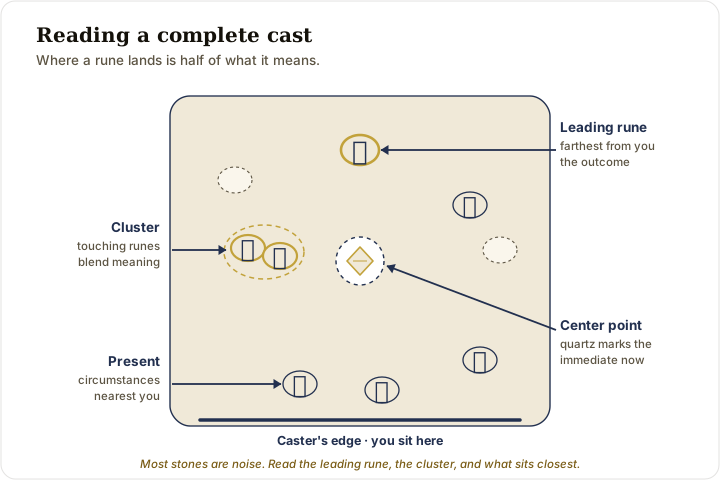
A small honest note from my own practice: the first few times I cast, I wanted to interpret everything. Every gap meant something, every rune that wobbled mattered, the cat walking past was an omen. It is not. Most stones in a cast are noise. What you are looking for is the one cluster that genuinely jumps off the cloth, the leading rune that lands and makes you go oh, and the proximity that you did not consciously expect. The all-face-down cast happens sometimes; the right response is to put the runes away and ask again in a week, not to keep throwing until you get the answer you wanted.
A worked cast: reading proximity in practice
A question: I am stuck on a writing project, what do I do.
Five of the thirteen land face-down and get pulled off the cloth. Of what remains, the Star lands furthest from me. That is the leading rune, and it tells me the long-arc outcome is hopeful and in line with purpose, which is reassuring before anything else.
Close to me, the Scythe is touching the Waves. The Waves are my emotional and creative current; the Scythe is the cut. Read together, the cluster is saying that the thing blocking me is a part of the work I am emotionally attached to, and the way forward is to sever it. Not edit, not soften: cut.
Between that cluster and the distant Star sits the Crossroads. It is the bridge between the cut and the good outcome, and it is naming the decision plainly. Stop circling. Pick the road. Make the cut and the Star comes into reach.
That is the whole shape of a complete cast: the distant anchor, the near cluster, and the rune that names what is being asked of you in between.
Make your own set (this matters more than buying one)
The tradition is explicit on this: a handmade set is considered stronger than a bought one, because the hours and attention you put into making it charge the tool with your own signal. Susan Sheppard pressed this point especially hard. Even if your set turns out wonky, the wonky stones you painted at your kitchen table will read better for you than a polished gemstone set from a shop.
Materials. Thirteen smooth river or beach stones of roughly even size is the most traditional route. Wood "cookies" (thin round slices of branch) work too, and wood lets you choose for correspondence: oak for strength, ash for spiritual reach, cedar for protection. If you are urban or low on access, air-dry clay discs or epoxy resin work fine. Forage gently when you are gathering from outside: take little, leave more, and never strip a site.
Marking. Black acrylic, an enamel marker, or a permanent paint pen on stone. On wood, many practitioners reach for a pyrography (woodburning) pen, which has the side benefit of pulling fire into the making. On wet clay, carve the symbol in deep before it dries.
Sealing. Clear nail varnish, Mod Podge, or a clear topcoat so the symbols survive being thrown across a table over and over. Skip this step and you will be repainting in a month.
Charging. As you draw or burn each symbol, sit with what it means. Think about growth and warmth while you paint the Sun. Think about every ending you have already survived while you burn in the Scythe. This sounds soft and it is the part that does the actual work; the meaning gets baked in while your hands are busy.
Housing. A natural-fiber pouch (cotton, silk, jute, leather) becomes the set's home and a small buffer between the runes and the ambient noise of a room.
A quick honest aside on buying. If making is not realistic right now (no quiet hours, no surface, a small flat with a curious toddler), a bought set still works once you cleanse it and sit with it for a few quiet sessions. There is no gatekeeping here. For the wider question of what an altar and a basic kit actually need, see the practitioner's tool kit.
Cleansing and caring for your runes
In this tradition, divinatory tools are treated as energetic sponges. Repeated handling and heavy emotional questions are believed to leave a residue that clouds the read over time. Cleanse the set right after you build it (or buy it), after a particularly draining cast, after anyone else has handled them, and on a regular cadence with the new or full moon if you want one.
The mistake beginners make is matching the method to the mood instead of to the material. Wood especially will not forgive you. Match method to what your runes are actually made of.
- Sacred smoke (garden sage, rosemary, cedar, lavender, palo santo). The safest universal method, fine for every material. Light the bundle, let the plume rise, pass each rune through it. Many practitioners rotate the stone counterclockwise through the smoke as a release gesture.
- Salt burial. Bury the runes in a bowl of unprocessed sea salt or Himalayan pink salt for around twenty-four hours. Excellent for sturdy stone and resin. Do not do this with wooden runes; salt dehydrates wood and cracks it.
- Moonlight overnight. Lay them on a windowsill or somewhere safe outdoors under a full moon. Gentle, traditional, and it recharges with feminine and intuitive energy at the same time as it cleanses. Pairs naturally with the moon phases if you want a rhythm.
- Running water. Hold sealed stone runes briefly under a stream, a tap, or collected rainwater while you visualize the water carrying the static off. Avoid for porous unsealed wood, and avoid for water-soluble stones like selenite and malachite, which will dissolve or release something you do not want in your hands.
- Visualization only. Hold the runes, breathe out what is stuck, breathe in fresh earth energy. The fallback when you have no supplies and no time, and a genuine practice in its own right.
After cleansing, charge the set: hold the runes tightly in cupped hands, breathe your intention into them, say a small blessing if that fits your practice. Then back into the pouch. For the wider logic of releasing stuck energy from a space, not just from objects, cleansing and banishing covers it.
This supports how you feel and how you work; it is not a stand-in for medical care, money advice, or legal counsel. If something physical, financial, or legal is genuinely wrong, please go to the right professional too.
Witch's runes vs other beginner divination tools
The witch's runes are the lowest-barrier "throw it and read by feel" oracle on the table. The pictograms are universal, the rules are short, and a homemade set costs almost nothing.
A pendulum is the precision tool: tight yes-or-no questions, a clear binary read, very little ambiguity. Tarot is the structured option: seventy-eight cards, a steep learning curve, and rich detail once you are in it. Witch's runes sit between them: more flexible than a pendulum, less to memorize than a deck.
Pick by the question you are actually asking. For a sharper introduction to the swing, see the pendulum basics and the pendulum vs runes head-to-head. If you are shopping for a first divination tool on merit rather than aesthetic, beginner divination tools lays out what is worth your money.
Where to go next
A few honest next reads, depending on where you actually landed:
- Came in here looking for the Norse alphabet? That is the Elder Futhark, properly read.
- Want to widen the menu? other divination methods and how to scry.
- Brand new to the craft overall? Start at witchcraft for beginners and build from there.
If the runes feel right, paint a set this week. Cast badly. Cast again. The fluency is in your hands, not in any book.
Keep exploring
Browse more guides, or start with the basics of the practice you are curious about.
Browse more guides