How to Manifest With Witchcraft: A Beginner's Bridge
If you want to learn how to manifest with witchcraft, you are closer than you think: you already set intentions and write them down. The witch does that too, then picks up a candle.
Three beginner workings to actually try
Three workings, in order of effort. A kitchen, a pen, and ten quiet minutes are enough. Pick one.
1. Bay-leaf intention (the closest cousin to scripting)
If you already script, this is the working that will feel most like home. You write the intention. You burn it. The fire does what re-reading the page used to do.
Bay (Laurus nobilis) has carried associations with wishes, success, and protection for centuries, which is why it shows up so often in folk magic for fast, specific asks. The leaves are also broad, dry, and flammable, so they make a genuinely usable piece of magical parchment.
Walk it through:
- Pick a whole, unbroken dried bay leaf and a pen. Match the ink to the goal if you can: green for money, red for love, black for boundaries.
- Write one potent phrase. A single word like "callback." A specific dollar figure. A short line like "the right yes finds me." Concise beats paragraphs here, and the brevity is the discipline.
- Hold the leaf flat between your palms. Picture the outcome as already done, the way the manifestation books taught you. Pour that picture into the leaf.
- Light it from a candle flame over a fire-safe bowl. Bay catches fast. There is a sharp, almost peppery snap when the oils in the leaf go up, and a curl of smoke that lifts straight before it spreads. Watch it.
- Dispose of the ash on purpose. To draw something in, blow the cool ash gently toward your front door. To release something, scatter it to the wind or bury it.
Honest practitioner note: bay smoke is fast and bright, and the working reads that way too. It is excellent for one specific ask (a callback, an offer at a number, a clear yes). It is the wrong tool for "fix my whole life." Match the working to the size of the request.
The mundane pair is unmissable. Send the application. Make the call. Ask for the meeting. The bay leaf is the nudge. You are the hand.
2. Candle intention rite (the cornerstone)
Candle magic is the workhorse of modern witchcraft. One candle, done with care, is a complete ritual in miniature, which is why nearly every practitioner-author who writes for beginners (Cunningham, Madame Pamita, Mat Auryn among them) leans on it.
Walk it through:
- Choose your color. Green for abundance, pink or red for love, white as a clean all-purpose, black for protection and banishing.
- Cleanse the candle. A quick wipe with saltwater, or a pass through incense smoke. The belief is that you are clearing whatever residual energy the candle picked up between the factory and your altar; the felt effect is that the candle starts to feel like yours.
- Carve. With a pin, a needle, or a wooden skewer, inscribe a name, a single word, or a sigil into the wax. Press lightly. The mark only needs to be there, not deep.
- Dress. Anoint the candle with a corresponding oil. Olive oil is enough to start, no need to buy "money-drawing oil" on day one. Practitioners often work from the middle out: middle to top to draw something toward you, middle to bottom to send something away. The oil acts as the binder.
- Roll. Press the oiled candle into a small dish of dried herbs and turn it once or twice. A pinch of cinnamon for speed. A pinch of basil for money. Lavender for peace. Less than you think.
- Light, speak, sit. Strike the match, light the wick, say the intention out loud once. Then sit with it. The point of speaking aloud is mostly so your own ears hear you commit.
- Read the flame as it goes. A tall, clean flame is read as a clear road. A sputter or a dance is read as a blockage or a contested outcome. If you must put the candle out before it finishes, snuff it; the tradition is that blowing it out symbolically blows the intention away too.
Honest aside, because it always happens: the first time the wax pools and the rolled herbs catch a little, your stomach drops. This is normal. It is also why the fire-safe dish is non-negotiable and why over-dressing the candle is the most common rookie mistake. Three pinches of dried herb is plenty. A handful is a small kitchen fire.
A small material ask: choose beeswax or soy where you can. Paraffin is cheap and very smoky, and the rite is intimate enough that what you breathe matters.
For the full method, the variations, and the deeper flame-reading, see the candle magic guide. For matching candles to specific goals without overspending, honest candle picks.
3. New-moon intention jar (the slow-cook one)
Lunar timing gives a spell a clock. The new moon, when the sky is dark, is the traditional time to plant a seed of an intention and let it grow across the cycle. By the time the moon is full, the jar has been sitting on your altar for about two weeks, quietly radiating.
Walk it through:
- Clean the room first. Physically tidy, then cleanse with smoke or a bell or whatever you reach for. The new moon's energy is read as a blank slate, and you want the room to match.
- Write the intention on a small piece of paper. Fold it toward yourself three times to draw the thing in.
- Layer the jar. Drop in the folded paper. Add a sweetener (honey or sugar) if you want the situation to soften toward you. Add the corresponding herbs (rose petals for love, basil for money, lavender for peace). Add a personal token if you have one (a thread, a fingernail clipping, a coin).
- Seal it. Close the lid, then drip melted wax from a corresponding candle over the seam. The tradition is that the wax seal locks the spell in, turning the jar into a small, continuous battery for the intention.
- Let it sit. Put the jar somewhere quiet on your altar, a shelf, the back of a closet if you are in the broom closet. Leave it through the waxing moon to the full moon, and longer if it still has work to do.
Honest aside: jars feel slow because they are slow. That patience is part of why they read as serious in the body. Spells you rush often feel rushed coming back to you. Jars feel inevitable.
For the sweetening variant specifically, the honey jar method goes deeper. For other jar formats, spell jar basics. For matching the working to the moon, moon timing and when the next new moon falls.
Tiny picker: which working fits which intention?
| Working | Best for | Time horizon | Effort | Mundane pair |
|---|---|---|---|---|
| Bay leaf | One small, specific ask (a callback, a yes, a number) | Minutes | Very low | Send the email today |
| Candle rite | Any drawing-in intention with one clear goal | One sitting | Low to medium | Take the meeting this week |
| New-moon jar | Slow-build intentions: a relationship, a career arc, a move | Weeks | Medium | Keep showing up across the cycle |
If you cannot decide, start with the bay leaf. The barrier is lowest, the feedback is fastest, and the working teaches you what "intention into matter" feels like before you spend money on candles. Kitchen ingredients are real ingredients, and "I only had a tea light" is a valid altar.
If these are your first spells, The Grounded Witch walks spellwork in honest order, from the first candle to what to do when a working does not land.
What "mundane before magical" actually means
Magic is a probability nudge, not a substitute for action. The candle and the resume go together.
This is the doctrine serious practitioners come back to again and again: mundane before magical. You light the candle for the job, and you also send the application. The belief is that the spell nudges the hiring manager's hand or floats your resume to the top of the pile. The belief is not that a job offer materializes out of thin air because you visualized hard enough at a flame.
It is also a guardrail for your sanity. Not every flicker is a sign. A spell candle sputters because it is overloaded with herbs nine times out of ten, not because something is attacking you. A bad dream is usually a heavy dinner. Treating every coincidence as a cosmic message is how practice tips into paranoia.
A clear line, then we move on: spellwork is not a substitute for medical care, legal advice, financial help, or a call to the police if you are in danger. If something physical is wrong, see a doctor. If something legal is wrong, see a lawyer. Magic sits alongside those, never in front of them.
"Magic plus action" is the phrase you'll hear in the craft, and it is the one that tends to bear out.
What to do after the spell
Cast and release. State the intention, close the working, then stop poking it. The "set it and forget it" instinct is doctrinally correct; constant re-casting is read as not trusting the spell to do its work, and it tends to muddy the result.
Disposal is the part most guides skip, and it matters more than the aesthetics:
- Paper, herbs, and ash for "drawing in" can be buried (in a pot of soil if you do not have a yard) to ground the energy. For "release," scatter to the wind or compost where appropriate.
- Do not salt the earth. Salt is the classic banishing material, but tipping it onto soil sterilizes the ground and kills plants. Used banishing salt goes in the indoor trash, full stop.
- Glass jars are not for rivers or oceans. Older texts will tell you to throw them in moving water; modern practice (and basic ecology) treats that as littering. Empty the jar, wash it, cleanse it, and reuse.
- Leftover natural wax can be remelted for the next working. Wax from a banishing or protection spell is typically wrapped in paper and dropped in a public bin away from the house, on the belief that you do not want what you sent away to come back through your own door.
Then life starts again. Send the application. Take the call. Show up to the date. The spell did its half.
The engine under the hood: correspondences
Every color, herb, day, and moon phase carries a traditional association. You pick ingredients whose associations match your goal, and the spell layers up.
That is the entire operating system of beginner spellwork. The Hermetic root of it ("as above, so below") is the old tradition behind why practitioners believe a small arrangement on an altar can echo a bigger pattern in a life. Treat it as the inherited logic of the practice, not a physics claim, and it stops feeling weird. Modern manifestation teaching keeps the same line as the law of correspondence, one of the 12 universal laws.
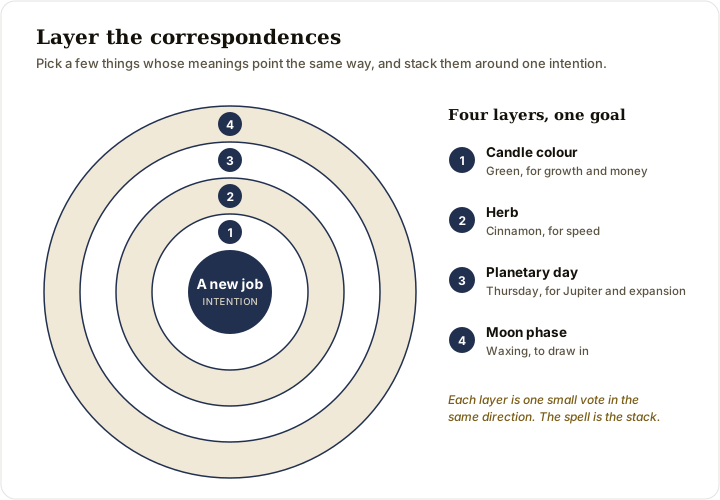
A worked example of the layering, for a new-job spell:
- Green candle for growth and money.
- Cinnamon rolled on the candle for speed.
- Thursday for Jupiter and expansion.
- Waxing moon because the cycle is currently growing, which matches "drawing in."
Each layer is a small vote in the same direction. The spell is the stack.
You do not need to memorize the whole chart to start. Reach for herb associations, color associations, planetary days, and the moon phase when you want to check a choice. Most beginners overbuild their first spell. Two or three layered correspondences is plenty.
Why your manifestation might not be working yet
A kind audit, not a lecture. If the workings keep not landing, run through this list before you decide magic isn't for you.
- The intention was too vague. "More money" is a wish. "Five thousand dollars in clean income by August" is a spell. Witchcraft rewards specificity in a way generic manifestation does not.
- You skipped the mundane half. No application sent, no number called, no date booked. The candle is not the labor.
- The timing was wrong-side of the moon. Drawing-in workings on a waning moon, or release workings on a waxing one, will feel like rowing against the current.
- You keep re-casting. Every re-cast tells the spell you don't trust it. Pick one working per intention per cycle and let it breathe.
- The goal is not actually yours. Sometimes a spell quietly refuses to land because you don't really want the thing, only the version of yourself you think wanting it makes you. The craft tends to be honest about that, even when you'd rather it weren't.
No working guarantees an outcome. Spellcraft stacks odds; it does not override the free will of other people or the agency of the universe. For the longer audit, spell troubleshooting. If it is the mindset half that keeps stalling rather than the spell, that audit lives on the other side of the bridge.
A short note on appropriation and sourcing
If you arrived here with a "smudge kit" already in your cart, this is the kind paragraph.
White sage and palo santo are both badly overharvested, and "smudging" is a specific closed Indigenous ceremony, not a generic word for "smoke cleansing." Smoke cleansing as a general practice is ancient and cross-cultural, and you can do it well with garden sage, rosemary, pine, mugwort, or your own grown herbs. The ritual works. The shopping habit is what needs adjusting.
Hoodoo, Rootwork, and other lineage traditions are closed practices. They are not open studio time for outsiders, and the honey jar most internet witches know is borrowed from Hoodoo in ways that deserve more care than the average TikTok suggests. Respect the door even when no one is watching it.
More on both: closed practices, plainly and sourcing your herbs without harm.
Manifestation, but with a toolkit
Witchcraft is manifestation with a physical toolkit. You stop visualizing the outcome and start building it with a candle, a written word, a pinch of cinnamon, and a deadline the moon sets for you.
That is the entire shift in one sentence. Where manifestation works almost entirely between your ears, spellwork moves the same intention into the room. Wax. Smoke. Salt. A jar with a lid that closes. The mental work doesn't disappear, it just gets a place to land.
Nothing about that handoff requires robes, a coven, or a Sephora bag of crystals. The mindset half of manifestation (scripting, the 369 method, vision boards, vibrational alignment) belongs to the manifestation side of your practice. Spellwork is the other half: it takes the intention you are already setting and gives it a body.
You don't need to "become a witch" to try this. If you feel the pull, you are allowed to pick up the candle. There is no checklist, no permission slip, and nothing to join.
The bridge in one line: visualizing vs. ritualizing
Manifestation is cognitive. Spellwork is sensory.
In manifestation, the practitioner is mostly a receiver, tuning her internal frequency to match what she wants and waiting for reality to mirror it back. In witchcraft, she is an active co-creator. She picks ingredients with traditional associations, arranges them deliberately, lights the thing, and speaks the intention out loud so her own ears can hear it.
Most practitioners I know treat manifestation as step one (the focused intention) and spellcraft as what they do with it next. The visualization writes the file. The ritual saves it to disk.
Quick comparison: manifestation vs. spellcraft
| Manifestation (Law of Attraction) | Witchcraft (spellcraft) | |
|---|---|---|
| Core philosophy | Like attracts like; reality mirrors your dominant internal frequency. | Sympathetic magic; intention is anchored by manipulating corresponding physical symbols. |
| Role of practitioner | A magnetic receiver, aligning to receive what the universe offers. | An active co-creator, directing energy toward a chosen outcome. |
| Primary tools | Vision boards, journaling, affirmations, meditation, emotional regulation. | Candles, herbs, oils, sigils, lunar timing, the four elements. |
| View of reality | Risks tipping into toxic positivity; negative thoughts feel dangerous. | Accepts that chaos exists regardless of mood; uses banishing and protection where needed. |
| Mechanism in practice | Subconscious reprogramming and cognitive alignment. | Sensory ritual that bypasses the doubting mind and anchors the intention in the body. |
Neither column is the "real" one. They are two halves of the same instinct. The witch just adds matter to it.
Where this leaves you
You came in to manifest. You leave with a candle, a bay leaf, and a jar plan. The mindset half of your practice still matters; keep scripting, keep journaling, keep doing the inner work where it lives. This side of your practice is just the part that has a body.
If you want the mechanism under all of this, how spells actually work is the next read. If you want the broader on-ramp, start here as a beginner witch, and if money is tight, on a budget is honest about what you actually need.
And if you are still hovering at the door, wondering whether you are allowed: am I a witch? is waiting.
Keep exploring
Browse more guides, or start with the basics of the practice you are curious about.
Browse more guides