Witchcraft on a budget is not a downgrade, a workaround, or a starter tier you graduate from. A struck match, a pinch of table salt and your own focused breath are doing the same metaphysical work as a two-hundred-dollar altar kit. You do not need permission, a shopping list, or a credit card to start. If you feel the pull, you are already a witch, and the practice is already available to you tonight, in the kitchen, with what you have.
Witchcraft on a budget, in one breath
A struck match, a pinch of table salt and your own focused breath are as real as a two-hundred-dollar altar kit. You do not need to buy anything to start. Spending is welcome later, on its merits.
What the algorithm sells as "the witchy aesthetic" is one expression of a much older, much cheaper craft. The visual stack of taper candles, crystal grids and apothecary jars is beautiful. It is also optional. The work itself happens between your intention and your attention, and both of those are free.
If WitchTok made you feel priced out, that is the platform's logic, not the craft's. Anti-hype, not anti-money. The lie is the problem, never the seller.
Why "broke witch" is a real tradition, not a downgrade
The long lists of "required" ritual tools you see in older books come from a particular lineage: European ceremonial magic, which historically catered to wealthy, educated men who could afford rare resins, hand-forged blades and engraved silver. That is one strand. It is not the whole rope.
The other strand, much older and much more widely practiced, is folk magic. Cunning folk, hearth witches, midwives, and village healers worked with whatever the kitchen, the hedgerow and the woodpile gave them. The cauldron was the cooking pot. The wand was a stick. The grimoire was a household ledger with strange margins.
When you reach for a kitchen knife and a pinch of salt instead of a consecrated athame and black tourmaline, you are not improvising downward. You are stepping into the older witch types lineage, where the kitchen witchcraft of the working poor was the dominant tradition for centuries. Broke is not purer. It is just as real.
The household swaps: what to use instead of what to buy
The rule under every swap: the object carries no power on its own. The action you perform with it cues your nervous system into ritual space. A blade directs energy because you are directing energy along it. A cup holds magic because you are holding the moment. Lacing the shoes is not what wins the race, but the lacing tells the body the race is starting.
| Traditional tool | Typical price | Household swap | What it actually does |
|---|---|---|---|
| Athame (ritual blade) | $40 to $150+ | Paring knife, pocket knife, fallen branch, or your own pointed finger | Directs energy, traces protective perimeters |
| Cauldron (cast iron) | $35 to $100+ | Heavy ceramic mug, soup pot, dutch oven, fire-safe rice bowl | Fire-safe vessel; stands in for water and the womb |
| Chalice (silver or crystal) | $25 to $80+ | Thrifted wine glass, water tumbler, favourite teacup | Holds ritual water; receives energy |
| Pentacle (engraved disc) | $20 to $60+ | Drawn on paper, scratched on a wooden coaster, laid out in twigs | Grounds energy; focal point for earth |
| Protective crystal (black tourmaline) | $15 to $50+ | Table salt, crushed eggshell (cascarilla), found stone | Absorbs and shields; sets a physical ward |
| Incense or smudge bundle | $10 to $30+ | A bell, a glass tapped with a spoon, a broom, an open window | Moves stagnant air and energy out of a room |
A few of these benefit from a sentence of context. The athame's job is to direct, so anything that helps your hand point with intention will do; I have used a wooden chopstick when nothing else was nearby. The chalice loves to be personalised, and an acrylic paint marker on a $2 thrifted wine glass will turn it into yours in five minutes. The pentacle can simply be drawn, every time, with a fingertip in salt on the table top.
The full altar build, when you want one, lives in altar setup. The optional buy-list lives in witch tools. The honest commercial pick, if and when you want to spend, lives in starter kit.
A note on fire safety with kitchen vessels
Coffee mugs and glass bowls can crack or shatter under sustained heat, and a thin ceramic dish can craze if you put a wick straight on it. Use a tealight in a small heatproof saucer inside the "cauldron," not a roaring flame against cold glass. Never leave a lit candle unattended. The whole point of a budget practice is that the rest of your life keeps running unharmed.
Cleansing and warding with what you already have
A short, kind word on the white sage and palo santo question before the practice. Both became WitchTok cleansing defaults in the late 2010s, and the demand has done real damage: wild white sage (Salvia apiana) populations across Southern California have been hit hard by mass commercial harvesting, much of it on land the Chumash, Tongva and Cahuilla peoples have stewarded for generations. Palo santo has a similar story in South America. These are living practices belonging to specific communities, and the marketplace tore them out of context. The kinder, cheaper, more honest alternatives were always sitting in your kitchen.
- A bell, or a glass tapped with a metal spoon
- A household broom, sweeping stagnant energy out the front door
- Open windows on opposite sides of the room; a cross-draft is a cleansing
- A single white tealight in place of any colored spell candle
- A battery candle or a small desk lamp where flame is forbidden (dorms, rentals)
- Table salt or crushed eggshell at the thresholds
More on the appropriation question lives in closed practices. For a full walk-through of clearing a room, see cleanse your home, and for the firmer end of the work, banishing ritual.
A five-step salt warding rite
The whole kit: one candle, one shallow bowl, one pinch of table salt. Done at the kitchen counter, on the floor of a studio apartment, on a windowsill in a dorm. The first time I did this I used a $1 tealight and the salt cellar I season pasta water from, and it did exactly what it was meant to do.
- Preparation. Set the candle in the centre of your working area, with the bowl of salt directly in front of it. If you want to fortify the salt further, mix in a little ash from the candle wick or a pinch of black pepper for a quick "black salt."
- Ignition and intent. Strike the match. Light the candle. Say the intention once, out loud, in whatever words feel true. "Light against shadow, flame against fear, I call protection to gather here" is one line that holds.
- Consecrate the salt. Hover your dominant hand an inch above the bowl. Push your attention down into the grains, and speak the salt's job to it. "Salt of earth, guard this space."
- Set the perimeter. Take pinches of the charged salt and scatter it lightly across doorways, windowsills and the line where the room meets the hall. The grain catches the candlelight as it crosses the threshold, and that small visual is half of why this works on the nervous system.
- Close. Sit still for a beat. See the salt as a glowing barrier holding the line. When it is locked in your mind, snuff the candle.
More on the protection register lives in protection spells.
Your pantry is already an apothecary
Most of what you would buy from a specialty herb shop is already on your spice rack, and the herbs you have stayed friends with for years (the rosemary you keep meaning to use up, the basil you grow in a windowsill pot) tend to work better in your hands than something exotic and unfamiliar. Familiarity is part of correspondence.
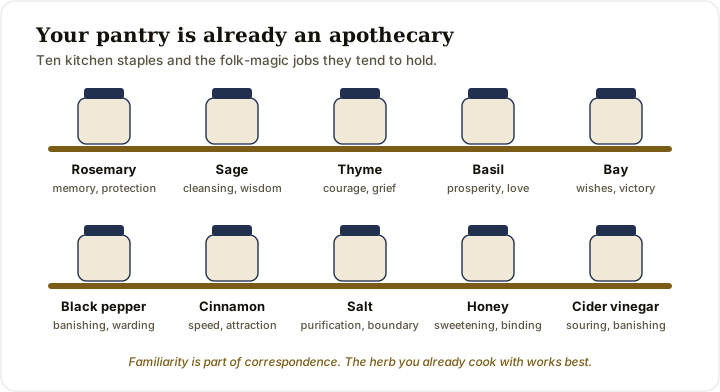
On the liquid shelf: apple cider vinegar is the classic souring agent in folk magic, used to turn a situation away from you or to cut a tie cleanly. A drop of hot sauce in a candle dressing is said to speed a working along. Olive oil or coconut oil, infused for a week with a pinch of dried herb on a sunny windowsill, becomes a respectable anointing oil for a candle's body or your own pulse points. (More on this in kitchen witchcraft.)
On the produce shelf: a halved onion left under the bed overnight is an old folk method for drawing sickness or heavy mood out of a body, then thrown straight in the outdoor bin in the morning. A potato can be hollowed out, filled with a written petition and herbs, and buried in a houseplant.
The full correspondence chart lives in herb correspondences. If you start eyeing the local park's herbs, please read ethical wildcrafting first; "free" and "safe to ingest" are not the same word.
One tiny patch-test rule
Any oil you put on skin gets a patch test on your inner forearm twenty-four hours before you anoint anything more sensitive. Any "edible" spell ingredient still has to be food-safe, stored properly, and within use-by. This supports how you feel, not a diagnosis. If something physical is wrong, please see a doctor too.
The internal toolkit: practices that cost nothing
Every paid tool above is optional. The four practices are the actual engine, and none of them have a price tag: breath, visualisation, movement, and the written record. You can run a serious craft on these four alone for a year, and many people quietly do.
Breath and grounding (the four-square root)
Take your shoes off. Sit upright on a chair with your feet flat on the floor, or sit cross-legged on the ground if you have it. Straighten your spine without rigidity, so the breath can travel.
Begin a four-square breath: in for four counts, hold for four, out for four, hold for four. Do this for about a minute before you reach for any imagery. The first thirty seconds will feel like nothing. Around the fifth or sixth round, the breath starts to do the work for you.
Now picture your solar plexus opening, and visualise roots descending from the soles of your feet, through the floorboards, through the building's foundation, down through soil and bedrock to the cool dense centre of the earth. On the inhale, draw the earth's steadiness up into your body. On the exhale, send anything scattered, jangly or anxious back down the roots to be neutralised.
Honest note: the first time you do this it will feel like a slightly silly visualisation exercise. By the end of week two, the inhale lands differently. By month two, you can drop into the state in three breaths at a bus stop. That is the whole spell. The full drill lives in grounding and centering.
Movement and walking as ritual
For solitary work, the cheapest way to raise energy is to use your body. Put on one song you love. Move to it without watching yourself in any mirror. The trance state ceremonial witches build with imported resins and an hour of choreography, your nervous system will give you for free in three minutes of honest dancing in a locked bedroom.
Walking meditation is the subtler twin. Walk a quiet block, or a single corridor, at half your usual pace. Notice the sound your shoes make. Notice the air on the back of your neck. When a thought arrives, let it walk past you instead of joining you. The first ten minutes feel pointless. Somewhere in the second ten, the path becomes the spell, and you arrive home holding a question's answer that you were not consciously asking.
A cheap notebook IS a grimoire
A $2 dotted notebook from the supermarket stationery aisle, blessed with a single sentence on page one ("this is the record of my craft"), is a grimoire. The leather-bound, parchment-pretty version is lovely if you want one later, and there is no urgency.
A bullet-journal style works beautifully here. A grocery list on the page next to a moon-phase log next to a tarot pull is not a flaw; it is the texture of a real practice that lives inside a real life. Perfectionism is the thief here, not budget. Write in pen, cross things out, keep going.
If you want to think through the format question (notebook vs binder vs digital), journal vs binder is the place. The wider how-to is book of shadows. For a daily rhythm to hold all of this, daily practice.
How to consecrate a kitchen knife (or any mundane object)
There is a real psychological hurdle in picking up the same paring knife you used to chop a courgette this morning and using it to direct energy at sunset. The hurdle is not magical, it is associative, and a quick consecration clears it. Free, five moves, takes about ten minutes the first time.
- Cleanse. Strip the day off the object. Bury it overnight in a bowl of table salt, or leave it on the windowsill under tonight's moon, or hold it under cold running tap water for a minute while picturing white light moving through the metal and washing the day-energy out.
- Cast a mental circle. Sit in a quiet room. Visualise a soft dome of light around you and the object, sealed at the floor.
- Hold and dedicate. Take the cleansed object in your dominant hand. Close your eyes. Picture, vividly, the work it is going to do: tracing wards, dressing candles, slicing a lemon for a sweetening jar.
- Breathe the intent in. Inhale, picturing your intention as a coloured light gathering in your chest. Exhale it onto the metal in one slow, deliberate breath.
- State and close. Say out loud, in plain words, that the object is now part of your craft. When you need to put it back into the cutlery drawer, reverse step 3 in your head and call it mundane again. It will hold both lives without complaint.
The WitchTok problem, named kindly
The algorithm rewards the look of the craft over the practice of the craft. Short-form video is a visual medium, so a thirty-second clip of a perfectly lit altar with twelve crystals and three taper candles will out-perform thirty seconds of a woman sitting still and breathing. That is a platform fact, not a spiritual one.
The cost of this lands on the newer practitioner in three ways. First, financial exclusion: a baby witch with $20 to her name watches a $200 altar setup and concludes she does not yet "count." Second, spiritual bypass: the comforting illusion that ordering a pre-made spell jar is a substitute for the slower, harder, internal work the jar was meant to scaffold. Third, the appropriation pipeline: closed practices and protected plants get torn out of context and rebranded as trending consumer goods.
None of this means the witch buying a beautiful tarot deck is doing anything wrong. The enemy here is the lie ("buy this and your life will transform"), never the seller, and certainly never the practitioner choosing to spend. Spending is welcome when the object earns its keep. The test is sincerity, not aesthetic.
If you want to think harder about the gap between the visual and the practice, aesthetic vs practice. The honest list of supplies that are usually a waste of money lives in supplies to skip. And when you do want to spend on one thing, honest starter kit.
Where it IS worth spending (eventually, if you want to)
Anti-hype is not anti-money. A few categories tend to earn their cost back many times over, when the timing is right.
A good divination deck is the obvious one: a tarot or oracle deck whose art genuinely speaks to you, whose card stock you enjoy shuffling, will get pulled out for years and pay its $25 back in answered Tuesday-night questions. A sturdy journal you actually want to write in beats the prettiest one you are too precious to mark up. One well-made beeswax pillar candle, used for slow burns over months, can be a richer investment than a Sephora-bag of paraffin tealights you race through in a fortnight.
If you want recommendations on merit rather than hype: books roundup, divination tools, journal pick, and the honest answer to are kits worth it.
Voices worth reading (free or library-priced)
Almost all of these are on Hoopla, OverDrive or your local library system; the library card is the single best magical tool I will ever recommend. If you have to buy, used copies on second-hand book sites usually run a few dollars.
- Broke-Ass Witchcraft (Raven Morrigan). Best for: burnt-out, anxiety-shaped, working-too-many-hours practice. Not for: anyone wanting elaborate, multi-day ceremonial structure.
- Thrifty Witchery (Martha Kirby Capo and Vincent Higginbotham). Best for: building intuition and inner skill before any purchase, with concrete exercises. Not for: anyone hoping to skip the inner work.
- Witchcraft on a Shoestring (Deborah Blake). Best for: DIY makers; rune-carving, sabbat recipes under $10. Not for: anyone who hates a craft project.
- The Thrifty Witch's Book of Simple Spells (Wren Maple). Best for: pantry spells with five ingredients or fewer. Not for: practitioners chasing intensive ceremonial layering.
- Bare Bones Magic (Emilee Avink). Best for: declutter and intention-amplification on a minimalist altar. Not for: maximalists drawing energy from a heavily-dressed altar.
- Spells for Change (Frankie Castanea). Best for: politically engaged practice, magic alongside collective action. Not for: anyone wanting an apolitical or strictly Wiccan liturgy.
- Rebel Witch (Kelly-Ann Maddox). Best for: eclectic, anti-cookie-cutter paths and writing your own. Not for: strict traditionalists wanting lineaged structure.
A wider review of beginner books, with honest pros and cons, lives in best witchcraft books.
A one-week, zero-dollar starter
Spending nothing, this is what the first seven days of a real practice can look like. Magic plus action. Use what you have.
To expand that no-cost week into a grounded first year, The Grounded Witch keeps the rule: start with what you own, write down what happens, let the practice earn its tools slowly.
- Monday. Sit on the floor. Four-square breath for five minutes. Run the grounding visualisation once. Note one line in any notebook about how the body felt at the end.
- Tuesday. Pick one kitchen knife. Walk the consecration above. Use it that night to chop something for dinner, then put it back in the drawer mundane.
- Wednesday. Salt the thresholds of your home or room with the five-step warding rite. One candle, one bowl, one pinch.
- Thursday. Walk a quiet block at half pace as walking meditation. Carry one question in. See what walks out with you.
- Friday. Open a notebook. Write a one-sentence dedication on page one. Underneath, write what you hope to give to this practice and what you hope to receive from it.
- Saturday. Pick one pantry herb, one intention, one tealight. Light the candle, hold the herb in your hand, name the intention, sprinkle the herb at the candle's base. Burn it down safely. This is a beginner spell.
- Sunday. Rest. Read back the week's notes. Mark what bore out and what quietly did not. The honesty is the practice.
The fuller sequencing for first moves lives in baby witch checklist, and the first castable workings in beginner spells.
A kind word about the broom closet
Almost all of these practices work inside a shared bedroom, a parental house, a strict rental, or a job that needs to never see this part of you. Mug cauldrons live in cupboards. LED tealights pass any inspection. A bullet-journal grimoire reads as a planner. Discretion and budget overlap more than they are usually given credit for. More on living this way, well and quietly, in broom closet witch.
What to read next
If you are piecing together first moves and want the ordered checklist, the checklist is the next stop. If you want a single small spend that genuinely earns its keep, the starter kit is the honest review. If you want to keep the no-cost momentum and let the practice settle into a rhythm, take either daily practice or kitchen witchcraft and walk it for a month. The craft is already yours. The rest is just where to put your hands next.