Am I a Witch? Signs, Doubts and the Honest Answer
If you are drawn to the craft and you start doing it, you are a witch: modern witchcraft has no test, no central authority, and no bloodline requirement. The title is claimed, not granted.
What actually makes someone a witch: the action answer
Identities are not essences. They are built by repeated action, the way a writer becomes a writer by writing badly for years and then less badly. A candle lit on a Tuesday for something you actually want. An intention stirred into the tea before the hard meeting. The moon noticed instead of ignored. A dream written down before it dissolves. A second candle, a third, a hundredth.
Do that for long enough and the question stops being "am I a witch" and becomes "what am I working on this week." The shift is quiet, and you will probably not notice the moment it happens. One day you will catch yourself answering a friend's question about a tough decision with a phrase like "let me sit with it through the new moon and tell you Sunday," and you will hear yourself, and that will be that.
If you want a concrete next step, how to actually start is the longer walk, and a starter checklist is the short one.
A short, gentle self-check
Not a quiz. Journal seeds. Sit with one a day this week, or all of them in one sitting, or none of them. There is no scoring.
- What pulled you to ask this question today, specifically today?
- What does the word "witch" feel like in your mouth when you say it out loud, alone, in a room?
- What small thing would you do this week if no one were watching and no one would ever know?
- What in your home is already an altar, even if you have not called it that?
- Whose permission are you still waiting for?
The last one is the load-bearing one. Most readers can name the person without thinking. The work of the next year, give or take, is noticing every time you reach for that permission and reaching for your own instead.
Read "signs you're a witch" lists as folklore, not a test
This is the part the internet gets the most wrong. The "fifteen signs you are a witch" listicles are not diagnostic. They are aggregated folklore and archetypal traits that tend to cluster among the kind of person who walks toward this practice rather than away from it. Resonating with six out of fifteen is not failing a cosmic exam. Resonating with two is not failing either. The lists are a mirror, not a rubric.
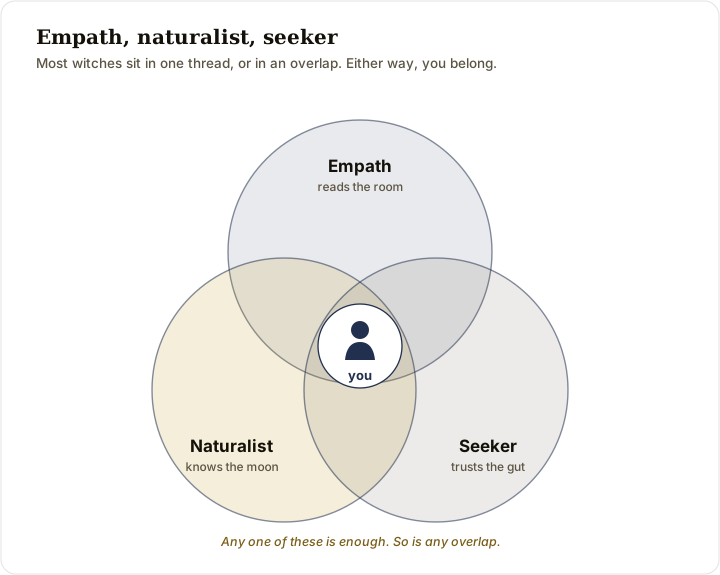
The three threads people usually find themselves in are the empath, the naturalist, and the seeker. Most witches I know sit in the overlap of two; plenty live happily in one.
The empath / energetic-sensitive thread
You read a room the second you walk into it. You leave parties feeling like someone wrung you out. You can tell when an object in a thrift store has a sad history attached to it, and you put it back. You are the friend people text at 2am.
In psychology, this cluster of traits maps onto what gets called the highly sensitive person. In the craft, that same sensitivity is the foundational instrument: it is how practitioners learn to sense energy, to know when a space needs cleansing, to feel a working land or not land. Either framing is welcome here, and they do not cancel each other out. The sensitivity is the same sensitivity. What changes is what you decide to do with it.
The naturalist thread
You can name the moon phase without checking. You feel different in a forest than in a parking lot, and you have always known it. As a child, your pockets came home full of small specific things: a striped pebble, a wren feather, the empty shell of a snail. Some of those things sat on your windowsill for years and you never thought of them as an altar, until one day you read the word "altar" and your stomach dropped, because of course that was what it had always been.
If this thread is loud for you, the green and kitchen paths are where most readers in your shape end up. There is the green path for the herb-and-garden inclination, and the kitchen path for the practice that lives in soup and bread and a stirred cup.
The seeker / intuitive thread
The dreams are vivid, sometimes uncomfortably accurate. The gut feeling about that person turned out to be right and you wish it had not been. You were the kid in the library's mythology section while everyone else was outside. You have kept a journal, more or less, since you were nine, and it has always been part diary, part observation log, part list of things you want to be true.
That journal is already a proto-grimoire, if you decide to call it that. The grown-up version of the same instinct is the book of shadows, and most seekers I know find that naming it changes the way they keep it, in a good way.
What the lists are not
The signs are not a checklist. They are not pass/fail. They are not a personality test. They are not a fraud detector. And if none of the three archetypes feels exactly like you and the pull is still there, the pull is the data. Trust the pull over the listicle, always.
You don't have to believe in the supernatural
There is a whole wing of the craft that calls itself SASS: skeptical, agnostic, atheist, science-seeking. These are practitioners who hold that magic is a psychological practice, that the spell is ritualized focus, that the candle is mythopoetic discourse made visible, and that the placebo effect is not an insult but one of the most reliably documented mechanisms in the entire human nervous system. Plenty of them practice every day.
Other witches believe the candle moves the world in a literal way: that energy is energy, that spirits act, that the universe responds to a clear request. Both frames are welcome here, and the practice tends to look surprisingly similar from the outside no matter which one you sit in. If you want the epistemology question unpacked at length, that lives on is witchcraft real; if the SASS frame is the one that finally lets you call yourself a witch without flinching, secular witchcraft is where to start.
The "magic plus action" frame
Whichever side of the belief line you stand on, the practice tends to bear out the same way in real life: magic plus action. You light the candle for the job, and you also send the application. You cast for the breakup to be clean, and you also have the conversation. You do a working for your health, and you also book the doctor. The candle and the calendar reminder are not rivals. They are how this works.
What "witch" doesn't automatically include: closed practices
The open-door framing needs one clear, kind boundary. The words "witch," "practitioner," "mage," and "mystic" are open: anyone who does the practice can use them. Some other titles are not.
A Mambo or a Houngan is a priest in Haitian Vodou, conferred by formal initiation inside a tradition rooted in a specific ancestry and history. "Shaman" originates in a Tungusic and Siberian context and now most often refers to Indigenous medicine workers; it is not a synonym for an eclectic witch. A Gardnerian Wiccan is someone initiated by an existing Gardnerian coven; you cannot self-confer the lineage. White sage and palo santo are bound up with closed ceremonies and, separately, with ecological overharvest; there are plenty of European-tradition cleansing herbs (rosemary, mugwort, juniper, bay) that do the same job without that weight.
None of this is a scolding. It is the difference between an open title and a conferred one, and getting it right is part of how a thoughtful practice looks. The longer treatment, with the why behind each line, is on closed practices.
A quiet note on belief, anxiety, and when to step back
Spiritual practice supports how you feel; it is not a diagnosis or a treatment, and it does not replace one. If anything you are experiencing is frightening, intrusive, or interfering with sleep, work, or relationships, that deserves real care from a doctor or therapist alongside whatever practice you keep. A grounded craft and grounded care are friends, not rivals; the witches I trust most have both a tarot deck and a therapist, and they do not feel any tension between the two.
There is no witch pope
The community shorthand for this is that there is "no witch pope." No central scripture, no licensing board, no high council that signs off on your practice. That open-source quality is not a loophole; it is the actual structure of modern witchcraft, and it is the reason two people on the same path can practice in radically different ways and both be doing it right. If the worry underneath your question is the harder one, whether any of this is real at all, that is a separate conversation, and I have a longer one on is it real.
Why this question hurts (and why almost every new witch asks it)
The fear under the question is usually some mix of three things. That you are a fraud. That you are doing it wrong. That someone you love would laugh, or worse, look at you with quiet pity. None of those fears mean you do not belong. They mean you grew up in a culture that taught you to wait for someone with a title to tell you who you are. That habit can be unlearned, and a fair amount of the craft is the unlearning.
Most of us were raised inside religious or cultural structures that conferred identity from above. A priest dipped the baby. A bishop confirmed the teenager. A degree was signed, a license issued, a title earned by someone else's permission. Then you wander into a tradition where the door has no lock and the porch light is on, and the disorientation is so total it reads as wrong.
It is not wrong. It is the part you have to walk through. Almost every practitioner I know has stood on that porch and felt like a tourist. Imposter syndrome is so common in the craft that veteran writers treat it as a developmental milestone rather than a problem to solve. The fear of being seen, of being called silly, of being the witch the village would have whispered about, is old. Some of it is yours; some of it is inherited. I trace more of that thread in the inherited fear piece, because it deserves its own room.
"Am I doing it wrong?"
The specific shape of the fear usually goes: I do not have an altar. I have one cheap rose quartz from a museum gift shop. I have never cast a circle. All I do is light a candle some nights and sit with what I want to be true. Surely that does not count.
It counts. The community's answer, over and over, is that the practice is the autonomy and the intention, not the props. A daydream held in a "very relaxed, altered state" with a clear aim is a working. A quiet candle is a working. A walk where you actually notice the moon is a working. If your worry is more specifically that you love the look more than the practice itself, sit with aesthetic vs practice for a minute; it is a fair worry and it has a clean answer.
You are not "born" a witch (and that is good news)
The hereditary-witch trope is one of the most stubborn things pop culture has done to us. Harry Potter, The Craft, the "seventh daughter of a seventh daughter" line. The story always lands the same way: magic is a bloodline, the chosen one is chosen, and the rest of us are muggles forever.
Veteran practitioners are blunt about this. Nobody is born a witch any more than they are born a doctor. You study and practice, and then you are a witch. The author Terry Pratchett, who wrote witches more honestly than most novelists, put it as: anyone can be a witch if they put the time in. That sentence is doing a lot of work. It democratizes the door. It moves the question from "am I one of the special people" to "am I willing to do the thing." The first question has no answer. The second is yours to make.
What about feeling "called"?
The calling is real; it is just not a mandate. In this community, "called" usually means a curiosity that refuses to leave. A pull toward the moon you cannot quite explain. An eye that catches on the herb section of the grocery store. A teenage obsession with tarot that you put down for ten years and then picked back up the week your life cracked open.
You do not need a vision or a thunderclap. The persistent curiosity is the invitation. If it has been tapping you on the shoulder for a while, that is the calling, in the only form it usually comes.
So, am I a witch?
Nobody else can hand you this, and nobody else can take it from you. That is the part that feels terrifying for about a week and then feels like the only honest way it could have ever worked.
If you have read this far, the door is already open. The only question left is what you walk through it to do. If you want the next page to be a practical one, your first steps are there; if you want to stand in the doorway a little longer and look at the shape of the room before choosing a corner, the different paths are laid out for browsing. Either way, you have already started. The word for what you are doing is craft.
Keep exploring
Browse more guides, or start with the basics of the practice you are curious about.
Browse more guides