The Witch Wound: Reclaiming After Religious Hurt
The witch wound is the quiet flinch that comes up when you try to take up space, trust your gut, or call anything you do spiritual.
What the witch wound actually is
The witch wound is the inherited, somatic fear of being seen, trusting your intuition, and stepping into your own spiritual authority. Practitioners trace it to centuries of persecution and to high-control religion. Naming it is the first quiet step toward laying it down.
In the language practitioners use, the wound is a learned flinch around three specific things: visibility, intuition, and any feminine power that answers to itself. It is the reflex to shrink in a meeting, second-guess a strong inner no, or apologise for a craft you have not even started yet.
It is not a diagnosis and it is not a verdict on you. It is a name for something a lot of women and queer folk recognise the moment they hear it, and naming it is most of the work of laying it down.
This is a gentle starting place, not therapy. Hold that lightly while you read.
How the wound shows up day to day
The relief, for most readers, is in the recognition. The pattern is consistent enough that writers like Lisa Lister and Celeste Larsen describe almost the same list.
- Shrinking in rooms where you have something to say
- Dimming your light around people who might find it "too much"
- Apologising for taking up space, time, or air
- A persistent distrust of your own gut, even when it turns out to be right
- People-pleasing as a survival strategy you can feel in your jaw
- Body-shame, especially around desire, anger, or pleasure
- An ambient, unflattering suspicion of other women you barely know
- Panic at the idea of saying out loud what you actually believe
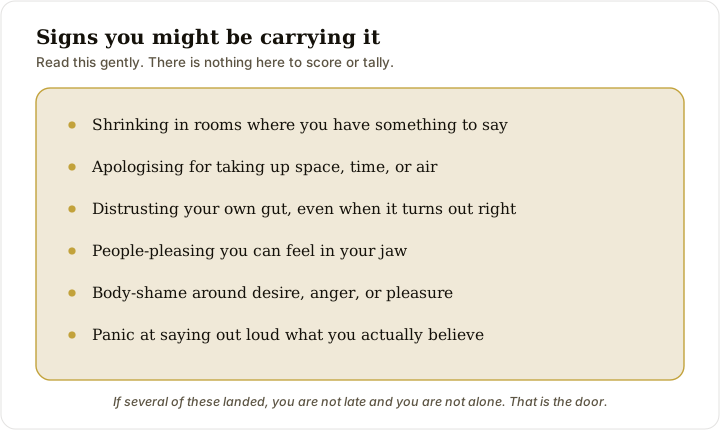
If most of that list landed, you are not unusual and you are not late. You are recognising a thing that already had its hands on you. That is the door.
Where it comes from: the honest history
There is documented record and there is lore, and a lot of online witchcraft writing blurs the two. Separating them is part of how you build trust with your own practice.
Documented. Historians estimate roughly 100,000 prosecutions for witchcraft across early-modern Europe and British America, with 40,000 to 60,000 executions. The Malleus Maleficarum, a 1487 inquisitor's handbook, codified the paranoia. The fevered peak, sometimes called the Great Hunt, ran roughly 1560 to 1630. The people most often targeted were women, especially the kind who threatened a tightly held order: midwives and herbalists who bypassed the church-sanctioned doctor, outspoken women who would not be small, and the poor or elderly who had no one to defend them. Named figures show the pattern: Agnes Sampson, a respected Scottish healer tortured and executed in 1591; Bridget Bishop, a midwife, the first hanged at Salem in 1692; Martha Carrier of Andover, hanged for being too independent for her neighbours; Rebecca Nurse, a frail and pious seventy-one-year-old caught in a land feud.
Lore. The "Burning Times" as a single coordinated war on witches, and the inflated figure of nine million dead, are framings that came later, often through twentieth-century revival writing. The documented toll was smaller and more complicated, and that honesty is part of why you can trust the rest. The fear was real. The numbers were not nine million.
For the trial-by-trial record, more in the Salem trials.
"It feels like it's in my body"
Practitioners and writers like Lister, Larsen, and Kirsty Gallagher talk about the wound as inherited, cellular, carried in the blood and bones of descendants. The science-adjacent metaphor most often reached for is epigenetics: if your DNA is a piano, the keys do not change between generations, but stress and environment can alter the sheet music so certain notes are played loud and others stay quiet.
You can hold this two ways and the practice does not change.
For the believing reader, this is ancestral memory: a great-grandmother who learned to stay quiet, passing the staying-quiet down through a body. For the more skeptical reader, this is conditioning plus a nervous system shaped by generations of "stay small to stay safe," reinforced by every modern message that confident women are "too much." Either way, the flinch in your shoulders when you consider lighting a candle in front of someone is not a personal failing. It is a survival reflex that learned its job too well.
When the wound is religious trauma, not just history
Some of what gets called the witch wound is older than any one lifetime. Some of it is much more recent, and has a name.
In 2011, the psychologist Dr. Marlene Winell coined the term Religious Trauma Syndrome to describe what happens to people leaving high-control, authoritarian faith. RTS is not a diagnosis in the DSM-5, and Winell is careful about that, but it is a clinical framework many therapists now use because it describes a real cluster of symptoms with unusual precision.
Winell argues that authoritarian religion runs on two messages: you are not okay and you are not safe. Doctrines like original sin and eternal damnation seal them in: you are inherently guilty, fully responsible for being so, and powerless to fix it without total submission to the institution. That is a double bind a child cannot escape, which is why survivors of high-control faith are often compared, in clinical settings, to people with complex PTSD.
Leaving rarely feels like freedom at first. It often feels like grief, because something that organised your entire sense of meaning has gone, and the loss is real even when the leaving was right.
A clear, kind line: this is not therapy
The witch wound is real, and spiritual practice can hold space around it. It cannot treat it.
If what you are sitting with is complex post-traumatic stress, suicidal ideation, dissociation, or clinical depression, the right next move is a licensed clinician, ideally one who knows religious trauma. In the US, the 988 Suicide and Crisis Lifeline is a phone call or text away; outside the US, your country's equivalent is the same kind of door. Finding a trauma-informed therapist is part of the reclaiming, not a failure of it. A candle is a candle. A therapist is a therapist. You are allowed to want both.
The Christian-to-witch pipeline
A lot of readers arrive here after deconstruction, and the path is common enough now that it has a name. People leave a high-control faith and notice, after the relief, that something is missing. Not the dogma. The ritual. The seasonal rhythm. The felt sense of the sacred and the comfort of doing something with your hands when life is too big for thinking.
Witchcraft offers most of that with the hierarchy, the moral policing, and the male-only authority lifted out. The practice is tailored to you instead of dictated at you. For some, that includes the supernatural; for others it does not. There is a whole branch of secular witchcraft, sometimes called atheopaganism, where ritual is treated as a psychological and somatic tool rather than a literal claim about spirits, and it is no less serious for that.
You do not have to know yet whether you "believe." You can show up to the practice and let the practice tell you. If you are at the front door and want a softer entry, just getting started is the kinder ramp.
The fear that follows you out
Almost every deconstructed practitioner I have ever talked to has a version of this story: she logically knows hell is not coming for her, and the first time she opens a tarot deck her hands shake anyway. She lights a candle for the new moon and a wave of "I am going to be punished for this" crashes over her so hard she blows it out.
That is not a sign you should not be here. It is residue. Evangelical and other high-control upbringings install a visceral terror of "the occult" early and deep, and the nervous system does not get the memo just because the mind has changed. Your prefrontal cortex deconstructed. Your amygdala did not.
The pattern that helps is slow, structured, and not heroic.
Psychoeducation first. Read enough history to know that early church leaders intentionally demonised the gods of rival religions to suppress them, and that the things you were taught are "demonic" are mostly someone else's old, beloved, peaceful practice. The fear loosens when the programming is named.
Then micro-dose the exposure. A closed tarot deck on your desk for thirty seconds. Not pulled. Not shuffled. Just there. Tomorrow, a minute. The week after, on a different shelf. The first deck I bought sat in its box for a month before I opened it. I would walk past it, notice the spike, walk on, notice it had passed. That was the practice. That was enough.
Run a somatic check-in while you are doing it. Heart, jaw, shoulders, breath. If panic rises, pause. Put the object away. Safety is the whole point; nothing you are building gets built on a panicked nervous system.
Recontextualise out loud. "This is ink printed on cardstock. It has no power to harm me." Say it to the air. The sentence is for your body, not for your beliefs.
Then, slowly, integrate. Weeks or months later, the deck comes out, gets shuffled, gets used. The candle stays lit through the whole prayer. Not every practice will land for you, and that is information, not failure. My first attempt at a formal cleansing felt like theatre and I quietly never did it again; the second one, a year later, with the windows open and a different intention, settled something I had been carrying for months. Both were honest. One worked.
For the moral fear specifically, more in the sin question. For the nervous-system layer underneath, grounding and centering is the practice I would start with.
You can keep what comforted you
Deconstruction is not a demand that you burn down every part of the faith you came from. A lot of what felt sacred to you as a child was sacred. The institution that delivered it does not get to keep it.
Many readers raised Catholic find that the mysticism they loved was always magical in shape: candles lit with intention, incense as a carrier for prayer, holy water, the felt body of a liturgical year, the saints called on by name for specific kinds of help. None of that has to be left at the door. You can light a candle to Saint Dymphna, called on in tradition for mental health and trauma; to Saint Jude for situations that look impossible; to Saint Brigid, who walks comfortably as both a Catholic saint and a Celtic goddess of poetry, healing, and the forge. Practitioners reach for them not as gatekeepers between you and a judging god, but as ancestors, spirit guides, or simply familiar company.
The principle is plain: take what heals you, adapt what you can, leave the rest without ceremony. If the seasonal rhythm of your childhood is what you grieve most, the wheel of the year gives you eight cross-quarter and solar holidays to walk through instead.
The shadow work this opens up
The witch wound, once named, tends to point at the deeper work underneath: the parts of yourself a high-control upbringing taught you to fear, package away, or apologise for. Anger. Desire. Doubt. The body. The voice that says no.
In practitioner circles this is called shadow work, after Jung's idea that what we refuse to look at runs us anyway. Some readers find the Dark Goddess archetypes useful as containers for it: Lilith for the boundary-setter who walked out rather than be subservient, Medusa as a symbol owned by survivors of violation, Persephone for the descent into your own underworld and back. None of them are mandatory. They are language some practitioners use because language helps.
The method itself is too much to do justice to here. Shadow work for beginners is the better starting place, and journal prompts is the door if you would rather start on the page.
Gentle reclaiming practices
Pick one. Not the list. One.
Each of these uses what you already have. The practice is not the props.
| Element | What it tends to soften | A 90-second version |
|---|---|---|
| Earth | Dissociation, the floating feeling, "I am not really here" | Step outside, bare feet on actual ground. Five slow breaths. Notice the temperature. |
| Water | Stagnant grief, purity-culture shame, the urge to scrub yourself clean | Cup cool water in your hands, name what you want to wash off, rinse it down the drain. |
| Fire | Old scripts, repressed rage, sentences you were punished for thinking | Write the sentence on a slip of paper. Burn it safely. Watch it go. |
| Air | The voice you swallowed | Say the sentence out loud, once, in a room with the door closed. That is enough. |
| Spirit | The sense that you are alone in this | Sit with one lit candle for ninety seconds. No prayer required. Just the company of the flame. |
The pattern, drawn from the elemental frame Danielle Dulsky writes about in The Holy Wild, is that each element handles a different shape of stuck. You do not need all five. You need the one that matches today.
If money is the friction, witchcraft on a budget keeps every single one of these in reach. If you want a slightly more structured release than burning a slip of paper, a simple banishing is the next step up.
Finding people without joining another high-control group
This is the part most reclaiming guides skip and the part survivors of high-control faith most need. The instinct your old church trained you to override is the one to trust now.
Red flags in any coven, teacher, online "circle," or priestess training:
- A leader who claims exclusive access to truth, a special line to a deity, or a "lineage" you cannot verify
- Demands for total loyalty, or pressure to cut friends and family who "do not understand the path"
- Mandatory rituals or calls that eat all your free time
- Questions reframed as "disrespect," "low vibration," or spiritual immaturity
- Money for initiation, escalating fees for "the next level," or financial pressure framed as energetic exchange
- Sex framed as a required part of training, advancement, or initiation by anyone, ever
If your shoulders go up around a teacher the way they used to go up at church, that is not a coincidence. Solitary practice is a complete, legitimate path; many of the writers shaping modern witchcraft have walked it for decades. Solitary or coven lays out the honest tradeoffs.
"Becoming your own priestess" without the hype
The phrase has been merchandised so thoroughly that I almost left it out. It still names something real.
Becoming your own priestess is not a title someone confers on you, not a certification, not a course bundle. It is the shift from external locus of control, where truth is what the pastor or the text or the leader says it is, to internal, where truth is met in your body, your intuition, and the practice you actually do. The divine, in this frame, is not a distant authority demanding you submit to it. It is woven through the earth and the seasons and the pulse at your wrist, and you do not need a middleman.
Treat any "priestess certification" with the red-flag list above. The lunar archetypes some practitioners work with, Maiden / Mother / Crone, and Sharon Blackie's lovely reframing of elderhood as "hagitude" in her book of the same name, are one optional map among many. They are not a checklist of who you have to become. Aging into your own authority is the point. The labels are scaffolding.
Permission, in five sentences
You have permission to move at the speed of your own nervous system, not the speed of anyone else's healing arc.
You have permission to doubt and discard, to try a practice and put it down again if it does not fit.
You have permission to grieve what you left, including the god you loved, the community you lost, and the years you spent disconnected from your body.
You have permission to not know yet whether you are a witch, a pagan, a mystic, or simply a woman coming home to herself.
You have permission to remix: to keep the saint, the rosary, or the hymn that still comforts you, and weave it into whatever you build next.
Take your time, and let the healing be as gentle and as unhurried as you need it to be.
Keep exploring
Browse more guides, or start with the basics of the practice you are curious about.
Browse more guides