Is Witchcraft Real? An Honest, Both-Sides Answer
Yes, witchcraft is real, and it depends what you mean.
The honest answer, both wings at once
The community is real, the rituals are real, and the effects on mood, behavior, and felt meaning are documented. Controlled studies have not shown supernatural effects under blinded conditions. Believing practitioners experience the craft as communing with spirits or shaping subtle energies. Skeptical practitioners experience the same rituals as applied psychology, sensory ritual, and the open-label placebo. Both groups end up at "this changed how I live," and there is a documented reason why.
Practitioners themselves will tell you the craft does not break physics. It is not Harry Potter and it is not stage magic. What it is, in both wings, is a disciplined practice that measurably reshapes the practitioner. Whether that reshaping reaches outward into the world is the part where the two wings part ways.
If your real question is "am I one of these people," that is a different question, handled in am I a witch. If your real question is whether the movie stereotypes are accurate, those live in common myths. And if you are asking the same question about manifestation, that one has its own honest answer.
What "real" actually means here
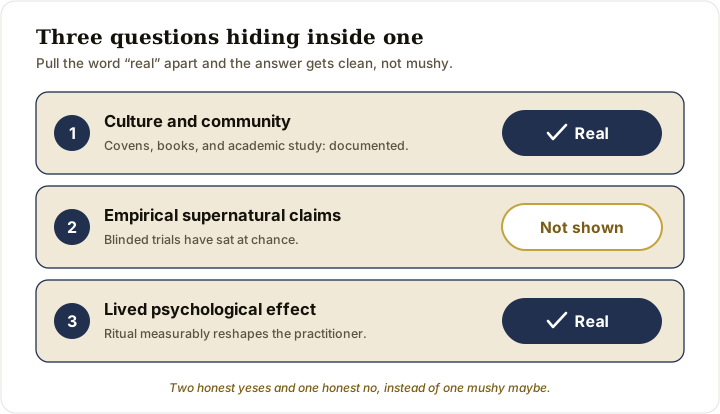
The word "real" is doing too much work in the question. Pull it apart and the answer gets clean instead of mushy. There are three layers stacked inside "is witchcraft real," and they each deserve their own honest answer.
Three questions hiding inside one
- Is the community and culture real? Yes, unambiguously.
- Have controlled studies shown supernatural mechanisms? No.
- Does the practice produce real changes in the people doing it? Yes, and the mechanism is documented.
That is the whole map.
The community is unambiguously real
The sociological footprint of modern witchcraft and Paganism is documented inside ordinary academia, not just in covens and on TikTok. There is a peer-reviewed academic discipline called Pagan Studies, anchored by the journal The Pomegranate: The International Journal of Pagan Studies, relaunched as a fully academic journal by Equinox in 1999. The American Academy of Religion houses a Contemporary Paganism Research Group. Scholars study modern witchcraft the way they study any other living religion.
The anthropologist Sabina Magliocco, in her ethnography Witching Culture, frames modern witchcraft and Neo-Paganism as religions of experience rather than rigid belief. Practitioners do not need an unbroken historical lineage to have a real practice. The rituals, the altered states, the felt sense of meaning, the community, all of it is observable and recurrent. That part of the answer is simply yes.
Documented, not just online
A working witch today might learn from a Discord server, but the practice she is plugged into has a paper trail. Generations of practitioners have written about it (Scott Cunningham, Doreen Valiente, Margot Adler, Starhawk). Academics have studied it in the field. None of that proves the spirits, but it does prove the craft is a real thing humans do, not a marketing trend invented last summer.
What controlled studies actually show
Where rigorous trials have tested specific supernatural mechanisms, the results have sat at chance. The findings are narrow and worth naming plainly, because the honesty is part of why you can trust the rest.
| Study or test | What it measured | Finding |
|---|---|---|
| 1998 JAMA Therapeutic Touch experiment | Whether 21 practitioners could detect a human biofield | No better than chance |
| 2000 systematic review of distant healing (23 RCTs) | Distant healing on health outcomes | Positive results attributed to expectancy effects and methodological flaws |
| Triple-blind distant-intent water-crystal test | Aesthetic ratings of ice crystal formation by 2,500+ judges | No macroscopic effect beyond chance |
| STEP multicenter trial (Study of the Therapeutic Effects of Intercessory Prayer) | Intercessory prayer on cardiac bypass recovery | No measurable effect on complication-free recovery |
These are findings, not a verdict on personal faith. A believer can hold these results in one hand and her practice in the other; many do. The studies are evidence about specific testable claims, not about the question of meaning.
What this rules out, and what it does not
What blinded trials rule out is the supernatural mechanism under those specific conditions: an invisible biofield reliably detectable by trained hands, distant intent reliably altering matter, prayer reliably altering hospital outcomes. What they do not rule out is the psychological effect of doing the ritual on the person doing it. That is a separate question with its own evidence, and the next two sections take it seriously from both sides.
The believer's reality: spirits, energy, and trained will
To take the believing wing seriously, you have to enter its frame for a moment. In this tradition, the universe is animated. There are spirits, ancestors, and gods who can be addressed; there are subtle energies that can be shaped. Witchcraft is the disciplined skill of working with both. It is closer to herbalism or sailing than to stage illusion; it has techniques, it has correspondences, it has practitioners who get better at it.
Who this wing includes
- Wicca: a modern Pagan religion founded in the mid-20th century by Gerald Gardner, often coven-based, frequently honoring a Triple Goddess and a Horned God as the two poles of nature. (wicca vs witchcraft has the side-by-side.)
- Traditional and folk witchcraft: regional folklore, ancestral spirits, herbalism, sympathetic magic, typically less interested in ceremonial structure.
- Syncretic and eclectic solitaries: practitioners who blend astrology, animism, divination, and devotional work into a personal theistic or energetic practice.
If you want the wider field, types of witches sketches them. If you want the non-theistic strand specifically, secular witchcraft is its own path.
Frater U.D.'s Models of Magic, in plain language
The German occultist Ralph Tegtmeier, writing as Frater U.D., offered a useful map in 1991. He outlined five paradigms practitioners use to make sense of what they are actually doing when they do magic. Believers tend to lean on Spirit and Energy; skeptics lean on Psychological; chaos magicians swap between all of them on purpose. Knowing the five clears up a lot of arguments that are really just two people speaking different models at each other.
| Model | What it says magic is | Who tends to use it |
|---|---|---|
| Spirit | Petitioning autonomous entities (gods, ancestors, spirits) | Shamans, traditional witches, theistic Wiccans |
| Energy | Shaping subtle universal forces (chi, prana, mana) | Energy workers, many modern Wiccans |
| Psychological | Addressing the deep subconscious through symbol and trance | SASS witches, Atheopagans, the Austin Osman Spare lineage |
| Information | Transmitting an information pattern to a target | Cybernetics-influenced occultists |
| Meta-Model | Use whichever frame is most useful right now | Chaos magicians |
The Meta-Model is the chaos magician's move; chaos magic walks it in depth.
Conviction as a tool, and how believers explain failure
In the believing frame, magic requires the practitioner to be a person whose word holds. Starhawk, in The Spiral Dance, argues that a bag of herbs has the power to heal because the practitioner says it does, and for that saying to carry weight, the practitioner has to live as someone whose sayings carry weight elsewhere. If you habitually lie or break small promises in mundane life, you have eroded the muscle the spell relies on. Aleister Crowley's older line says the same thing more crisply: magic is "the Science and Art of causing change to occur in conformity with Will."
This shapes how believers read failure. When a spell does not produce its result, the believing frame rarely concludes "magic isn't real." It concludes something more like: you cast a job spell but did not send the application; your focus was scattered; the timing was off; something in your subconscious was vetoing the request. The believer treats magic the way a sailor treats wind, as a real force subject to many other real forces. The practical breakdown of this lives in why didn't my spell work.
The skeptic's reality: same rituals, different mechanism
A growing strand of the craft practices the same rituals without invoking the supernatural. The Reddit community r/SASSWitches, founded in 2019, coined the acronym: Skeptical, Agnostic/Atheist, Science-Seeking. It grew from roughly 7,000 subscribers in early 2020 to over 16,000 today, and it is one of the friendliest corners of the internet for this conversation. SASS witches use Tarot, candles, jars, and seasonal ritual, and they do not claim anything supernatural is happening.
Mark Green's Atheopaganism walks adjacent ground: a fully naturalistic, Earth-centered religion that accepts the universe as peer-reviewed science describes it and keeps the rituals because rituals work on the mind. Green's argument is that ritual is an evolved human strategy that meets real psychological needs; you can drop the cosmology and keep the technology. If this is the wing you came in through, secular witchcraft is the full guide.
Open-label placebo, in plain English
The secular wing rests heavily on a real finding: open-label placebos work. An open-label placebo is one you know is a placebo, told to you up front, and it still produces measurable benefit. The lucky socks you wear to the interview do not have powers; you know that, and they still lower your baseline anxiety because the act of putting them on is a self-soothing ritual you trust. The "close door" button on the elevator may be mechanically disconnected, but pressing it still gives you a small jolt of agency.
Research at Harvard Medical School and reported in journals including the Journal of Neuroscience shows that ritual and conditioning, not just positive thinking, trigger genuine neurobiological responses that can alter mood and physical symptoms even when the person knows the treatment is inert. The closest clinical cousin is the secular mindfulness program: Mindfulness-Based Stress Reduction and Mindfulness-Based Cognitive Therapy strip Buddhist contemplative technique of its cosmology and keep the practice, and systematic reviews find measurable effects on stress, pain management, and wellbeing. That is what the secular wing is doing with witchcraft, knowingly.
The honest line on harder territory: this supports how you feel and how you move through your day. It is not a substitute for treatment when something physical or psychiatric is wrong. See a doctor too.
What this looks like in a real practice
A SASS-style spell jar for self-love, walked from the inside, looks like this. You decide on the working before the kitchen gets involved, because the decision is part of the spell. You walk to gather what you have on hand: dried rose, a pinch of pink salt, a little dried lavender from last summer, a snip of your own hair. The lavender still smells the way it did the afternoon you cut it, slightly dusty, slightly green, and that smell is doing real work on your nervous system. You put the phone in another room. You write the line you want to remember on a small square of paper, fold it small, drop it in. You speak the line out loud over the open jar, and there is always a half-second where your own voice surprises you. You seal it with wax, in a color that means something to you. You set it on the windowsill where you will see it in the morning.
What is happening: mindfulness, sensory anchoring, intention-setting, self-directed language, the small ceremonial signal that closes one mental chapter and opens another. The SASS witch is not claiming an invisible entity is curing anything. She is claiming that the act, performed sincerely, restructures a small piece of how she pays attention. That claim is supported. Spell jars walks the form; how spells work handles the mechanism question across both wings.
The unifying answer: interpretive drift
This is where the two wings stop arguing. In 1989, the psychological anthropologist Tanya M. Luhrmann published Persuasions of the Witch's Craft, a book that set out to answer one question: why do intelligent, educated, rational adults end up deeply committed to magical practice? After years of participant observation with London covens, her answer surprised her. Belief did not usually precede practice. Practice produced belief.
She named the process interpretive drift. As a person reads occult literature, attends rituals, meditates, and gets in the habit of noticing symbolic connections, their attention slowly rewires. They start to see meaning where they did not see it before. The world has not changed; the way they perceive it has. The closest everyday analogy is a wine sommelier in training. At first, wine is wine. After months of guided tasting, the same glass reveals leather, cherry, and oak; the wine has not changed, but the brain has been taught new categories of attention. Witchcraft does the same thing to perception of meaning, mood, and synchronicity.
Why this is not a debunking
This is the part that surprises people: interpretive drift does not pick a side. It describes a real cognitive shift, not a delusion. A believer can hear "your brain has been trained to see symbolically" and call it the soul learning to perceive what was always there. A skeptic can hear the same sentence and call it neural plasticity in action. Same finding, two compatible frames. The fight people expect to break out here does not have to.
The ritual effect, on the same wavelength
The Harvard Business School psychologist Michael Norton, in The Ritual Effect, makes a related case from the secular side. Habits performed on autopilot (brushing your teeth) become rituals when you layer them with mindfulness and symbolic meaning, and rituals measurably change how humans handle grief, build courage, and bond in groups. The occult scholar Richard Kaczynski's Mind Over Magick cross-references magical practice against cognitive neuroscience and brain imaging. He compares the mental state of skilled ritual work to athletes finding the zone, and uses the Stanford Prison Experiment as a frame for why putting on ritual garb and stepping into a cast circle so reliably shifts perception and behavior. The brain responds to symbolic action whether the frame around the action is sacred or secular. That is the thread that holds the two wings together.
A quick side-by-side of the two wings
| Question | The believing wing | The skeptical wing |
|---|---|---|
| What animates the universe? | Spirits, gods, and subtle energies | The natural laws science describes |
| What is a spell doing? | Petitioning a spirit or shaping energy | Training the subconscious through ritual and sensory cues |
| Where do results show up? | The external world and inner spiritual connection | Mood, behavior, resilience |
| Foundational ideas | Spirit and Energy Models, Crowley's Will, Wiccan duotheism | Psychological Model, open-label placebo, Jungian archetypes |
| Why a spell "didn't work" | Mundane interference, timing, focus, subconscious blockage | Weak ritual structure, low engagement, unrealistic target |
Both columns describe practitioners who report meaningful, repeatable effects on their lives. They disagree about the mechanism. They agree more than they disagree about the work.
What this question is not
A few things commonly get tangled up with "is witchcraft real," and each is worth a clean line.
It is not the same question as "is witchcraft a sin"
The sin question lives inside an Abrahamic frame that most modern witches do not share. The famous biblical line ("Thou shalt not suffer a witch to live," King James Version) rests on a translation choice that historians and linguists widely consider a stretch: the Hebrew word kashaph more accurately means "poisoner," and the English shift to "witch" is heavily attributed to the political climate around King James I of England, whose paranoia after nearly dying in a 1589 sea storm produced his Daemonologie and shaped the 1611 translation. The full treatment, with the moral question handled gently, is in is witchcraft a sin.
It is not the same question as "am I a witch"
Whether witchcraft is real is a question about the world. Whether you are a witch is a question about you. They have different answers and require different conversations. The second one lives in am I a witch.
It is not the same question as "is the aesthetic real"
The black-cottage TikTok aesthetic is not the practice, and the practice does not require the aesthetic. You can be a working witch in jeans on a Tuesday afternoon. Aesthetic versus practice holds that one, and common myths cleans up the rest.
The visible footprint: a real industry, a real culture
The "yes" side of the answer has receipts. The market research firm IBISWorld pegs the US Psychic Services industry, which includes astrology, Tarot, aura reading, and fortune-telling, at roughly $2.3 billion in revenue in 2024, with over 105,000 people employed. Revenue has grown steadily since the pandemic, partly on the back of post-2020 anxiety driving demand for spiritual guidance. Pew Research surveys suggest about 30% of US adults use these services at least once a year; only about 1% rely on them "a lot" for major decisions.
The digital footprint is wilder. Videos tagged #WitchTok had amassed 18.7 billion views by mid-2021 and 19.8 billion by that October, and contemporary mystical-tag estimates push the combined figure past 45 billion. Niche tags like #SpellJar have crossed 255 million views on their own.
| Footprint | Figure | Year |
|---|---|---|
| US Psychic Services revenue (IBISWorld) | ~$2.3B | 2024 |
| US Psychic Services employment | 105,000+ | 2024 |
| US adults using these services at least once a year (Pew) | ~30% | recent |
| #WitchTok views | 18.7B | mid-2021 |
| #WitchTok views | 19.8B | October 2021 |
| Related mystical tags combined | 45B+ | contemporary |
| #SpellJar | 255M+ | contemporary |
This is the part where I think the honest line includes the cost. The algorithm has widened access to non-traditional spirituality and given marginalized practitioners a place to gather, and it has also accelerated misinformation and premium-priced reading services charging suspiciously cute prices (the "angel number" $222 video readings). The scene is real, the reach is real, the hype is real, and so is the grift sitting next to the real practice. Worth knowing in either direction.
So, is it real
Three takeaways.
- You do not have to believe in the supernatural to get something real out of the practice. The rituals work on the mind because the mind is wired to respond to symbol, sense, and intention. SASS witches and Atheopagans are doing measurable psychological work without claiming anything they cannot back up.
- Believing in the supernatural does not invalidate the psychological benefits. The same neurobiology that explains the ritual effect deepens the believer's experience rather than competing with it. If you trust the spirits, the brain still responds to the candle.
- The thread that runs through both wings is focused intent. Whether you address an ancient goddess, direct the energy of a place, or speak to your own subconscious through a Jungian archetype, the practice is a deliberate refusal to be a passive observer of your own life.
Witchcraft is real the way love, grief, and art are real. It does not always submit to the microscope, and its effects on the people who live with it, on the culture around it, and on the lives it reshapes are undeniable. Whichever wing answers the question for you, the question itself was a good one to ask.
Where to go from here
If you came in asking whether you are one of these people, the next stop is am I a witch. If you came in asking whether the practice itself is worth starting, where to begin is the gentle on-ramp. If the skeptical wing is the one you recognized in the mirror, the secular path is its own real thing. And if the cinema version is still cluttering up your question, common myths clears the fog.
Keep exploring
Browse more guides, or start with the basics of the practice you are curious about.
Browse more guides