Crystals for Witchcraft: By Purpose and Element
Crystals for witchcraft are tools, not cures, and you do not need a glass case full of them to begin. In practice, a stone becomes a focal point: you pair it with an intention, choose by magical purpose (protection, grounding, love, divination, cleansing) or by elemental correspondence (earth, air, fire, water), and let the weight of it in your hand do part of the work of holding focus. A river stone you picked up at thirteen and never let go of will outperform a hundred dollars of mid-grade rose quartz you do not love.
Crystals in Witchcraft, at a Glance
In witchcraft, practitioners pair a crystal with an intention so the stone becomes a focal point for the spell, chosen by magical purpose (protection, grounding, love, divination, cleansing) and by elemental correspondence (earth, air, fire, water). Most working witches I know carry three or four stones in steady rotation, not a velvet roll of forty.
A working summary for the skimmer:
- Choose by purpose first, element second.
- One stone per intention is enough; sets get unwieldy fast.
- Cleanse, then charge. They are separate steps.
- Never drink water that has touched a crystal whose chemistry you have not verified.
- A free river stone you love beats a pricey crystal you do not.
How Witches Actually Use Crystals
In crystal practice, the belief is that every stone carries a kind of resonance from how it formed: pressure, heat, time, the slow geometry of its lattice. When you pair that resonance with a specific intention, the stone becomes a psychological and energetic anchor for the working. The technical word for it is correspondence; the felt word is "this one matches."
The pairing is magic plus action. Light the candle, hold the stone, do the work. She lit a black tourmaline at the threshold before her boss meeting, and she also drafted the email she had been avoiding. The job came through the email; the tourmaline gave her hands something to hold while she sent it.
Practitioners treat stones as a porous sponge. Carried through a hard week or stacked on the altar through a heavy spell, they soak up the texture of what you used them for and need to be cleared before they will hold a new instruction. You feel it before you reason it: the rose quartz that felt soft a month ago is suddenly heavy or dull.
The mineralogical side (Mohs hardness, chakra assignments, deep healing lore) is its own subject. The frame here is what witches do with stones in a working. For how spells work underneath the symbolism, and for the sister chart for herbs, head sideways.
Crystals by Magical Purpose
| Purpose | Go-to stones | How practitioners use them | Where it lives |
|---|---|---|---|
| Protection | black tourmaline, obsidian, hematite | at thresholds, in pockets, on the doorframe | edges of the working, not the center |
| Grounding | smoky quartz, red jasper, river stones | held after big spellwork, in palm and pocket | pocket, palm, boot |
| Love | rose quartz, rhodonite, emerald | worn close to skin | jewelry, pocket, pillow |
| Divination | clear quartz, amethyst, lapis lazuli | parked on the deck, on the brow in meditation | altar, deck box, scrying setup |
| Cleansing | selenite, fluorite, halite | sweeping the field after a spell | windowsill, altar centre, perimeter |
Protection
Protective stones live at the edges of a working, not the center. Black tourmaline is the one most practitioners reach for first; you'll find it on doorframes, in pockets near phones and laptops, by the bed. In crystal practice, obsidian is the harder cousin: a stone for cord-cutting, sharper boundaries, the breakup-after-the-breakup. Hematite gets used as a mirror, deflecting whatever someone is pushing at you back the way it came.
I keep a small chunk of black tourmaline at the threshold of my front door and one in my bag. They have been there long enough that I notice when one walks off. More on the perimeter side in protection work and cleansed home.
Grounding
Grounding stones anchor elevated energy back to the body so spellwork does not leave you frayed. Smoky quartz is a filter; red jasper is a stabilizer; a river stone in the pocket is the broke-witch backup that genuinely works because the weight is the point. After candle magic that ran hot, I sit on the floor and hold a smoky quartz palmstone until my hands stop buzzing. That is the entire ritual.
The energy-body side runs in grounding and centering.
Love (self and romantic)
Most love work is glamour and self-tending more than coercion of a specific person. Rose quartz handles the self-compassion track; rhodonite is the one I reach for after a rough breakup because the tradition specifically names it the stone of the brokenhearted; emerald is the older lineage's stone of long-term devotion, attributed to Venus. Wear it close to skin. Pocket, necklace, ring, tucked in the bra against a hard day.
Divination and insight
Stones for divination are passive receptors, not engines. Clear quartz amplifies; amethyst calms the chatter; lapis lazuli is the practitioner's "open the inner eye" stone, traditionally placed at the brow during meditation. The simplest use is to park an amethyst or a chunk of black tourmaline on top of your tarot deck between readings, which is believed to clear the residue of past sessions from the cards.
For mechanics and methods, divination methods and how to scry go deeper.
Cleansing
Cleansing is the chore that makes the rest of the work land. Selenite is the famous exception in the practice: it is described as never needing to be cleansed itself, and as cleansing other stones placed beside it. Fluorite gets used for mental clutter and pre-spell jitter. Halite (rock salt) gets crushed and sprinkled around a perimeter when something needs ritually swept.
Selenite has one rule: do not wet it. It will dissolve. Selenite is gypsum, and gypsum is water-soluble. For the bigger sweep, banishing ritual.
Crystals by Element (so your altar balances)
The four-element altar comes from Wicca and the wider current it shaped: Earth in the north, Air in the east, Fire in the south, Water in the west. A stone in each quarter physically anchors an abstract force, and a spell that pairs two elements (say Fire for drive plus Earth for stability) reads as more balanced on the altar than a single-element working.
| Element | Direction | Stones | Spells they belong in |
|---|---|---|---|
| Earth | North | jet, malachite (raw is toxic), moss agate, petrified wood, halite | money, home, career, body |
| Air | East | citrine, fluorite, mica (do not wet), pumice, topaz | study, communication, truth |
| Fire | South | carnelian, ruby, bloodstone, obsidian, red jasper | courage, transformation, starting things |
| Water | West | amethyst, aquamarine, moonstone, lapis lazuli, river stones | shadow work, dreams, emotional healing |
Earth (North: stability, money, body, home)
Earth stones anchor a spell into physical reality. Practitioners use jet for absorbing ambient negativity, malachite for drawing wealth (kept polished and dry; the raw form has real copper hazards), moss agate in gardens and pockets for slow steady growth, petrified wood for ancestor and lineage work, halite to ritually sprinkle a perimeter. A "money bowl" with a chunk of malachite and a few coins is a classic earth working.
For altar mechanics, altar layout and cast a circle carry the structure.
Air (East: mind, communication, study)
Air stones get deployed for hard conversations, exams, and writing that has to land. Citrine for swift, optimistic forward motion; fluorite on the desk for academic focus; mica for multifaceted communication; pumice for "blow this off me on the next breath"; topaz for revealing what is hidden. I keep a tumbled citrine on my keyboard. It does not write the email. It reminds me to.
Fire (South: will, courage, transformation)
Fire is the engine of spellcraft. Carnelian for passion and creative ignition; ruby for vitality; bloodstone in the hand before a hard conversation; obsidian for severance; red jasper to anchor and stabilize the fire so you do not burn out by Wednesday. Pair Fire with Earth on the altar when the working is "start this new thing AND make it last."
Water (West: emotion, intuition, dreams)
Water stones run subconscious and emotional. Amethyst under the pillow for vivid dreams; aquamarine in the pocket for panic; moonstone for cycle and lunar timing; lapis lazuli on the brow during meditation; a plain river stone for softening a harsh emotional climate. These are the stones I reach for most often in winter.
More on dream and shadow material in shadow work and on lunar timing in moon magic.
Working Crystals into a Spell
On the altar
The standard setup is one stone per quarter (matching the element), one center stone for the intent. The quarter stones stay put; the center stone is the one you charge during the working and carry afterwards. The candle gets lit, the words get spoken, the stone goes in the pocket for a week.
For tools and layout, altar setup and witch tools cover the rest.
Crystal grids
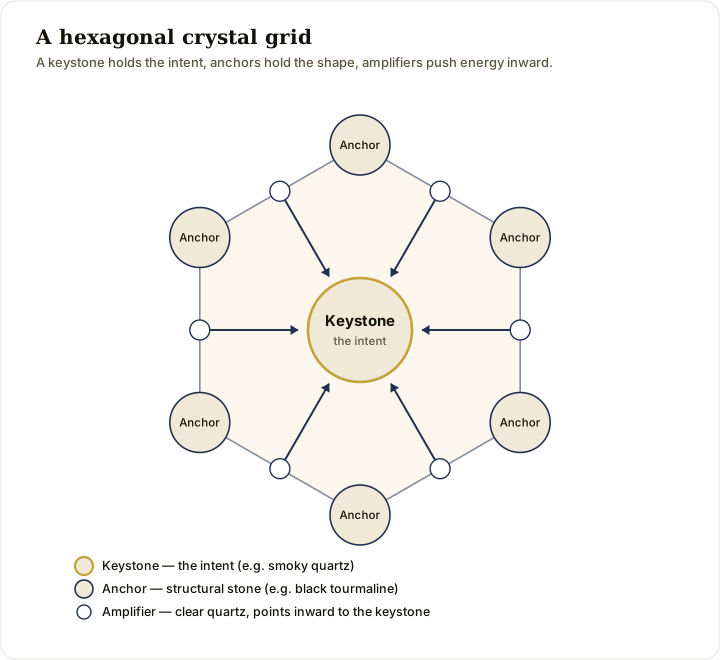
A grid is a stone arrangement built on a geometric pattern (hexagon, circle, square) with three roles: a keystone in the center for the intent, anchor stones in the structural points, and amplifier points (usually small clear quartz) facing inward to push energy toward the center. A standard home-protection grid is a smoky quartz keystone, six black tourmaline anchors in a hexagon, six clear quartz points facing the keystone.
You activate the grid by tracing the connecting lines between the stones with your finger or a wand, speaking the intention as you go. The geometry holds half the spell; your intent holds the other half.
Wands and ritual foci
A wand tipped with clear quartz works as a magnifying glass for directed energy, focusing what you are projecting outward to a specific point. The wand is not required. Your dominant hand does the same job. The wand is a convenience and, honestly, a pleasure, the way a beautiful pen is a pleasure for someone who writes.
With your divination tools
Most readers I know park an amethyst or a chunk of black tourmaline on the tarot deck between sessions, which is believed to clear residual energy from the cards. The same goes for oracle decks and runes. The stone sits on top of the deck in its box. That is the whole protocol.
More in with divination tools.
Cleansing and Charging
In crystal practice, maintenance is two non-interchangeable steps: cleanse first (empty the stone of accumulated energy), then charge (program it with the next instruction). A stone you have not cleansed will hold the residue of the last working and dilute the next one. This is the single most common reason a stone "stops working" for a baby witch. It did not stop. It is full.
Cleansing options
Pick by what the stone can physically survive.
- Smoke. Pass the stone through the smoke of rosemary, lavender, pine, or a resin like frankincense. Slow, easy, works on almost everything.
- Moonlight. Set the stone on a windowsill from sunset to dawn under a full moon (any moon works). The gentle universal option. Safe for every stone.
- Sound. A singing bowl, a bell, a tuning fork. Vibration shakes loose what is clinging.
- Earth burial. Bury in soil (not salt, for sensitive stones) for twelve to twenty-four hours. Heavy reset for heavy work.
Avoid water for anything you have not verified, and avoid salt for porous or soft stones. For moon-specific charging, charge under the moon and moon water carry the timing.
Charging options
Once the stone is empty, give it a job. Three methods that hold up:
- Projective hand. Hold the stone in your dominant hand. Visualize the goal with as much sensory detail as you can manage (the email arrives, the room feels safe, the body is calm). Push the feeling into the stone until it feels full. Scott Cunningham described this as the foundational method, and it remains the one most witches actually use.
- Breath and word. Hold the stone close to your mouth. Speak the intention out loud in short, declarative breaths. "I am protected. I am protected. I am protected." The voice does the work the visualization sometimes will not.
- Sunlight. For Fire-element and active intents, charging in direct morning sun is traditional. Only use this on stones that handle UV; rose quartz, amethyst, and citrine all fade in prolonged sun, while clear quartz handles it.
Safety: Toxic, Water-Soluble, and Salt-Reactive Stones
Belief frames most of crystal work. This part is chemistry.
Never drink a "gem elixir," moon water that has touched the stone, or a crystal-infused bath whose composition you have not verified. Many popular crystals are chemically toxic, water-soluble, or salt-reactive. The geological database Mindat.org and the Gemological Institute of America's reference materials are the standard places to check a stone's composition before any wet method. This supports your practice, not your health; if something physical is wrong, please also see a doctor.
| Stone | Hazard | What to avoid | Safer cleansing |
|---|---|---|---|
| selenite, desert rose | gypsum, dissolves in water | water of any kind | smoke, moonlight, sound |
| halite | dissolves entirely | water | smoke, moonlight |
| lepidolite, mica | flake apart in water | submersion | smoke, sound, moonlight |
| calcite, celestite | surface erosion | repeated water | smoke, moonlight |
| opal, turquoise, labradorite | porous, salt leaches | salt and saltwater | smoke, moonlight |
| carnelian, hematite, fluorite | scratched and dulled by salt | salt | moonlight, sound |
| malachite, azurite, chrysocolla | leaches copper if wet | water elixirs, raw dust | smoke, moonlight (dry only) |
| pyrite | produces sulfuric acid wet | water | smoke, dry sound |
| galena | lead | bare skin, ingestion | display only; dry handle with gloves |
| cinnabar | mercury vapor | heat, acid, skin | display case only |
| raw tiger's eye, serpentine | asbestos fibers in raw form | inhalation of dust | display polished, never sand |
| realgar, orpiment | arsenic | any handling | locked display case |
Will dissolve or flake in water
Selenite, desert rose, halite, lepidolite, mica, calcite, and celestite either dissolve outright (the gypsum and rock salt group) or come apart along their layered structures when water gets into the fissures. The rough guideline practitioners use is the Mohs hardness scale: a stone rated under about 5 or 6 should be assumed unsafe for water. Polished hard stones (clear quartz at 7, amethyst at 7) handle a quick rinse. Selenite at 2 does not.
Damaged by salt
Salt is corrosive and abrasive. Opal, turquoise, and labradorite are porous enough that salt leaches into the microscopic fissures and discolors them. Carnelian, hematite, and fluorite are soft enough that salt scratches and dulls the finish. The traditional "bury in sea salt overnight" cleanse is fine for very hard stones and a slow disaster for these.
Chemically toxic
The dangerous ones are dangerous because of what they are made of, not their energy.
- Copper-bearing: malachite, azurite, chrysocolla. Beautiful stones. In water, especially acidic water, copper carbonate leaches out and the result is toxic. Raw, unsealed forms also produce hazardous dust if filed or sanded.
- Iron and sulfur: pyrite, hematite, and magnetite oxidize (rust) in water. Pyrite is the worst of the three because it can produce sulfuric acid when wet.
- Lead: galena. Handle with gloves, wash hands. Do not ingest residue.
- Mercury: cinnabar. Toxic to touch; can release fatal vapors if heated or exposed to acid. Display case only.
- Asbestos fibers: raw, unpolished tiger's eye and serpentine. Polished, sealed pieces are generally considered safe; never sand or break them yourself.
- Arsenic: realgar, orpiment. Stunning, deadly, locked display.
For chemical composition, Mindat.org is the standard reference; the Gemological Institute of America publishes mineral data as well. Check a stone before you trust it in water or against skin.
The indirect-method elixir
If you want the energetic resonance of a toxic stone without the chemical leach, the traditional workaround is the sealed-jar method: place the dry stone in a sealed glass jar, set that jar inside a larger bowl of water. The water never touches the crystal. The resonance, in belief, still passes through the glass. It is a workaround, not a beverage, and not a substitute for medical care.
A Note on Where Your Crystals Come From
The global crystal trade is largely unregulated. Reporting from the last decade has tracked citrine and smoky quartz sourced from artisanal mines in the Democratic Republic of the Congo where child labor is documented, and lapis lazuli from Afghanistan tied to armed groups including the Taliban. The point is not perfection or paralysis. The point is paying attention: asking where a stone came from, valuing the inherited piece and the river stone, treating "ethically sourced" as a question to put to the seller rather than a label to trust at sight.
Building Your First Working Set
The "witch starter kit" pressure is mostly marketing. Four stones will carry a baby witch through a year of practice, with cheap or free substitutes for each:
- Clear quartz point. Amplifier, scrying focus, all-purpose. Substitute: a clear glass piece picked up at a thrift store and cleansed.
- Black tourmaline. Protection at thresholds and in pockets. Substitute: a heavy dark river stone you found yourself.
- Rose quartz. Self-compassion, love work. Substitute: a pink pebble.
- Smoky quartz. Grounding after big spells. Substitute: a smooth grey stone with weight to it.
- A river stone you love. Free. Already yours. Already wants the job.
Add an amethyst when dream work calls and a selenite stick when you start needing to cleanse the others. That is the whole arc for most of a first year.
If a beautiful tumbled set is what you actually want, that is a real joy and you are welcome to it. Buy honestly, from a seller who answers source questions, and skip the ones who guarantee results. For the budget version, witchcraft on a budget and the baby witch checklist map it out; for an honest look at boxed bundles, the starter kit roundup names what is worth it.
Where to Go Next
For the underlying mechanism, how spells work explains why pairing a stone with intention does anything at all. For altar layout that uses these correspondences, set up an altar. The plant-side companion is herb correspondences. And for charging a stone in moonlight properly, moon magic for charging runs the full timing.
Keep exploring
Browse more guides, or start with the basics of the practice you are curious about.
Browse more guides