Knot Magic: Cord Spells and Cord Cutting
Knot magic is sympathetic spellwork done on a length of cord: you tie an intention into the fiber to bind or store it, and untie or cut to release. The working takes a piece of natural cord and ten quiet minutes. The Nine-Knot Spell is the form most baby witches learn first, the witch's ladder is the same logic stretched into a sustained charm, and cord cutting is its release rite.
Choosing your cord: fiber, length, and color
The most important decision is whether the cord is natural. Synthetics defeat the disposal step; polyester does not burn cleanly and does not compost. If your working ends in fire or earth, use a natural fiber.
| Fiber | Texture & feel | Element / planet | Best for | Burn or bury |
|---|---|---|---|---|
| Cotton | Soft, absorbent, breathable | General-purpose | Beginner spells, gentle manifestation, any cord you will burn | Yes to both |
| Silk | Strongest natural thread, smooth | Air, water / Moon, Venus | Emotional work, intuition, attraction, bonds that need to hold | Burns cleanly; bury naturally dyed silk only |
| Wool | Warm, insulating, slightly fuzzy | Earth, fire / Saturn | Nurturing, protective, shielding a person from outside influence | Burns slowly; bury natural wool |
| Hemp | Coarse, durable, earthy | Earth, fire / Saturn, Mars | Grounding, robust shielding, health work, psychic "roots" | Yes to both |
Length follows the working. A Nine-Knot Spell wants one to three feet, enough to space nine knots without crowding. A cingulum is nine feet by tradition. A witch's ladder is whatever fits the doorway or altar shelf you will hang it on.
Color is the easiest correspondence layer: green for money and growth, red for passion and courage, white for protection and clarity, black for binding and the mysteries, blue for calm and healing, purple for power and the spiritual. Use what you have before you buy. A piece of beige cotton with the right intent always beats a "perfect" green silk you do not actually own. If you want to stock up cheaply and on purpose, the dollar-tree side of stocking up sits in budget witchcraft.
The Nine-Knot Spell, step by step
The number nine reads as "triple triple" in Western esoteric writing, three by three, completion squared. The chant is the engine: nine short rhyming lines, each tied to a knot, the rhythm pulling you into a light trance while the knot count escalates the charge. By knot six or seven the recitation usually shifts into something closer to humming, and that shift is the spell working.
The knots are not tied left to right. They are tied at the ends, then the middle, then in the gaps. The cord visibly hangs in three taut spans by knot five, and that visual is the point: you are stretching tension across the whole length, not stacking it at one end.
You need: a natural cord one to three feet long, in a color matched to the intent (green silk for prosperity, red wool for passion, white cotton for clarity are useful defaults), and somewhere quiet for ten minutes.
- Knot 1. Tie at one end. "By knot of one, the spell's begun."
- Knot 2. Tie at the opposite end. "By knot of two, the magic comes true."
- Knot 3. Tie in the middle of the cord. "By knot of three, so shall it be."
- Knot 4. Tie halfway between knots one and three. "By knot of four, this power is stored."
- Knot 5. Tie halfway between knots two and three. "By knot of five, my will shall drive."
- Knot 6. "By knot of six, the spell I fix."
- Knot 7. "By knot of seven, the stars of heaven."
- Knot 8. "By knot of eight, the hand of fate."
- Knot 9. "By knot of nine, the thing is mine."
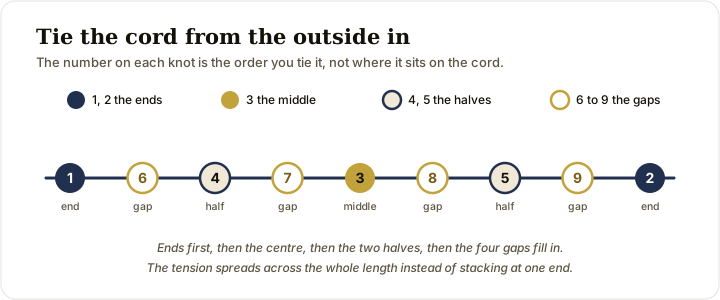
After the ninth knot, carry the cord: pocket, bag, under a pillow, taped inside a notebook, wherever you will feel it. When the goal lands, close the spell by untying the knots in reverse order, or by burning the cord in a fireproof dish and thanking it. Untying is also how a cord working gets taken back if you change your mind about it, which is the same instinct behind reversing a spell cast in any other form.
The pairing that actually moves things is magic plus action. You tied the cord for the job; now send the application. You lit the cord for the breakup conversation; now have the conversation. The cord is the part that holds your nerve. The action is the part that meets the world.
If you want to script your own version of the chant rather than borrow this one, writing a spell is a small skill that pays out fast, and any working worth doing twice belongs in your book of shadows.
What tends to bear out, from doing this often, is the feeling of remembering. The cord in your pocket is a tap on the shoulder all week.
What does not bear out, ever, is the spell carrying an action you have not taken. A green cord tied for a job will not file the application for you. It will only make sure you do not forget that you said you would.
The witch's ladder as a stored charm
A modern witch's ladder is a braided cord, usually three strands, tied with nine knots, with small natural objects woven in as you go: a feather for air and clear communication, a small shell for water and emotion, a bone fragment or seed for ancestor and continuity, a sprig of dried herb for the specific correspondence you want.
Where the Nine-Knot Spell is a single working you finish, release, and put down, the ladder is an ambient charm. It hangs above a doorway, over the bed, or beside the altar, and works the way a kept candle works: low, slow, constantly present.
Practitioners use the modern ladder for wish-binding (a knot for each part of a long-running hope), as a meditation anchor (one knot per breath cycle, all the way down the cord), and as a home charm. None of those uses match what a skeptical Victorian audience would have called the 1878 Wellington object. That is fine. The form has been reclaimed for benign work.
If the ladder is functioning as a ward, pair it with the broader sweep in protection spells or a doorway sweep from home cleansing.
Storing energy, then deploying it
The "battery" idea is the bit baby witches usually love first. You charge a cord on a high-charge night, a full moon esbat, a Sabbat, a meaningful astrological hour, with no immediate intent to spend it, and the tightened knots hold the charge until you need it. Months, sometimes years.
Deployment is the mirror of the Nine-Knot finish: at the moment the situation arises, you untie the specific knot that holds the energy you want, and let it go.
A few useful patterns:
- Healing cord. Charged on a full moon, kept folded in a drawer. When a friend gets sick, you visit, sit with the cord in your hand, untie one knot quietly at the bedside.
- Pain-release cord. Tied while the pain (physical or emotional) is at its peak, so the working stores the feeling rather than building it. You untangle the knots slowly, on a calmer day, to dissipate it.
- Carry vs. store. A working you want active in your daily life lives in a pocket. A working you want held in reserve lives on the altar. A working that should color your sleep lives under the pillow.
The moon-charging logic crosses directly into moon magic and moon water; many practitioners charge a cord and a jar of water in the same window. If you want both a stored charge and a flame in the same working, the cleanest pairing is with candle magic.
Disposing of a bound cord (do not skip this)
If you tied a habit, an illness, an intruder, or a worry into a cord, you do not want that cord sitting on the altar. That is a toxic battery left plugged in. A binding or banishing only finishes when the cord leaves your space.
Three accepted methods, each with one rule:
- Bury the cord off your property in soil that is not yours. Natural fiber only. Never bury salt with it. Salt destroys the soil's ability to support anything else for a long time, and you do not want to leave that as a parting gift.
- Burn it to ash in a fireproof vessel. Fastest neutralization. Wash the vessel after.
- Mundane discard in a public bin off your property. Bag it, drop it, walk away, and say out loud, "this is done."
The load-bearing phrase is off your property. A bound cord buried in your own garden, or burned in your own fire pit and left in the ash, has not actually gone anywhere; you have only moved it from one shelf to another. If you want a cleansing pass on the space afterward, the standard sweep lives in banishing.
Cord cutting: the symbolic release rite
Cord cutting severs your internal tie to a person, a habit, or a pattern. It is not therapy. It does not bend another human's will. And it does not replace mundane safety steps if you are in any kind of danger.
The right targets for a cord cutting are the ones you keep coming back to in your own head: anxiety spirals, intrusive loops, self-sabotaging beliefs ("I am not someone good things happen to"), doom-scrolling and other compulsions you can name, an old version of yourself you have outgrown, and yes, the emotional entanglement with another person, where what you are cutting is the bond, not the person. You can love a parent and still need to sever a draining dynamic. The rite is for the dynamic.
Write the boundary into the rite itself. "I release this pattern" is the line that lands. "I make my ex stop calling" is the line that does not, both because it tries to bind another person and because it sets the spell up to fail.
If you are in active trauma, clinical depression, or any kind of physical danger, the cord is a complement to professional care and mundane safety, not a substitute. A licensed clinician can do things this rite cannot. So can a locksmith. Deeper internal work belongs in shadow work, where ritual and clinician get named separately.
The two methods, compared
There are two main ways to perform a cord cutting, and the choice is largely a matter of temperament.
| Candle method | Knife (athame) method | |
|---|---|---|
| Tools | Two candles (often black and white), natural twine, fireproof tray, lighter | One length of cord, a consecrated knife or dedicated shears |
| Agency | Passive: you light it and watch the flames eat through | Active: you do the cutting, in one stroke, with your own hand |
| Pacing | Slow, meditative, visually dramatic | Immediate, decisive, no ambiguity |
| Reading | Allows wax and flame divination as it burns | None; the cut is the message |
| Risk | Real fire hazard. Wide tray, constant supervision | Low, given basic blade care |
| Best for | Long-running attachments where you want a slow goodbye | Sharp, definitive endings where ambiguity hurts you |
The candle version is the one that went viral on social media, and that is part of why traditional practitioners are cool on it. The knife version has been around much longer.
Walk-through: candle cord-cutting
- Cleanse the space and clear the tray. Pick two candles, often one black for the habit, person, or tie being released, and one white for you. Carve names or intentions into the wax with a pin or your athame.
- Tether. Stand the candles a few inches apart on a wide fireproof tray. Tie a piece of natural twine or cotton string securely around the base of each candle, linking them physically.
- Light both at the same moment. Sit with the connection: name the feeling, name the cost.
- Watch. The candles will burn down. Eventually the flames catch the string. The string burns through.
- Read the working. Which side burned faster, whether the string broke clean or smoldered, whether one candle drowned itself in wax. These are the messages.
- Dispose of the wax remnants and ash in a sealed bag, in a bin off your property.
This is the fire-risk method. Wide tray, nothing flammable within arm's reach, no leaving the room. If you cannot supervise it the full way down, do the knife version instead.
Walk-through: knife cord-cutting
- Hold one length of cord between your two hands, or fasten the ends to two symbolic objects (you and "the tie", you and a photo, you and a slip of paper with the habit named).
- Raise energy. Push the entire emotional weight of the bond into the cord. Anger if anger, grief if grief. Let the cord feel heavy. (This is the step beginners want to skip. Don't.)
- Speak the line. "I release this pattern now. It no longer defines me." Or your own clean version. Say it once, in your normal voice.
- Cut. One stroke. Consecrated knife, athame, or dedicated shears. Don't saw at it. Don't hesitate.
- Earth the ends. Visualize the two severed ends of the cord, the astral versions, plugging deep into the soil, where they can be neutralized and cannot snap back to you.
- Bury or discard the two halves in separate locations. Different bins, different fields, just not the same place.
- Keep silent. Do not text three friends about it. Do not post about it. The silence rule is less about secrecy than about your own nervous system: every time you re-narrate the cut, you re-tie a small loop. Let it rest.
What "energetically heavy" actually feels like, the first time, is harder to describe than to recognize. The cord starts at normal weight. You push the feeling into it. Somewhere in the second or third minute the cord stops feeling like a piece of string and starts feeling like something you want to put down. That is the moment to cut.
The strange post-storm flatness right after is also why the silence rule works: your body is settling, and talking pulls it back out.
Grounding after the rite (do not skip this either)
Cord work raises more energy than people expect, and the closeout is half the working. Skip it and you get the same set of symptoms every time: floaty, jittery, low-grade emotional sogginess, an evening that does not feel quite like yours.
Three quick methods that actually work:
- Roots visualization. Bare feet on the floor or on actual ground. Imagine roots growing out of your soles, deep into the earth. Push the buzzing energy down through them. Sixty seconds is enough.
- 5-4-3-2-1. Name five things you can see, four you can touch, three you can hear, two you can smell, one you can taste. This is a clinical anxiety drill and it works on ritual-state come-down too.
- Eat something heavy. Bread, crackers, a few salted nuts, a small pinch of salt on the tongue. Digestion pulls energy inward to the body, which is exactly the redirection you want.
Stones to keep at hand for the come-down (held in tradition, never a substitute for the food):
- Black tourmaline. The gentle daily shield. Practitioners reach for it for routine grounding because it is the easy one to wear; the stone has genuine pyroelectric properties and feels stable in the hand.
- Black obsidian. Volcanic glass, sharper energy. Useful for the heavy come-down after a cord cutting, less appropriate as everyday wear, because it pulls hard.
- Hematite. Heavy iron, heavy anchor. Helpful when the rite left you scattered and you need to feel your body's weight again.
The full energy-hygiene drill, including the version you can run daily without any spell attached, sits in grounding and centering. The stones in more depth, including how to clear them between workings, sit in crystals for witchcraft.
Common questions about knot magic
Does the cord have to be natural? Yes if you plan to burn or bury. No if it is a carried amulet you will eventually retire to a drawer.
Can I reuse a cord? Not for binding or banishing work; that cord goes away. Yes for a stored-positive amulet, until you decide to retire it on purpose.
What if I tie a knot wrong, or in the wrong place? Re-tie it. Intent ran the working, not the geometry. The placement diagram is a help, not a gate.
Can I do this without the chant? Yes. The chant is a focus tool. A clear sentence, repeated nine times in your own words, works just as well.
Is cord cutting safe to do alone? Generally, yes. If you are in active trauma processing, do it alongside therapy and not instead of it, and ideally on a day you are not already at your edge.
Can I cord-cut for someone else? No. The rite cuts your tie. Cutting someone else's tie for them, even with the best intentions, is the kind of working that backfires.
What knot magic actually is
Knot magic uses a physical object, a cord, as a proxy for something abstract: love, protection, anxiety, a goal. Tightening the knot traps the intention inside the fiber. Loosening or severing it lets the intention go. That is the whole theory, and it is the same engine Scott Cunningham described in Wicca when he called magic "the projection of natural energies to produce needed effects."
The cord works because it moves a fleeting thought into a stable, material thing you can carry in a pocket, hang above a door, store on an altar, burn, or bury. A thought you forget by lunch; a knotted cord you find again the next morning.
A cord can do three jobs:
- Bind a force, locking a habit, an intruder, or a worry in place.
- Store energy as a battery, charged on a high-charge night and saved for later.
- Release energy, either by untying a stored charm or by cutting through a tether you no longer want.
You can buy expensive ritual cord. You can also use kitchen twine, an old shoelace, or a length of embroidery floss from the bottom of a drawer. Start with what's in the house.
A short history
Knotted cords show up almost everywhere humans handle string. Mesopotamian healers tied knots into protective bands. Egyptian papyri describe knotted love spells and royal burial cords.
Roman brides wore a girdle fastened with a "Hercules knot" that the groom untied on the wedding night, and untying three knots of different colors was the folk-magic recipe for causing impotence. Norse seers called völur practiced seiðr and sold sailors "wind knots", where the first knot loosed a gentle breeze, the second a strong wind, and the third a storm.
The deeper logic is older than any of these uses. The three Fates of Greek myth, the Roman Parcae, and the Norse Norns all spin, measure, and cut the thread of a human life. Once thread is fate, manipulating thread becomes shorthand for trying to manipulate fate.
The witch's ladder
The single most cited "ancient" knot artifact in modern witchcraft is contested in its own museum. In 1878, workmen demolishing a house in Wellington, Somerset, broke through a sealed attic and found six brooms, an old armchair, and a one-and-a-half-meter rope braided with feathers. They called it a witch's ladder and said local witches used such things to cross over rooftops. A local physician, Abraham Colles, published an account in 1887, and the anthropologist Edward Burnett Tylor (author of Primitive Culture) presented the object to the British Association for the Advancement of Science as evidence of malevolent magic: stealing milk, causing illness.
The audience pushed back hard. Several argued the rope was a sewel, an ordinary farm tool, string with feathers tied along it, used to scare deer off crops. The debate never resolved. Tylor's widow donated the object to the Pitt Rivers Museum in Oxford in 1911, and it sits there now under "Magic and Witchcraft", its origin still officially uncertain.
The tradition most modern witches inherit took its shape in fiction. In 1893, the Anglican priest and folklorist Sabine Baring-Gould published a novel, Mrs. Curgenven of Curgenven, in which a witch's ladder of black wool and cock's feathers wove pain into a victim before being dropped in a pond. Baring-Gould later admitted to Tylor that the magical mechanics were mostly his own invention. Charles Godfrey Leland documented a similar Italian charm, the ghirlanda, and those two sources are most of what twentieth-century occultists were quietly working from.
The artifact is real and contested. The wish-binding craft built around it is a Neopagan reclamation, and a good one.
The cingulum
Modern Wicca formalized cord work in the mid-twentieth century through Gerald Gardner and Doreen Valiente. They named the cingulum (Latin for "girdle"), a consecrated cord traditionally nine feet long, worn around the waist in ritual. The practical use is geometric: the cord is the compass that measures and casts the circle. The symbolic use is heavier, an umbilical to the Goddess, a mark of degree, the literal bond a candidate is tied with at initiation.
Cord color reads as rank in many lineages, with significant variation. A common scheme:
- Green for novices, or earth and growth.
- White for first-degree initiates: purity, new beginnings.
- Blue for second degree: wisdom, the divine feminine.
- Plaited red, white, and blue for third degree.
- Black for the mysteries and protection.
- Gold or silver for High Priest and High Priestess.
The cingulum sits inside the longer story of the "witch's measure", the folk idea that a thread cut to a person's exact length holds a sympathetic link to them. Cord magic and circle-craft are two faces of the same instinct; more on the geometry side in casting the circle.
Where to go next
If the Nine-Knot Spell is your first real working, draft your own version of the chant with write a spell and log the whole thing in your grimoire; the second working you do is easier because the first one was written down.
If the cord cutting brought up more than you expected, the right order is shadow work first, a licensed clinician second if the weight stays, and circling back to knot work only after both.
If you want to keep going on tactile spellwork, the cleanest next steps are candle magic (the natural pairing for the cord-cutting candle method) or a spell jar.
Keep exploring
Browse more guides, or start with the basics of the practice you are curious about.
Browse more guides