How to Cast a Circle: A Clear Step-by-Step Rite
Learning how to cast a circle takes a corner of floor, a few minutes, and a willingness to talk to your own bedroom. The rite itself is small and orderly: cleanse, ground, walk the perimeter clockwise to draw a boundary, call the four directions to witness, do your working, then dismiss the directions and walk the perimeter counter-clockwise to take it down. Everything else is decoration you can add later, when and if you want to.
In practice belief, the circle is not a flat ring on the floor. It is a sphere, dome above and bowl below, a temple between the worlds that doubles as a shield and as a container for the energy you raise. That is tradition and practice, not physics. The rite changes you and the room; whether anything else moves with it is between you and your gods.
The answer in one breath
To cast a circle: cleanse the space, ground yourself, walk the perimeter clockwise (deosil) with an athame, wand, or your dominant index finger to draw an energetic boundary, call the four quarters (East, South, West, North), do your working, then release the quarters in reverse and walk the perimeter counter-clockwise (widdershins) to take it down. If you need to step out before you close, "cut a door" rather than walking through the wall.
That is the whole rite in a sentence.
The full sequence at a glance
You build the circle clockwise and you take it down counter-clockwise. You call the quarters in order and dismiss them in reverse. Hold those two symmetries in mind and the rest is detail.
| Step | Direction | What it's doing |
|---|---|---|
| 1. Cleanse the space and yourself | none | clearing psychic clutter from the room and your body |
| 2. Ground and center | down | anchoring your nerves into the floor before you raise anything |
| 3. Cast the perimeter | deosil (clockwise) | drawing the energetic boundary |
| 4. Call the quarters | deosil, East to North | inviting the elemental directions to witness and guard |
| 5. Do the working | inward | the spell, devotion, divination, or meditation |
| 6. Release the quarters | widdershins, North to East | thanking and dismissing the directions in reverse |
| 7. Take up the circle | widdershins (counter-clockwise) | pulling the boundary back into the tool or your body |
| 8. Final ground | down | discharging leftover energy into the earth |
If you do nothing else, do the bookends: ground at the start, ground at the end, and release what you called.
Deosil and widdershins: the one direction rule
Deosil is clockwise, the path of the sun across a Northern Hemisphere sky. Widdershins is counter-clockwise, the opposite arc. The rule is plain: deosil to build, invoke, and gather; widdershins to release, dismiss, and dismantle.
There is a long modern argument about closing direction. Some practitioners are uncomfortable walking widdershins at all and prefer to close their circle deosil with releasing intent, on the logic that the unraveling motion has too much old-grim baggage. Both versions hold up. Pick one and use it every time. Consistency is what your nervous system reads as ritual; flip-flopping is what it reads as noise.
Before you cast: cleanse the space and yourself
A circle drawn over stale energy will hold stale energy. The cleanse is the part newer witches skip and then wonder why the rite feels flat.
Cleanse the space
Three working options, any of which is enough:
- A besom swept above the floor, never touching it. The point is the psychic sweep, not the dust.
- Smoke from incense: frankincense, rosemary, or mugwort are workhorse choices. White sage is a closed practice for many people outside Indigenous lineages; if that is not yours to use, skip it and reach for something else (more on this in closed practices).
- A bell rung slowly along the walls. The sustained tone reaches into corners the broom and smoke miss.
Cleanse yourself
A ritual bath with sea salt and a simple herb (hyssop, rosemary, or rue) is traditional. If you do not have a tub, or you do not have an hour, a brief hand-wash with intent works: cool water, salt rubbed between the palms, the conscious thought that what does not belong is leaving with the rinse.
Ground and center
Feet flat. Roots down. Breath slow. Picture the day's tension dropping out of your soles into the floor like sand out of an hourglass, and stabilizing earth-quiet drawing back up through the same line.
That is the short version. For the longer drill, with the body cues that make it actually work, see grounding and centering.
What you actually need to set up
The honest minimum is a clear patch of floor, a candle, a pinch of salt, a small bowl of water, and something to direct with: an athame, a wand, or your dominant index finger. Scott Cunningham's point in Wicca: A Guide for the Solitary Practitioner still holds: the tools are psychological props, not gatekeepers. A pointed finger sends as cleanly as a consecrated blade if you mean it.
The fuller traditional kit, if you want it later:
- Athame for directing energy, never for cutting physical objects
- Wand as an alternative directing tool
- Besom for the sweep
- Censer for incense
- Chalice for water or wine
- Salt dish for the Earth quarter
- Four quarter-candles in colors keyed to the directions
How to lay the altar across these tools lives in witch altar. Buying advice for the tools themselves lives in witch tools. If you are working with one candle and a coffee table, that is also a complete kit; the budget version of every line item is in witchcraft on a budget.
Step-by-step: casting the circle
1. Stand at the perimeter
Most traditions start in the North or the East. Gardnerian covens vary on this; the important thing is to pick a starting point and use it every time, so your body learns the shape of the rite.
2. Walk deosil with your tool pointed at the floor
This is the cast itself. Walk the perimeter clockwise. Point the athame, wand, or finger toward the floor at a low angle. Visualize a stream of light running from the tip: blue, white, or silver, whichever you see most clearly. The light pools along the floor and stays where you laid it.
The full traditional version is three passes:
- First pass: athame or wand draws the energetic line.
- Second pass: salt-and-water sprinkled along the boundary (Earth and Water).
- Third pass: a lit candle or censer of incense carried around (Fire and Air).
A single confident pass is enough for ordinary work. Three passes give the rite weight when you want weight (a dedication, a sabbat, a working you have been planning for weeks).
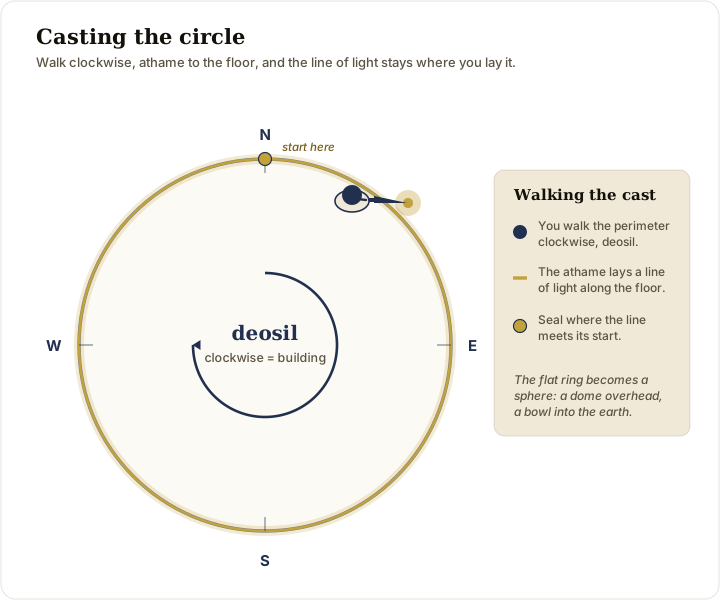
3. Seal the circle where the line meets its start
When the end of the drawn line meets the beginning, the boundary is sealed. This is the moment to see the circle for what it is: not a flat ring on the floor but a sphere, dome rising over your head, bowl sinking into the earth. The room inside that sphere is your temple for the next while.
4. Call the four quarters
Stand at the center. Face East first, then turn deosil through South, West, and North. At each direction, lift the tool or your open hand and speak the call. The traditional shape is plain and steady:
"Guardians of the East, powers of Air, I call you to witness this rite and guard this circle."
Substitute the element and direction at each turn. Some traditions name archangels (Raphael in the East, Michael in the South, Gabriel in the West, Uriel in the North); some name elementals (Sylphs, Salamanders, Undines, Gnomes); some simply call the element itself. Use whichever language you actually believe in. Calls you do not believe ring hollow no matter how good the script is.
A compact correspondence table to keep at the altar:
| Quarter | Element | Color | Altar representation |
|---|---|---|---|
| East | Air | yellow | incense smoke, a feather |
| South | Fire | red | a lit candle |
| West | Water | blue | a chalice or bowl of water |
| North | Earth | green or black | a dish of salt, a pentacle, or soil |
For deeper color symbolism see color correspondences; for the herbs that fit each quarter and what they do, herb correspondences.
5. Do the working
The circle is now active. Anything you would call serious goes here: spellwork, devotional rites, meditation, divination, a self-dedication. The spell mechanics themselves live in how spells work; the energy-raising drills and the famous "cone of power" live in grounding and centering; the full first-time dedication, written for a solo practitioner, is in self-dedication ritual.
Cutting a door: how to step out mid-rite
Sooner or later the cat will yowl, or you will realize you forgot the lighter on the kitchen counter. You cannot walk through the wall of a cast circle without consequence; in this lore the boundary is a taut membrane, and walking through it shatters the seal and bleeds out the energy you just raised.
The fix is a small sub-rite called cutting a door.
- Approach the boundary, traditionally in the Northeast quadrant (the liminal anchor between dark and light in this system).
- With the athame, the boline (the white-handled cutting knife), or your finger, pierce the boundary and trace a doorway: floor up, across in an arch, back down to the floor. This cut is made widdershins, temporarily undoing that section.
- Step through. Turn back to the circle. Insert the blade at the bottom of the arch and trace the same shape deosil to "zip" the doorway shut behind you.
- To return, repeat the same cut-and-seal from the outside, then step in.
A footnote practitioners pass around: cats and dogs are treated as already moving between the worlds, and are believed not to disturb the boundary by walking through it. Do not panic about the cat.
Step-by-step: closing the circle
Closing is the cast in reverse. The order matters more here than at any other point of the rite: always release what you called.
1. Release the quarters in reverse
Return to the center. Face North first, then turn widdershins through West, South, and East. At each direction, thank rather than command. The Wiccan line many use:
"Stay if you will, go if you must. Hail and farewell."
The elements were guests, not servants. Treat them like guests on the way out.
2. Take up the circle widdershins
Stand at your starting point (North if that is where you began). Point the tool at the floor. Walk the perimeter counter-clockwise. Visualize the glowing line being drawn back into the blade tip, or back into your open palm, like a thread being wound onto a spool. By the time you reach the start, the sphere is gone.
A closing line of your choice. The traditional one is, "the circle is open but unbroken; merry meet, merry part, and merry meet again."
3. Ground the residue
Even a small circle leaves residual buzz in the body. Place your hands flat on the floor and breathe the excess down into the earth for a minute or two. Then eat and drink something: the traditional "cakes and ale," but bread and water, tea and a cookie, or a slice of apple all work. The physical acts of chewing and swallowing pull your consciousness back into your body and end the ritual cleanly.
A circle left open is treated as a doorway left ajar. The eating is the bolt on the door.
The solitary, simplified version
For ten minutes and a corner of a bedroom:
- Sit comfortably on the floor or on the edge of the bed. Three slow breaths to ground; if you need a longer entry, run the drill from grounding and centering first.
- Visualize a violet-blue flame at your sternum. Push it outward in your mind's eye, breath by breath, until it surrounds you in a clean bubble.
- Whisper the call to each direction, turning where you sit if you can: "thank you, Air. Thank you, Fire. Thank you, Water. Thank you, Earth."
- Do the working in your mind's eye, on paper, or with a single candle.
- Reverse it: thank each direction in reverse order, pull the bubble back into your chest breath by breath, and touch the floor with both palms.
The first time I cast a circle in this stripped-down way, alone in a rented room with the door wedged shut, the embarrassing part was not the gesture. It was hearing my own voice say "guardians of the East" in a room that mostly heard me on phone calls. The air did thicken a little; that part is real and small and easy to miss if you are waiting for a movie. The voice cracked on the second direction and I kept going anyway, and that is what made it a rite instead of a draft.
Cunningham's whole point is that the pointed finger replaces the athame and the visualized flame replaces the chalk line. Tools are props. The circle is in the will.
When you can skip the circle (and when you really shouldn't)
A cast circle is a tool you reach for on purpose, not a tax you pay to be a real witch.
Skip it for a daily candle lit at the kitchen altar, a quick sigil scratched into a notebook, a simmer pot on the stove, devotional moments, a cup of moon water made on the windowsill. Most everyday practice does not need a full cast.
Don't skip it for spirit contact you do not already have a relationship with, a self-dedication, deity invocation in an unfamiliar tradition, energy-heavy or banishing work, or anything where the point is specifically to contain what you raise. If the working asks for a container, give it one.
When it feels like nothing happened
The most common questions from a first cast, answered straight:
- "I felt nothing." Normal for the first several casts. The shift is subtle: a faint pressure change, a slight hush in the room, sometimes a tingle at the crown. Repetition builds the sensitivity, not the script.
- "I forgot a step." Order matters more for closing than for casting. The cardinal rule is to release what you called; if you forgot to call the West, your circle is just slightly lopsided, but if you forget to dismiss anything you invited, that is the part to fix.
- "I walked through the line by accident." Step back inside deosil with conscious intent, re-seal the spot in your mind, and continue. Do not abandon the rite over it.
- "Did the spell fail because the circle was wonky?" Almost certainly no. Spells fall down for other reasons, mostly the human ones. Why didn't my spell work covers the real culprits.
A brief, honest history
Modern circle-casting as it is taught today is largely a 20th-century Wiccan invention. Gerald Gardner's Witchcraft Today (1954) is the founding public document, and the Alexandrian texts that followed (Stewart and Janet Farrar's A Witches' Bible) gave the rite its most exhaustive scripts. Raymond Buckland carried the practice to the United States in Buckland's Complete Book of Witchcraft, and Scott Cunningham's Wicca: A Guide for the Solitary Practitioner stripped it down for the solitary witch who would never join a coven.
The "Operation Cone of Power" story, in which Gardner's New Forest coven is said to have raised a cone in 1940 to psychically repel a Nazi invasion fleet, belongs in the lore column, not the history one. It is beloved foundational mythology and worth knowing, but the documented record is thinner than the legend, and honesty about that is part of why you can trust the rest.
What to do after your first cast
Once you have walked the rite once, the next ones get noticeably easier. A few places to take it from here:
- The first big working most witches do inside a cast circle is a self-dedication ritual.
- If you want a calendar to cast around, the sabbats of the Wheel of the Year give you eight built-in occasions.
- Full-moon rites have their own shape: esbats.
- And if the harder question underneath all of this is whether you should be doing any of it at all, the answer is short and kind in am I a witch.
Keep exploring
Browse more guides, or start with the basics of the practice you are curious about.
Browse more guides