Honey Jar Spell: The Sweetening Jar, Done Right
A honey jar spell is a sweetening jar from Hoodoo, the African American folk tradition: petition, herbs and honey sealed under a candle that, in practice, coaxes and never compels.
Make one tonight
- Gather your supplies for a self-love jar, where you are both the caster and the target. A half-pint glass jar with a metal lid (a clean jam jar is perfect); honey (or molasses if you want the older lineage); a small pink or white taper or chime candle; a slip of paper and a pen you like writing with; rosemary (a sprig of fresh or dried) or Florida water for cleansing; two to four self-love botanicals (rose petals, lavender, chamomile, a pinch of hibiscus); a small piece of rose quartz, only if you already have one; and a heat-proof plate or saucer to set the lit jar on. Everything comes from a grocery store, a hardware store and your own cupboard; nothing needs to come from a witch shop, a teacher, or anybody's permission.
- Cleanse the empty jar. Smoke from the rosemary works (pass the open jar through it, mouth down then mouth up), or a quick wipe with Florida water. You are clearing whatever was on the glass before you, including the day you have just had.
- Tear the petition paper. The petition is the part that does the most work, and the part beginners most often rush. Slow here. Tear the edges of your paper by hand: Hoodoo tradition holds that scissors close the energy off, while torn edges leave it open and flowing.
- Write your name. Down the centre of the paper, write your own name in an odd number of repetitions. Three for new growth, seven to draw something toward you, nine to anchor. There is no wrong choice; pick the one that feels right when you say the number out loud.
- Cross and cover. Turn the paper ninety degrees and write your name again across the first set, so the two columns cross and your name covers itself. In a relational jar this is "cross and cover" the target; in a self-love jar it is you claiming your own ground.
- Circle it with affirmation. Without lifting the pen, draw an unbroken circle of affirmation around the crossed names. Plain language is fine: "I am gentle with myself. I am loved. I belong to me." Keep going until the circle closes.
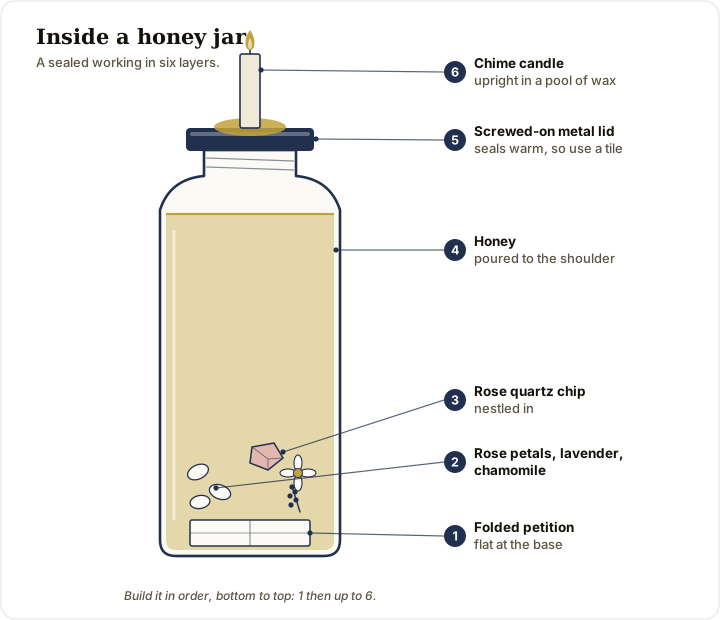
- Fold it toward yourself, three times. Folding toward you draws the intention in; folding away would send it out. Lay the folded petition flat on the bottom of the jar.
- Layer two to five botanicals over it. A small handful of rose petals, a pinch of lavender, a pinch of chamomile, a single dried hibiscus flower if you have one, a chip of rose quartz tucked in. Two to five is the working range; throwing in everything you own muddles the intention.
- Pour the honey slowly and speak. Pour until the herbs are submerged. Slowly is the point; this is the moment to say the words. The historical incantation Hyatt recorded from a rootworker is "Sugar, you is de sweetening of all things," which is direct and beautiful. The ethical self-love phrasing I use is Sweet to myself, sweet from myself, sweet within. Three times, into the jar, while the honey covers the herbs. Then screw the metal lid on firmly and wipe the rim.
- Dress and fix the candle on the lid. This is the step that turns the jar from a craft project into a working spell, and what makes it a honey jar. Anoint your pink or white chime candle with a thin film of olive oil, rubbing from the base toward the wick. Rubbing toward you draws; rubbing away sends. Light a match and gently melt the bottom of the candle until a small puddle of wax forms; press the candle upright into the centre of the metal lid and hold it for a few seconds until the wax sets. It will stand on its own.
- Light it and let it burn down. Set the jar on the heat-proof plate or a piece of tile, well away from curtains and pets: chime candles are short and burn in roughly an hour, but the jar lid does get warm. Never leave it unattended; if you have to step away, snuff the candle and relight later. Sit with it. Read the petition under your breath if you want. Let the candle burn all the way down so the wax pools and crusts over the lid. That pooled wax is the seal, both physically and ritually; each candle adds another layer until the lid looks like a small white or pink mountain.
Full mechanics on dressing, timing and reading candles are at candle magic. If even that supply list feels like a lot, the budget version of every item is at low-cost swaps, the wider context for what tools do is at core tools, and if you would rather buy one tidy box to begin, there is guidance at a starter kit.
Honey jar quick picks
- Tending: a fresh chime candle on the same day each week, Friday by tradition.
- Sweetener: honey for slow and long-lasting, molasses for the oldest lineage, white sugar for fast and short.
- Herbs: rose for compassion, lavender and chamomile for calm, cinnamon sparingly for speed.
- Reading the flame: a tall, steady flame means the working is taking; rule out wax and drafts before reading a sign.
- Other targets: a workplace, a court date or a consenting family tie, never a named, unconsenting person.
- Closing: running water, the earth, or wrapped and binned with thanks.
- Lineage: the recipe belongs to Hoodoo; name it as such and read its scholars.
Why start with the self-love jar
The self-love jar is where I send everyone first, including people who came in wanting something else entirely. You are both the caster and the target, which removes the consent question completely, and it teaches you every move you would use in a relational jar later: petition, layering, sealing, candle, tending.
It is for the stretch where your inner voice has gone sour on you, where you cannot stop auditing yourself, where you want to be on your own side again and cannot quite find the door. The first time I made one, I sat at the kitchen table on a Friday evening in the slanted late light, lit a small bundle of rosemary, and watched the smoke curl up over the empty jar. The smell was sharp and clean and slightly resinous. When I wrote my own name on the petition, the first time my pen hesitated; the second time it did not. That is half the spell, the fact that you sat down and wrote your own name on purpose.
You pair this well with shadow-work practices for the emotional layer underneath, and with wellbeing rituals for a steady weekly rhythm that holds you up.
Tending the jar over weeks
A honey jar is not a one-night spell, it is a relationship. The wax mountain that grows on the lid is the visible record of how often you showed up. That showing-up is the magic at least as much as the ingredients are.
A workable rhythm:
- Weekly cadence. Friday is the traditional day, because it carries Venus and softness; the waxing moon is the traditional phase, when things grow. Either is fine. Same day each week is what matters.
- Wake the jar. Before lighting a new candle, pick the jar up and gently shake or roll it. You are stirring the spirits of the ingredients, not mixing a cocktail; a slow turn is enough.
- Re-read the petition aloud, or speak the incantation again. The repetition is part of the spell.
- Press a fresh chime candle into the old wax at the centre of the lid, light it, and let it burn down. Each week adds another layer.
Keep the jar somewhere you will see it: an altar if you have one, otherwise a windowsill or a shelf in the bedroom. The visibility is part of the work. For more on a weekly spiritual rhythm see daily practice, and for the current sky see the moon phase calendar.
Reading the burn: a beginner's ceromancy
Watching the candle is the divinatory half of the work. Hoodoo practitioners call this ceromancy, and it is observation, not prophecy. A few patterns worth knowing:
- A tall, steady, clean flame. The working is taking, the ground is receptive, leave it be.
- A flickering or dancing flame. Energy is moving but unsettled; the situation has motion in it, not necessarily bad.
- A sputtering or popping flame. Something is resisting, or there is a voice in the conversation you have not heard yet. Sit longer.
- Heavy black soot up the side of the jar. Often read as interference or a heaviness to clear; consider a cleansing before the next candle.
- A flame that drowns in its own wax pool. Trim wicks shorter next time and switch to smaller chime candles; this is usually a wax problem, not an omen.
I find the steadiest readings come from doing nothing while the candle burns. Phone down, breath slow, eyes on the flame. The skill of reading subtle signals develops over time; if you want to train it more deliberately, see developing the clair senses.
Choosing your sweetener and herbs
If you want to adapt the self-love starter to another situation, two choices do most of the work: the sweetener (which sets speed and longevity) and the botanicals (which set the flavour).
| Ingredient | What it is | Speed | Longevity | Best for |
|---|---|---|---|---|
| Molasses | Sweetener (dark, thick) | Slow | Enduring | Long-term foundational shifts; historical lineage |
| Honey | Sweetener (modern default) | Slow | Long-lasting | Binding sweetness; the all-purpose base |
| White sugar | Sweetener (granulated) | Fast | Short | Quick favours, single events, immediate needs |
| Brown sugar | Sweetener (warm middle) | Moderate | Moderate | Comfort, warmth, gentle reconciliation |
| Cinnamon | Botanical (catalyst) | Fast catalyst | Modifies the jar | Heating cold ground; quickening money or focus |
| Rose petals | Botanical (love) | Gentle | Modifies the jar | Self-compassion, romance, devotion |
| Lavender | Botanical (calm) | Slow, soothing | Modifies the jar | Reducing anxiety, peace, tranquil resolution |
| Chamomile | Botanical (calm) | Slow, soothing | Modifies the jar | Calming anger, soothing the spirit |
| Hibiscus | Botanical (sovereignty) | Gentle | Modifies the jar | Independence, grace, standing in your own ground |
A few notes the table cannot hold:
- Molasses carries the oldest lineage, the deepest shifts and the longest fuse; use it when the work is foundational.
- Brown sugar sits between speed and depth.
- White sugar is for a jar for the job interview next Tuesday.
- Rose petals are the most flexible self-love botanical.
- Lavender and chamomile calm a volatile inner climate: peace, reconciliation, sleep.
- Cinnamon brings heat, speed and quickening; use it sparingly, it changes the whole jar.
- Rose quartz chip works as an anchor stone for unconditional love.
Two to five ingredients per jar. The matrix is more focused than a long list, and focused jars work better.
The ethics: why we will not do "name a crush" love spells here
A sweetening jar aimed at a specific, unconsenting person to make them love you is not on offer here. That is not gatekeeping; it is the line most thoughtful practitioners hold. Overriding another person's free will to manufacture affection is domination dressed as romance, and it tends to bring back what it sounds like: a coerced, hollow, unwell thing.
The test is the one you would want anyone else to use: would you be comfortable if someone cast this on you without your knowing? If the answer is no, do not cast it on them.
There are two ethical routes for love work. The first is to target the qualities rather than the person ("a loving, respectful, healthy partner") and let life bring a real match. The second, and the better starting place, is to sweeten yourself.
Frame any of this as magic plus action: a jar paired with the honest conversation, the boundary, the therapist, or the leaving. Magic supports how you act in the world; it does not replace acting. More on this is at the Wiccan Rede and on intent-setting at writing a spell.
Variations once you've done the self-love one
When the self-love jar has taught you the moves, a few directions open up.
- A workplace dynamic. Sweetening a difficult boss or a tense team. Petition aimed at the role and the relationship ("a smooth, fair working relationship with my team"), not at coercing a specific person's inner life.
- A court date. Softening a hearing, a custody meeting, a tribunal. Standard in the older Hoodoo literature; pair with all the mundane preparation a case requires.
- A strained but consenting family relationship. Where both people want the air to clear, a sweetening jar can be part of the work.
- A general "draw a healthy partner" jar. Target the qualities (kindness, honesty, mutuality), never a name.
A romantic jar between two specific people is appropriate only when both are doing the work together, knowingly. The line stays clear: no named, unconsenting target. For the wider container-spell family see spell jars, and for defence rather than sweetening see witch bottles.
When and how to close the jar
A spell ends. The jar deserves a closing as deliberate as its opening. There are three traditional routes:
- Running water for dispersal. Once the work has done what it can, unscrew the lid, scoop the organic contents into a river, stream, or the sea, and let the current carry the energy off. Wash the glass and bring it home, or recycle it.
- Buried in the earth for grounding. Pour the contents into a hole and return them to the ground. In an apartment, the deep soil of a large potted houseplant works as a substitute.
- Wrapped and thrown out, with thanks. If neither of the above is realistic, wrap the jar in paper (especially if there is wax and glass involved, to protect waste workers) and put it in the bin a little away from the house. Give thanks first; this is closure, not abandonment.
A self-love jar is a permitted exception. Many practitioners keep theirs on the altar indefinitely, lighting a fresh candle whenever they need the reminder. You will know when it is finished by feel: the season it was built for has passed, the inner voice it was softening has softened, and lighting the candle no longer carries weight.
Common first-jar troubles
- The candle drowns in its own wax. Trim the wick shorter (about a quarter inch), or switch to slimmer chime candles. Standard candles can over-pool; chimes are sized for this work.
- The honey crystallizes after a few weeks. Not a bad omen. Honey crystallizes in cool rooms. Warm the jar gently by setting it in a bowl of warm (not hot) water for fifteen minutes; the crystals soften.
- You feel nothing the first week. Expected. Sweetening is slow because the medium is slow. Light next Friday's candle; the first noticeable shift usually shows by the third or fourth week, often as a change in how you feel about the question, not in the question itself.
- It feels performative or hollow. Tear a fresh petition. Write your name again. The petition step is the heart of the spell because the act of writing your own name on purpose is half the work; the second time, it usually lands.
- The candle keeps going out. Check for a draft first. If the room is still and the candle keeps refusing, sit with what that might be saying about the question. Sometimes the answer is to change the petition.
For a wider diagnostic when something just is not landing, see why a spell didn't land.
Where it comes from: the Hoodoo lineage
Hoodoo is an autonomous African American folk magic tradition forged in the U.S. South under enslavement, when West and Central African people (notably the Bakongo) carried their cosmologies across the Middle Passage and adapted them to a continent whose plants, animals, and dangers were unfamiliar. They wove in Native American herbal knowledge and pieces of European folk magic and grimoire lore. The result is intensely practical: protection, healing, work, money, court cases, love, all built from what is in the kitchen and the yard.
Hoodoo is not Haitian Vodou and it is not Louisiana Voodoo. Those are codified religions with established pantheons and communal rites; Hoodoo is a folk magic system, often solitary, that historically lived inside Black Christian life. Scholars sometimes call this the "invisible institution," where the Book of Psalms doubled as a grimoire and ancestral spirituality survived behind a Protestant or Catholic facade. The fuller comparison is at Voodoo and Hoodoo, and the wider conversation about respecting living traditions sits at closed-practice context.
Why this history matters when you make a jar: you are borrowing a recipe from a tradition that survived under conditions designed to erase it. Name what it is. Read its scholars. Do not call it generic witchcraft.
The scholars who documented it
These mechanics are documented in serious ethnography.
- Zora Neale Hurston, anthropologist and novelist, recorded Hoodoo and Voodoo work in Mules and Men (1935), including time spent with rootworkers in Florida and New Orleans.
- Reverend Harry M. Hyatt's five-volume Hoodoo, Conjuration, Witchcraft, Rootwork (1970 to 1978) gathered nearly 4,800 pages of interviews with Southern rootworkers in the 1930s, with recipes, prayers, and petitions in their own words.
- Yvonne P. Chireau's Black Magic: Religion and the African American Conjuring Tradition argues that Conjure was not superstition but a real instrument of healing, protection, and power for a marginalized people.
- Katrina Hazzard-Donald's Mojo Workin': The Old African American Hoodoo System traces how an older African Religion Complex eventually got marketed and watered down in the twentieth century.
If you want one place to start outside this guide, Hurston is the most readable.
Molasses came first, honey came later
Raw honey, in the antebellum South, was a luxury. The sweeteners that enslaved people could actually reach were molasses, cane syrup, and brown sugar, the by-products of the very fields they worked. So the historically authentic base of a sweetening jar is darker, thicker, and slower than the golden jars you see online; a nineteenth-century rootworker likely reached for the molasses bowl.
Honey became the modern default only in the twentieth century, once commercial processing made it cheap on grocery shelves. Use honey if that is what you have; molasses if you want the older lineage in the jar. Knowing the difference is part of the respect.
How it works
A honey jar is one branch of a wider family of intention jars; the defensive cousin, kept by the door against ill-will, is the witch bottle. The honey jar's job is sweetening: it asks something bitter, cold, or stuck to grow warmer, kinder, and more workable.
The logic underneath is sympathetic magic, the cross-cultural principle that like calls to like and that a symbol, treated with care, can move the thing it stands for. The way I think about it: a road map is not the road, but plotting a route on the map and walking the route are paired acts; the chart and the territory keep talking. A sweetening jar treats your honey, your herbs, and your written name as a small territory of its own.
Because the medium is sweet, the working asks the target (a boss, a situation, your own inner voice) to grow sweeter, kinder, more agreeable. Because honey and molasses are slow and clinging, the magic is slow and clinging. It does not flip a switch. It thickens the air around a question over weeks, until something has more room to soften. The broader theory of how a spell travels is at how spells work.
Coaxing, not compelling
Sweetening is gentle by design. It is not a binding, not a domination, not a hex.
It can only warm ground that is capable of warming. If the relationship cannot bear love, sugar will not invent it. If the job is genuinely a bad fit, honey will not glue you to it. Practitioners speak of the jar bringing out the target's best qualities, not rewriting them. Hold that distinction and you will be doing the work the tradition actually does.
Where to go next
If the Hoodoo lineage is what drew you in, the next reading is closed-practice context and Voodoo and Hoodoo. If it was the container itself, the wider intention-jar family is where the craft opens up. And if you are newer than all of this and the jar was your first real spell, the slower walk through everything else is at the beginner path.
Keep exploring
Browse more guides, or start with the basics of the practice you are curious about.
Browse more guides