Planting by the Moon: A Phase-by-Phase Guide and Crop Table
Planting by the moon costs nothing to start, needs no land, no biodynamic calendar subscription, and no decision about what you believe: you look up, you note whether the moon is filling out or thinning, and you sow accordingly. The almanac charts are one of four traditions, each with its own logic, and you are free to follow just one; the simplest is plenty to start with.
My first season, I followed the simplest version with a windowsill, four pots, and a notebook from the corner shop, marking phases in pencil because I kept getting the dates wrong. Lettuce on the waxing moon did beautifully. My phase-perfect tomato sowing, timed to the day, rotted quietly in soil that was still too cold, which taught me the actual hierarchy faster than any chart could.
The Short Answer: The Weather Sets the Window, the Moon Picks the Day
Plant when your frost date and soil temperature say you can. Inside that window, the oldest and simplest rule is: sow above-ground crops while the moon is waxing, below-ground crops while it is waning.
Four separate rule systems live under the name lunar gardening: the two-half waxing and waning rule, the four-quarter refinement, planting by the signs with its fruitful and barren days, and Maria Thun's biodynamic root, leaf, flower and fruit calendar.
The phase is the same on a given date everywhere on Earth, so a moon rule travels. The seasons do not. Southern Hemisphere gardeners keep the phases and flip the months. For the phase tonight, the moon phase calendar has it, and the day-by-day planting calendar marks each day's window and sign.
The One Rule That Comes Before the Moon
Check your regional frost dates and the soil temperature your crop actually needs before you open any lunar calendar, and never put a frost-tender seedling into cold ground because the quarter looked right.
Extension horticulture guidance in Illinois, at Texas A&M AgriLife, at NC State and at Washington State converges on the same priority order: soil temperature, soil moisture, and local frost dates first. That is not an argument against the tradition. It is the floor the tradition stands on, and every experienced moon gardener I have met treats it that way.
Soil thermometers cost about the price of a coffee. Mine has saved more seedlings than any timing rule.
The Two-Half Rule: Waxing Up, Waning Down
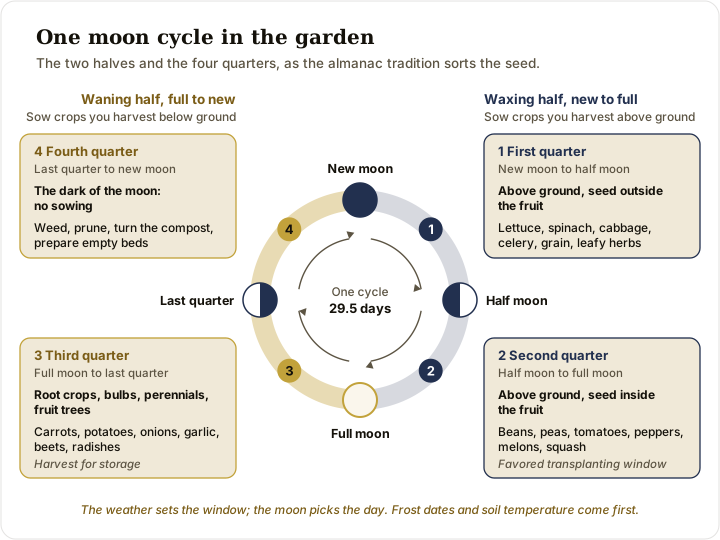
The two-half rule splits the 29.5-day synodic cycle at the full moon and sorts your seeds by where the harvest happens.
- Waxing, new moon to full: sow crops you harvest above ground. Lettuce, tomatoes, beans, broccoli, herbs.
- Waning, full moon to new: sow crops you harvest below ground. Carrots, potatoes, onions, garlic. This half also takes the harvesting, the pruning, and the bed preparation.
In almanac tradition, moisture is said to rise in the soil as the moon waxes and to settle back as it wanes, which is the reasoning the old books give for the split. That is the tradition's own account of itself, offered as the logic of the practice rather than as measured physics.
Start here. You can verify the input by stepping outside, which means no calendar to lose track of and nothing to buy. The same two-half shape runs through ritual practice too, where the waxing moon carries increase and the waning moon carries release; Scott Cunningham mapped it onto the Goddess as maiden, mother and crone. That side of lunar timing lives in moon magic by phase, and the garden version works perfectly well without it.
The Four Quarters: A More Granular Version of the Same Cycle
The four-quarter system, as the almanacs print it and as Texas A&M AgriLife summarized it in 2016, cuts the same 29.5 days into four task windows and sorts crops by where the seed sits.
First quarter, new moon to half moon. Above-ground crops that carry their seed outside the fruit: lettuce, spinach, cabbage, celery, grain, leafy herbs.
Second quarter, half moon to full moon. Above-ground crops that carry their seed inside the fruit: beans, peas, tomatoes, peppers, melons, squash. Traditionally the favored transplanting window.
Third quarter, full moon to last quarter. Root crops, bulbs, perennials, fruit trees, and harvesting for storage.
Fourth quarter, the dark of the moon. No sowing. Weed, prune, turn the compost, prepare empty beds.
Peas belong in the second quarter throughout, because the seed sits inside the pod.
| Lunar window | Plant anatomy profile | Main garden tasks | Example crops |
|---|---|---|---|
| New moon to first quarter | Above ground, seed outside the fruit | Sow leafy greens and brassicas | Cabbage, lettuce, spinach, celery, leafy herbs |
| First quarter to full moon | Above ground, seed inside the fruit | Sow fruiting vegetables, transplant seedlings | Tomatoes, peppers, beans, peas, melons, squash |
| Full moon to last quarter | Below ground, roots and bulbs | Sow roots, plant trees, harvest for storage | Carrots, potatoes, onions, garlic, beets, radishes |
| Last quarter to new moon | Resting window | Weed, prune, compost, prepare beds | No sowing |
How to Read a Seed Packet by Anatomy
Sort your seeds by anatomy once, at the kitchen table, and you will never need a chart in the garden again. Three piles, and the question is only where the plant fruits and where it keeps its seed.
Pile one, above ground with the seed outside the flesh: spinach, chard, kale, rocket, dill. Pile two, above ground with the seed inside: courgette, cucumber, tomato, runner beans, a packet of sugar snap peas. Pile three, below ground: beetroot, spring onion, carrot, garlic.
Two packets stall everyone. Brassicas that you eat as a flower, cauliflower and broccoli, are usually filed with the leafy pile because that is how the almanacs list them. Radishes are the other one: the root is the harvest, so they go to pile three even though the tops are the visible part. Potatoes are not seeds at all, and seed potatoes go in the below-ground pile where they belong.
My piles live in three labelled envelopes in a biscuit tin. It took ten minutes and it is the only part of this system I have never had to look up since. Gardening as a devotional practice, rather than as timing, is the green witchcraft side of the same soil.
Planting by the Signs: Fruitful and Barren Days
Planting by the signs tracks not the moon's light but the zodiac sign it stands in, roughly two and a half days per sign, and sorts those signs into fruitful and barren.
NC State Extension's account of the tradition, written up by Pettis in 2025, counts Cancer, Scorpio, Pisces, Taurus, Capricorn and Libra as fruitful, the days for sowing and transplanting. Leo, Virgo, Aquarius, Gemini, Aries and Sagittarius count barren, traditionally used for weeding, pest work and harvesting.
In this tradition the mapping is not elemental. Virgo is an Earth sign and counts barren; Libra is an Air sign and counts fruitful. If you want to follow this system, learn the list rather than reasoning from the elements.
In Appalachian practice this grew into the Man of the Signs, the zodiac laid down the human body from head to feet: Aries head, Taurus neck, Gemini arms, Cancer breast, Leo heart, Virgo bowels, Libra loins, Scorpio genitals, Sagittarius thighs, Capricorn knees, Aquarius legs, Pisces feet. The logic that follows is analogical rather than astronomical. Knee days and feet days, low on the body, are held favorable for what grows low in the soil, so potatoes and onions go in under a waning moon in Capricorn or Pisces.
One regional custom, recorded in a single account rather than as a general rule, has beans and other vining crops sown on Gemini arm days: reaching appendages for a reaching plant, despite Gemini counting barren. Folk systems tolerate that kind of local exception better than written ones do.
The sign columns are the layer I quietly stopped using after one season. Two and a half days is a narrow gate, and I found myself not planting on good afternoons for reasons I could not feel in the soil. Plenty of gardeners I respect run on signs alone. It just was not my rhythm. Plant lore of a different kind, the magical uses rather than the sowing dates, sits in herb correspondences.
Maria Thun's Biodynamic Calendar: Root, Leaf, Flower and Fruit Days
Maria Thun built the biodynamic sowing calendar in the mid-twentieth century from Rudolf Steiner's anthroposophy, a spiritual philosophy that holds there is an objective spiritual world open to disciplined study. It drops waxing and waning entirely in favor of the sidereal rhythm, the 27.3-day cycle of the moon's actual position against the constellations.
Thun sorted the days by which part of the plant they favor:
- Root days: moon in the Earth constellations, Taurus, Virgo, Capricorn.
- Leaf days: moon in the Water constellations, Cancer, Scorpio, Pisces.
- Flower days: moon in the Air constellations, Gemini, Libra, Aquarius.
- Fruit days: moon in the Fire constellations, Aries, Leo, Sagittarius.
Layered on top is the ascending and descending moon, which is orbital trajectory and not phase. The moon ascends from Sagittarius to Taurus, climbing higher in the sky each day; in biodynamic practice sap is held to rise then, so that is the window for harvesting above-ground crops and taking cuttings. It descends from Cancer to Scorpio, and that is the window for planting, transplanting and composting. A descending moon can perfectly well be waxing.
Thun-style calendars also mark blank or avoid days around the lunar nodes and around apogee and perigee, when sowing is set aside.
This system cannot be read off the sky. It needs a published calendar, which is a purchase, renewed annually. That is a small and genuine pleasure if the sidereal rhythm suits you, and an optional extra if you were only ever going to use the waxing and waning rule.
| System | What it tracks | Cycle length | Core rule | What you need to follow it |
|---|---|---|---|---|
| Two-half synodic | The moon's light relative to the sun | 29.5 days | Waxing sows above ground, waning sows below | Nothing but the sky |
| Four-quarter synodic | The same cycle, quartered | 29.5 days | Four task windows sorted by where the seed sits | An almanac or a phase page |
| Planting by the signs | The moon's tropical zodiac sign | About 2.5 days per sign | Sow on fruitful signs, work on barren ones | An almanac with sign columns |
| Biodynamic sidereal | The moon's constellation, plus ascending and descending | 27.3 days | Root, leaf, flower and fruit days | A published Thun-style calendar |
Where the Traditions Openly Disagree
The systems track different things, so they issue conflicting instructions on the same afternoon, and no master reconciliation exists.
Potatoes are a third-quarter crop in the synodic system, sown on the waning moon. If that third quarter falls in Leo, the sign system says do not plant at all, because Leo counts barren. One calendar is telling you to get the seed potatoes in and the other is telling you to pull weeds.
A biodynamic grower will sow carrots under a waxing moon without hesitation, provided the moon is descending and standing in an Earth constellation, which makes it a root day. The two-half rule forbids exactly that.
Practitioners resolve this by picking one system and following its internal logic to the end of the season. I run the two-half rule with the four-quarter refinement when I am organized enough, because I can check it by looking up and because sorting seeds by anatomy made sense to me the first time I heard it. That is a preference, not a verdict. The sign gardeners and the biodynamic growers are following coherent traditions with longer pedigrees than my notebook.
Your First Season: A Five-Step Start
- Get your local baselines first. Frost dates and the soil temperature each crop needs. Your regional extension service publishes both, free.
- Pick one system and resist cross-referencing. The fastest way to talk yourself out of planting is to open two calendars and find they disagree. One set of rules, one season.
- Sort your seeds by anatomy into the three piles, before planting season starts, while you still have patience for it.
- Run the phase protocol. New moon, pile one. First quarter, pile two. Full moon, pile three. Last quarter, tools down: weed, prune, compost.
- Keep a record. Sowing date, phase, crop, and what happened. This is the step that actually teaches you, and the step everyone skips.
The record is where the practice lives for me. Cheap notebook, phases marked in pencil, the damp-cardboard smell of seed trays on the kitchen counter in March while I write the date down. Two seasons in, that notebook told me that my failures clustered around cold soil and slug pressure, not around phases, and that my waxing-moon lettuce sowings kept doing well, a pattern I hold loosely. If you already keep a garden record, the garden pages can just be more of the same book. For the dates themselves, the moon phase calendar is enough.
A Phase-by-Phase Walk Through One Cycle
Waxing crescent, new moon to first quarter. The light is thin and growing. Sow the leafy, seed-outside pile: spinach, lettuce, cabbage, celery, the herbs. Cold-hardy things go in first, as soon as the soil works without clumping on the fork.
Waxing gibbous, first quarter to full moon. Sow the seed-inside pile: tomatoes, peppers, beans, peas, squash, melons. This is also the traditional transplanting stretch, and it is the part of the cycle I am busiest, moving seedlings out in the evening with the moon already up.
Waning gibbous, full moon to last quarter. Roots, bulbs, perennials, fruit trees. Harvest for storage. Almanac lore holds that produce cut on a waning moon keeps better and rots less, a teaching carried by tradition rather than by trials; I have never been able to tell the difference in my own onions. The full moon itself is when the lunar year gets ritual attention in esbats, and a jar on the sill turns into moon water with no extra effort.
Waning crescent, last quarter to new moon. Hands off the seed. Weed, prune the woody shrubs, turn the compost, prepare empty beds. Three or four days that give the whole calendar its shape, because they are the days the garden otherwise never gets.
Across the Growing Season
One example of the lunar month laid over a temperate climate calendar, to adapt rather than obey.
Early spring. Cold-hardy greens as soon as the soil works, at the new moon. Peas at the second quarter, seed inside the pod. Early roots, radishes and hardy carrots, after the full moon. The dark of the moon goes to compost and soil amendment.
Late spring, after your last frost. First-quarter and second-quarter transplanting of tomatoes, peppers and squash into soil that is genuinely warm. Third quarter for succession-sown roots and for dividing early perennials.
Summer. Fourth quarter for serious weeding and for cutting back overgrown foliage. The full-moon stretch for harvesting and for preserving what comes in.
Autumn. New moon for cover crops like winter rye. Third quarter for garlic, and for lifting storage crops, squash and potatoes. What comes out of the ground then is where kitchen witchcraft takes over, and the seasonal frame most practitioners hang all of it on is the Wheel of the Year.
Southern Hemisphere: same phases, seasons reversed.
What the Published Research Actually Found
The published field trials on lunar planting are few, small and mixed, and the most recent review of the literature found no reliable, science-based evidence justifying agricultural practices conditioned by the moon.
The classical sources. The oldest surviving farmer's almanac in the Western tradition is Hesiod's Works and Days, from Greece around 700 BCE, which gives day-by-day guidance across a thirty-day lunar month divided into waxing, middle and waning thirds. Hesiod tells the farmer to avoid the thirteenth of the waxing month for beginning to sow, while calling the same day best for setting plants (line 781 in Hugh G. Evelyn-White's 1914 translation). Pliny the Elder, in Natural History Book 18, chapter 75 (Bostock and Riley translation), advises that produce is cut, gathered and housed to more advantage while the moon is on the wane, that manure be touched only on the waning moon, and that the roots of trees be covered up while the moon is at full.
The almanac line. Early modern printed almanacs standardized weather, saints' days and lunar phases for European farmers, and colonial American almanacs printed moon phases and signs in the same format. The lineage runs unbroken to the Old Farmer's Almanac, founded in 1792, and the Farmers' Almanac.
Spiess, published 1990, University of Kassel. Chronobiological trials under biodynamic management on a farm near Frankfurt, sowing daily: winter rye across eight years, little radish, cultivar Parat, across three. Spiess found lunar effects weak, did not confirm Thun's sidereal root, leaf, flower and fruit effects, and reported the radish results as only partly statistically significant.
Kollerstrom and Staudenmaier, 2001. A proponent reanalysis of Spiess's radish data, computing yields as deviations from a moving average rather than from seasonal quadratic trends. They reported roughly a 7% yield increase for radishes sown in Earth constellations and argued the original analysis was flawed. It remains a contested reanalysis, with the original author's conclusions standing alongside it.
Jovchelevich, Botucatu, Brazil, 2005 to 2006. Carrot sowing-date trials, Daucus carota L. A significant lunar-phase effect showed up in dry mass, not in fresh-mass yield, and the author described the two-year results as not conclusive.
Mayoral, Solbes, Cantó and Pina, 2020, in Agronomy 10(7):955. A review across the scientific, botanical and physics literature, concluding there is no reliable, science-based evidence justifying agricultural practices conditioned by the moon.
The tides objection. A common explanation in the tradition runs that if the moon moves oceans it must move sap. The moon's tidal pull on something plant-sized is negligible next to Earth's own gravity, which acts at roughly 9.8 metres per second squared. A Clemson extension agent, quoted in a local news report, added a related point: tides rise and fall twice daily, so if tidal force drove sap, plants would surge twice a day rather than once a month.
Illinois Extension, in a 2022 post by Pankau, gives the two figures most often quoted in these discussions: the moon's gravitational effect is roughly 300,000 times weaker than Earth's, and the light of a full moon is roughly 128,000 times dimmer than sunlight.
| Study or review | What it tested | What it found | Limits |
|---|---|---|---|
| Spiess, 1990 | Winter rye over 8 years, little radish (cv. Parat) over 3, sown daily under biodynamic management | Lunar effects weak; Thun's sidereal day-types not confirmed | Radish results only partly statistically significant; single farm |
| Kollerstrom and Staudenmaier, 2001 | Reanalysis of Spiess's radish data, moving-average method | Reported about 7% higher radish yield in Earth constellations | Proponent reanalysis of another team's data; method contested |
| Jovchelevich, 2005 to 2006 | Carrot sowing dates, Botucatu, Brazil | Lunar-phase effect on dry mass; no fresh-mass yield effect | Author called the two-year results not conclusive |
| Mayoral, Solbes, Cantó and Pina, 2020 | Review of scientific, botanical and physics literature | No reliable, science-based evidence for moon-conditioned practice | A review, not new field data |
| Singiri et al., 2023 | Tobacco and mustard seedlings under full moonlight, lab | DNA-methylation changes, stress metabolites, phyB and phot2 upregulated; mustard seedlings grew more | Controlled light exposure, not a planting-date or yield trial |
| Priyanka et al., 2024 | Brassica juncea, three-night moonlight exposure, lab | Moonlight registered as an environmental signal | Lab exposure; no crop-timing or yield conclusions |
The Moonlight Studies, Kept in Scope
Moonlight is far too weak to power photosynthesis, so the recent laboratory work treats it as a signal rather than a fuel, and the findings are narrower than either wing tends to hope.
Singiri and colleagues, publishing in Plants in 2023, exposed tobacco to full moonlight and recorded changes in DNA methylation, a process that alters which genes are active without changing the underlying DNA sequence, along with stress-associated metabolites and the upregulation of the photoreceptors phyB and phot2. Mustard seedlings in the same work grew more.
Priyanka and colleagues, in Plant Cell and Environment in 2024, exposed Brassica juncea to moonlight across three nights and found the plants registering it as an environmental cue.
Both are controlled lab light exposures. Neither is a planting-date trial and neither measured a harvest, so neither tested almanac or biodynamic crop timing either way. What they establish is that some plants can detect moonlight at all, which is genuinely interesting and a narrower question than whether sowing dates matter. The tradition is old, coherent and unproven, and holding a practice without proof is a normal thing to do; the wider version of that question sits in the honest both-sides view.
Why Gardeners and Witches Keep Doing It
The lunar calendar is a pacing structure, and pacing is the thing home gardens fail at.
The moon gives you an unignorable two-week beat that turns up in the sky whether or not you opened an app. When it is waxing, the seedlings have a deadline. When it is full, that is the signal to stop sowing and go pull the weeds you have been walking past for a fortnight. The tasks that would drift to "eventually" get a slot, and the gardener ends up outside, looking closely at soil and leaves, twice a month minimum.
I sowed on the cue, and I also checked the soil temperature, watered, thinned the seedlings and netted the brassicas. The pairing is the practice. For the believing wing, the phase is a devotional rhythm and the garden is where it lands. For the skeptical wing, it is a calendar you actually keep.
Spending here is welcome and entirely optional. A printed almanac is a small real pleasure and a Thun calendar is worth it if the sidereal system is the one you are following; a free phase page does the same job for the two-half rule, and you can skip what to avoid entirely by buying nothing at all. A windowsill pot of basil is a complete beginning. Two river stones and a jam jar have started more practices than any kit. If you want the wider path this sits inside, gardening as devotion rather than as timing, that is green witchcraft, and taking anything from land you do not cultivate brings in foraging ethics.
Where to Go Next
Tonight's phase and the dates of the coming quarters are on the calendar. For the ritual side of lunar timing rather than the garden side, the waxing and waning correspondences live in moon magic, and day-of-week timing sits with planetary days. For the whole green path, soil as devotional ground, start with the green path.
This is a gardening tradition, not agronomic advice, and for anything your crops, your land or your livelihood depend on, your local extension office is the authority worth calling.
Keep exploring
Browse more guides, or start with the basics of the practice you are curious about.
Browse more guides