Planetary Days and Hours: Magical Timing Made Simple
Planetary days assign each weekday to one of the seven classical planets, and tradition times a working to the day whose energy matches its heart. It is qualitative time, not natal astrology and not a forecast: scaffolding for focus, not a control panel for the universe.
The quick chart: which day favors which working
| Day | Ruling planet | Archetypal energy | Favored magical and mundane intentions | A signature correspondence |
|---|---|---|---|---|
| Sunday | Sun | Vitality, authority, illumination | Success, health, leadership, public visibility, career breakthroughs, setting the week's tone | Gold and yellow; sunflower, chamomile, rosemary |
| Monday | Moon | Intuition, emotion, cycles | Divination, shadow work, emotional release, purification, domestic and family work, planning | Silver and pale blue; jasmine, mugwort, moonstone |
| Tuesday | Mars | Action, courage, momentum | Hard boundaries, overcoming obstacles, defense, competition, breaking stuck patterns | Iron and red; nettle, garlic, thistle |
| Wednesday | Mercury | Intellect, communication, speed | Writing, study, negotiations, tech and logistics, talismans of the word | Mixed yellows and greens; lavender, fennel, hazel |
| Thursday | Jupiter | Expansion, opportunity, abundance | Prosperity, wealth and career growth, wisdom, opportunity, philosophical clarity | Royal blue and purple; oak, sage, bay laurel |
| Friday | Venus | Love, harmony, aesthetics | Romance, self-love, reconciliation, artistic and creative work, social harmony | Copper, pink and green; rose, vervain, jasmine |
| Saturday | Saturn | Restriction, discipline, endings | Banishing, binding, long-term structure, deep organization, defensive work, endings | Lead, black and dark blue; cypress, mullein, Solomon's seal |
Each row gives the day, its ruling planet, the archetypal energy classical sources hand it, the kinds of working tradition favours there, and one signature correspondence to anchor an altar or a candle.
Pick the day that matches the heart of the intention, not the literal topic. A money working tied to a creative launch tends to sit better on a Sunday than a Thursday, because the engine of it is visibility, not pure expansion. A "love" working that is really about leaving cleanly is a Saturn job, not a Venus one.
Where the intention lines up with a working you already know, the obvious pairings hold: Venus days for a honey jar, Saturn days for protection work or a clean banishing, Jupiter days for an abundance candle working.
Sunday: Sun (vitality, visibility, the self)
Sunday is the day for being seen on purpose. Classical sources hand it to the Sun as the engine of vital force and the core self, and tradition reaches for it when the working is about success, health, leadership, public visibility, or setting the broader tone of the week.
In practical terms, this is the day to launch the thing, apply for the promotion, ask to be looked at. Mundanely, it is also the day for the kind of self-care that has a posture in it: cleaning the desk you sit at, doing your hair like you mean it, writing the bio.
The Agrippan anchors are gold and yellow and orange; sunflower, chamomile, cinnamon, rosemary, and St. John's wort. Light a gold or yellow taper, write the petition in your handwriting, sit with it.
Sunday is also the day I quietly notice whether I am building something I actually want to be visible for, or just performing. The working lands better when the answer is the first one. More on aligning hues to the planet at color correspondences.
Monday: Moon (intuition, emotion, the inner weather)
Monday is for listening. In lunar tradition, the Moon rules the unseen and the felt, so Monday is held for divination, shadow work, emotional release, purification, and the kinds of domestic and family work that turn on attunement rather than push.
It is also the better day for planning than for executing. The intuitive shape of the week tends to surface on a Monday morning if you let it: free-writing, a pull from your deck, an honest hour with the journal.
The Moon does not like to be forced. If a Monday intention is "decide," the working will often refuse to land; if it is "notice what I already know," it will.
For the lunar layer that sits underneath the weekly chart (the third timing variable, not weekday timing), the depth lives at moon magic. For the practice of pulling a card with the morning's coffee, divination practice.
Tuesday: Mars (action, courage, boundaries)
Tuesday is short on patience and that is the point. Mars rules drive, defense, hard boundaries, and the kind of momentum that breaks a stuck pattern, so tradition reaches for this day when hesitation is the actual problem.
It is also the classical day for baneful work (binding, severing, hexing) when paired with the matching hour and the right lunar phase. The folklore of that side of the craft has its own context at hexes and curses.
For most practitioners most of the time, the Tuesday job is smaller and harder: holding the line in a conversation, sending the email you have been redrafting for a week, writing the boundary down and meaning it. The defensive side of the same energy lives at protection spells.
The Agrippan anchors are iron, red, and the stinging plants (nettle, garlic, thistle). A red candle, a needle, a sharp word said out loud.
Wednesday: Mercury (communication, learning, logistics)
Wednesday is the messenger's day. Pitches go out, contracts get read, the hard email gets drafted, and the studying you have been avoiding finally happens.
Mercury rules the gaps between people, so any working that lives in the spoken or written word does well here: incantations, petitions, sigil work, and the actual practice of writing a spell that says what you mean.
Mundanely, Wednesday is the day to batch what your brain treats as small but draining: inbox, admin, scheduling, the three messages you have been putting off. The Mercury hour tends to make them feel light.
The plants here are mixed-natured (lavender, fennel, hazel, peppermint), which fits the planet. Quicksilver, of course, in name only; the metal is named for him.
Thursday: Jupiter (abundance, opportunity, growth)
Thursday is the premier day for prosperity workings, and the prosperity meant by the tradition is wider than money. The "Greater Benefic" tends to expand whatever it touches, so Thursday works for wealth, opportunity, wisdom, career growth, joy, and the kind of philosophical clarity that lets you actually see what you want.
The Thursday discipline is magic plus action. Light the candle for the new client and send the pitch the same afternoon. Light it for the raise and ask for the raise. The day amplifies; it does not deliver.
A practical small ritual: a green or royal-blue candle, a bay leaf with the intention written on it, the leaf passed quickly through the flame and dropped into a heatproof dish. Then the email.
For the full method, candle magic; for the broader frame of how to pair a working with the action it needs, manifestation.
Friday: Venus (love, beauty, harmony)
Friday is the supreme window for love work in the tradition: a new partner, a deepening, a reconciliation, the slow patient practice of self-love. Venus also rules the aesthetic and the creative, so art-making, social repair, and difficult conversations that need a diplomatic softening all fall into her remit.
The honest practitioner note here: Venus rituals land harder when you include yourself in the love being called, not just an other. A working that asks for "someone to love me the way I deserve" without you knowing what that actually looks like has nowhere to go.
The Friday altar tends toward pink and green, copper, rose, vervain, and jasmine. A pink candle, a small honey jar, a piece of rose quartz from your existing kit. More on the stones at crystal practice, and the classic Venus working at the honey jar spell.
Saturday: Saturn (structure, banishing, endings)
Saturn is the slow, serious one. Saturday is held for banishing, binding, long-term structure, deep organisation, defensive work, and the workings that end what needs to end.
It is also, plainly, the boring-essential day. Reviewing the foundations of a project, paying the tax, line-editing the manuscript, redoing the budget. The mundane and the magical here are the same shape: structure first, growth later.
Practitioners reach for Saturday when the working has weight to it. A banishing ritual for a habit you are done with, a witch bottle for a household that needs a perimeter, a careful home cleanse before the next chapter begins.
The Agrippan anchors are heavy: lead, black and dark blue, cypress, mullein, Solomon's seal. The candle is black, the work is slow, the result is durable.
Planetary hours: the 24-hour layer underneath the day
A planetary hour is the unit of time the Chaldean cycle (the seven planets ordered slowest to fastest, explained below) hands you when you go finer than the day. The misconception worth clearing first: these are not sixty-minute clock hours. The day's daylight gets divided into twelve equal pieces and the night into twelve, and the length of those pieces stretches and shrinks with the season and your latitude.
The rule that organises the rest is absolute: the first planetary hour, beginning at the exact moment of sunrise, is always ruled by the day's planet. Sunday's first hour is the Sun, Monday's is the Moon, Tuesday's is Mars, and so on. After that, the hours cycle through the Chaldean order until the next sunrise.
The steps in plain language:
- Find local sunrise and sunset for your date.
- Subtract sunrise from sunset to get total daylight minutes; divide by twelve. That is the length of one daytime planetary hour.
- Do the same with sunset to next sunrise, divided by twelve. That is the night-hour length.
- The first daytime hour belongs to the day's ruling planet.
- Each subsequent hour follows the Chaldean order: Saturn, Jupiter, Mars, Sun, Venus, Mercury, Moon, and around again.
Around the spring and autumn equinoxes, when day and night are roughly equal, planetary hours sit close to sixty minutes. Around the summer solstice, daytime hours stretch long and night hours shrink; the winter solstice flips that.
Do not calculate this by hand. The tradition tracked it because there was no other option; a free location-aware planetary hours calculator or a phone app will give you the day's whole table in a tap. Several reputable ones exist; pick one whose data source you can verify and stick with it.
The "double power" stack: day + hour
The operational move that makes planetary timing worth the trouble is stacking the day and the hour. When the hour's planet matches the day's planet (a Venus hour on a Friday, a Sun hour on a Sunday), tradition treats the energy as at its peak. That window is the "double power" slot.
Three of the cleanest examples straight from the tradition:
- Love, reconciliation, or a difficult relational conversation: a Venus hour on a Friday.
- Asking for a raise, launching a money working, signing a contract for opportunity: a Jupiter hour on a Thursday. Asking for the same raise during a Saturn hour, by contrast, is read as inviting delay and harsh criticism.
- A creative launch or a visibility push: a Sun hour on a Sunday.
Mixed stacks are also valid and often smarter. Ending a relationship cleanly tends to sit better on a Saturn day with a Venus hour: Saturn ends, Venus softens the landing. Courage for a money conversation can sit on a Jupiter day with a Mars hour: Jupiter holds the abundance frame, Mars supplies the spine. The day is the broad weather; the hour is the local gust.
The grimoire tradition layers material correspondences on top: candle work in Sun and Mars hours, water work and bath rituals in Moon and Venus hours, breath and spoken incantation in Mercury and Jupiter hours, buried talismans and graveyard work in Saturn hours. Match what you do to who you are calling.
The third layer: lunar phase (and where it lives)
Advanced practitioners stack a third variable on top of day and hour: the phase of the Moon. Waxing for drawing in, waning for releasing, dark moon for the heaviest banishing.
A maximum-potency banishing in the tradition might wait for a Saturn hour, on a Mars day, during a waning or dark moon. Maximum-potency abundance might wait for a Jupiter hour, on a Thursday, with a waxing moon. The point is not to chase the alignment; the point is to know it exists when the working is important enough to wait for it.
The full how-to for the lunar layer sits at moon magic, and the live tracker for what phase you are actually in is the moon phase calendar.
A worked example: planning a real working
Say the intention is, "I want to call in a new client without sounding desperate." The decision tree is:
The heart of the ask. Opportunity is Jupiter. The actual pitch language is Mercury. The relational softness, the not-sounding-desperate part, is Venus. Three planets are in play, which is honest, because real intentions usually are.
Pick the spine. The spine here is opportunity, so the day is Thursday (Jupiter). The hour is where you stack the supporting energy: a Mercury hour on Thursday for the writing of the pitch, or a Venus hour on Thursday for the warmth of the approach. Either is defensible. I would pick the Mercury hour, because the pitch language is the part most likely to actually decide the thing.
Tune with the moon. If the lunar phase is waxing, you are with the current and you go. If the phase is waning, you delay a few days unless the deadline is real.
The slot itself. Light a green or royal-blue candle (see candle magic). Write the pitch by hand first, the way you would speak it to a friend; type it after. Send it before the planetary hour ends. The working is the writing and the sending together. The petition lives at how to write a spell if you want a full structure for it.
Magic plus action. The slot does not send the email for you.
Caveats: when not to use this
A few honest limits, plainly:
Eclipses. Classical tradition treats eclipse seasons as the moment the light is cut, and almost universally pauses constructive workings regardless of how favourable the day and hour look. A favourable Venus hour during an eclipse is still an eclipse.
When the intention is unclear. Timing cannot rescue a working you have not yet understood. Sit with the question first. A Jupiter hour does not know what to amplify if you do not.
When the math starts to block the doing. If you are still waiting for the perfect window two weeks later, the perfect window has passed. The action carries more weight than the slot. A pretty good Thursday now beats a perfect Thursday in three weeks.
Health, money, legal. Planetary timing supports how you focus and act, not a diagnosis, a financial guarantee, or a legal outcome. Speak to a doctor, a financial professional, or a lawyer in parallel.
What planetary days are (and what they aren't)
In planetary days, each weekday belongs to one of the seven classical planets, and tradition pairs that day's energy with a kind of working: Sunday/Sun for visibility, Monday/Moon for intuition, Tuesday/Mars for action, Wednesday/Mercury for communication, Thursday/Jupiter for abundance, Friday/Venus for love, Saturday/Saturn for boundaries and endings.
The frame underneath the system is the old Neoplatonic idea of cosmic sympathy. A struck tuning fork sets a second, identically tuned fork humming across the room, and the terrestrial world, in this view, hums in answer to celestial movement.
You do not have to accept that frame literally to use the chart. As a practice, planetary days are a way of compartmentalising goals into windows that already carry a mood, so you stop trying to fix every part of your life on the same Wednesday afternoon.
What this is not: a birth chart, a transit forecast, or a promise that the working will land. Natal and transit work lives elsewhere. Planetary timing is one variable, and the spell you actually cast (and the action you actually take) is still the load-bearing part.
The Chaldean order (why the days are in this order)
The engine underneath the weekday chart is the Chaldean order, an ancient sequence that lines the seven classical planets up by their apparent speed across the sky, slowest to fastest:
- Saturn (slowest)
- Jupiter
- Mars
- Sun
- Venus
- Mercury
- Moon (fastest)
If you assign one planet to each hour of a day in that order and let the cycle loop, two things fall out cleanly. The first hour after sunrise on Sunday is the Sun's; cycling through Saturn, Jupiter, Mars, Sun, Venus, Mercury, Moon for twenty-four hours lands the next sunrise on the Moon. The Moon's day is Monday. Run it again and the next sunrise lands on Mars. The weekday sequence we use is the leftover of that math: twenty-four divided by seven leaves a remainder of three, and the remainder is what marches the rulership forward by the right amount each dawn.
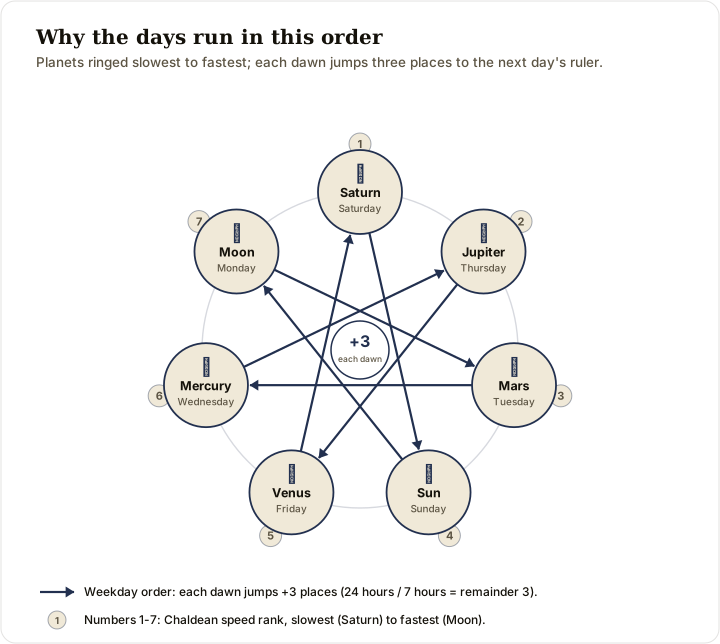
The receipt is in the language. In Romance languages especially, the weekday names are the system: mardi for Mars, mercoledì for Mercury, vendredi for Venus, samedi for Saturn. The English Saturday is the obvious survival; Thursday is Thor, the Norse equivalent of Jupiter. The grid is older than the calendar.
The outer planets (Uranus, Neptune, Pluto) are not in this order because they were invisible to the naked eye and unknown to the tradition that built it, and dropping them in breaks the math. Modern psychological astrology uses them. Classical planetary-hour magic deliberately does not.
A quick history (so you know where this came from)
The bones of this system are old and well documented. The Chaldean order and the planet-to-hour mapping crystallised in Hellenistic Egypt and show up in the Greek Magical Papyri, a Greco-Egyptian collection where practitioners were already instructed to align invocations with specific planetary hours.
The medieval Arabic Picatrix (originally Ghāyat al-Ḥakīm, "The Goal of the Wise"), composed in the 10th or 11th century and translated into Latin in the 13th, framed planetary magic as a Neoplatonic discipline that demanded inner clarity and intellectual mastery before the practitioner went anywhere near a celestial force.
Heinrich Cornelius Agrippa's Three Books of Occult Philosophy, published in 1533, is the synthesis most modern correspondence charts ultimately trace back to: the metals, colours, herbs, and intentions assigned to each planet, the whole Renaissance grammar of the day. When you read a planetary table on the internet, you are usually reading Agrippa at several removes.
The day names are the receipt. Mardi is Mars's day in French, mercoledì is Mercury's in Italian, samedi is Saturn's, Saturday is Saturn's in English, Thursday is Thor (the Norse Jupiter). The system is literally baked into the calendar you already use.
What about Uranus, Neptune, Pluto?
The outer planets are missing from the chart because they were invisible to the naked eye and unknown to the people who built the system. The seven-planet math is also what generates the clean 24-hour and 7-day loop; insert an eighth or ninth body and the loop breaks.
Modern psychological astrology absolutely uses Uranus, Neptune, and Pluto, and there are real practitioners who work with them magically. Classical planetary-hour magic, however, is deliberately a seven-planet practice. If you want to keep the math working, you keep the planets ancient.
Time Magic: the secular read
For the skeptical or science-seeking reader, the same chart works as a productivity scaffold. Mercury hours for email and pitches, Moon hours for free-writing and reflection, Saturn hours for line-edits and admin, Venus hours for the networking call, Mars hours for the hard task you have been avoiding, Jupiter hours for the big-picture work.
The "magic" in this framing is the radical move of assigning disciplined focus to a slot, and outsourcing the choice of what to do next so decision fatigue stops eating the day. The brain spends a startling amount of energy choosing between options; the chart does the choosing for you.
The believing reader and the secular reader can use the exact same grid. The framing differs, the practice does not. That is part of why this tradition has lasted.
Where to go from here
The lunar layer underneath day and hour lives at moon magic, and the live tracker for the current phase is the phase calendar. For the colour of the candle on each day, colour correspondences is the next read; for the herb side of Agrippa's grammar, herb correspondences. To put a line to each day, affirmations for each day of the week runs Monday to Sunday, and Monday affirmations gives the Moon's day a set of its own. And the simplest first working that uses any of this well is still candle magic.
Keep exploring
Browse more guides, or start with the basics of the practice you are curious about.
Browse more guides