Samhain (sow-in) is the witches' new year, the cross-quarter sabbat that opens the dark half of the wheel, and for many of us the most sacred turn on the whole calendar. You feel it before you know what to call it: the slant of early dark, the ache for someone you have lost, the dread of a long winter, a quiet tug toward a candle in the window.
Permission first, before any history or rite. There is no coven you have to find, no kit you have to buy, no checklist that decides you in or out. A kitchen apple, a tea light, and ten honest minutes at a window mark this night well; so does a full altar with two black tapers and a bolline if that is what you want.
In this tradition the veil between the living and the dead is said to thin now. Whether you hold that as literal or as a description of how the body remembers loss in October, the practice still does its work.
What Samhain Is, in One Breath
Samhain (sow-in) is the cross-quarter sabbat from sundown October 31 to sundown November 1 in the Northern Hemisphere, and April 30 to May 1 in the Southern. Witches mark it as the new year, the death-half of the wheel, and the night the veil between the living and the dead is felt to thin.
- When: sundown to sundown, October 31 to November 1 in the North, April 30 to May 1 in the South.
- Where on the wheel: the cross-quarter between Mabon and Yule on the wheel, the inward turn into the year's death-half. Dates float year to year, and the next sabbat keeps them current.
- Why it matters: ancestor honoring, divination for the year ahead, and the release of what is finished.
A Simple Solitary Samhain Ritual (Six Steps)
The rite is six small moves: cleanse, set the altar, invoke, divine, banish, feast and close. Walk it as written your first year, then strip and add as your practice tells you.
It is held as belief, not physics. Tradition teaches that the Crone and the Horned Lord meet you here; results come through that opening and through what you do in waking life the next morning. Cast and act.
Step 1: Cleanse the Space and Yourself
Run a hot bath with a fistful of fresh rosemary and three broken pieces of star anise, by one candle if you can. Sink in until the water cools enough to notice. The smell of rosemary steeped at the temperature of a bath is not the smell in a stew; it is sharper, almost medicinal, and it shifts the mood faster than a shower ever has for me.
Step out, dry off, dress simply. In the room where you will work, take a besom (a broom kept for ritual; a tied bundle of dried herbs works) and sweep deosil (clockwise) without touching the floor. You are not chasing crumbs; you are moving the room's stagnant air a direction it has not gone today, and the small swishing sound is part of the cue.
Open a window a crack if you will burn anything later. Ventilation is not optional on this night, both for fire safety and for any incense you use. The same logic scales up in home cleansing, and a steadier body for the rest of the rite comes from grounding first.
Step 2: Set the Altar (Facing West) and Cast the Circle
West is the direction of the setting sun and, by extension, the realm of the dead. Set a small surface against the west wall if you can, the kitchen table at the west end if you cannot, the windowsill of a west-facing window if that is what you have. None of this is fussy; the orientation is the work.
On it: two black taper candles (Goddess on the left, Horned God on the right), a fire-safe cauldron or heavy bowl at the center, an apple, a bolline (a small working knife; a clean paring knife is fine), one divination tool, and one or two photographs of the dead you intend to honor. That is all. The altar wants room to hold what arrives.
Cast the circle next. A line of salt poured slowly, a ring of fresh earth, or a black cord laid in a circle around you all work; move deosil. Call the four quarters (east, south, west, north) in the form your tradition uses, or simply name each direction and what it carries (air, fire, water, earth). More on a steady year-round build in altar build, with full quarter-call language in casting a circle.
Step 3: Invoke the Crone and the Horned Lord
Light the Goddess candle first and speak to her aloud. In Wiccan tradition the words are something like, "Dark Mother, ruler of the night, Goddess of death and rebirth, lift the veil between the worlds that I may commune with those I love." You can paraphrase; the form matters less than the choice to use your voice.
Light the Horned God candle next and ask him to walk the wandering souls safely. The felt shift when you say these things out loud in an empty room is the thing nobody tells you about. My first year I almost laughed at how self-conscious I felt; by the fourth, it had become the moment the room went still. If calling either by name feels premature, deity work walks the etiquette.
Step 4: Divine for the New Year
The traditional way to put it is that the veil is thin and the omens are clear; the practical way is that you are quieter than you have been in months and your subconscious has more room to surface. Either way, this is the night for divination.
Pull three tarot cards, or stare into a black scrying mirror until the edges go soft, or look unfocused at the flame of the God candle. Ask the two questions everyone asks: what do my ancestors want me to know, and what must I prepare for in the dark months ahead. Write down what you hear, even the parts that feel like nothing. The full method options live at divination methods, with a starter walk at scrying.
Step 5: Banish What's Dead (Parchment to Cauldron)
Write on a small square of paper the one thing you are ready to be done with. A habit, a relationship that is over but still living in your head, a sorrow that has had its full term. One thing, not a list; a list dilutes the focus.
Hold the paper to the flame of the God candle, drop it into the cauldron, and watch it through to ash. Say aloud: from darkness, light; from death, birth. That is the spell, and it is honest about what spellwork is.
Now the part most pages skip. The rite makes the opening; the next-morning action makes the result. The relationship you burned in October needs an unfollow, a returned key, a conversation. The job you released needs an application sent. Magic plus action, every time, and how spells work is mostly about this pairing.
Step 6: Feast of the Dead and Close the Rite
Take the apple and cut it horizontally with the bolline. The five-chambered star at the core is the pentagram, and it is one of the small physical proofs that has carried a lot of practitioners over the line from curious to committed. Take one slow bite. Set the rest on a plate (a pentacle, if you have one) as the offering.
Pour a small cup of apple cider or dark ale and set it beside the plate. Speak to the photographs by name. Tell them what you have wanted to tell them. Thank them.
To close, bid them goodnight and ask them to return to their rest. Thank the Crone and the Horned Lord, and snuff the tapers (do not blow them out; tradition says you give the breath back, not the flame). Leave one safe lantern or jar candle burning in a window to guide spirits home until you sleep. Take down the circle the way you cast it, counter-clockwise. The closing matters as much as the opening; an uncast circle leaks energy and leaves you flat the next day.
A Note on Disposing of the Offering
Tradition tells you to bury the apple and any leftover offering at the base of an old tree or at a crossroads. If you live in an apartment, that is not a moral failing; the spirit of the instruction is return organic matter to the earth, and a countertop electric composter, a Bokashi bin, or your building's municipal compost stream honors it.
Whatever you choose, do not eat what you offered. The food has done its work.
Why Witches Call Samhain the New Year
The Celtic day began at sundown, so the Celtic year began in the dark. By the time Samhain arrived, the last of the harvest was in, the herds had been culled for winter, and the slate of the agricultural year was wiped. Divination at this point set the year ahead because there was nothing material left to decide; the next move was inward.
That inward turn is the engine of the new-year frame. Yule is the year's pivot, Imbolc its first sign of light, but Samhain is the start: the year begins in stillness, not in resolution. The full eight-sabbat shape of that argument sits at the wheel.
A Brief Honest History (Documented vs Lore)
A lot of what gets repeated about Samhain online is half right. Separating documented from lore is part of why this practice can carry weight.
What is documented: some Neolithic passage tombs in Ireland and Britain, built between roughly 4000 and 2500 BCE, were oriented to the sunrise at Samhain, which means people were tracking this point on the year long before anyone wrote about it. The 9th- and 10th-century Old Irish tale Tochmarc Emire (The Wooing of Emer) names Samhain as the first of the four seasonal festivals, the time "when the summer goes to its rest." The 11th-century Lebor Gabála Éirenn associates the night with great gatherings, bonfires, and the opening of the burial mounds. Historically, Samhain was a pastoral milestone: the cattle came down from summer pasture, the unsustainable animals were slaughtered for winter meat, the last grain was stored. That much is solid.
What is lore: that modern Wicca is an unbroken survival of an ancient Celtic religion. It is not. The historian Ronald Hutton lays this out at length in The Triumph of the Moon: A History of Modern Pagan Witchcraft; the duotheistic Crone-and-Horned-God myth most of us work with today was articulated in the mid-20th century by Gerald Gardner and Doreen Valiente, layered onto older Celtic agricultural bones and Victorian folkloric scholarship. The bones are real; the modern liturgy is recent. Naming the seam is what lets the rest of the practice carry weight.
The Thinning Veil and the Mythos
The night holds grief that ordinary nights cannot, and the tradition has a story for why.
In modern Wiccan myth, the Horned God (the masculine divine, associated with the wild, the hunt, and the year's life force) reaches the end of his cycle at Samhain and goes willingly into death. He descends to the Summerland and becomes a comforter and guide to the souls there, holding them through the winter until they are reborn. The Goddess, the year's other half, fully takes on her Crone aspect: keeper of accumulated wisdom, mother of endings, the dark mother. In mourning her consort, she lets the land go cold.
The veil between the worlds is said to thin in this passage. Beloved dead can return for the night; unfinished things can be heard. The deities most often invoked at this turn are Hecate (the Greek guardian of crossroads and the spirit realm), the Morrigan (the Celtic shaper of fate and the cycle of death), Cerridwen (the Welsh keeper of the cauldron of transformation), and the Cailleach (the Gaelic veiled hag who brings winter). Each rules a different chamber of the same room: choice, fate, transformation, weather. Calling any one of them by name is a serious thing, and deity work walks the etiquette.
Samhain Correspondences (the Cheat Sheet)
In this tradition, certain items carry the season's energy by virtue of color, scent, story, or growing season. None is required; all are useful to know so you can pull from what you have.
| Category | Traditional item | What practitioners reach for it for |
|---|---|---|
| Colors | Black, orange, red, brown, gold | Black absorbs and protects, holds the dark of the womb and the tomb; orange carries the harvest's last warmth; red, brown, and gold are the dying-leaves spectrum of the year going to rest. |
| Herbs and woods | Rosemary, mugwort, wormwood, pine, sage, oak and acorn | Rosemary for remembrance and ancestor honoring; mugwort and wormwood for vision and divination (handle with care); pine and sage for cleansing; oak and acorn for endurance through the dark. |
| Foods | Apples, root vegetables, pork, hazelnuts, pomegranates | The apple's hidden pentagram makes it the food of the dead; roots are treasures pulled from the underworld; pork honors the historical meat harvest; nuts hold the promise of return; pomegranates carry the Persephone story. |
| Tools | Besom, cauldron, scrying mirror, pentacle, bolline | Besom sweeps energy; cauldron holds the burn; scrying mirror opens the gaze; pentacle holds the offering; bolline cuts the apple. |
| Symbols | Bones, skulls, jack-o'-lanterns | Bones and skulls are memento mori; carved gourds took over from the turnip lanterns recorded in 19th-century Ireland and Scotland. |
| Animals | Raven, crow, owl, bat, black cat | Wisdom, prophecy, night-sight, transformation, guardianship of the spirit realm. |
| Deities | Hecate, the Morrigan, Cerridwen, the Cailleach | Crossroads and spirit work, fate and death, transformation, winter and the wild old woman. |
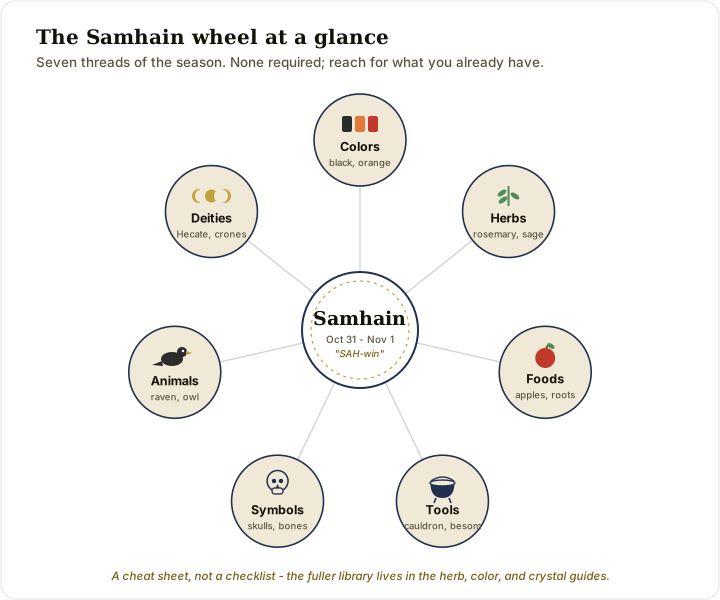
A fuller library lives in herb correspondences, color magic, and crystals for the season.
Safety: Mugwort, Wormwood and the Cauldron
Mugwort and wormwood both contain thujone, which is genuinely toxic in dose and is a known abortifacient; never ingest either without supervision from a clinician who knows herbalism. If you are pregnant, trying to be, or nursing, leave them off your altar entirely. Both are fine to burn for vision-work in a well-ventilated room; neither is a casual tea.
Keep the cauldron on a heatproof surface away from curtains, sleeves, and cats. Hair tied back. A cup of water within reach. None of this is theatrical; it is the difference between a rite and a fire.
Ancestor Work and the Dumb Supper
Tradition treats the dead as guests, not memories. The night's foundational act is welcoming them in, and the most fully articulated form of that welcome is a meal known as the Dumb Supper.
Building the Ancestor Altar
A length of black cloth over the surface. Photographs of the dead, faces visible. Heirlooms with their fingerprints still on them. A small dish of something they loved (my grandmother's was Russian Caravan tea; I set out a thimble of it). A black taper. One white candle for the un-named: the ancestors of the line you do not know personally, the lost.
The discernment piece nobody warns you about: you do not have to invite every relative. Hard family stays off the altar. You can honor the line generally with the white candle and put on the cloth only the people you genuinely want at your table. There is no rule that says blood owes blood entry. Choose chosen family. More on the steady altar build in altar build.
How a Dumb Supper Actually Runs
The Silent Supper is choreographed, and the choreography is the rite. Run it like a host's checklist:
- Set the table early. Fine china if you have it (the night likes the formality), candlelight, fall-colored linens, autumn leaves down the center.
- Lay an extra place setting at the head of the table. Drape the chair in black cloth. Light a single tall candle at this place to guide the dead to their seat.
- Before guests arrive, have each living person write a private letter to the dead they are inviting. Sealed; unread.
- The moment guests cross into the dining room, no one speaks. Phones off, not silent.
- Serve the empty chair first, the best portion of every dish. Then the living eat by candlelight, in absolute silence, projecting their letters and their love inward.
- Some traditions serve the meal in reverse, dessert to bread, or have guests walk backward to the table, to mark that the Otherworld inverts ours. Treat as tradition, not requirement.
- At the end, each person rises, brings their sealed letter to the empty chair, drops it into the cauldron there to burn, gives a silent farewell, and leaves the room.
- The food on the ancestor's plate stays overnight. Dispose of it respectfully in the morning (bury, compost, or municipal organics). The living never eat it.
The first Dumb Supper I sat through, the silence broke me by the second course. That is part of how I know it works.
Why the Silence Works (Belief-Framed)
Tradition holds that the silence creates an opening the dead can walk through. The mechanism a skeptic can hold without strain is plain sensory restriction: low light, no speech, candle flicker, an enforced slowness. Daily noise quiets, and grief and memory have room to surface. Both readings honor the same observation, which is that something rises in the silence that does not rise at a dinner party.
No medical claim attaches. If grief work brings up more than you can carry, please bring it to a person trained to hold it.
The Southern Hemisphere Flip
The wheel is keyed to the land under your feet, not the date on the calendar. If you live in Australia, New Zealand, southern Africa, or South America, your Samhain runs sundown April 30 to sundown May 1; during the Northern Samhain, you are at Beltane, in the rising green half of your year.
Holding a death-rite while the jasmine blooms outside is energetically a mismatch and tends to feel hollow. Practitioners who try the date-aligned version a few times usually give it up and flip to the season-aligned one, which is what the wheel has always been about.
Samhain vs Halloween: What's Actually Different
Most witches do both, happily. Costume party Friday, Dumb Supper Saturday. The difference is intent, not opposition.
| Feature | Samhain | Modern Halloween |
|---|---|---|
| Core intent | Introspective, sacred reverence for the dead; honoring the wheel and the harvest. | Secular entertainment, fear-thrills, costume play, consumer spectacle. |
| View of the dead | Revered ancestors and beloved guides actively welcomed across the veil. | Monstrous caricatures (ghosts, ghouls) to be feared or laughed at. |
| Primary activities | Dumb Suppers, solitary or coven ritual, divination, ancestor altars, releasing what is done. | Costume parties, trick-or-treating, horror films, haunted houses. |
| Historical origin | Celtic pastoral meat harvest and Neolithic solar alignments. | Christian overlay (All Hallows' Eve, 8th-9th c.) layered with 20th-century American commercialization. |
| Tone | Slow, candlelit, often tearful. | Loud, theatrical, sugar-high. |
How Halloween Grew Out of Samhain
The Catholic Church reached the Celtic territories in the 8th and 9th centuries and did what religions tend to do with stubborn local festivals: it overlaid them. November 1 became All Saints' Day (All Hallows' Day), November 2 became All Souls' Day, and October 31 became All Hallows' Eve, which contracted in everyday speech to Halloween. The November 1 anchor stayed; the meaning slowly migrated.
What got diluted between then and now is mostly an American story. Turnip carving is documented in Ireland, Scotland and parts of England from the early 1800s, when boys hollowed out roots, cut faces into them and set them on walls and in graveyards to frighten passers-by; the National Museum of Ireland holds a cast of a Donegal "ghost turnip" from around 1900. Whether the custom reaches back any further is not established, whatever the internet says. That practice crossed the Atlantic with Irish emigrants and met the larger, easier-to-carve pumpkin. The serious divination rites used to read the year ahead became bobbing for apples: a parlor game with the shape of a divination intact and the meaning gone. None of that is grievance; it is the documented path Hutton traces in Triumph of the Moon.
Soul Cakes: A Simple Hearth-Magic Bake
Before the candy industry got involved, the people who knocked on doors on All Hallows' Eve were going souling: the poor and the young offering prayers for a household's dead in exchange for spiced cakes called soul cakes. That trade is the documented ancestor of trick-or-treating, and the cakes themselves are kitchen magic at its plainest.
The correspondences are baked in: salt for wisdom, ginger for healing, nutmeg for prosperity, cinnamon for banishing. Score a pentagram on top for the pagan roots, a cross for the medieval syncretic form, or leave them blank if you are still feeling out where you stand.
Ingredients
- 2 to 3 1/2 cups all-purpose flour (start at 2, add to texture)
- 1 stick (8 tablespoons) unsalted butter, softened
- 1/2 to 1 cup sugar, to taste
- 2 egg yolks (or 1 whole egg)
- 1/2 cup warm milk
- 1 to 2 teaspoons pumpkin pie spice (or a blend of cinnamon, nutmeg, ginger, clove)
- 1/2 teaspoon salt
- 1/2 cup currants, raisins, or dried cranberries
Method
- Preheat the oven to 400°F (200°C). Whisk the flour, salt, and spice together in a small bowl.
- Cream the butter and sugar in a large bowl until pale and fluffy. Beat in the egg yolks.
- Fold the spiced flour into the wet mixture. It will look crumbly. Add the dried fruit.
- Add the warm milk one tablespoon at a time, kneading by hand into a soft, uniform dough.
- Turn the dough out onto a floured surface and roll it to about half an inch thick. Cut with a biscuit cutter or an upturned glass.
- Score a pentagram (or a cross) into the top of each cake. Brush with milk or beaten yolk for a golden glaze.
- Bake on a parchment-lined sheet for 12 to 15 minutes, until shiny and golden brown. Serve warm, cider on the side, the first cake left on the ancestor altar.
Kitchen witchcraft sits next to candle work in most practices for exactly this reason: the oven is an altar that pays for itself.
A No-Cost, Broom-Closet Version
No altar, no cauldron, no problem. The night still belongs to you.
Ten minutes in the kitchen after the house is asleep:
- One apple from the fridge. One tea light. One notebook. A west-facing window.
- Light the tea light on the sill. Cut the apple horizontally and look at the star. Take a bite.
- In the notebook, write the name of one person you have lost and one thing you want them to know. Then write one habit you are ready to be done with.
- Sit with it for the length of the candle, or for five quiet minutes if the candle will outlast your patience.
- Snuff the candle. Tear out the page, fold it twice, put it somewhere you will not lose it. In the morning, throw it out without rereading. Take one small action toward the habit-release before noon.
This counts. None of the trappings change what is actually happening, which is that you turned toward the dark on the right night and you let yourself be seen by it. The same principle runs through witchcraft on a budget, broom-closet practice, and the longer baby witch checklist.
Common Questions (the Honest Answers)
Do I have to be Wiccan to mark Samhain?
No. Eclectic, secular, and folk witches mark it; non-witches who keep a relationship with their dead mark it. The Wiccan myth gives the night its modern shape, and you can use the shape without taking on the theology. Secular witchcraft keeps the rite and skips the deities.
Can I do this if I'm still Christian, or still in the broom closet?
Yes. The medieval Christian practice of praying for the dead on All Souls' Day shares blood with this; many practitioners hold both. If safety or family means nobody can know, the no-cost version was written for you, and broom-closet practice has more. The fear question underneath is answered at is witchcraft a sin.
What if I don't know my ancestors, or my family is genuinely hard?
You get to choose. Chosen-family ancestors are real ancestors. A beloved teacher, a writer whose work raised you, a friend you lost: they go on the altar, fully. Blood relatives who hurt you stay off, unconditionally. The line you do not know personally gets honored by a single white candle for the un-named, and that is enough.
Is the veil really thin?
Held as belief, yes; tradition has said so for as long as there has been a tradition. Held as observation, something does shift in a candlelit room on October 31, and people who have done this for years tend to stop arguing the cause and let the night do its work. Both readings get you to the same altar.
After Samhain: What Comes Next on the Wheel
The Crone half of the year has just begun. The next pivot is Yule, the winter solstice, when the Sun God is reborn from the cauldron and the wheel turns again. Between now and then is the long inward stretch where shadow work tends to surface; many of us work with shadow work specifically through November and December because the conditions are right for it.
If the year-ahead question from Step 4 stayed with you, divination methods walks the tools in depth, and the eight-sabbat arc holds in the wheel of the year. The dark has its own gifts. Take what arrives.