You do not need a coven, a hearth, or a single fancy tool to mark Yule. If you can sit in a dark room with one candle and a sprig of pine on the longest night, you are already doing the thing the old midwinter fires were doing: refusing the dark, calling the light back, and trusting that it answers.
What Yule Is (and When It Falls)
Yule is the witches' winter solstice, a Sabbat with Germanic and Norse roots that falls around December 21 in the Northern Hemisphere and around June 21 in the Southern, marking the longest night and the rebirth of the sun.
In modern witchcraft it sits as one of the eight points on the Wheel, the four solar holidays plus the four older cross-quarter days. Its job is small and enormous: name the deepest dark without flinching, then strike a match. Practitioners frame the night as the Goddess giving birth to the sun, or as the Oak King taking back his crown, or simply as the moment the days quietly turn toward longer light. Pick the framing that does not make you wince. To find out when the next Sabbat lands, dates move year to year because the solstice is astronomical, not calendrical.
Yule Dates by Hemisphere
The solstice is a sun event, not a calendar date, so the exact moment slides by a day or two each year. Modern practitioners hold the rite on the nearest convenient evening; the magic does not check your watch.
| Hemisphere | Date window | What it marks | Its summer mirror |
|---|---|---|---|
| Northern | ~Dec 20-23 | Longest night, sun reborn | Litha in late June |
| Southern | ~Jun 20-23 | Longest night, sun reborn | Litha in late December |
The "hemispheric flip" is the standard fix in Australia, southern Africa, and South America: shift every Sabbat by six months so the Wheel matches the actual season under your feet. Holding Yule during a 35C December is the kind of disconnect the Wheel was never built for.
That fix is not universally beloved. Some Southern Hemisphere practitioners point out that even the flipped European model still imports a four-season Anglo-Celtic frame onto landscapes that recognize six or eight ecological seasons. Mediterranean-climate witches make a similar point: early February is not snowdrops and frozen earth for them, it is torrential rain on green hills. The growing answer is eco-localization, building a personal calendar from the bioregion you actually live in. The Wheel turns the seasons, not the page of a planner.
The History Behind Yule: Germanic, Norse, and What's Lore
The word "Yule" comes from the Old Norse Jól and the Old English ġéol, both naming a midwinter festival kept by heathen Germanic peoples. The earliest written mention sits in Bede's eighth-century The Reckoning of Time, which records a period in the old pagan calendar called giuli around the winter solstice. That is the documented anchor.
Snorri Sturluson, the thirteenth-century Icelandic scholar, gives the most detailed picture in Heimskringla: ceremonial drinking, oath-swearing over the cup, and the sacrifice of a boar to Freyr, the god of peace, prosperity, and fertility. The festival was not a single night but a stretch of roughly twelve days, the gap the lunar calendar needed to catch up with the solar year. Agricultural societies could not work frozen ground, so the long midwinter pause became feasting on slaughtered meat and finally-fermented drink. Plenty, briefly, in the worst stretch of the year.
The Wild Hunt belongs in a separate column: lore, beautifully told but not archaeology. In Norse and Anglo-Saxon storytelling, Odin (Woden), who carried the title Jólfaðr or "Yule-father," led a spectral host of dead heroes, hounds, and gods across the chaotic winter sky on his eight-legged horse Sleipnir. Those who wandered too far from the hearth on Yule nights risked being swept up. That is myth doing what myth does, making the actual danger of midwinter (cold, hunger, getting lost) into a story you can sing. You can honor it as living tradition without claiming it is history.
For the deeper reconstructionist track (Heathenry, Asatru, Celtic recon), the recon paths primer is the next step.
The Oak King and the Holly King
The dominant modern allegory for Yule is the duel of the Oak King and the Holly King. The Oak King is the waxing light, growth, the lengthening sun; the Holly King is the waning dark, rest, the shortening sun. At Yule the Oak King defeats the Holly King and the days begin to lengthen. At Litha the Holly King strikes back and the slide toward winter begins.
It is a clean, powerful frame and it is almost entirely modern. The myth is not preserved in ancient Celtic primary texts. It was assembled in the mid-twentieth century, most influentially by the poet Robert Graves in The White Goddess (1948), building on Sir James Frazer's earlier The Golden Bough (1890) and its theme of dying-and-reviving vegetation kings. Janet and Stewart Farrar then folded it into British Traditional Wicca in the 1970s, and from there it spread everywhere.
That history is not a flaw. It is a trust signal. Knowing the Oak and Holly Kings are a poetic reconstruction rather than a recovered ancient rite lets you use them honestly: as a working symbol for the balance of light and dark, not a counterfeit ancient artifact. The image still does its job. You just hold it with open hands.
Yule Correspondences at a Glance
In witchcraft, correspondences are the physical things (color, plant, scent, food, symbol) that practitioners reach for because they carry the energy of the season. Use what you have; the chart is a map, not a shopping list.
| Category | What to reach for | What practitioners use it for |
|---|---|---|
| Colors | Red, green, gold, white, silver (yellow and orange for the sun) | Evergreen life, hearth blood, returning solar fire, the quiet of snow |
| Trees and greens | Pine, spruce, cedar, fir, holly, mistletoe, ivy, yew | Immortality, warding, fertility, ancestor work |
| Herbs and resins | Rosemary, sage, bay laurel, blessed thistle, frankincense, myrrh | Purification, ancestor honor, banishing, reverent atmosphere |
| Spices | Cinnamon, clove, nutmeg, ginger | Heat, prosperity, mimicking solar fire |
| Foods | Pork (Yule ham), turkey, spiced cider, wassail, eggnog, gingerbread, fruitcake, caraway cakes | Abundance against scarcity, gratitude, hearth warmth |
| Symbols | Yule log, candles, bells, spinning wheel, stag, the Julbocken (Yule Goat) | Light reborn, warding, the turning Wheel, horned wildness |
For depth on any one column, the herb chart, color magic, crystals, and incense and oils each live in their own guide.
Why These Plants Made the Cut
There is a practitioner logic to it that a botany list misses. Evergreens are on the altar because they refuse to die when everything else does; bringing a pine bough indoors is a small, stubborn vote for life. Holly belongs to the waning king, the prickled-leaf warden of the dark half. Mistletoe was the Druid plant, sun-grown on the oak's high branches, and practitioners still reach for it for fertility and peace. Yew is the deep tree, planted in graveyards for a reason, used in practice for ancestor work and breaking what needs breaking.
Caraway cakes soaked in cider feel like a quaint detail until you try it. The seeds taste like Christmas you cannot quite name; practitioners use them for protection, memory, and keeping a household's love steady through the long nights. The first time you bake a batch and the kitchen smells like caraway and warm apples, you understand why this list survived.
How to Celebrate Yule: The "I Sorrow Not" Solitary Rite
This is one well-known way to mark the longest night alone. It comes from Scott Cunningham's Wicca: A Guide for the Solitary Practitioner (1988), the book that made solitary practice feel as real and as valid as any coven rite. The shape of it: name the dark honestly, then strike the light. That is the whole turn.
You are working with open flame, dried botanicals, and resin incense. Ventilate the room, never leave the candle unattended, and skip the older suggestion to splash rubbing alcohol in the cauldron for a dramatic flash. That trick is a house fire waiting to happen. Yule magic supports how you feel through the dark; it is not safety, medical, or legal advice.
What You'll Gather
Pack the night like a practitioner, not a Sephora cart.
- A cast-iron cauldron or any heat-proof vessel (a thick ceramic dish works)
- One thick red or gold pillar candle that fits inside it
- Long matches or a taper for lighting
- Sprigs of pine, rosemary, bay, juniper, cedar (whatever the corner store or your yard offers)
- A handful of dried autumn leaves you kept back from October
- Pine, cedar, or frankincense resin on a charcoal disk (or a stick of pine incense if resin is a stretch)
- Spiced cider and a small cake (caraway if you have it, plain if you don't) for the closing feast
If your "cauldron" is a soup pot, the magic still runs. River stones, kitchen herbs, and a tealight are enough. For the full altar walkthrough, altar basics covers the spread; for cost-zero swaps, witchcraft on a budget is the one to keep open.
Step 1: Set the Altar
Lay the evergreens around the working space first. Scatter the dried leaves across the cloth, the old year breaking down. Set the cauldron in the center with the unlit candle inside it, and leave the room a little darker than feels comfortable.
The smell is the first part of the rite. Cedar warming near a candle has a resinous, slightly sweet edge you do not notice until everything else is quiet. Bay laurel snaps audibly when you break a stem. Pay attention to those small sensory details; they are how the night signals it has started.
Step 2: Cast the Circle, Light the Incense
Light the charcoal disk first (it takes a minute to catch, hold the match to it until it sparks and hisses), then drop a pinch of resin on it. Cast the circle the way you cast it: a circle of stones around the altar is the traditional Cunningham form, but any clear, intentional boundary works. Circle casting walks the mechanics; grounding settles your body inside it.
Invite the Goddess as Great Mother and the God as the reborn Sun Child, or name the powers you actually work with. Practitioners across paths phrase this differently. The point is you are setting the room with witnesses.
Step 3: Speak the "I Sorrow Not" Invocation
Stand at the unlit cauldron and gaze into it, the dark vessel, the dark womb of the year. Then say:
I sorrow not, though the world is wrapped in sleep. I sorrow not, though the icy winds blast. I sorrow not, though the snow falls hard and deep. I sorrow not; this too shall soon be past.
The line lands differently in a dark room than it does on a page. There is a stubbornness in it. You are not pretending the dark is not real; you are refusing to be levelled by it. This is the moment the rite turns.
Step 4: Ignite the Light
Strike the long match. Light the red or gold candle inside the cauldron. As the flame catches, speak:
I light this fire in Your honor, Mother Goddess. You have created life from death; warmth from cold; The Sun lives once again; the time of light is waxing. Welcome, ever-returning god of the Sun! Hail, Mother of All!
The first time most practitioners do this alone, the second invocation comes out shakier than expected. The first one is defiance and feels almost easy. The second one is welcome, and welcome is harder.
Step 5: Walk Deosil, Chant, Meditate
Walk slowly clockwise (deosil, with the sun) around the altar three times. Chant softly:
The wheel turns; the power burns.
Then sit. Look at the candle. Let the chant fall away. The meditation is on dormant energy: seeds under frozen soil, sap waiting in the roots, things in your own life that are not dead but resting. This is the unglamorous part. It is rarely the cinematic "energy rush" online posts promise. It is more often a quiet settling, like a room dropping in temperature by one degree. That settling is the work.
Step 6: Personal Workings and the Simple Feast
If you have a spell for the longer dark (peace in the household, an inner thaw, a knot of something you want to release), this is the slot for it. Candle magic and writing your own spell cover the mechanics.
Then the Simple Feast. Bless the cider and the cake, eat and drink a little of each, leave a small portion for the spirits or the land. Food is the grounding agent; the body needs to come back into the room before you release the circle. Open the circle the way you closed it, thank the powers, and let the candle in the cauldron burn down safely (or snuff it with intention to relight tomorrow).
Craft a Tabletop Yule Log
The ancient Yule log was not a craft. It was a hardwood trunk, often oak or ash, dragged into the hearth with ceremony, lit from the charred end of last year's log, and kept burning for the full twelve days of the festival. Families saved the ashes for protection, tucked under beds against lightning and scattered into spring fields for fertility.
Most of us do not have that hearth. The modern Yule log is a small altar centerpiece, a foraged or gifted piece of wood drilled to hold candles. Tradition says it should not be bought; it should be found, gifted, or harvested from your own land. That keeps the link to the actual place you live.
- Forage the base. A flat-bottomed log or thick branch, 12 to 18 inches long, about 5 to 6 inches across. Oak is traditional. Local wood is honest.
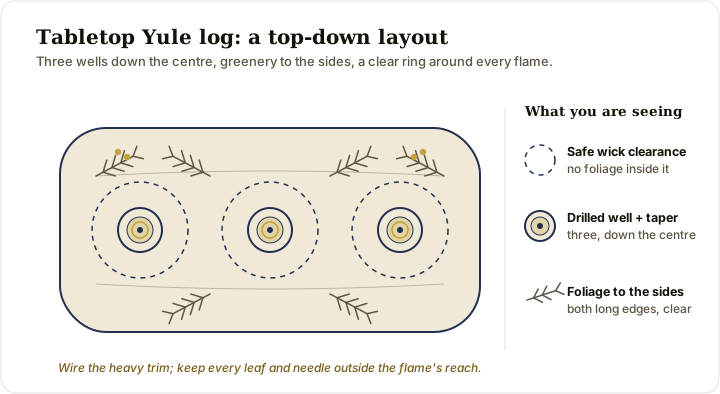
- Drill candle wells. Three or four wells along the top with a 1-inch spade or Forstner bit, about an inch deep. Three is the standard set, for the Triple Goddess (Maiden, Mother, Crone), or for red/white/black, or for red/green/gold.
- Seat the tapers. Beeswax tapers if you can get them; snug fit so they stand straight without rocking.
- Adorn. Tuck pine, holly, ivy, and mistletoe along the length, secured with floral wire, twine, or hot glue. Pinecones, dried orange slices, and cinnamon sticks fill the gaps. Keep every leaf and needle clear of the wick height; the foliage closest to flame is the part that catches.
- Anoint. Optional rub of clove, cinnamon, pine, myrrh, or frankincense oil along the bark, a sensory cleansing.
- Burn with intention. On solstice night, light the candles at the center of your table or altar.
One honest note that the prettier tutorials skip: hot glue near beeswax is fussier than it looks. The wax under warm candles will sweat and soften any glue too close to the flame. Wire the load-bearing decorations and use glue only for the small dry trim.
Yule vs Christmas: The Shareable History
If you grew up with a Christmas tree and the question "is any of this actually Christian" has been quietly sitting in your chest, the short answer is: not the parts you love most. The tree, the log, the ham, the carolers, the bearded man in the sky, the bells: those are older than the Nativity and they came from somewhere.
The early church did not eradicate the midwinter festivals it found in Europe. It assimilated them. Saturnalia and Jól were too beloved and too necessary to the psychological survival of an agrarian people in the dark months. The cleaner strategy was to overlay Christian narrative onto existing pagan practice: Sol Invictus, the unconquered sun, became the Light of the World; the rebirth of the Sun God became the birth of Christ; the December feasting carried on with new words said over it. Historians and modern pagans agree on this in broad strokes.
| Shared custom | Pagan / Yule root | Modern Christmas form |
|---|---|---|
| The evergreen tree | Germanic and Norse trees brought indoors, decorated with fruit and runes to coax tree spirits back in spring | The decorated Christmas tree as the central visual of the holiday |
| Santa Claus / Father Christmas | Odin as Jólfaðr, leading the Wild Hunt on his eight-legged horse Sleipnir; household offerings to local spirits | A bearded man flying the sky pulled by eight reindeer, with milk and cookies for him and his "elves" |
| Gift-giving | Saturnalia and Yule generosity-as-blessing, gods rewarding open-handed households | The commercial and social heart of the modern holiday |
| Caroling | Wassailing, agrarian villagers singing through orchards to banish evil and bless the apple crop | Groups singing door to door or in public, sacred and secular |
| The holiday ham | The Yule boar sacrificed to Freyr for peace and fertility | The glazed Christmas ham at the table |
| Mistletoe | Druid-sacred plant, sun-grown on oak, used for fertility and peace | A sprig in a doorway, an excuse for a kiss |
| Bells | Rung to drive off winter demons; soft jingles signaling welcome fae | Sleigh bells, church bells, carol bells |
If you still love Christmas, you are not crossing a line by celebrating Yule. The customs were ours first. Loving both is honest.
The Twelve Days of Yule
Some witches, especially those drawn to Heathen or Norse-leaning practice, observe a longer Yuletide of twelve nights rather than a single rite. The number comes from the old lunar-to-solar bridge: roughly twelve days were needed to reconcile the two calendars, and that liminal stretch became sacred. The Alpine Rauhnächte preserves a similar idea.
Two common modern framings: December 20, called Mōdraniht or Mother's Night, through December 31; or December 21 through January 1. Pick the one that fits your year.
The daily rhythm is yours to design. A different colored candle each night for a virtue you want to sit with. Deep shadow work as the sun begins to wax. Quiet domestic rest; the old festival was a deliberate pause from regular business. On the last day, a hard house clean (literal and energetic) to clear the old year out before the light takes back over.
Common Questions
Do I have to celebrate on the exact astronomical solstice? No. The nearest quiet evening you can hold is fine; modern practitioners hold the rite within a day or two of the true solstice all the time.
Can I do Yule on no money at all? Yes. A tealight, one pine sprig from a city street, and a mug of hot cider is a complete altar. The poverty of the setup has nothing to do with the depth of the night. More swaps in witchcraft on a budget.
I'm still in the broom closet at Christmas dinner. A foraged centerpiece with three candles reads as decor to anyone who is not looking for craft. Discreet practice has more on holding a hidden practice inside a Christian family.
What if I still love Christmas? You are welcome. The customs share roots; celebrating both is not a contradiction.
This is my first Yule. Start small, one candle and the "I sorrow not" lines. The beginner path and the baby witch checklist are the gentler runways.
Where to Go Next
For context on how Yule sits inside the year's eight festivals, the full Wheel of the Year is the next read. The next Sabbat after Yule is Imbolc, the first stirring of light around early February. If you want one slim book to live with through the dark months, Cunningham's Solitary Practitioner is the gentlest entry and Susan Pesznecker's Yule in Llewellyn's Sabbat Essentials series is the dedicated single-Sabbat guide; both sit in honest book picks.