LGBTQ+ Witchcraft: History, Inclusive Traditions and Books
On this page
LGBTQ+ witchcraft does not require anyone's permission, least of all from the men who wrote the first modern rulebooks: if you feel the pull, you are already a witch, and you can begin tonight with a kitchen candle and a window that faces the moon. There is no checklist, nothing to join, and no gender you have to perform to make magic work.
The honest history is more interesting than a reassurance, though, and you deserve the real shape of it. Early Wicca was built on a male and female polarity that its founder treated as mechanically necessary, and queer practitioners were shut out of it. They did not wait to be let in. They built their own initiatory lineages, rewrote the ritual language, and those traditions are still running and still initiating.
Is there room for queer and trans people in witchcraft?
Yes, and the interesting part is who made the room. The earliest Gardnerian framework refused gay men; queer and trans practitioners pushed back from inside it, founded traditions of their own from 1977 onward, and changed how circles are cast, so today you can find groups whose inclusion is written into their founding documents and groups that still gatekeep by anatomy.
Witchcraft and Paganism are not the same thing and neither is a single organisation, which is exactly why the answer varies by group rather than by the whole movement. If those terms are still blurry, start with what Paganism is and Wicca or witchcraft.
The short version of the history
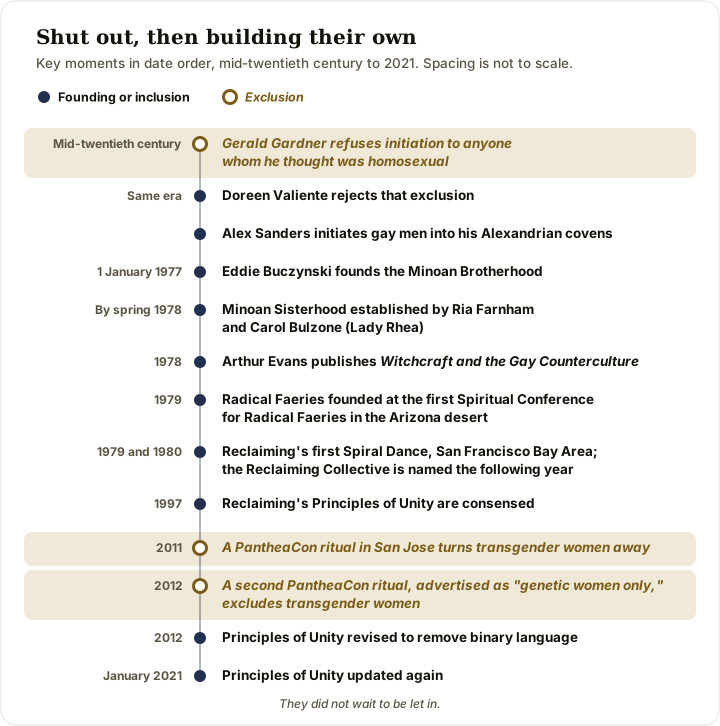
- Mid-twentieth century: per the World Religions and Spirituality Project, citing his High Priestess Lois Bourne, Gerald Gardner refused initiation to anyone whom he thought was homosexual.
- Same era: Doreen Valiente, who wrote much of Wicca's early liturgy, rejected that exclusion.
- Alex Sanders, founder of the Alexandrian tradition, initiated gay men into his covens.
- 1 January 1977: Eddie Buczynski founds the Minoan Brotherhood.
- By spring 1978: the Minoan Sisterhood is established by Ria Farnham and Carol Bulzone (Lady Rhea).
- 1978: Arthur Evans publishes Witchcraft and the Gay Counterculture.
- 1979: the Radical Faeries are founded at the first Spiritual Conference for Radical Faeries in the Arizona desert.
- 1979 and 1980: Reclaiming's first Spiral Dance is held in the San Francisco Bay Area, and the Reclaiming Collective is named the following year.
- 1997, 2012, January 2021: Reclaiming's Principles of Unity are consensed, then revised to remove binary language, then updated again.
- 2011 and 2012: two PantheaCon rituals in San Jose exclude transgender women and become the community's public reckoning.
Where the exclusion came from: Gardner, Valiente, Sanders
The barrier was theological before it was social. Early Wiccan teaching held that magical energy was generated by the union of male and female polarity, enacted symbolically in the Great Rite, which made a same-sex pair not merely unwelcome but, in that framework, mechanically incapable.
Per the World Religions and Spirituality Project, citing Bricket Wood High Priestess Lois Bourne, Gardner refused initiation to anyone whom he thought was homosexual. That is the documented claim, and it is enough.
Resistance came from inside the same coven lineage. Doreen Valiente, whose liturgy most Wiccans still speak in some form, rejected the exclusion of homosexuals, and Alex Sanders initiated gay men into Alexandrian covens even while his tradition kept a heavy fertility emphasis.
When exclusion is written into the physics of a tradition rather than into its manners, you cannot fix it with a friendlier welcome; someone has to rebuild the engine. If you want the lineage map itself, that sits in traditional lineages, and if you arrived here carrying older religious hurt, the witch wound takes that up properly.
The first traditions built for queer practitioners: the Minoan Brotherhood and Sisterhood
The first substantive answer to exclusion was a new initiatory lineage.
Edmund "Eddie" Buczynski was a gay working-class New Yorker and an archaeologist who came up through Welsh Traditionalist and Gardnerian practice, and who found covens that would tolerate a gay member while still requiring him to work inside a heterosexual ritual frame.
He founded the Minoan Brotherhood on 1 January 1977, reaching back to Bronze Age Crete for an ancient precedent for a male priesthood. In Minoan tradition the system is duotheistic, venerating the Cretan snake goddess Rhea and her son the bull god, and it gave gay and bisexual men a homoerotic context in which to work polarity and sex magic rather than a straight one to borrow.
By the spring of 1978 a counterpart existed: the Minoan Sisterhood, established by Ria Farnham and Carol Bulzone, known as Lady Rhea.
Both are still closed, initiatory lineages, which means you approach them as a seeker rather than a reader. What they showed is portable even if you never knock on their door: in their practice, the gods are met in the body you actually have. More on that kind of relationship in working with deities, and on the classic lunar rite in drawing down the moon.
The counterculture thread: Arthur Evans and the Radical Faeries
In 1978 the gay rights activist Arthur Evans published Witchcraft and the Gay Counterculture, arguing that queer people had served as spiritual specialists in pre-Christian societies and that the European witch trials were a campaign against queer and matriarchal subcultures.
Evans leaned heavily on the witch-cult hypothesis popularised by Margaret Murray, which academic historians have thoroughly discredited. His history does not hold up.
Its legacy is real anyway. For a generation of queer Pagans the book supplied a sense of lineage, and I would still read it as a document of 1978 rather than as a source on the fourteenth century. The related claim that the slur "faggot" comes from gay men used as kindling at witch burnings is contested folklore among etymologists, not documented history, so do not carry it into an argument. For what the trials actually were, see witch trial myths and the Salem trials.
The other 1979 thread was less bookish. The Radical Faeries were founded that year at the first Spiritual Conference for Radical Faeries in the Arizona desert, organised by gay activists including Harry Hay and Don Kilhefner, per the archival record held by the Online Archive of California, and they blended queer consciousness, environmentalism and neo-pagan spirituality while explicitly refusing heteronormative assimilation.
Inclusive traditions, in their own words
Four groups worth knowing, each described from what it publishes about itself rather than what the internet says about it. Reading a tradition's own statement first is the single most useful habit a queer seeker can build.
| Tradition | Origins as the group states them | Core focus | Stated position on gender and polarity | Open to |
|---|---|---|---|---|
| Reclaiming | San Francisco Bay Area; first Spiral Dance 1979, Collective named 1980, Starhawk and Diane Baker | Goddess-centred magic joined to direct political action and ecology | Welcomes all genders and all gender histories; non-gendered circle casting is common; divine imagery named across many genders | Anyone who consents to the Principles of Unity |
| Anderson Feri | Mid-twentieth-century United States, Victor and Cora Anderson | Ecstatic, initiatory American witchcraft treating life force and consensual sexuality as holy | Downplays polarity as a mandatory engine; the creation account describes a Goddess containing all genders | Initiatory, by teacher; the Andersons affirmed gay, lesbian and bisexual students |
| Fellowship of the Phoenix | A queer neopagan tradition with temples in Chicago and Seattle | Neopagan devotional practice honouring queer and trans ancestors | Built as a queer tradition rather than adapted into one | All LGBTQ+ adults |
| Green Faerie Grove | Columbus, Ohio, founded at Yule 1998 | "Queer Spirit," drawing in its own words on Greco-Roman mythos, Druidry, Celtic, Kemetic, Voodoo and Shamanic practices, men's mysteries and the Radical Faerie movement; hosts the annual Between the Worlds gathering | A Pagan brotherhood working men's mysteries | Its stated mission is "to provide a safe space for gay, bisexual, and transgender men to worship creation in all of its awesome, diverse splendor in community and brotherhood" |
The Grove's influence list is its own, and it includes Vodou-derived practice, which is a living initiatory religion with its own gatekeepers rather than a set of techniques to lift from a website; if any of that catches your eye, read closed practices before you touch it.
A group being queer-founded does not make it right for you. Two of these four are brotherhoods, which is a real and stated limit, not a loophole. Weighing that against practicing alone is the whole of solitary or coven.
Reclaiming and the Principles of Unity
Reclaiming is non-hierarchical and consensus-run, so its theology lives in one document instead of a governing body, and that document's revision history reads as a map of a tradition changing its mind in public.
Consensed in 1997, the Principles of Unity originally honoured "both Goddess and God" and "female and male images of divinity." By 2012 the community had recognised that this wording upheld a binary that excluded transgender and non-binary practitioners, and revised it.
The revision cost something. The prominent Reclaiming priestess M. Macha NightMare publicly disaffiliated over it, which is worth stating plainly rather than smoothing away; inclusion was contested inside the tradition, not handed down by consensus of the comfortable. The document was updated again in January 2021.
The current text welcomes "all genders, all gender histories, all races, all ages and sexual orientations and all those differences of life situation, background, and ability that increase our diversity," and names "Goddesses, and Gods of myriad expressions, genders, and states of being." It also states that "All living beings are worthy of respect."
I have sat in open Reclaiming-style circles a handful of times, and the first time I heard a caller say that line about myriad expressions and genders, out loud, to fifty people, I noticed my shoulders drop before I understood why. I had been braced for the sentence where I would be the exception.
Anderson Feri and a Goddess who contains all genders
Feri, founded by Victor and Cora Anderson, declines the polarity engine that British Traditional Wicca was built on. In Feri's own telling, the creation account describes a Goddess who contains all genders within herself and who birthed the universe by making love with herself.
The Andersons explicitly affirmed their gay, lesbian and bisexual students and treated all consensual sexuality and life force as inherently holy. The lineage view sits in Feri in context.
The polarity debate, and how the ritual language changed
The sticking point is polarity. Traditional Wiccan theology treats magical energy as generated by the union of opposites defined as male and female, usually explained with a battery analogy: you need a positive terminal and a negative one to complete the circuit.
Read literally, that framing says a same-sex pair or a non-binary practitioner lacks the charge. Nearly every exclusion argument you will encounter is a restatement of it, dressed as mechanics rather than prejudice.
Inclusive practitioners answer it by moving polarity off the body. In that reframe, polarity is a spectrum of energies present in every person, active and receptive, dark and light, earth and sky, so the current runs between states rather than between genitals.
The liturgy shifted with it. In Reclaiming, circle casting moved from Goddess-only, to Goddess and God, to entirely non-gendered, and the change was not cosmetic. BrightFlame, a Reclaiming practitioner, describes it this way:
"Like many in Reclaiming, when I acknowledge the Elements in ritual, I no longer call for them to join us (some name this invoking). Rather, I acknowledge their being all around and that they are sacred. Like many in Reclaiming, when calling to Allies and Mysterious Ones, I invite not command. Another way we evolve."
Acknowledging rather than summoning changed my own circles more than any tool I ever bought. I still light the quarter candles in the same order, still get the sulphur smell of the struck match at the east candle, but the words are now a greeting to something already in the room. The practical difference is that nothing in the rite depends on my body being legible to anyone.
If you are building from the ground up, casting a circle covers the bones, an inclusive Beltane handles the sabbat where fertility imagery gets heaviest, and drawing down the moon walks the rite that most often gets framed as gendered.
The PantheaCon flashpoints, stated plainly
At PantheaCon in San Jose in 2011, a Dianic ritual run by an Amazon Priestess Tribe group turned transgender women away at the door. That is the moment the Pagan community stopped being able to treat biological essentialism as a private disagreement between traditions.
It repeated in 2012. A scheduled ritual advertised as "genetic women only" drew a peaceful silent protest outside the ritual room, organised by T. Thorn Coyle, held in response to transphobic rhetoric posted online in the preceding months. The protest held space rather than disrupting the rite.
The aftermath was a schism. Several groups severed ties with that lineage and took up the term Pan-Dianic, keeping female mysteries while dropping the essentialism. The Amazon Priestess Tribe's statement reads:
"We support the right of trans-women to create rituals specific to their experiences, and to share these with other trans-women and cis-women as they see fit."
Strictly essentialist Dianic groups still exist, alongside explicitly inclusive ones, and nobody has an authority to referee between them. That is precisely why the vetting questions further down are worth asking out loud instead of assuming. The fuller Dianic account lives in the Dianic tradition.
What the surveys actually found
Queer and bisexual people have shown up in Pagan survey samples at high rates for forty years, but the studies used different samples and methods, so read each on its own terms rather than stacking them into a trend line.
| Study | Years | Sample | Reported figures | What it does not tell us |
|---|---|---|---|---|
| Loretta Orion, published in Never Again The Burning Times | Mid-1980s | 189 respondents | 11% homosexual, 28% bisexual, 61% heterosexual | Small, self-selected sample from one era's networks |
| The Pagan Census, Helen A. Berger and Andras Corban Arthen | 1993 to 1995 | Over 2,000 US Neo-Pagans | 9.3% homosexual (4.8% lesbian, 4.5% gay male), 19% bisexual, 67.8% heterosexual | No non-binary or trans categories were offered |
| Pagan Census Revisited, Berger, Lewis and Bogdan | 2009 to 2010 | Over 8,000 responses, 6,420 from the US | 7.6% homosexual, 22.1% bisexual | Not comparable line-by-line with the 1990s census; recruitment and wording differed |
Pew Research Center's 2014 Religious Landscape Study, published in 2015 with a sample of 35,071 US adults, found that 11% of lesbian, gay and bisexual respondents identified with non-Christian faiths. That category is made up mostly of Jewish, Muslim, Buddhist and Hindu respondents. Pew did not measure Pagans, so it is not a Pagan figure and cannot be reported as one.
Separately, Woodell and Schwadel (2020) report, as summarised by the Association of Religion Data Archives, that LGB emerging adults were almost twice as likely to disaffiliate from religion. That is a finding about leaving, not about where anyone went next.
The numbers do settle one argument: if someone tells you queer witchcraft is a TikTok invention, the sample frames say otherwise, and they say it from 1985.
A queer-specific reading list
If I could hand you one book it would be Outside the Charmed Circle, because it treats gender and sexuality as active forces you work with rather than complications you work around. Everything below is written for or by queer, trans and intersex practitioners; general beginner picks live in beginner book picks.
| Book | Author and publisher | Year | Best for | Not for |
|---|---|---|---|---|
| Outside the Charmed Circle | Misha Magdalene, Llewellyn | 2020 | Trans and non-binary readers who want theory they can actually use | Anyone wanting a spell-a-night book |
| Gay Witchcraft: Empowering the Tribe | Christopher Penczak, Weiser | 2003 | Gay men entering the Craft with no background | Readers looking for advanced non-binary framework |
| All Acts of Love and Pleasure: Inclusive Wicca | Yvonne Aburrow, Avalonia | 2014 | Coven leaders rewriting their own liturgy | Solitaries with no group to reform |
| The Satyr's Kiss | Storm Faerywolf, Llewellyn | 2022 | Queer men working sex magic seriously | Anyone uncomfortable with explicit sexual material |
| Lavender Witchcraft: Crafting Queer Magical Practice | Sam Wise, Moon Books | Published 25 August 2026 | Building a queer practice from current ground | Readers wanting historical scholarship |
Penczak's Gay Witchcraft is the book that made a generation of gay men feel entitled to the Craft, and its tool and correspondence chapters read like 2003 when you come back to them; the belonging chapters have not aged a day. Aburrow's book is the one to buy if you hold authority in a group and the one to skip if you do not, because most of it is aimed at reforming structures a solitary does not have. And The Satyr's Kiss is exactly as explicit as it says, which is a feature for its readers and a good reason to preview it if that is not your practice.
When you are assessing anything outside this list, watch for essentialism dressed as reverence, the kind that hangs magical capacity on anatomy or cycles; spotting essentialist books breaks down the tells.
Finding a circle that fits
Read a group's own published statement before you read anything else about it. Reclaiming's Principles of Unity is the model for what a clear one sounds like, because it names genders, gender histories and orientations outright rather than gesturing at "all are welcome."
Then look in the boring places. Tradition websites list their own temples and contacts, local occult and metaphysical shops still keep contact boards and know who is actually meeting, and regional gatherings let you watch a group run a rite before you commit to anything. No single directory is authoritative, so treat any list as a lead rather than a vetting.
Ask leadership three questions before you commit, and ask them in a conversation rather than by email:
- How does your tradition view and use gender polarity in ritual?
- Are rituals, initiations and elevations gender-segregated?
- What is your policy on transgender and non-binary initiates, and how are they placed in roles that traditionally require a specific gender?
A confident answer is specific and unbothered. It names the practice, names the exceptions, and tells you who currently holds which role. An evasive answer redirects to how loving everyone is, to how long the tradition has done things a certain way, or to "energy" as an explanation for who stands where. If a group tells you anatomy determines the magic you can raise or the circle you can stand in, you have your answer, and you have it cheaply.
Spending is not how you get in. A group that requires you to arrive equipped is telling you something; the honest ones care what you have read, not what you have bought, and money on the way in tends to go to the wrong shelf, which is the whole of what to avoid. If you are weighing a group against practicing alone, solitary or coven lays out the tradeoff, practicing discreetly covers working without an audience, and if you are still stuck on whether you count at all, am I a real witch answers that in one line.
Solitary practice is a whole path, not a fallback
If there is no safe group within driving distance, your practice is not stalled. Solitary practitioners set their own altar, cast their own circle and choose their own deities with nobody's inherited theology in the room, and the tradition has treated this as a complete path for decades rather than a waiting room.
Practically, that means you decide what the quarters are called, whether polarity features at all, and which sabbats you keep. My own altar has changed shape four times and never once needed a vote.
You also lose what a good group gives: correction, training in someone else's hands, and a person who notices when you are avoiding the hard work. You can substitute reading, a journal you are honest in, and one or two practitioners you trust, but you have to substitute something deliberately.
Start small and cheap. starting out covers the first month, your altar gets a working surface up with what you own, secular witchcraft is there if deity is not your language, and a daily practice is what actually makes any of it stick.
Where to go next
If you came for the tradition comparisons, compare traditions goes lineage by lineage, including the fuller Dianic and Feri accounts. If the vocabulary is still slippery, what Paganism is and Wicca or witchcraft sort out the umbrella from the religion from the practice.
If what surfaced while reading was older and heavier than curiosity, that is common in queer practitioners leaving a church behind, and the witch wound takes it seriously. And if you simply want to light something tonight, where to begin is the plainest first step there is.
Keep exploring
Browse more guides, or start with the basics of the practice you are curious about.
Browse more guides