Celtic and Norse Paganism: A Grounded Primer
Celtic and Norse paganism are two distinct pre-Christian European traditions, revived today through a mix of source-led reconstructionism and freer eclectic practice. Both were polytheistic, animistic, oral, and stubbornly regional. Both have also been so thoroughly romanticised since the 18th century that the real beginner's work is separating what is attested from what is beloved modern invention. That separation is what makes the rest of the practice trustworthy.
What "Celtic and Norse paganism" actually means
Both traditions are orthopractic rather than orthodox: they cared about ritual, reciprocity, and right action far more than about agreeing on a creed. Neither had a Bible. Neither had a pope-figure. Neither had a tidy continental pantheon laid out in a chart.
The two umbrellas, plainly:
- Celtic covers the Iron Age peoples of Western Europe, usually split into Insular (Ireland, Wales, Scotland) and Continental (Gaul, Iberia, Britain).
- Norse is the North-Germanic strand of a wider Heathen family that also includes Anglo-Saxon and Continental Germanic practice.
Each lived as a constellation of regional cults sharing structural family resemblances, not a single church. For the broader umbrella, see paganism; for the question every newcomer brings, see Wicca vs witchcraft.
The historiographical gap
Neither tradition wrote down its theology before Christianisation, so every text we have was filtered by someone with an agenda. That single fact shapes the whole field.
The Celtic record rests on three flawed pillars:
- Hostile Greco-Roman ethnography. Caesar, Tacitus, and Diodorus Siculus described Celts to justify conquering them, and Romans habitually slotted Celtic gods into Roman equivalents. The archaeologist Barry Cunliffe, borrowing a phrase from the Irish scholar Proinsias Mac Cana, called the surviving evidence a "fertile chaos." What we read as "Mercury" or "Mars" on a Gallo-Roman inscription is almost certainly a local deity wearing a Roman label.
- Silent archaeology. Votive deposits in bogs and springs, inscriptions to hundreds of regional gods, ritual deposits at sacred groves. Rich, but it speaks only in objects.
- Christian-era Insular literature. The Irish and Welsh mythological cycles were written by monks centuries after conversion, weaving older oral material into a national pseudohistory that traced native gods back to biblical figures.
The Norse record is narrower and later. Two sources do almost all the work:
- The Prose Edda, written by Snorri Sturluson around 1220, more than two centuries after Iceland's official Christianisation. Snorri was a medieval Christian intellectual writing a handbook for poets, and he protected himself from heresy charges by framing the gods as ancient Trojan heroes wrongly deified by their descendants.
- The Poetic Edda, preserved in the Codex Regius (late 13th century), a compilation of older poems by multiple anonymous authors across several centuries. The translator Jackson Crawford has likened it to a "playlist on shuffle" rather than a holy book.
This is why honest modern practice is humble and source-led. The gaps are real. Pretending they are not is the original sin of the romantic revival.
| Tradition | Primary sources | Date relative to conversion | Bias or limit | Best used for |
|---|---|---|---|---|
| Celtic | Greco-Roman ethnography (Caesar, Tacitus, Diodorus) | Contemporary, hostile | Imperial justification; Roman name-swapping | Outsider snapshots; named deities, with caveats |
| Celtic | Archaeological votives and inscriptions | Iron Age onward | Mute objects; no doctrine | Confirming animism; naming regional gods |
| Celtic | Insular Irish and Welsh literature | 500 to 1000+ years after conversion | Christian monkly framing | Mythic narrative; cosmological imagery |
| Norse | Prose Edda (Snorri, c. 1220) | ~220 years after Iceland's conversion | Medieval Christian; euhemerised | Mythic synthesis; poetic vocabulary |
| Norse | Poetic Edda / Codex Regius (late 13th c.) | Centuries after conversion | Multi-author compilation by Christians | Oldest surviving fragments of myth (Völuspá, Hávamál) |
| Norse | Runestones and runic inscriptions | Iron Age onward | Short memorial texts, not myth | Ritual phrases, naming patterns |
Celtic paganism: cosmos, deities, festivals
Celtic religion was hyper-local: a goddess of a particular spring, a god of a particular tribe, not a continent-wide pantheon. The richest narrative record is the Insular Irish tradition, and even that arrives through Christian hands.
The Celtic cosmos and the Otherworld
The Iron Age Celtic world was animistic in a strong sense: spirits resided in specific rivers, mountains, springs, and trees. The Otherworld (the Irish sídhe) is not a heaven above or a hell below. In Celtic belief it sits alongside the mortal realm, reachable through mounds, mists, certain caves, or the sea on certain days.
In Insular Irish mythology the Tuatha Dé Danann, "the tribe of the gods," ruled Ireland before retreating into the sídhe when humans arrived. Read as cosmology, that detail matters: the gods did not leave; they moved sideways.
Named deities you'll actually meet
A small honest cast, with the understanding that no single pantheon mapped across all Celtic peoples.
- The Dagda. "The good god" in Irish, Eochaid Ollathair, the father of many. Fertility, weather, time, abundance. He carries a club that kills with one end and restores with the other, and a cauldron that is never empty. Strongly associated with Samhain.
- The Morrigan. A phantom-queen of war, sovereignty, and fate, appearing as a raven or crow over battlefields. Often triune (three sisters), which is a real Celtic motif and quite distinct from the modern Maiden / Mother / Crone overlay.
- Brigid. A goddess of hearth, smithcraft, healing, and poetry, anchored to Imbolc. Later folded by the Irish Church into Saint Brigid, which is its own complicated story.
- Lugus / Lugh. A pan-Celtic god of skill and many crafts, with cognates across Ireland, Wales, and Gaul.
- Continental specifics. Taranis, a thunder god holding a wheel; Teutatis, a protector of the tribe; among many others known only from inscriptions.
For approaching any of these as a modern practitioner, with proper care, see working with deities.
The four Fire Festivals (attested, agricultural)
Four cross-quarter days are securely attested in Gaelic sources as turning points of the pastoral year:
- Samhain (around November 1): the end of the harvest, the start of the dark half, the night the veil between worlds thins.
- Imbolc (around February 1): Brigid's festival, the first stirrings of spring, the start of lambing.
- Beltane (around May 1): fire and fertility; livestock driven between twin bonfires for purification before going to summer pasture.
- Lughnasadh (around August 1): the start of the grain harvest; athletic games and the cutting of the first sheaves.
These four are real. The neat eight-spoked calendar that fuses them with the solstices and equinoxes is not Iron Age; it is a 1950s synthesis. For the modern eight-festival cycle as practitioners actually live it, see the Wheel of the Year and the individual guides at Samhain, Imbolc, Beltane, and Lughnasadh.
Norse paganism: cosmos, deities, festivals
Norse religion comes to us in more cosmologically tidy shape than Celtic religion, mostly because one medieval Christian Icelander (Snorri) organised the surviving fragments to teach poetry. Treat the system as Snorri's edit, not a verbatim Iron Age cosmology.
Yggdrasil, wyrd, and the Gifting Cycle
The Norse cosmos is structured around Yggdrasil, the immense World Tree connecting nine realms (Midgard for humans, Asgard for the Æsir, Jotunheim for the giants, and so on). The whole structure is fatalistic: even the gods are subject to wyrd, a binding fate that walks them all toward Ragnarök, the prophesied end and rebirth of the world.
The spine of Norse ritual practice is reciprocity, captured in the Latin tag do ut des, "I give so that you may give." Practitioners call it the Gifting Cycle. Humans offer (the blót) to gods, ancestors, and land spirits; the unseen world gives back peace, harvest, victory. The relationship is transactional in the warm, communal sense, the way a household runs on mutual obligation.
The Æsir and the Vanir
Two divine tribes who, in the surviving myth, fought a war and then exchanged hostages. After the merger:
- Æsir. Odin, the All-Father, a god of wisdom, runic magic, poetry, and battle-frenzy, who hangs nine nights on Yggdrasil "given to myself" to win the runes. Thor, the protector, who swings Mjölnir against the chaotic jötnar. Tyr, the law-keeper who loses his hand to the wolf Fenrir.
- Vanir. Njord, god of the sea and prosperity. Freyr, his son, god of harvest and virility. Freyja, his daughter, goddess of love, battle, and seiðr, a form of trance-magic that survives in fragmentary descriptions.
The neat "god of X" labels Marvel-fy them. Read the Hávamál once and you will meet an Odin who is restless, deceptive, and far stranger than a domain card.
The attested blóts (sacred time, not a Wheel)
Norse sacred time was governed by lunar reckoning and seasonal turning, and the sources only confirm a small number of major festivals:
- Vetrnætr / Winter Nights (around the October full moon): the Norse new year and start of winter, a three-day feast that included Álfablót (offerings to elves) and Dísablót (offerings to female ancestral spirits).
- Jól / Yule (the full moon following the new moon after the winter solstice, broadly late December into January): midwinter feasting, drinking, and oath-swearing, marking the return of the sun. For the modern sabbat version, see Yule.
- Sigrblót (around the April full moon): the start of the summer half, with sacrifices to Odin for victory in the season's raids and battles.
Anything more granular than this in a "Viking calendar" image online is reconstruction or invention. The historical record is genuinely thin.
| Parameter | Historical Celtic | Historical Norse |
|---|---|---|
| Primary sources | Greco-Roman ethnography; Insular Christian-era literature; archaeology | Snorri's Prose Edda; Poetic Edda; runic inscriptions; archaeology |
| Cosmology | Hyper-local animism; Otherworld parallel to ours, reached via mounds and mists | Yggdrasil and the nine realms; fatalism, wyrd, Ragnarök |
| Major deities | The Dagda, the Morrigan, Brigid, Lugh; regional Taranis, Teutatis | Odin, Thor, Tyr (Æsir); Njord, Freyr, Freyja (Vanir) |
| Ritual focus | Votive deposits in water and bogs; cross-quarter fire festivals | Blót (sacrificial offering); symbel (ritual toasting); Gifting Cycle |
| Sacred time | Four cross-quarter Fire Festivals | A handful of full-moon blóts (Vetrnætr, Jól, Sigrblót) |
The modern revival: reconstruction vs eclecticism
When people say "I'm Celtic pagan" or "I'm Norse pagan" today, they could mean any of four very different things, and conflating them is the fastest way to lose a conversation. For where this sits in the wider witchcraft landscape, see Wicca vs witchcraft; for the Wiccan lineages specifically, see Wiccan traditions.
Wicca (eclectic / syncretic)
Wicca is a 1950s British synthesis by Gerald Gardner, with later contributions by Doreen Valiente and others. It is a ceremonial occult religion structured around a Horned God and a Triple Goddess, the casting of magic circles, the eight-festival Wheel of the Year, and an ethic the Wiccan Rede famously condenses as "an it harm none, do what ye will."
Wicca borrows freely from Celtic and Norse names, often invoking Brigid, the Morrigan, Freyja, or Odin within an essentially modern ritual frame. That borrowing is not lineage. It is honest to enjoy Wicca as Wicca; it is not honest to call its content Iron Age.
Modern Druidry (OBOD, ADF)
Modern Druidry traces its public lineage to the 18th and 19th centuries, and its early shape was substantially fabricated. A Welsh stonemason called Iolo Morganwg (Edward Williams) wrote the Barddas, the Druid's Prayer, and the Awen symbol (three rays of light flowing down, often capped with three dots), and passed them off as ancient lore.
The major modern orders, the Order of Bards, Ovates and Druids (OBOD) and Ár nDraíocht Féin (ADF), are openly clear about Morganwg's forgeries and have built a thoughtful contemporary path on honest ground: bardic inspiration (Awen), a three-realms cosmology of Earth, Sea, and Sky, and a heavy ecological emphasis on trees.
Celtic Reconstructionism (CR)
Celtic Reconstructionism emerged in the 1980s as a deliberate reaction against Wiccan and romantic overlays in "Celtic" practice. The method is unromantic: read Old Irish, Welsh, and Scots Gaelic; read the archaeology; build practice only from what is attested.
CR centres the Hearth Cult, the household-level practice of offerings to ancestors, the landwights (land spirits), and the housewights (house spirits) at a domestic shrine. It is hard polytheist: the gods are distinct persons, not facets of one Goddess and one God. There are no magic circles, no quarter-callings, no Wiccan-style ceremonial overlays.
Heathenry (inclusive)
Heathenry is the broad umbrella for reconstructed Germanic religion, Norse and Anglo-Saxon and Continental together. The shape mirrors CR: the Hearth Cult, the Gifting Cycle, ancestor veneration, blót and symbel as the central rites. Many practitioners also work with seiðr in a careful, modern-reconstructed form, and runic divination has its own thriving practice; for the method itself, see reading runes.
| Path | Lineage | Approach to magic | Stance on inclusion | Core ritual structure |
|---|---|---|---|---|
| Wicca | 1950s synthesis (Gardner, Valiente) | Ceremonial; circle-casting; Wheel of the Year; Rede-guided | Universalist | Circle-cast, quarter-call, draw down the moon, eight sabbats, esbats |
| Modern Druidry | 18th/19th-c. revival; OBOD/ADF in the 20th c. | Bardic, often ceremonial; tree and landscape reverence | Universalist | Three-realms calling (Earth, Sea, Sky); Awen attunement; seasonal rites |
| Celtic Reconstructionism | 1980s, source-led | Attested charms only; no Wiccan overlays | Universalist, culture-and-language framed | Hearth Cult; offerings to ancestors and land spirits |
| Heathenry (inclusive) | Late 20th c., Eddas, sagas, folklore | Runic work, seiðr; deeply wyrd-shaped | Universalist mainstream; small Folkish fringe is condemned | Hearth Cult; blót; symbel |
A careful note on Ásatrú, "folkish" groups, and inclusive Heathenry
This one will not be softened. "Ásatrú" means "faith in the Æsir" and began as an Icelandic religious denomination in 1972, where it remains broadly inclusive. In the United States in particular, the label was co-opted by white-nationalist organisations, most prominently the Asatru Folk Assembly (AFA); in the UK, the Odinic Rite plays a similar role. These "Folkish" groups argue that Norse religion is the genetic inheritance of people of Northern European descent. They are condemned by mainstream Heathenry as ethno-nationalism wrapped in a hammer pendant.
Inclusive Heathenry is Universalist: in this view, anyone can hear the gods, regardless of ancestry. The Troth, a major inclusive Heathen organisation, drafted Declaration 127 in 2016, formally refusing fellowship with the AFA. Many practitioners now simply call themselves "Heathen" rather than "Ásatrú" to put distance between their practice and the co-opted label.
If you wear a Mjölnir, you should know which side of that line your community sits on. For broader guardrails on practising respectfully across cultural lines, see closed practices.
Flagging the fictions: beloved "ancient" ideas that are actually modern
Most of these are still meaningful as modern practice. The Wheel of the Year is a real, living calendar that has carried millions of practitioners through real seasons. The Maiden / Mother / Crone is a workable symbol. The point is not to strip them away. The point is honesty about when they were born, because the honesty is part of why you can trust the rest.
The unified eight-fold Wheel of the Year (1950s)
The neat ring of eight sabbats took shape in Gerald Gardner's Wicca in the 1950s, combining the four Celtic fire festivals (Samhain, Imbolc, Beltane, Lughnasadh) with the solstices and equinoxes that modern Druidry already kept. Gardner's coven settled on all eight as equals in 1958, and the Druid Ross Nichols adopted the pattern in 1964 (Ronald Hutton, "Modern Pagan Festivals", Folklore, 2008). The names "Ostara," "Mabon," and "Litha" were coined by an American Wiccan, Aidan Kelly, in the 1970s.
The Wheel is a real and beautiful modern instrument. It is not how an Iron Age Irish farmer or a 9th-century Norseman tracked the year. For the modern eight-festival cycle as practitioners actually live it, see the Wheel of the Year.
Robert Graves' The White Goddess (1948) and what it seeded
Robert Graves' The White Goddess is probably the most influential bad book in modern paganism. Celtic scholars treat it as poetic fiction; Graves himself admitted he worked from poetic intuition and drew heavily on Iolo Morganwg's earlier forgeries. From Graves we inherit:
- The Celtic Tree Calendar. Graves invented a 13-month lunar calendar mapping trees to letters of the early-medieval Irish Ogham alphabet. Ogham is real (a writing system of 20 to 25 characters called feda, carved as strokes across a stemline and read bottom to top), but it is an alphabet, not a calendar. The actual ancient evidence for Celtic time-keeping is the Coligny Calendar from Roman Gaul, a complex lunisolar system with intercalary months.
- The universal Triple Goddess. Triune goddesses in Celtic myth are real (the Morrigan, the Matres). The specific scheme of one universal Maiden / Mother / Crone progressing in step with the waxing, full, and waning moon is Graves'.
- The Oak and Holly Kings. The mythic battle between the Oak King of the waxing year and the Holly King of the waning year is taught widely as ancient Celtic myth. It is not. Graves wrote it.
The Nine Noble Virtues (1974)
The "Nine Noble Virtues," sometimes presented as the ethical core of ancient Viking life (Courage, Truth, Honor, Fidelity, Discipline, Hospitality, Self-Reliance, Industriousness, Perseverance), do not appear together in the Eddas, the sagas, or on any runestone. They were codified in 1974 by John Yeowell ("Stubba"), a former member of Oswald Mosley's British Union of Fascists, and John Gibbs-Bailey of the UK Odinic Rite.
Read alongside the sources, the list reads less like Iron Age ethics and more like a Victorian commandments substitute for ex-Christians. Actual Norse ethical thought in the Hávamál is pragmatic, ambiguous, and shaped by wyrd and reputation; it permits oath-breaking for survival and reserves real hospitality for the in-group. Many inclusive Heathens discard the NNV entirely, both for the politics of their origin and for their historical thinness.
| Modern invention | Year and inventor | What people think it is | What the evidence actually shows |
|---|---|---|---|
| Eight-fold Wheel of the Year | 1950s Wicca, all eight equal from 1958 | Ancient pan-Pagan calendar | Four Celtic fire festivals combined with the Druidic solar dates; "Ostara," "Mabon," "Litha" coined by Aidan Kelly in the 1970s |
| Celtic Tree Calendar | 1948, Robert Graves | Ancient Druidic 13-month tree calendar | Ogham is a 20- to 25-letter early-medieval alphabet; the ancient Celtic calendar is the lunisolar Coligny Calendar |
| Maiden / Mother / Crone Triple Goddess | 1948, Graves | Universal Iron Age goddess archetype | Triune goddesses exist in Celtic myth; the Maiden/Mother/Crone-tied-to-lunar-phases scheme is Graves' |
| Oak King vs Holly King | 1948, Graves | Ancient Celtic seasonal myth | Invented by Graves; no pre-1948 source |
| Nine Noble Virtues | 1974, Yeowell + Gibbs-Bailey (Odinic Rite) | Ancient Viking ethical code | Not in the Eddas or sagas; written by a Folkish UK group with fascist roots |
What a reconstructionist ritual actually looks like
This is where Wicca-trained practitioners often expect a circle and don't find one. There is no quarter-calling, no athame tracing the air, no Lord and Lady invoked. In Heathen practice, the spine is offering, sharing, and oath, in a specific historical order. The modern reconstructed rite settles into six steps that go in this order:
- Hallowing. The space is cleansed by fire (a candle, sometimes a brand passed over the table) and bounded by tracing the sign of Thor's hammer in the air, four short strokes that always land low in the chest before they finish. It feels more like grounding than circle-casting; nothing rises around you. You are simply set apart.
- Invocation. The practitioner stands in the Elhaz posture, both arms lifted into a Y, and calls the deity, ancestor, or land spirit being honoured by name. The Y is uncomfortable to hold for long, which is part of the point.
- The blót. In the sources, the rite called for animal sacrifice and the sprinkling of blood (hlaut) from a hlautbowl. Almost no modern practitioner does this. The modern offering is good mead, beer, or food, poured into the bowl or directly onto the earth. It is not a polite substitute; the principle is reciprocity, not gore.
- Sharing. The remainder of the food and drink is consumed by the participants. Eating what was offered is the moment that knits the gift into a shared meal. In practice, this is when the room warms up.
- The symbel. A horn is passed in three rounds. The first hails the gods. The second hails ancestors or heroes. The third is open: boasts, oaths, pledges of action. Heathens hold the third round tightly because, in this worldview, a spoken oath weaves directly into wyrd. People pause longer before they speak in that round than in any other ritual moment I have sat through.
- Closing. Thanks are spoken, the gifting cycle is acknowledged closed, and the bounded space is released.
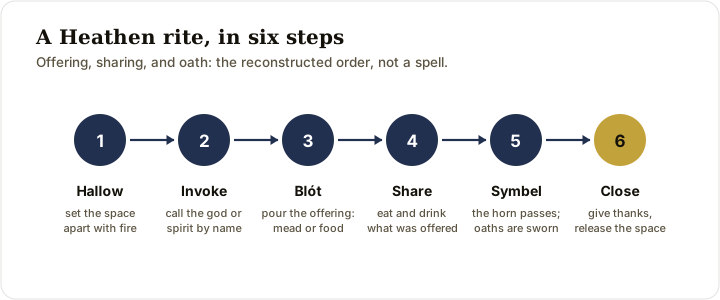
What lands, even for sceptics, is how unlike a "spell" it feels. Nothing is being commanded. Something is being given, received, eaten together, and sworn.
A starter reading list (vetted, non-Graves)
If you build your reading on Robert Graves, you will spend years unlearning him. Start instead with the translators and scholars working from the sources:
- For Norse, the linguist Jackson Crawford's translations of the Poetic Edda and Prose Edda (chosen for stripping the Victorian gloss back to the Old Norse).
- For Celtic, Sioned Davies' translation of The Mabinogion (Welsh) and Jeffrey Gantz's Early Irish Myths and Sagas (Penguin Classics).
- For living, inclusive community to observe, The Troth for Heathenry (the inclusive Universalist standard, drafter of Declaration 127); the Order of Bards, Ovates and Druids (OBOD) and Ár nDraíocht Féin (ADF) for modern Druidry.
For witchcraft proper as a separate question, witchcraft books for beginners is the better next step.
Go to the sources first, listen to living communities, and let your own path take shape from what you learn.
Keep exploring
Browse more guides, or start with the basics of the practice you are curious about.
Browse more guides