Imbolc is the festival you feel before you can name it: the day the light tilts and the ewes start to milk and something under the frozen ground takes a slow, secret breath. You do not have to be Wiccan, Celtic, or initiated to mark it. If you light a single candle and notice the dusk arriving later than last week, you are already in the room with it.
What Imbolc Is, in One Breath
Imbolc is the Gaelic cross-quarter festival on February 1 to 2 (August 1 to 2 in the Southern Hemisphere), marking the first stirrings of spring (the lambing season, ewe's milk, the returning light) and sacred to the goddess Brigid.
It sits halfway between the deep winter solstice and the spring equinox, one of four cross-quarter festivals on the the wheel. It is older than Wicca. Modern witches inherited it, polished it, and put it back on the calendar, but its bones are pre-Christian Gaelic. The presiding figure is Brigid, a triple goddess of poetry, healing, and the forge, later folded into Saint Brigid of Kildare.
You do not need a coven, an altar, or a pantheon to feel it. The season does most of the work. Your job is to notice.
When to Celebrate Imbolc (and the Southern Hemisphere Flip)
There are two honest answers and both are correct.
The traditional date is fixed: from sunset on February 1 to sunset on February 2. The Celts counted the day from dusk, so the festival opens on what we would call the evening of the 1st. The other answer is astronomical: the true midpoint between the winter solstice and the spring equinox, which falls when the sun reaches fifteen degrees of Aquarius, somewhere between February 3 and 6 depending on the year.
In the Southern Hemisphere, none of that lines up with the land. February there is the end of summer. Practitioners in Australia, Aotearoa, and South America move the festival to August 1 or 2 (sometimes as late as August 7 if they are watching the sky), so the rite matches their actual lambing and thaw.
| Date convention | Northern Hemisphere | Southern Hemisphere | Why practitioners pick it |
|---|---|---|---|
| Traditional fixed | Sunset Feb 1 to sunset Feb 2 | Sunset Aug 1 to sunset Aug 2 | The inherited calendar date; easiest to share |
| Astronomical midpoint | Feb 3 to 6 (15° Aquarius) | Aug 5 to 7 | Matches the sky, not the page |
Pick the one that matches your land. The wheel is supposed to fit where you live; if a date does not, move it. For a quick check of when the next one lands, the next-sabbat tool does the math.
The "Ewe's Milk" Roots: What the Name Actually Means
The accepted reading is i mbolg, Old Irish for "in the belly." It points straight at pregnant ewes in late winter, the lambing about to begin, and the slow secret of new life under the frost. That is the festival's literal meaning: belly, womb, the thing that is hidden but already moving.
There is a second, older gloss: oimelc, "ewe's milk," recorded around 900 CE in Cormac mac Cuilennáin's Sanas Cormaic. Modern Celticists are skeptical. The linguist Eric Hamp argued the derivation is likely reverse-engineered, a medieval guess back-formed from the season's obvious agricultural reality. Hamp suggested instead that the Old Irish words for milk and milking grew from a lost Indo-European root meaning purification or cleansing. The Old Irish verb folcaim, "to wash oneself," sits in the same family.
So the name carries three threads at once: a belly that is full, milk that is fresh, and water that washes. All three are Imbolc.
One piece of grounding that is not lore, it is stone. At the Hill of Tara in Ireland, the Neolithic passage tomb called the Mound of the Hostages was built more than five thousand years ago and is aligned so that the rising sun lights its inner chamber on two mornings of the year: Imbolc and its dark twin across the wheel. Someone, very long ago, knew exactly where the year was halved.
Why the Cailleach Wants a Sunny Imbolc
In Gaelic folk belief, the Cailleach is the winter hag, the divine crone who rules the cold half of the year. The story goes that on Imbolc she goes out to gather firewood for the rest of winter. If she means to keep the cold going a long while, she will arrange a bright, sunny day so she can collect plenty of wood. So in the old reckoning, a foul, stormy, miserable Imbolc was good news: the Cailleach had slept in, her woodpile was thin, and spring was on its way.
If you wake up on the morning of the 2nd to gray sleet and a wind that bites, the tradition would have you smile.
Brigid: Triple Goddess of Poetry, Healing, and the Forge
Brigid is the central figure of Imbolc and one of the most beloved deities of the Irish pantheon. In Irish myth she is a daughter of the Dagda, the chief god of the Tuatha Dé Danann, the supernatural race who held Ireland before mortal humans arrived. Her name is read two ways, both of them fitting: "exalted one," or "fiery arrow."
She is described as a triple goddess, and this is where care matters: her triplicity is not the modern Wiccan Maiden / Mother / Crone frame. The 9th-century Sanas Cormaic names three sisters, all called Brigit, who together hold three domains of Celtic life.
- Brigid of the Filí, patroness of the poet-seers, the "fire in the head" of inspiration, prophecy, and the storyteller's spark.
- Brigid of Leechcraft, goddess of medicine and midwifery, associated with sacred wells and thermal springs that healed the sick and helped women through childbirth.
- Brigid of Smithcraft, protector of blacksmiths, ruler of the forge, the transformer of raw ore into useful tools.
She is also a goddess of grief. Irish tradition holds that she was the first woman in Ireland to keen, that visceral wailing lament, when her son Rúadán fell in battle. Practitioners who reach for her find she does not pretend that loss is not loss.
If you have never worked with a deity before, the slow on-ramp here is worth reading first. Brigid is famously generous to newcomers, but she is a real presence in the practice, not a mascot.
From Brigid to Saint Brigid: Honest Syncretism
When Christianity arrived in Ireland in the 5th and 6th centuries, Brigid did not disappear. She moved. The Church did not try to erase her; it absorbed her. She became Saint Brigid of Kildare, abbess and patron saint, named alongside Patrick and Columba.
The scholar Dáithí Ó hÓgáin pointed out that the miracles attributed to the saint are almost a copy-paste of the goddess's mythic powers: multiplying food for the poor, controlling weather, protecting livestock. The abbey Brigid founded at Kildare kept a perpetual sacred flame tended by her nuns, a direct continuation of the goddess's association with eternal fire.
You will see modern practitioners who keep the two firmly separate, and others who treat them as the same being wearing two robes. Both are honest. The honest history is that the line between them was never clean.
Imbolc vs Candlemas: Parallel, Not a Rebrand
You will see the claim, often, that Candlemas (the Catholic feast on February 2) is "just Christianized Imbolc." It makes a tidy story. The history is more interesting.
Candlemas is officially the Feast of the Presentation of Jesus at the Temple, marking the ritual purification of Mary forty days after birth as Jewish Mosaic law required. The earliest record of a Christian observance of that milestone comes from a Western pilgrim called Etheria, who visited Jerusalem in the late 4th century and found it celebrated on February 14, because at that time the Nativity was kept on Epiphany, January 6. When the Western Church set the Nativity to December 25 in 336 CE, the forty-day count shifted; Emperor Justinian I formally fixed the date as February 2 in 542 CE. The candle blessing that gives the feast its English name was added by Pope Sergius I in the late 7th century.
That tradition grew in the Mediterranean and the Middle East. It is not Celtic in origin. It only met Imbolc when Catholicism arrived in the British Isles, and then the two settled into each other because they already rhymed: both about purification, both about returning light, both at the same hinge of the year. Lady Wilde, writing in the 19th century, claimed the Church scheduled Candlemas to drown out pagan "saturnalias" in early February. Modern historians treat that as folklore, not record.
The cleanest way to hold it: two traditions, parallel, that married because they were already in love.
Imbolc Correspondences at a Glance
Correspondences are how practitioners tune the air of a rite to a season. They are not rules. They are a vocabulary. If snowdrops will not grow where you live, choose what does.
| Category | Imbolc correspondences | Why |
|---|---|---|
| Colors | White, silver, pale green, pale yellow, red and pink | Lingering frost and milk; first shoots and beeswax; returning sun, forge fire, and lambing blood |
| Herbs and flora | Snowdrops, crocuses, daffodils, angelica, rosemary, basil, bay, heather, rushes | The first flowers through frost; pungent, sunlit herbs for purification; rushes for the cross |
| Foods | Dairy (milk, butter, soft cheese), seeded breads, honey cakes, cinnamon, ginger, onion, chive | Ewe's milk made literal; seeds as the planted dark; warming spice for the body's hearth |
| Crystals | Amethyst, clear quartz, garnet, ruby, onyx | Clarity and the thin veil of winter; the dark fertile earth and Brigid's forge red |
| Metals | Cast iron and steel; silver | Brigid's forge and the smith's mastery of fire; moonlight on snow and her healing waters |
For deeper reading on any column, the color magic chart, the herb chart, and the crystals primer go deeper.
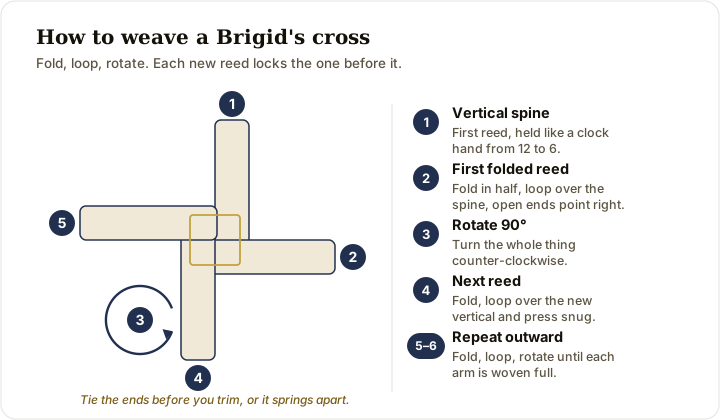
How to Make a Brigid's Cross (Step-by-Step)
A Brigid's cross is an equilateral cross with a tight woven square at its center and four arms (sometimes three) radiating out. Traditionally it is woven on St Brigid's Eve, January 31, and hung above doorways, windows, and over stables for the year ahead, to invoke her protection over the household against fire, hunger, and illness. The old custom is to take down last year's cross and burn it in the hearth fire before the new one is hung. If you live in a city flat with no hearth, a deep metal basin outside is the safer version.
Traditional rushes are still the prettiest material, but most witches I know now use what is in the cupboard. Pipe cleaners work brilliantly for beginners and hold their shape without binding. Paper drinking straws, soaked for a minute, weave very like rushes. Long stalks of dried grass or wheat work if you damp them first; dry stems crack at the fold.
You need sixteen to twenty pieces, each roughly the same length, plus four small rubber bands or lengths of string to bind the ends.
The technique has a small rhythm to it (fold, loop, rotate) and once your hands have it, it stops being a craft and becomes a meditation. Wet rushes if you are using them, and tie the ends before you trim them. If you trim first, the whole thing pops apart in your hand. Ask me how I know.
- Hold one reed vertical in your non-dominant hand, like a clock hand pointing from 12 to 6. This is your starting spine.
- Fold a second reed in half with a sharp crease. Slide the fold over the spine so the open ends point right, toward 3 o'clock. Pinch the center tight.
- Rotate the whole thing 90 degrees counter-clockwise (clockwise if you are left-handed and that feels more natural). What was pointing to 3 is now pointing to 12.
- Fold a third reed in half, loop it over the new vertical with the open ends pointing right again. Press it snug against the center.
- Repeat: fold, loop, rotate. Each new reed locks the one before it. Work outward until each of the four arms has about four to five reeds woven in.
- Bind each arm tightly with a small rubber band or twine close to the woven square. Only then trim the ends with scissors so all four arms are the same length.
One real safety note: a dried woven cross above a working candle is a fire risk. Hang it well clear of any open flame, never directly above your altar candles, and never burn last year's cross indoors without a proper hearth or a metal basin outside. Brigid is a smith. She respects fire kept where fire belongs.
For where to display it inside the practice, the altar primer has good options, and the cross is a classic piece of household protection.
A Solitary Imbolc Rite of First Light
This is a gentle rite. Not a coven ceremony, not a high-Wiccan eight-step, just a way to mark the festival on your own with what you have. Read it through once before you do it, so you are not flipping back to your phone mid-cast.
The mechanism it leans on, named once: sympathetic magic. The Scottish anthropologist James George Frazer described it in The Golden Bough as the Law of Similarity, where like calls to like. You build a small image of what you want to happen (a bowl of snow melting in candlelight, say) and that picture works on you. The skeptical witch can read this as ritual changing the practitioner from the inside out. The believing witch reads more. Both work the same way at the altar.
And the pairing that makes any rite real: magic plus action. Light the candle for the new project. Also open the document. The call comes more often to the witch who sent the application.
If you have never grounded into a rite before, the short technique takes a minute.
Step 1: Bathe and Sweep
Start with water. Tie a small handful of dried basil, bay, or chamomile in a square of muslin or a clean sock and hang it over the warm tap so the bath fills through the herbs. Add a handful of Epsom salts. As you sit in it, let your mind do one slow job: the heat is pulling stale winter off you. Not metaphorically; just stay with the sensation.
Out, dry, dressed in something clean.
Then take a broom (a besom, if you have one, but any broom works) and sweep the floor around where your altar will sit. You are not sweeping dust. You are sweeping the heavy, settled energy of three frozen months. Sweep toward the door.
If your whole flat feels heavy, that is a different job: a full home cleanse does it properly, or a banishing rite if it is something stickier.
Step 2: Set the Altar
Lay a white cloth. Place at the center either a Brigid's cross or a Brídeóg, a small straw doll representing the goddess. Around her, set:
- Seven candles (any color, but white, red, and a pale green is the traditional spread), each in a stable, fireproof holder
- A small bowl of snow, or ice cubes if you have no snow
- A silver coin and one flower petal beside the bowl
- A small dish with a piece of bread or a honey cake and a little pour of milk as offering
If you want more on the basic shape of an altar, the altar primer covers it.
Step 3: Cast the Circle and Call Brigid
Ground first. Feet on the floor, three slow breaths into the belly. Cast your circle the way you cast it, or read the casting technique if it is new.
Standing at the altar, call her in your own words. Something like:
Brigid, I light this fire for you. Bright Brigid of poetry, of healing, of the forge. Come to this small hearth tonight. Bless the words on my tongue, the hands at my work, and the heart that is still thawing.
In the tradition, practitioners reach for her this way; the felt result is in how you change inside the rite, not in a guaranteed return. If you are working with a goddess for the first time, the deeper goddess practice is its own page.
Step 4: The Light, and the Bowl of Snow
Light the first candle. Say: Even in winter, life is stirring.
Light the second. Even in the dark, the milk is rising.
Keep going, one by one, each with a sentence of your own. By the seventh the altar is bright and warm enough that you can feel the heat on your face. Set the bowl of snow where the candles' heat can reach it.
Then sit. Watch the snow melt. This is the working: not a chant, not a flourish, just attention. As the snow goes to water, picture the thing in you that has been frozen (a creative block, a grief, a long flat depression) loosening with it. Like calls to like. What thaws on the altar is meant to mirror what thaws in you.
For more on why the candle itself does work, the candle primer and the mechanism page both go deeper.
Step 5: Three Wishes
When most of the snow has gone to water, take the central candle and use its flame to light three smaller candles, or hold three intentions over the seven you already have.
The first is for someone you love (their healing, their safety, their good year). Speak their name.
The second is for the earth: a fertile, kind spring; whatever soil you walk on; whatever you can do to help it.
The third is for yourself. The one you are most embarrassed to ask for. Say it plainly.
Step 6: Cakes and Milk, and Close
Break the bread, drink some of the milk, and leave a real portion of each on the altar as offering. Not symbolic; an actual piece of bread, an actual swallow of milk. Brigid is hospitable. She notices.
Take the silver coin and the flower petal in your hand. Hold them in the candle's warmth for a minute and let them carry the rite. They are your talismans for the season. Pocket the coin; press the petal into your a book if you keep one.
Thank Brigid. Release the circle. Snuff the candles, or let them burn down somewhere they cannot tip. Take the offering bread and milk outside the next morning; pour the milk at the roots of a tree.
Ground again on the way back to your evening. The same technique as before works.
A Quiet Imbolc If You Can't Do the Full Rite
Most Imbolcs in my life have not looked like the rite above. Most have looked like this.
One white candle on a clean kitchen counter. A mug of warm milk with honey, drunk slowly. A short sweep of the front step. One sentence written on the inside of a notebook cover: this is what I'm planting. That is enough. Brigid is not standing at the door with a clipboard.
If you are skint, the broke-witch primer has more along these lines. If you are practicing where housemates or family cannot see, the discreet practice page is for you. And if Imbolc is the year you start a daily anchor, a simple daily rhythm is how I would build it.
Imbolc Foods Worth Cooking
Food is the most accessible Imbolc magic there is, because the festival is literally about the first fresh dairy of the year.
Butter on hot bread, deliberately. A small soft cheese eaten slowly. A mug of warm milk with honey and a scratch of nutmeg, drunk while looking out a window. A seeded loaf, because seeds are the planted dark that will yield in the light. Honey cake for the same reason. Anything warming: a curry, an onion soup, a stew with cinnamon and clove.
If you bake one thing this Imbolc, even a small loaf, name what you are planting as you knead. The kitchen is its own altar. The kitchen-witch path is built entirely on this idea.
Common Questions About Imbolc
Is it pronounced "im-bolk" or "im-molk"? Both are commonly heard. The older Irish pronunciation glides toward "im-molk" or "im-mulk," because the b and l in i mbolg are soft and the medieval gloss oimelc was already pulling toward that sound. Either is fine; "im-molk" is closer to tradition.
Do I have to honor Brigid to celebrate it? No. Plenty of practitioners mark the cross-quarter without invoking any deity at all; the season itself is the point. A secular path is wholly valid, and so is celebrating Imbolc with a deity from a different pantheon if that is your road.
What if I'm in the Southern Hemisphere in February? Mark August instead, with your land. Your lambing season, your thaw, your sky. The wheel by hemisphere holds the whole inverted calendar.
What Comes Next on the Wheel
Imbolc is the threshold. It is the festival of not yet, but soon. What it points toward is the spring equinox, when the light catches up with the dark and the ground is actually warm enough to plant in. If you want the whole shape of the year laid out, the wheel overview holds it. And for tracking what the sky is doing without doing the math yourself, the next-sabbat tool will tell you.
Light the candle. Drink the milk. Let her in.