Lughnasadh (say it LOO-nuh-suh) is the first of three pagan harvest sabbats, traditionally August 1 in the Northern Hemisphere and around February 1 in the Southern, when practitioners cut, bake, and share the season's first grain in gratitude for what the year has finally produced. You don't need a wheat field, a coven, or a thirty-step ritual to keep it. A loaf of grocery-store bread on a plate, eaten slowly, counts.
The festival carries two names because it carries two histories: the older Celtic Lughnasadh, named for the god Lugh and the funeral games he held for his foster mother Tailtiu, and the Anglo-Saxon Lammas, from hlaf-maesse or "loaf mass." Both name the same agrarian moment: the first sheaf of grain finally cut, ground, and baked while everyone is still half-starved and exhausted from the long stretch before. That mood is the whole point. Lughnasadh is not lazy abundance. It is the relieved, tired thank-you of someone who made it.
What Lughnasadh is, in one breath
Lughnasadh is the first-grain harvest sabbat on the wheel, marking the turning of summer toward autumn and the moment a year of work becomes something you can put in your mouth. It sits halfway between the summer solstice and the autumn equinox, with Mabon (fruit harvest) six weeks later and Samhain (final harvest) at the year's hinge.
Both names are in modern use and both are correct. Lughnasadh is what you'll hear from witches leaning into the Celtic side; Lammas is what you'll hear in older British folk practice and church-adjacent traditions. The dossier writers fight about which one is "right." Practitioners shrug and use whichever fits the morning.
The emotional core is steady across both: gratitude for what came in, honest acknowledgement of what it cost, and a small act of sharing.
When to celebrate Lughnasadh (and the southern-hemisphere flip)
Three dates are all valid, and witches pick by temperament. Calendar Lughnasadh is August 1, the easy default. The astronomical cross-quarter falls around August 6 or 7, when the sun reaches 15 degrees of Leo, and is the choice for practitioners who like their sabbats tied to the sky rather than the date.
Earth-based practice follows the land, not the page of the diary. Southern Hemisphere practitioners flip the calendar: in Australia, New Zealand, southern Africa, and parts of South America, the first harvest lands around February 1, when the land is actually offering it. On the same date, northern witches are quietly observing Imbolc. That mirror is the cleanest way to understand the inversion.
| Hemisphere | Calendar date | Astronomical date | What the land is doing |
|---|---|---|---|
| Northern | August 1 | Around August 6 to 7 | Peak summer; first grain ripening, days shortening |
| Southern | February 1 | Around February 4 | Late summer; the first harvest landing on the same astronomical turn |
For the live date in your timezone, sabbat dates tracks every turn of the wheel.
Lughnasadh vs Lammas: the same day, two stories
Lughnasadh is the older, Celtic festival, mentioned in early medieval Irish texts including the 10th or 11th century Tochmarc Emire alongside Samhain, Imbolc, and Beltane as one of the four major cross-quarter feasts. The name means "assembly of Lugh," and historian Ronald Hutton notes in The Stations of the Sun that it is the only major ancient Irish feast explicitly named after a known deity. Tribal assemblies, athletic games, hilltop gatherings, and the picking of bilberries on the last Sunday of July are the documented practices that survived in rural Ireland for centuries.
Lammas is the Anglo-Saxon Christian adaptation, a contraction of hlaf (loaf) and maesse (mass). The Church absorbed the existing agrarian rhythm by establishing a rite where the first sheaves of wheat were ground, baked into a single loaf, and brought to the parish to be blessed. The earliest mention appears in Anglo-Saxon chronicles around 921 CE as the "Feast of the First Fruits." One book of Anglo-Saxon charms instructs that the blessed Lammas loaf be broken into four pieces and placed at the four corners of a barn to protect the rest of the harvest from rot.
| Metric | Lughnasadh | Lammas |
|---|---|---|
| Cultural origin | Celtic, ancient Irish | Anglo-Saxon, early British Christian |
| Etymology | "Assembly of Lugh" | "Loaf mass" (hlaf-maesse) |
| Core theme | Tribal games, divine sacrifice, the labour of the fields | Communal milling and the blessing of the first bread |
| Primary figures | Lugh, Tailtiu, the Tuatha Dé Danann | The Christian God, the parish priest, local protective charms |
| Earliest documented | 10th to 11th century Irish texts | Anglo-Saxon chronicle, 921 CE |
The two merged because both are about the same moment. Modern practice uses the names interchangeably, and that is honest, not lazy.
The meaning underneath: the "hungry gap" and why this harvest hits different
Pre-industrial late July was sometimes called the "hungry month." The previous year's stores of grain, root vegetables, and dried meats were nearly gone; the new crops were standing in the fields, hardening and turning gold, but they were not yet ready. To cut too early ruined the yield and risked the whole community starving in the dark months. To wait too long risked rot, weather, and ruin from a different direction. The tension across those weeks was real and physical.
The first sheaf cut at Lughnasadh broke that tension. It was not a luxury moment. It was a relieved, exhausted, deeply communal moment of we are going to live. The grain had to be reaped, threshed, winnowed, and ground by hand, then baked into the first loaf, often before the day was out.
That mood is the un-paraphrasable thing about this sabbat. The lazy-abundance feeling, the cornucopia overflowing, the basket-of-everything energy, is Mabon's job in the second harvest. Lughnasadh is sweat on the back of the neck, sore arms, the first hot bread torn open while the rest of the field is still standing. It is also a useful frame for the personal harvest a modern witch might want to take stock of: not what you wished for in the spring, what you have actually pulled in by August, even if the season is not done.
The mythology: Lugh, Tailtiu, and John Barleycorn
Three figures stand at the centre of the festival. None of them is just a sun god, and one of them is a grieving mother nobody mentions.
Lugh of the Long Arm
Lugh is a Celtic polymath god of the Tuatha Dé Danann, the supernatural race at the centre of much of Irish mythology. His epithets sketch him better than any single title: Lugh Lámhfhada, "Lugh of the Long Arm," for his skill with a spear, and Lugh Samildánach, "skilled in many arts." He is a god of light, fire, craftsmanship, poetry, magic, and martial skill, all at once.
Older 19th-century scholarship flattened him into a generic "sun god," a reading Ronald Hutton pushes back on. In the festival, he holds the peak-of-summer energy: capability at its height, just before it begins to wane. The story goes that his birth fulfilled a prophecy that the Fomorian leader Balor would be killed by his own grandson; Lugh, in time, did the killing.
Tailtiu, whose name we keep forgetting
Despite the festival carrying his name, Lugh did not found it for himself. Lughnasadh is a funeral feast and a set of commemorative games for his foster mother, Tailtiu, a queen of the Fir Bolg (the mythic inhabitants of Ireland who preceded the Tuatha Dé Danann). In the lore, Tailtiu undertook the back-breaking work of clearing the vast plains of Ireland to make them fit for agriculture, and she died of exhaustion when it was done.
The first harvest is named for a god, but it is rooted in a mother who worked herself to death so anything could grow. The Óenach Tailten, the Tailteann Games Lugh founded in her honour, ran for centuries: feats of strength, horse racing, wrestling, trade, lawmaking, and "trial marriages" where couples joined hands through a holed stone, committed for a year and a day, then either wed properly or parted cleanly without stigma.
John Barleycorn must die
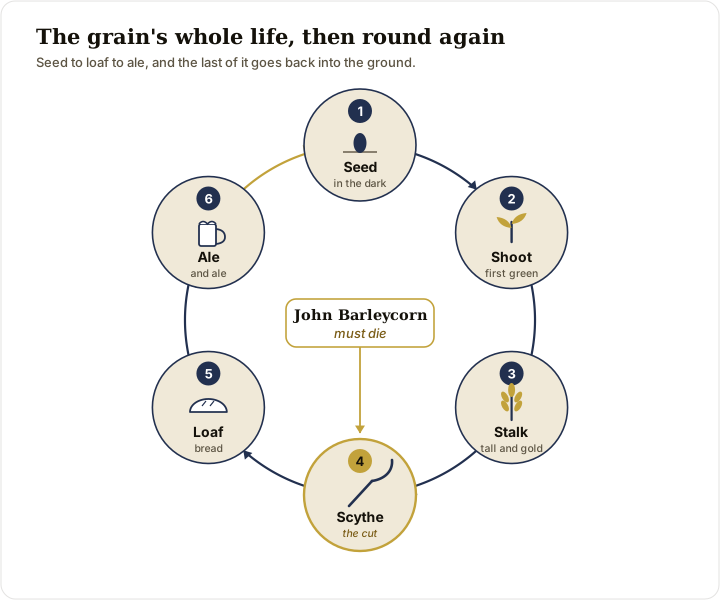
The British folk tradition gives the harvest a different face. John Barleycorn is the barley crop personified, an animistic figure rather than a sky god, famously set into ballad form by Robert Burns in 1782. The song walks his life: planted in the dark, growing a beard (the awns of the grain), cut down by men with scythes at his peak, beaten on the threshing floor, ground, drowned, transformed into bread, ale, and whiskey.
The recurring line is the festival's mood in five words: John Barleycorn must die. It is a celebration of life that requires you to acknowledge a death.
Lughnasadh correspondences: what to put on the altar
In witchcraft, correspondences are the symbolic links practitioners draw between physical things (colours, plants, stones) and the energy of a season or intention. For Lughnasadh, the honest short list is everything that points to grain at the moment of cutting: sun at peak, gold going to bronze, the smell of bread.
| Category | What to use | What it carries on this sabbat |
|---|---|---|
| Colours | Gold, yellow, light brown, bronze, deep green going crisp at the edges | Sun at its peak; the hardening, ripening stalk |
| Grains and herbs | Wheat, oats, barley, cornstalks, sunflower, frankincense, chamomile, rosemary | The literal harvest and the kitchen end of the practice |
| Foods | Fresh bread, summer squash, corn, blackberries, apples, cider, ale, mead | The transformation of sun, soil, and labour into something you can eat |
| Crystals | Citrine, carnelian, tiger's eye, amber | Manifested abundance, creative effort, focus, fossilised sunlight |
| Tools and symbols | Sickle or scythe, corn dolly, cornucopia, a chalice | The decisive cut, the preserved grain spirit, the vessel of plenty |
You do not need all of it. A piece of bread, a yellow candle, and a cup of something poured carefully will hold the whole festival. For deeper charts in either direction, herb correspondences, crystals, and colour magic are the long versions, and altar setup covers the layout.
A simple solitary Lughnasadh rite
This is the rite I actually use, walked the way I walk it. It takes about twenty minutes and works on a kitchen table.
What you need
A yellow or gold candle. A loaf or thick slice of bread (homemade if you have the energy, store-bought is honestly fine, sourdough from the supermarket is what I used the first three years). A cup of cider, ale, mead, or water. One small bowl for offerings. Optional: a stalk of wheat from a craft shop, a corn husk, a piece of citrine or tiger's eye, a square of cloth in gold or light brown.
1. Set the space
Clear the surface. Wipe it down. Lay the cloth. Set the candle, the bread, the cup, and the offering bowl in front of you. Face north for the earth element, or east for the rising sun if that feels right; if it doesn't matter to you, face whichever way the room lets you sit comfortably.
2. Cast the circle, plain version
Walk deosil (clockwise, sunwise) around the space, pointing with your dominant index finger or a wand, picturing a clear sphere of light closing around you. This marks a "between" space, not a summoning. If you are a secular practitioner and the visualisation feels theatrical, skip it: three slow breaths in and out, eyes closed, will do the same psychological work. The longer version lives in casting a circle.
3. Light the candle and welcome who you welcome
Strike the match. The little sulfur smell is part of it. Light the candle and watch the wick catch.
In Celtic-leaning practice, this is the moment to welcome Lugh and Tailtiu. In broader Wiccan practice, the Mother of the Harvest and the Lord of the Grain. In secular or animist practice, the land itself, or the people who fed you this year, or no one at all. Speak whatever you mean out loud. The line I tend to use:
Welcome, sun at its peak. Welcome, grain in my hands. Welcome, hands that did the work.
For more on this step, candle magic covers the technique and deity work covers the relational side.
4. The central act: hold the bread
This is the part that matters. Pick up the loaf or slice in both hands. Hold it close enough to the candle that the warmth catches the crust. Slow your breathing down.
Walk the grain's journey in your head, slowly, one step at a time. A seed in the dark earth months ago. A green shoot pushing up. A tall, gold stalk in a field somewhere you have never been, ripening in heat. The scythe (or the combine harvester; honesty is allowed). The grind. The water and the salt. The oven. The bag. Your kitchen. Your hands.
Tear off a piece and eat it. Slowly, the way you do not normally eat bread. Notice what it tastes like.
Tear off a second piece and put it in the offering bowl. Pour a splash of cider in beside it.
Then, while the candle is still burning, name your own harvest. Not what you wished for in the spring, what you actually pulled in. Out loud is more honest than in your head, but both work. The thing that grew. The job that finally landed. The friendship that turned out to be real. The boundary you held. Whatever it is.
Then name what didn't grow. The project that died on the vine, the relationship that didn't, the version of yourself you tried to be that never took root. Let it go like John Barleycorn going under. It is allowed to be done.
5. Close
Thank whoever you welcomed, by name. If you cast a circle, walk widdershins (counter-clockwise) once around the space, picturing the sphere of light dissolving back into the floor. Snuff the candle (pinching is traditional; blowing is also fine, despite the gatekeeping you may have read).
Take the offering bowl outside. Tip it onto bare earth under a tree, into a garden bed, or into a planter on a fire escape. It counts.
Bake the loaf: kitchen-witch Lammas bread
The easiest entry to a "loaf mass" is a rustic cornbread, which needs no proofing and no kneading and is done in half an hour. Heat the oven to 400°F (200°C) and grease a 9-inch round pan or, better, a cast-iron skillet. Whisk together one cup of all-purpose flour, one cup of yellow cornmeal, a quarter cup of sugar, a teaspoon of salt, and a tablespoon of baking powder. Stir in one egg, a cup of milk, and a third of a cup of vegetable oil. Pour into the pan and bake 20 to 25 minutes, until the top is golden and a toothpick comes out clean.
The magic, in this practice, is what you put in while you stir. Three things I name while mixing: one specific gratitude (not "I am grateful for my life," something concrete, like "I am grateful that my sister called me back on Tuesday"), one goal I want this bread to feed (the new job, the new project, the practice I want to keep), and the name of someone who fed me this year, literally or otherwise.
If you have a Saturday and want the longer version, a yeasted loaf with a slow first rise gives you more time to think while you wait. The cornbread is the answer for a Tuesday after work.
Serve it warm, with butter or honey. Give at least one piece away. A roommate, a neighbour, a partner, the friend who already said yes to coming over. The sharing is not decoration; it is what makes the loaf a Lammas loaf rather than dinner. More on this end of the craft in kitchen witchcraft.
Make a corn dolly (the spirit of the last sheaf)
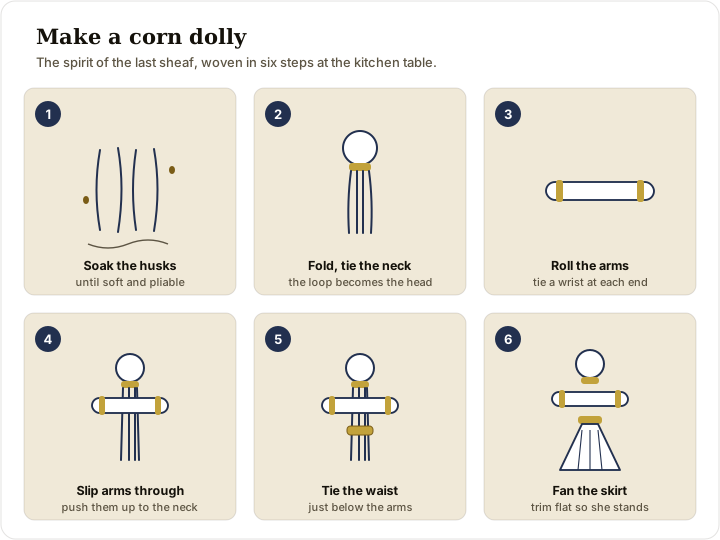
The folk belief is small and lovely: as the harvesters worked across the field with their scythes, the spirit of the grain retreated from them, sheaf by sheaf, until it was finally trapped in the very last standing sheaf. To keep that spirit safe through the winter, the last sheaf was carefully cut and woven into a small human figure, the corn dolly, sometimes called a corn maiden or corn mother. She lived in a place of honour in the house all winter. In spring, she was burned and her ashes mixed with the seed, or simply ploughed back into the field, returning the spirit to the earth.
You can make one at the kitchen table in twenty minutes. Dried corn husks are traditional and cheap from craft shops; raffia works; strips of brown paper bag will work in a pinch (the act, not the material).
- Soak. Soak the dried husks in warm water for 10 to 15 minutes until soft and pliable.
- Core bundle. Stack three or four husks, fold the bundle in half, and tie tightly about an inch below the fold with twine. The loop above the tie is the head; the tie is the neck.
- Arms. Roll a single husk into a long, thin cylinder. Tie small ties about half an inch from each end to make wrists.
- Assemble. Separate the body bundle just below the neck into front and back halves. Slip the arm cylinder horizontally between them, pushed up snug against the neck.
- Waist. Gather the husks together again just below the arms and tie another piece of twine for the waist.
- Skirt or legs. Fan the remaining husks out for a skirt, trimming the bottom even so she stands; or split them into two halves and tie at each ankle for trousers.
Embellish if you want: a shawl from another overlapping husk, a wisp of wheat for hair, a small ribbon. Keep her on the altar or a shelf through autumn and winter.
Reek Sunday: the festival is still going
The Lughnasadh hill-climb tradition didn't die. It got rebadged.
On the last Sunday of July, up to 40,000 pilgrims climb Croagh Patrick, a 764-metre mountain on the west coast of County Mayo, Ireland. Some walk it barefoot, as an act of penance, the way their grandmothers did. At the top there are "rounding rituals," where pilgrims walk deosil (sunwise) around ancient cairns like Leacht Benáin and Leaba Phádraig, praying.
It is officially Christian now, dedicated to Saint Patrick, with the earliest church record from 1113 CE. But folklorist Máire MacNeill, in her 1962 study The Festival of Lughnasa, traced it as a direct, unbroken continuation of a Lughnasadh hilltop assembly that predates Christianity by at least 1,500 years. The path is dotted with prehistoric monuments that long pre-date the church on the summit.
Worth knowing because the cycle is not a pretend revival. Some of it never stopped.
What to actually do this year
For the reader who skimmed to the bottom and wants to keep something:
- Bake or buy one loaf. Eat a piece of it slowly, properly, with attention. Save a corner for the ground.
- Name one thing you actually harvested this year. Out loud is better.
- Name one thing you tried that didn't grow, and let it go.
- Light a gold or yellow candle for ten minutes. Sit with it.
- Step outside. Touch the earth with your hand. Thank it.
That is a real Lughnasadh.
Where to go next
The first harvest opens the autumn stretch of the wheel. For the whole eight-sabbat cycle and where this one sits, start at the wheel. For the second, fruit harvest six weeks on, Mabon picks up the story. For the third and final harvest at the year's hinge, Samhain. If a sabbat rite of any kind is new ground, witchcraft for beginners is the gentler entry, and esbats handles the monthly full-moon rhythm in between.
Welcome to the harvest. Eat the bread slowly.