Color Correspondences Chart
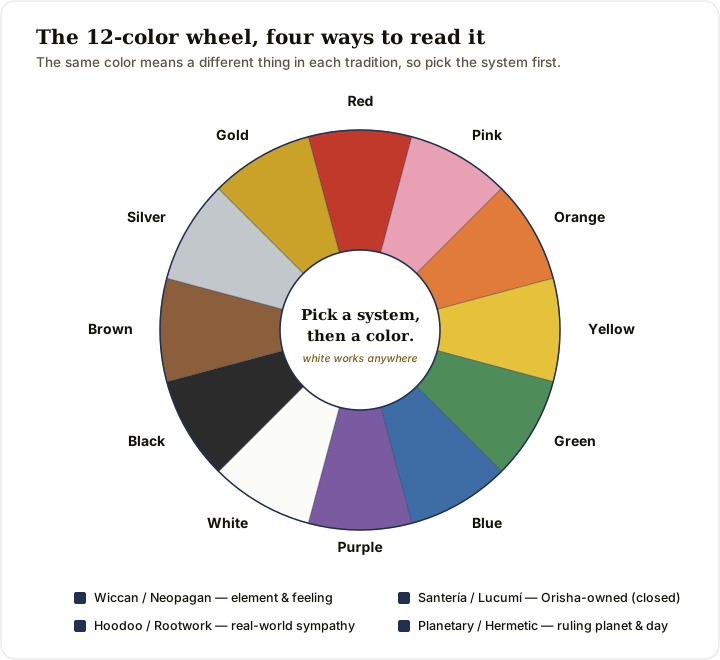
Color correspondences are four overlapping charts, not one: pick a tradition, then a color.
The 12-color chart, by tradition
| Color | Wiccan / Neopagan | Hoodoo / Rootwork | Santería / Lucumí | Planetary / Hermetic |
|---|---|---|---|---|
| Red | Fire element, passion, courage, willpower; the God side of the altar | Sex, fast victory, fast-moving petitions, love-drawing; the inner core of a reversing candle | Chango (with white); Elegua (with black); blood, lightning, the sacred life force | Mars, Tuesday: war, courage, breaking obstacles |
| Pink | Romantic love, self-love, friendship, gentle emotional healing | Reconciliation, romance, "clean living," drawing without aggression | Soft feminine aspects of certain spirits; not a primary Orisha color | Venus, Friday: harmony, beauty, pleasure |
| Orange | Creativity, motivation, joy, harvest (Samhain) | Road-opening, removing blockages, "stuck" remedies, prophetic dreams | Not a primary Orisha color | Mercury, Wednesday: intellect, communication, travel |
| Yellow | Air element, intellect, clarity, confidence | Money (as a stand-in for gold), prayer, devotion, cheerfulness | Oshun: amber, sweet rivers, wealth, sensuality | Sun, Sunday or Mercury, Wednesday: success, fame |
| Green | Earth element (modern), fertility, healing, nature, abundance | Money, gambling luck, steady work, business; with black, reversing money jinxes | Ogun (with black): wild forest, iron, the warrior | Venus, Friday or Jupiter, Thursday: prosperity, expansion |
| Blue | Water element, peace, patience, emotional healing | Protection, harmony, household calm; dark blue, historically, for suppression | Yemaya (with white): the deep ocean, motherhood, the amniotic fluid of creation | Jupiter, Thursday: justice, wealth, expansion |
| Purple | Psychic ability, third eye, deep meditation, spiritual development | Mastery, command, compelling; the court-case standby | Oya: whirlwind, transformation, the cemetery gates; Babalu-Aye for healing | Jupiter or Mercury: leadership, esoteric study |
| White | Purity, lunar energy, the universal substitute; the Boline (working knife) handle | Spiritual blessings, uncrossing, rest, weddings | Obatala: purity, peace, the mind, the sky | Moon, Monday: intuition, safe travels |
| Black | Protection, banishing, grounding, absorbing harm; the Athame handle | Banishing, reversing, mourning; historically (per Hurston) "for evil or death" | Elegua (with red); Ogun (with green); the concealed womb, the potential for form | Saturn, Saturday; Earth in Golden Dawn Hermeticism |
| Brown | Stability, home, animals, the physical earth | Court cases, neutrality, the "paper color" of legal bureaucracy | Orula (with green): wisdom, healing | Saturn, Saturday: tradition, long-term planning |
| Silver | The Goddess, lunar energy, intuition; the left side of the altar | Not traditionally used as wax | Not traditionally used as wax (Obatala's color is white) | Moon, Monday: secrets, divination, the astral |
| Gold | The God, solar energy, success, abundance; the right side of the altar | Fast money, attraction, often interchangeable with yellow | Oshun's royalty and wealth, interchangeable with yellow and amber | Sun, Sunday: fame, recognition, absolute victory |
Where two systems clash on the same color, the clash is the point. Do not blend across columns inside a single working unless you know exactly why.
The three places this chart is going to bite you hardest:
- Earth = black, or Earth = green? Golden Dawn ceremonialists face north and visualize a black pentagram, because Earth lives in Malkuth on the Tree of Life and Malkuth's colors are dark. Modern Wiccans face north and visualize a green one. Both are right inside their own room.
- Purple = inward, or purple = command? A Wiccan burns purple for psychic development. A Hoodoo rootworker burns purple to compel and dominate the people in a court case. Same wax, opposite direction.
- Black = banish, or black = the sacred womb? A Wiccan uses black as a shield. A Lucumí practitioner reads black as the concealed potential for form, the womb of creation. A Hoodoo worker might use it to break a curse or, in older fieldwork, to lay one. None of those is "what black means." It is what black means in that tradition.
The candle-color quick-reference for spellwork
Pick the tradition first, then the color. If you do not have a tradition you are working in, default to Wiccan or to white. This is the cheat sheet I keep written inside the front cover of my book of shadows.
- Love, gentle: pink, across every system.
- Love, passionate: red, Wiccan or Hoodoo.
- Protection: black in Wicca (shielding), blue or white-and-black in Hoodoo (reversing).
- Money: green in Hoodoo (sympathetic to cash), gold or yellow in planetary Sun work, green or purple in Jupiter expansion.
- Road-opening, unstuck: orange in Hoodoo. Highly specific and worth the column.
- Court cases: brown for the paperwork, purple to compel. Both are documented Hoodoo practice.
- Banishing or uncrossing: black, or a white-and-black double-action.
- Spiritual cleansing: white, anywhere.
- Psychic work: purple or silver in Wicca. Silver if you want to lean lunar.
- General "I do not know which is right": white. It substitutes everywhere.
For the technique of dressing, carving, and burning the candle itself, the deep dive lives in candle magic. For protective work specifically, protection. For sweet-talking a situation, honey jars. For clearing the room before any of it, banishing and cleansing.
A note on double-action and reversible candles
Double-action candles are a Hoodoo specialty: a pillar with two colors of wax, often a colored core poured inside a contrasting outer layer. In rootwork, the black layer is said to clear the curse or crossed condition first, and the colored layer then draws the new condition in.
The standard pairings, per documented rootwork practice:
- Red and black: removing a love-jinx or crossed romantic condition, then drawing passion back.
- White and black: general uncrossing and returning evil to the sender.
- Green and black: breaking a hex on money, business, or gambling luck, and reversing the financial damage.
Advanced rootworkers also "butt" these candles: cutting the top off and inverting the candle so it burns from its original base, which is said to "turn the trick back" on whoever sent it. I am noting this as documented practice, not coaching you through it. This is rootwork, and it loses meaning grafted onto a Wiccan or eclectic working.
How to read the chart
The four big systems pick color by four different logics. Once you can name them, you can spot the clash on any TikTok chart instantly.
- Wiccan and Neopagan: elemental and psychological. The color matches the element (Earth, Air, Fire, Water) or the feeling you want to invoke (peace, courage, focus).
- Hoodoo and rootwork: pragmatic sympathy. The color matches the real-world thing. Green for dollar bills, brown for court paperwork, red for blood and heat.
- Santería / Lucumí: divinely mandated. Each color belongs to specific Orishas and is not freely swappable. This is a closed initiatory religion; outside that initiation, the codes are someone else's, not a free vocabulary.
- Planetary and Hermetic: celestial timing. Color matches the ruling planet, ideally during that planet's planetary hour on its day of the week.
When in doubt, burn white. White is the one near-universal substitute across every system, and it will never embarrass you.
A note on the chart: I am sketching Lucumí color codes respectfully here, the way an outsider might describe another faith's sacraments, not handing out a how-to. More on why in closed traditions. The bigger family-tree question of wiccan vs witchcraft sits one level up from the chart itself.
The honest answer: there is no single color chart
Color magic correspondences are not one master chart but four overlapping ones, and what a green candle "means" depends on which tradition is holding it. A Wiccan reads green as the Earth element. A Hoodoo rootworker reads it as cash. A Lucumí practitioner reads it as Ogun's forest. A planetary magician reads it as Venus or Jupiter. None of them are wrong. They are speaking different languages with the same crayon box, and the trick to color magic is choosing which language you are working in before you light anything.
You do not need a permission slip to work with color. You do not need every color of candle, you do not need silk altar cloths, and you do not need to memorize every system to start. You need to pick one that fits the spell you are actually doing, and then stop blending past that.
TL;DR: Color in magic is a language with regional dialects, not a universal key. Green means Earth to a Wiccan, money to a Hoodoo rootworker, the wild forest of Ogun in Lucumí, and Venus or Jupiter to a planetary magician. Pick the tradition you are working inside, then match the color to that.
Most beginner charts pretend the four big systems agree. They do not. Where they line up, you can use them almost interchangeably and no one will blink. Where they clash, the clash is the whole point, and ignoring it is the fastest way to make a working feel muddy.
This is tradition and lived practice, not physics, and nothing on this chart is medical, legal, or financial advice. Treat candle color as a language for telling your own focused mind, and (if you believe so) the powers you petition, what the working is for. Spending matters less than coherence. A single white candle in an internally consistent ritual will out-perform a Sephora-sized stash burned at random. If this is your first time around any of it, just starting out is the gentler door in.
Color by color, tradition by tradition
The first working I did sloppily was a job-drawing candle on a Sabbat altar I had dressed for Beltane. Green wax, because money. Green altar cloth, because Beltane. Green herbs strewn around the base, because Earth. The whole thing went off without a single conflicting note, and also without a single specific one. The job did not come. What I had built was a green blur. The next time I worked for a job, I picked Hoodoo, dressed one green candle with a money oil on a brown cloth, set out a slip of paper with the role written on it, and left the seasonal altar alone in another room. The call came back inside the week. I do not know what that proves about magic. I know what it proved to me about clarity.
Red, pink, orange (the warm end)
Red is heat, but the heat is read differently in every column. Wicca treats it as Fire, courage, the willpower side of the altar. Hoodoo treats it as fast sex, fast victory, and the kind of petition you would send to a fast-moving spirit like St. Expedite. Lucumí reads it as Chango's lightning when paired with white, and Elegua's life-and-death edge when paired with black. Planetary magic reads it as Mars: war, conflict, the breaking of obstacles, burned on a Tuesday.
When to reach for red: when the working needs heat and forward motion. Not when it needs tenderness.
Pink is one of the few colors with near-universal consensus. Across Wicca, Hoodoo, and planetary Venus work, pink is the softer octave of red: gentle love, self-love, reconciliation, friendship, beauty. Pink does not dominate and does not burn anyone. It is the color I default to for any work involving someone I genuinely care about.
Orange splits more sharply than people expect. In Wicca it is creativity, motivation, the joy of harvest. In Hoodoo it is something very specific: road-opening. The "I am stuck and nothing is moving" candle. If you have ever felt that hard wall where every effort returns nothing, orange in the Hoodoo column has a long documented history of being the right reach. In planetary work it is Mercury, Wednesday, communication and travel.
Yellow, green, blue (the middle band)
Yellow's split is the cleanest example of "pick a system" on this whole page. To a Wiccan, yellow is Air: intellect, clarity, the breath of communication. To a Hoodoo rootworker, yellow is money, used as a stand-in for gold on cheaper candles. To a Lucumí practitioner, yellow is Oshun: amber, sweet rivers, sensuality, wealth. Wear a Wiccan hat to think clearly. Wear a Hoodoo hat to draw cash. Do not try to wear both at once, because they are not asking the same question.
Green is the biggest fracture in the entire chart. In modern Wicca, green is the Earth element, fertility, healing, growth. In Hoodoo, green is money, gambling, business, and (with a black layer) reversing the kind of jinx that has been bleeding your bank account. In Lucumí, green is the wild forest of Ogun, paired with black to call the warrior's iron. In planetary magic, green is Venus on a Friday or Jupiter on a Thursday, depending on whether you want pleasure or expansion. A single green candle on your altar is being asked four entirely different questions at once unless you have narrowed it.
That is the job-candle lesson I learned the hard way. The green candle I lit also read as Earth on a Wiccan altar, and the Earth context was diluting the money context. Once I picked one lane, things moved.
Blue is calmer on the surface and more complicated underneath. Wicca treats it as Water, peace, emotional healing. Hoodoo treats it as protection and household harmony, with darker blue used historically (per Zora Neale Hurston's fieldwork in Mules and Men) for suppression and worse. Lucumí reads blue as Yemaya, the depth of the ocean and the amniotic fluid of creation, paired with white. Planetary blue is Jupiter on a Thursday: justice, wealth, expansion.
Purple, white, black (the polarizing end)
Purple is the cleanest illustration of "inward versus outward" on this chart. In Wicca, purple is psychic development, the third eye, deep meditation. It points inward. In Hoodoo, purple is mastery, command, and the standby for court-case work where you want to compel the judge to rule your way. It points outward. In Lucumí, purple touches Oya's transformation and whirlwind, and Babalu-Aye in healing of severe sickness. In planetary work, purple is Jupiter or Mercury: leadership and esoteric study.
If you find yourself reaching for purple, ask: do I want this energy to act on me, or to act on someone else? The answer chooses your column.
White is the universal solvent. Every tradition treats white as a safe substitute when you do not have the right color, which is one reason traditional rootworkers exist who use only white wax. In Wicca, white is purity, lunar energy, and the handle of the Boline, the white-handled working knife used for cutting cords and harvesting herbs, paired against the black-handled Athame for energy work. In Lucumí, white is Obatala: the mind, the sky, the expansive side of the alchemical triad of creation. In planetary, white is the Moon on Monday.
If you only own white candles, you are not behind. You are equipped.
Black is the most maligned color in the chart and one of the most important to read carefully. It is not evil. In Wicca, black absorbs harm and grounds energy, which is why the Athame's handle is black: the blade contains and directs the force you channel through it without letting it leak. In Lucumí, black is the womb, the concealed, the potential for form to emerge; in the alchemical triad of black, white, and red, black is the recipient who makes creation possible. In Golden Dawn Hermeticism, black is Earth, the dense soil of Malkuth where the higher elements settle into matter. In Hoodoo, black does the heavy lifting of banishing and reversal, and Hurston's fieldwork includes harder workings that used it aggressively.
What black is never, in any of these traditions, is "evil." If you have been avoiding black candles because you absorbed that somewhere, consider this your permission slip.
Brown, silver, gold (the metallics and the dirt)
Brown is the most pragmatic color in Hoodoo. Wicca uses it for stability, home, and animal magic, which tracks with brown as the color of dirt and den. Hoodoo treats brown as the color of court cases and bureaucracy, because petitions were historically written on torn brown paper sacks and brown sympathetically links to the paperwork, dockets, and files of the legal system. If you find yourself reaching for brown, ask whether you are honoring a creature or addressing a system.
Silver belongs almost entirely to Wicca and planetary work. It is the Goddess, the moon, intuition, the left side of the altar in the gendered split modern Wicca often uses. Hoodoo and Lucumí do not traditionally use silver as a candle wax (in Hoodoo, silver dimes are protective coins, but silver wax is a modern import). If you see a silver pillar at a botánica, that is a recent product, not a tradition. The gendered Wiccan altar split itself is worth a careful look in altar layout.
Gold is the opposite end of that polarity. The sun, the God, success, the right side of the altar in the Wiccan split. Hoodoo treats gold interchangeably with yellow for fast money. Lucumí touches it through Oshun's wealth and royalty, again interchangeable with yellow and amber. Planetary gold is the Sun on Sunday: fame, recognition, ego, absolute victory. Gold is the one color where the four traditions come close to agreeing: when in doubt, gold means won.
Altar cloth color through the Wheel of the Year
Wiccan altar cloths shift across the eight Sabbats to mirror the season. This is modern Wiccan convention, not a universal pagan rule, but it is the most common framing English-speaking witches will meet.
- Yule (Dec 21): red, silver, gold, white, green.
- Imbolc (Feb 1): light greens, blues, yellows, pinks, white.
- Ostara (Mar 21): light greens, blues, yellows, pinks.
- Beltane (May 1): strong yellows, greens, reds, golds, white.
- Litha (Jun 21): pristine white or bright yellow, honoring the peak of solar power.
- Lughnasadh (Aug 1): lighter earthy browns, yellows, reds.
- Mabon (Sep 21): darker browns, reds, yellows.
- Samhain (Oct 31): black, orange, grey, dark blues.
Modern Wiccan altars often split the surface by divine polarity. The left side honors the Goddess in silver, white, or green; the right side honors the God in gold, yellow, or red. The full eight-Sabbat picture sits in the Wheel of the Year.
Planetary days: when timing clashes with seasonal color
Planetary magic adds one more layer of color over the top of everything else. Each day is ruled by a classical planet, and that planet has its colors.
| Day | Planet | Colors |
|---|---|---|
| Sunday | Sun | Gold, yellow |
| Monday | Moon | Silver, white |
| Tuesday | Mars | Red |
| Wednesday | Mercury | Orange, yellow |
| Thursday | Jupiter | Blue, purple, green |
| Friday | Venus | Pink, green |
| Saturday | Saturn | Black, brown |
Hermetic practice goes one step deeper than the day. Inside each day are planetary hours, with each hour ruled by a different planet on a rotating cycle. The framing I find most useful is that planetary hours behave like a tide. You can swim against them, but it is slow, and you can ride them, which is fast. The full breakdown lives in planetary days and hours.
What happens when the timing fights the season? If you want to do a grounding ritual on a Saturday, but that Saturday is also Litha, the Saturnian black candle and the solar white-or-yellow cloth do not agree. There is no umpire. Each tradition resolves it differently.
- A ceremonial magician trusts the planet. The Saturnian hour is absolute; the Sabbat is irrelevant to that operation.
- A Wiccan eclectic splits the altar (yellow cloth for the day, black candle for the working) or defaults to a white candle as a universal bridge.
- A Hoodoo rootworker ignores the planet entirely. If the court case starts Tuesday, the brown candle burns Tuesday, never mind that Tuesday is Mars's red day.
The chart is not going to choose for you. You choose which system is in charge of this specific spell, and the rest of the colors yield.
Why traditions disagree: a one-screen history
The four systems on this chart are not parallel inventions. They are layered over each other across roughly a hundred and fifty years, which is most of why TikTok charts feel like a smoothie of conflicting rules.
The Hermetic Order of the Golden Dawn codified its rigid color scales in the late 19th and early 20th century, weaving Renaissance magic, Kabbalah, alchemy, and astrology into a structured system. Their Earth is black, because Earth sits in Malkuth on the Kabbalistic Tree of Life and Malkuth's colors are citrine, olive, russet, and black: the dense, materialized end of the spectrum where the higher elements come to rest.
Hoodoo's color palette as most readers will encounter it today was heavily codified in the mid-20th century by spiritual-supply merchants, most famously Henri Gamache, whose 1942 Master Book of Candle-Burning paired colored candles with specific Psalms and condition oils. Earlier folk usage, documented by Zora Neale Hurston in her 1935 fieldwork book Mules and Men, treated black largely as "for evil or death." The current Hoodoo palette has broadened from there, but Gamache and Hurston are the two documented anchors worth knowing.
Modern Wicca, founded as a tradition in the mid-20th century by Gerald Gardner and elaborated by Doreen Valiente, deliberately shifted the elemental color of Earth from black to green to fit a nature-affirming aesthetic. That single shift is the reason most beginner charts disagree with most ceremonial charts on the most basic question on the page. It was a choice, and a recent one. More of the longer arc sits in modern witchcraft's history.
A respectful note on Lucumí (Santería) color codes
Lucumí Orisha colors are religious sacraments inside an initiatory tradition, not a free aesthetic vocabulary.
- The Orisha colors most often seen online (Yemaya blue and white, Oshun yellow and amber, Chango red and white, Obatala white, Elegua black and red, Ogun green and black, Oya's purple of transformation) belong to a living religion with priests, lineages, and rules about who handles what.
- Using these colors on a non-Lucumí altar to petition an Orisha is not the same as honoring traditional Wiccan or Hoodoo correspondences. It is reaching into a tradition you are not part of and pulling out the parts that look usable.
- If you are genuinely drawn here, the right next step is finding an initiated teacher, not a TikTok shortcut. The fuller etiquette around traditions like this lives in closed practices.
This is respect, not gatekeeping. The codes work the way they work because the relationships are real to the people inside them.
Common mistakes baby witches make with color
These are the four I see most, including in my own early notebooks.
- Mixing systems inside a single working. A Hoodoo reversible candle, on a Wiccan Sabbat altar, timed to a Hermetic planetary hour. It feels thorough. It is muddy. Pick a column and stay in it for one spell.
- Avoiding black because it sounds evil. Black is the most useful protective color in Wicca and one of the most sacred colors in Lucumí. If you have been skipping it, you are skipping half your shielding tools.
- Buying every color before learning what one candle does. A drawer full of unburned colored candles is not a practice. One white candle, lit with full attention, is.
- Forgetting that magic and action work together. Lighting the green candle for the job is the working. Sending the resume is the rest of the working. Either alone is half a spell.
If you only own white candles, you are not behind. White substitutes everywhere, in every system on this chart. The discipline is in the attention, not the inventory. More on building a small kit honestly in practicing on a budget, and on what to check when a spell falls flat in why spells don't work.
Choose one column, trust your own associations, and let the colors serve your intention rather than the other way around.
Keep exploring
Browse more guides, or start with the basics of the practice you are curious about.
Browse more guides