How to Plan a Ritual: A Step-by-Step Witch's Template
Learning how to plan a ritual is what turns "I lit a candle and hoped" into a working you can feel move. You need eight decisions on paper before you strike a match, and a template steady enough to scale up for a sabbat or down to five quiet minutes at your kitchen table.
Everything below is that template. Take what fits, ignore what does not, and copy the worksheet into your grimoire tonight.
The short answer
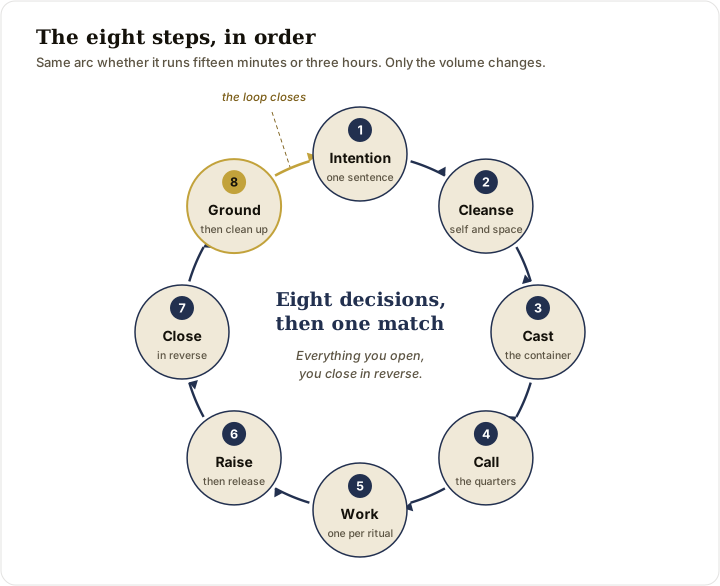
Planning a ritual means writing down eight things before you light anything: your one-sentence intention, how you will cleanse, how you will cast, what you are calling in, the working itself, how you will raise and release the energy, how you will close, and how you will ground and clean up. Do that on paper first and the ritual almost runs itself.
The arc is the same whether you are doing a fifteen-minute tea-light working at your desk or a three-hour Samhain rite by a bonfire. Only the volume changes.
The eight-part anatomy at a glance
Eclectic practitioners reorder or drop pieces all the time. What follows is the traditional skeleton, not a rulebook. See the whole shape first, then we descend into it.
- Set one clear intention.
- Cleanse yourself and the space.
- Cast (or acknowledge) a circle.
- Call the elements, and any deity you work with.
- Perform the working.
- Raise the energy, then release it.
- Give thanks and close, in reverse order.
- Ground, then clean up.
Step 1: Set one clear intention
The intention is the spine. Every choice you make after this, the color of your candle, the day of the week, the herb you crush between your fingers, is downstream of that one sentence. Get the sentence wrong and the rest of the ritual is beautifully directed at nothing.
Test yours against three rules: one sentence, present tense, specific enough to recognize when it lands.
"I want a better life" fails all three. "I am drawing a stable, well-paying role in book editing that lets me work from home" passes them. So does "I am releasing my fear of the check I need to write next week." So does "I am closing the door between me and my ex, so his name stops appearing in my mornings."
In this practice, the ritual amplifies focused intention. Vague ache in, vague ache out.
Step 2: Cleanse yourself and the space
Cleansing is the moment you tell your nervous system that you are done being the person who paid a phone bill twelve minutes ago and are becoming the person who does this. Two beats, in order.
Yourself first. A ritual bath is traditional: warm water, a handful of Epsom salt for purification, a squeeze of lemon for clearing, a sprig of fresh rosemary if you have it for the lift. If you have no tub, run hot water over your hands with intent and let it feel like more than washing. If even that is not available (you are at your desk on a lunch break, you share a bathroom, the water is off), close your eyes for three slow breaths and imagine the day sliding off your shoulders. All three of these work. The point is the pivot.
Then the space. Tidy the physical layer before you touch the energetic one, because dust and dirty mugs will drag your mind back to chores mid-rite. Once it is clean, sweep the corners with your besom (a broom kept for this and nothing else) if you have one, walking clockwise. Smoke cleanse with a safe, non-toxic herb bundle if your ventilation and lungs allow. Ring a small bell if smoke is off the table. Sprinkle salt water at the thresholds. Clap sharply in the corners. Any of these will do. The gesture that means something to you is the one that works.
Step 3: Cast (or acknowledge) the circle
The cast circle does two things at once. It builds a container to hold the energy you are about to raise, so the working stays coherent instead of leaking out into your kitchen, and it puts a shield around you so nothing you did not invite wanders in.
The basic movement: stand at the center of your space, face east or north, and walk the perimeter clockwise (deosil) three times. Trace the line with your index finger, a wand, or an athame (a ritual knife kept for directing energy, never for cutting anything physical). Visualize a sphere of blue or white light rising from that line, arching above your head and dropping below the floor. Mark the circle physically if it helps you feel it: sea salt, a coil of cord, small crystals at the four cardinal points, a tea light at each quarter.
Once the circle is up, you stay inside it until the ritual is done. If you genuinely have to leave (someone at the door, a child calls out), you "cut a door" with your athame in front of you, step through, and seal it behind you when you come back.
The full method sits in casting the circle. If circles feel like too much for a small working, know this: acknowledging one, standing in your space and stating "this is sacred ground for the next hour," is a legitimate lighter form. Do not skip the container; just size it to the working.
Step 4: Call the elements, and any deity you work with
With the container built, you invite the powers you want present. This is the hospitality beat, not the summoning beat. In traditional framing, elements and deities are honored guests, not staff.
Face each direction in turn (many practitioners start in the east and move clockwise) and speak a short welcome to the element there. A representative object on your altar at each quarter makes the invitation land.
| Direction | Element | Domain | On-altar stand-in |
|---|---|---|---|
| East | Air | Intellect, communication, new beginnings | Incense or a feather |
| South | Fire | Passion, transformation, willpower | A lit candle |
| West | Water | Emotion, intuition, healing | A chalice or bowl of water |
| North | Earth | Stability, abundance, the body | Salt, soil, or a stone |
If you work with a deity, invite them now, by name and with respect. A short line ("Brigid, I welcome your fire to this working; be here with me") is enough. If you are secular or non-theistic, this half of the step simply does not happen. Working with the elements and your own focused intention is a complete practice.
Step 5: The working itself
This is the one part of the ritual that changes every time. It is the reason you built everything else: the candle you dress and burn, the jar you fill with herbs and seal with wax, the sigil you draw and charge, the cord you tie into nine knots, the tarot spread you read for a clearer look, the silent prayer at the altar, the meditation on a specific outcome.
Pick one working per ritual. Two is a compromise both are hurt by. Write out the exact physical steps on your worksheet ahead of time so you are not fumbling in altered state ("carve name into candle, dress with olive oil from base to wick, roll in crushed rosemary, place in cauldron, light while speaking the chant").
Design the working itself with writing the working if it is not one you have done before. If you are new and want a small first one, beginner spells has the plainest starters.
Step 6: Raise the energy, then release it
The working needs fuel. In the older Wiccan language this fuel is the "cone of power," an image of energy spiraling up from the circle to a point above your head. Gerald Gardner described it as the coven's signature working, though the same mechanic runs in a solitary rite; the power exudes from your body and is held in by the circle until you send it out.
Raise it however your body actually knows how to. Drumming. Chanting a line of the intention over and over until the meaning wears off and it becomes sound. Dancing until you are winded. Rhythmic breathing that speeds up until it feels like a pulse. A visualization so vivid the room warms up. All of these work, and one will suit you better than the others.
The shape is always the same. Build. Build. Build past the point of comfort. Then, in a single moment, let it go. Fling your arms up, drop them to your sides, exhale hard, cry the word out, and picture the energy leaving through the top of the circle toward the intention.
Do not clench. Held energy stalls the spell. This is the cast-and-release beat, sometimes called "set it and forget it," and the "forget" is the crucial half. You are not managing the outcome from now on. You are handing it over.
Step 7: Give thanks and close, in reverse order
Closing mirrors opening, backwards. Skipping this feels like a small thing; it is not. You are ending a conversation with the powers you invited in, and leaving the circle up is considered rude to the guests and leaves your space energetically ajar.
Work through it in this order:
- Thank and dismiss any deity you invited. Direct, warm, brief. "Brigid, thank you for your fire tonight; go if you will, stay if you like."
- Thank and release the quarters. Face each direction, in reverse of how you called them, and thank the element there before letting it go.
- Take down the circle. Walk the perimeter widdershins (counter-clockwise), tracing the line and visualizing the sphere folding back into yourself, your athame, or the ground. The traditional closing line is, "The circle is open, but unbroken. Blessed be." Use it if it feels right; use your own words if it does not.
Step 8: Ground, then clean up
After a real energy raise, your body needs a landing. Grounding is that landing.
The oldest Wiccan version is "cakes and ale": a small piece of bread or a cookie, and a glass of wine, juice, or water, eaten and drunk deliberately at the altar. It is a beautifully simple mechanism; food and drink pull you back into the body. Secular versions are just as legitimate. Sit and put both palms flat on the floor. Splash cold water on your wrists. Eat a real meal. Go outside and walk on grass or pavement for ten minutes.
Full drills for the landing live in grounding and centering.
Then handle the physical cleanup. Biodegradable remains (herbs, ash, paper, wax dust) can be buried on your property if you want the energy to stay close to you, or at a crossroads if you want it to disperse and travel. Non-biodegradables (wax pooled in a jar, glass, foil) go in the regular trash, ideally with a quiet thank-you as you drop them in, which severs the tie so the intention does not sit in your bin all week.
The ritual planning worksheet
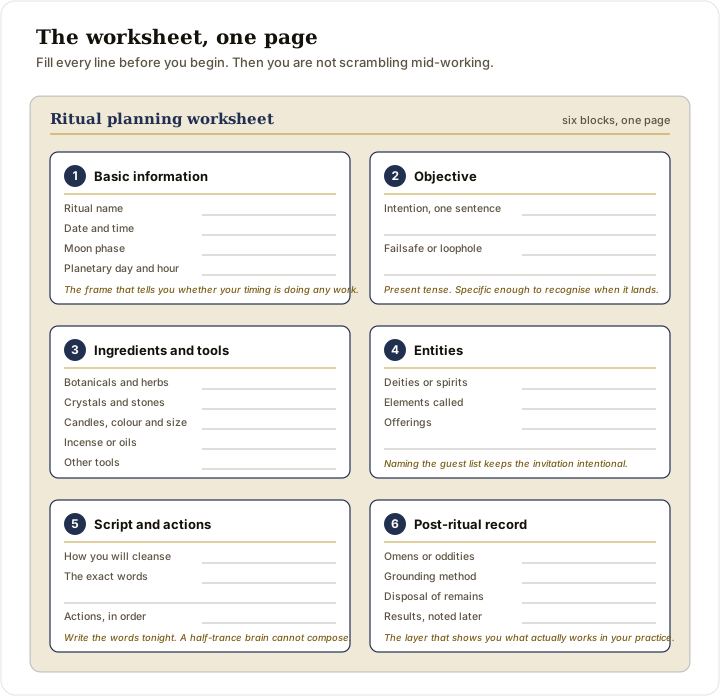
This is the piece to copy into your book of shadows once and reuse forever. Fill it out fully before you start the ritual. That way, when you are inside the working and half in trance, you are not scrambling for what comes next. You are just present.
1. Basic information. Ritual name. Date and time. Moon phase. Planetary day (and hour if you use them). Why it matters: this is the frame that tells you whether your timing is doing any of the work.
2. Objective. One-sentence intention (present tense, specific). Failsafe or loophole. Why it matters: the failsafe is a pre-planned condition to void the working if it manifests badly, and it is genuinely worth writing. A common form is, "I ask that this spell be fulfilled for the highest good of all involved, and I ask forgiveness in advance for any missteps in the working."
3. Ingredients and tools. Botanicals and herbs. Crystals and stones. Candles (color, size, whether they need to burn out completely or can be snuffed). Incense or oils. Any other tools (athame, chalice, cauldron, bell, tarot deck). Why it matters: writing this down catches missing ingredients before you are twenty minutes into a rite you cannot finish.
4. Entities. Deities or spirits you are inviting. Elements you are calling. Offerings (bread, honey, milk, wine, coins, a poem). Why it matters: naming the guest list keeps the invitation intentional rather than automatic.
5. Script and actions. Exactly how you will cleanse. The exact words you will speak. The exact physical actions of the working, in order. Why it matters: an altered-state brain cannot compose poetry from scratch. Write the words tonight so the ritual gets them.
6. Post-ritual record. Omens or unusual occurrences (candle flame behavior, wax shapes, sounds, mood shifts, dreams that night). Grounding method you used. How you disposed of the remains. Results, noted days, weeks, or months later. Why it matters: this is the layer that turns you into a real practitioner over time, because it lets you see what actually works in your practice and what quietly does not.
Timing: when to run the ritual
You can do a ritual whenever you need one, and in an actual emergency you should. When there is time to choose, three overlapping systems help you swim with the current instead of against it. You can also stack them, which is where timing gets interesting; a love working on a Friday under a waxing moon is doing more with each layer than any one layer alone.
Lunar phase
The moon's 29.5-day cycle is the timing layer most solitary witches actually plan around, partly because the phases are easy to feel and partly because they map so cleanly onto the arc of a working.
| Phase | Best for |
|---|---|
| New moon | Planting intentions, fresh starts, quiet groundwork |
| Waxing moon | Drawing in: money, growth, connection, luck |
| Full moon | Peak power: manifestation, charging tools, high-energy healing |
| Waning moon | Releasing: breaking habits, cutting ties, banishing |
| Dark moon | Deep shadow work, heavy banishing, introspection |
Working each phase in depth lives in lunar timing; live dates for the current cycle live in moon phase calendar.
Planetary day of the week
Each day of the week is traditionally ruled by one of the seven classical planets, an assignment worked out in ancient astrology (Babylonian and later Chaldean) and preserved in the names of the days themselves. Each planet carries a set of concerns.
| Day | Planet | Best for |
|---|---|---|
| Monday | Moon | Emotions, intuition, dreams, psychic work |
| Tuesday | Mars | Courage, defense, warding, victory |
| Wednesday | Mercury | Communication, travel, commerce, swift change |
| Thursday | Jupiter | Abundance, career growth, prosperity |
| Friday | Venus | Love, friendship, beauty, gentle passion |
| Saturday | Saturn | Banishing, binding, deep cleansing, protection |
| Sunday | Sun | Success, leadership, vitality, wealth |
Full breakdown at planetary days.
Sabbat and season
For a working large enough to earn the effort, some witches wait for the nearest sabbat. The seasonal energy is already doing half the lifting: Samhain for ancestor and shadow work, Yule for hope and rebirth, Imbolc for purification, Ostara for balance and new beginnings, Beltane for passion and creativity, Litha for solar power and vitality, Lughnasadh for gratitude and harvest, Mabon for release and equilibrium.
The full Wheel is at the sabbats. Depth on the two heaviest turns for personal work sits at Samhain and Beltane. Monthly full-moon rites are at esbats.
Correspondences: pick your ingredients on purpose
Correspondences are the maps that tell you which color candle, which herb, which stone, which scent points at which kind of intention. Every ingredient in a well-planned ritual is chosen because it maps to the working. Green for money because green is the color of growth and cash. Rose for love. Rosemary for protection. Amethyst for peace. The candle is not doing the magic; it is focusing your mind on the exact shape of what you want, so your intention lands somewhere specific.
The charts you want live at color correspondences, herb correspondences, crystals, and incense and oils.
Three universal stand-ins for when you do not have the "right" thing
You do not need a full apothecary to run a ritual. Three items will stand in for almost anything, provided you hold the specific intention in mind while you use them.
- A white candle for any color. White contains the whole spectrum. Light it while thinking green for money, red for courage, pink for love. The candle carries what you point it at.
- Clear quartz for any crystal. Clear quartz is traditionally called the master stone, a universal amplifier that takes on the intention you project into it. Cleanse it, program it, use it in place of amethyst, rose quartz, obsidian, or any other stone you do not own.
- Rosemary for any herb. Rosemary is a kitchen staple that carries protection, purification, and healing on its own, and it stands in for almost any botanical when charged with intention. Dried rose petals sub cleanly for love and healing. A pinch of cinnamon covers prosperity and speed.
There is an old community line worth quoting on this: the magic is in you; the stuff is just for amplification. Believe that and you can plan a full ritual with what is already in your kitchen. If you are working out how much to spend and on what, see witchcraft on a budget and the basic tool logic in witch tools, and route around the traps in what to avoid before you buy anything.
Fire, smoke, and safety
The physical layer of ritual work is where most avoidable accidents happen, and where a lot of otherwise good writing skims. This part is not fear-mongering; it is the section that keeps the practice a practice.
Candle safety
"Dressing" a candle means anointing it with a light coat of oil and rolling it in finely crushed herbs so it carries the correspondences of the working. The rule is less is more. A pinch of crushed herb has the same metaphysical weight as a handful.
- Use a thin sheen of oil, not a coat, and dust the herbs on rather than caking them.
- Never pile loose herbs on top of a glass-jarred pillar candle. If you want herbs in one, poke small holes into the wax near the top with a pin and drip a tiny amount of oil in. A puddle of oil on the surface is a bonfire waiting to happen.
- No string, twine, or ribbon on a burning candle. It becomes extra wick, and the flame runs away from you.
- Fireproof holders only. Cast iron or metal. Ceramic saucers and glass plates can and do crack or shatter under the concentrated heat of a burning candle mid-rite.
- Never leave a burning candle unattended, even when the working is technically in its "cast and release" phase.
Herbs and smoke
Not every plant used in witchcraft is meant for fire. Historically, several were used only topically, in ointments, or hung as protective charms above doors, and their smoke is genuinely dangerous.
- Never burn or inhale: belladonna (deadly nightshade), henbane, oleander, aconite (wolfsbane), foxglove. The fumes are neuroactive at best and lethal at worst.
- Even safe herbs (culinary sage, rosemary, bay) need real ventilation. Crack a window before you light anything.
- Skip petroleum-based markers, acrylic thread, and synthetic ribbon in anything you plan to burn; the fumes are toxic.
This section supports safe practice, not medical advice. If a plant, oil, or smoke lands wrong on your body, stop and see a doctor.
Scaling the ritual up and down
The eight-part template is useful precisely because it stretches. The same skeleton runs an hours-long sabbat and a five-minute pause at your kitchen table. Only the volume changes.
Scaling up
For a sabbat, a self-dedication, or a genuine turn in your life, plan the ritual weeks in advance. Track the astrological window, choose a planetary day and hour, gather tools you keep only for ritual (a dedicated chalice, an athame you love, a specific altar cloth), write a long script with real language in it, prepare an offering with weight (a whole loaf you baked, wine, honey, poetry read aloud). Layer the sensory channels: candlelight and firelight, incense, music you chose in advance, a texture under your hands. The point is depth of trance.
Occasions that earn the effort include a dedication and any of the sabbats on the Wheel.
Scaling down
Scott Cunningham's shorthand for this was to keep it simple. When you are wrung out from a full workday and the ritual is small maintenance rather than a milestone, do not attempt an hour-long ceremonial rite you will resent. Strip to the core mechanics.
Sit at your kitchen table. Ground with three slow breaths. Light one white tea light. Hold the intention as a single sentence for the length of one long exhale. Release. That is a full ritual.
For apartment witches with fire alarms, cats, and roommates, the swaps are real. Ring a small bell instead of smoke-cleansing. Mist the room with lemon water. Clap in the corners. If you cannot keep a physical altar, build an "astral altar" in your mind's eye during meditation and go there. Everyday small-scale practice lives at daily practice; discreet setups are at broom-closet witch; the fuller no-cost practice is at witchcraft on a budget.
Magic plus action: the rule that keeps the ritual honest
The last line of a well-planned ritual is not spoken inside the circle. It happens the next day, in the world. You light the candle for the job, and then you send the application. You do the protection working, and then you change the locks. You draw the sigil for the boundary, and then you have the conversation. The ritual moves the internal weather; you move the material one, and the pair is how this practice tends to work.
When a ritual result feels flat, the diagnostic almost always runs through three questions, in this order. Was the intention actually specific? Was the timing (moon, day, season) working with you or against you? Did you take the mundane action?
Deeper on that troubleshooting in why spells don't work.
Where to go from here
If this is your first-ever ritual, witchcraft for beginners gives you the wider ground under the template, and candle magic is the gentlest first working to run through the arc.
If you have done a few and want to level up, the next depth moves are learning to design the working yourself in how to write a spell and getting the container clean in casting the circle.
Whatever your next ritual is, open your book of shadows tonight and start filling in the worksheet, even if the ritual itself is a week out. Planning is practice. By the time you strike the match, most of the work is already done.
Keep exploring
Browse more guides, or start with the basics of the practice you are curious about.
Browse more guides