Witch symbols are a working visual shorthand for the forces and intentions a practitioner cares about, and you do not need to know any of them to be a witch. You came here decoding what you have already seen on a deck, a ring, a Pinterest board, or somebody's altar in a video, and you would like a real answer instead of a vibe. The single distinction most newcomers want is the one between the pentagram (the five-pointed star) and the pentacle (that same star set inside a circle, often a flat altar disc); that one clears up most of the confusion in one sentence, and the rest falls into place from there.
What witch symbols are, and how to read them
A witch symbol is a visual shorthand for a force, deity, or intention practitioners actually work with. Not décor. Not branding. A working tool.
Meanings shift by tradition. A ceremonial magician reading a pentagram in a Golden Dawn ritual is not reading it the way an eclectic Wiccan reads the silver one around her neck. Both are right inside their own frame, and that is part of why a label-ready reference is useful in the first place.
A few entries carry real-world warnings. Certain Norse runes have been hijacked by white supremacist movements, and a handful of widely sold items (white sage, palo santo, dreamcatchers) belong to closed Indigenous traditions.
Quick orientation, if you are skimming:
- Pentagram: five-pointed star, the elements.
- Pentacle: that star inside a circle, often a flat altar disc.
- Triple moon: Maiden, Mother, Crone.
- Horned God: the divine masculine, antlered.
- Elemental triangles: Earth, Air, Fire, Water, plus Spirit at the top.
- Sigil: an abstract glyph custom-made for a specific intention.
The pentagram vs the pentacle (the one distinction worth getting right)
The pentagram is the five-pointed star itself; the pentacle is that star set inside a circle, and in modern Wicca it is most often a flat consecrated disc on the altar.
Etymology earns the difference. Pentagram comes from the Greek pente (five) and graphein (to write), so it literally names the shape. Pentacle traces back through French pendent (to hang) plus the Latin -culum, meaning it began life as a physical object: a thing worn around the neck or laid on a table.
The five points each carry a meaning. The four lower points stand for Earth, Air, Fire, and Water; the topmost point stands for Spirit (also called Aether or Akasha), the binding fifth element.
Point-up versus point-down matters. With a single point facing upward, the star reads as "spirit ascending over matter," the everyday Wiccan orientation. Inverted, with one point down, it reads in traditional Wicca as "matter over spirit," or as the mark of a Second-Degree initiation, a deliberate inward turn toward shadow work. Anton LaVey's 1960s Church of Satan adopted the inverted version for the Sigil of Baphomet, and that is what people usually mean when they call it Satanic. Both readings exist; neither owns the symbol.
On a Wiccan altar, the physical pentacle is the disc of Earth. It sits in the North quarter, and witches lay herbs, crystals, and other tools on it to ground and charge them. Scott Cunningham, in Wicca: A Guide for the Solitary Practitioner, walks the disc through a simple consecration: touch it with the athame, sprinkle salt and water, pass it through incense and candle flame, then use it immediately to seal the rite.
That gravity carried into US law. In 2005 Sergeant Patrick Stewart, a Wiccan veteran of the Gulf War, was killed in Afghanistan; his widow Roberta Stewart, with Circle Sanctuary and Americans United for Separation of Church and State, fought a decade-long campaign to get the pentacle added to the VA's list of approved emblems for government-issued headstones. The VA settled in April 2007. The pentacle now stands beside the cross, the Star of David, and the crescent on military markers.
| Feature | Pentagram | Pentacle |
|---|---|---|
| Geometry | A five-pointed star, drawn in one continuous line | The same star, enclosed in a continuous circle |
| Physical form | Usually drawn, traced, or worn flat on jewellery | Often a wood, metal, or ceramic altar disc |
| Metaphysical focus | The balance of the five elements | Containment and interconnection of all five |
| Practical use | Traced in the air to invoke or banish | Laid on the altar to ground energy and consecrate |
More on the physical disc lives in altar tools, and the four-direction logic that gives the pentacle its place in the North belongs to circle casting.
The triple moon: Maiden, Mother, Crone
The triple moon is three lunar shapes set side by side: a waxing crescent on the left (points facing right, opening toward the full moon), a full moon in the centre, and a waning crescent on the right (points facing left, also opening toward the full moon).
Each shape is one face of the Goddess. The Maiden is the waxing crescent, springtime, untethered curiosity, and raw potential; she is reached for in spells for new beginnings, and practitioners associate her with Artemis and the Celtic Brigid. The Mother is the full moon at her zenith, abundance and creative fullness, invoked for sustenance, protection, and any labour of love; Demeter and Lakshmi are common touchstones. The Crone is the waning crescent, wisdom and endings and the underworld door, and she is the most often misread of the three; Hecate and the Welsh Cerridwen are her usual faces.
Honest history matters here. The modern Triple Goddess archetype was popularised by the poet Robert Graves in The White Goddess in the 1940s and theorised further by the archaeologist Marija Gimbutas. The historian Ronald Hutton, the most-cited modern academic on Wicca's roots, has shown that the claim of an ancient, universal Triple Goddess religion does not survive scrutiny. Practitioners embrace the symbol anyway, because what it actually does in practice is psychological: it says life is cyclical, not linear, and it gives names to phases of being the wider culture flattens.
If the triple moon is the symbol that pulled you in, the working side of lunar energy lives in moon magic, and the practical phase tracking sits at moon phases.
The Horned God
The Horned God is depicted as a man with the antlers of a stag or the horns of a goat, sometimes only as an antlered head. He is the masculine half of Wiccan duotheism: divine consort to the Goddess, lord of the wild, the hunt, and the underworld.
The horns are not demonic. That association is Christian, layered onto pre-Christian fertility gods as part of suppressing the religions they belonged to. In Wiccan reading the antlers say something simpler: humans and animals share a kingdom, and instinct is not the enemy.
He is also the "Sacrificed God." In the seasonal myth Wicca tells, he is born at Yule, grows through spring, weds the Maiden at Beltane, peaks at the summer solstice, and willingly dies in autumn so the harvest can feed the community, only to be reborn out of the Goddess at midwinter. Modern Wicca's Horned God owes a lot to Margaret Murray's witch-cult thesis from the 1920s (since largely debunked by historians), which Gerald Gardner nonetheless drew on when he built modern Wicca in the 1950s, naming the Celtic Cernunnos and the Greek Pan as parallels.
His full annual arc belongs at Wheel of the Year, and the etiquette of working with any deity at deity work.
The four elemental triangles, plus Spirit
The four-element glyphs are built from a single triangle, and the geometry is intuitive. Fire is an upward-pointing triangle, like a flame reaching up. Water is a downward-pointing triangle, like a drop falling. Air is the upward triangle with a horizontal bar across it, fire tempered by intellect. Earth is the downward triangle with a horizontal bar, water tempered by mass. The bar marks the "tempered" pair.
Spirit (also called Aether or Akasha) is the fifth element. It is the divine binder at the top of the pentagram, the thing that animates the inert four. Without it the chemistry happens; in this frame, with it the magic does.
Each element carries a direction, a tool, and a psychological domain. That is what makes them work in practice.
| Element | Glyph in plain terms | Direction | Altar tool | Domain |
|---|---|---|---|---|
| Earth | Down-triangle with a bar | North | Pentacle, bowl of salt | Body, stability, money, the physical |
| Air | Up-triangle with a bar | East | Censer, incense, wand | Mind, breath, communication, divination |
| Fire | Up-triangle | South | Candle, sometimes wand or blade | Will, courage, transformation |
| Water | Down-triangle | West | Chalice, bowl of water | Emotion, intuition, healing |
| Spirit | The top point of the pentagram | Centre | The witch herself | The binding thread |
Calling the quarters in a circle uses these exact correspondences, and the full procedure belongs in circle casting.
The Wheel of the Year as a symbol
The Wheel of the Year is drawn as an eight-spoke wheel. Four spokes mark the solstices and equinoxes (the "Lesser Sabbats," the astronomical ones). The other four mark the cross-quarter fire festivals halfway between (the "Greater Sabbats," the older Celtic ones).
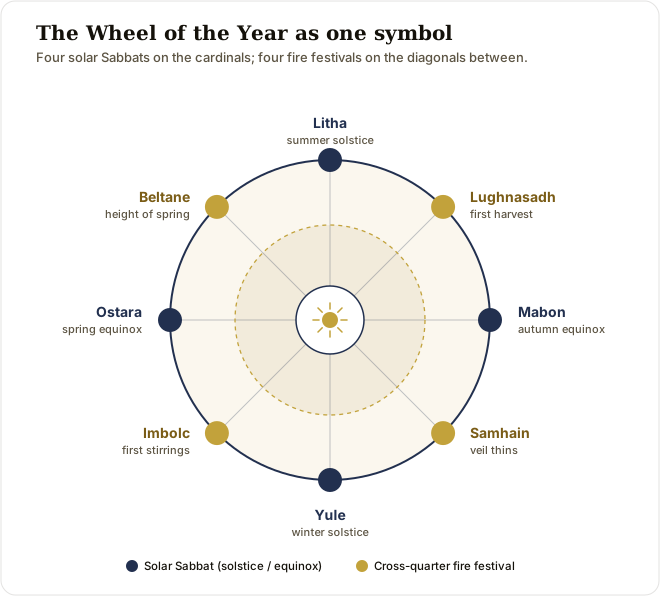
One line for each Sabbat, clockwise from midwinter:
- Yule (around 21 December): the longest night; the Sun God is reborn from the Goddess.
- Imbolc (1 to 2 February): the first stirring of spring; sacred to Brigid; the Goddess turns from Crone back to Maiden.
- Ostara (around 21 March): the spring equinox; dawn, fertility, balance.
- Beltane (1 May): the height of spring; bonfires, maypoles, the union of Horned God and Maiden.
- Litha (around 21 June): the longest day; the Sun God at his peak.
- Lughnasadh or Lammas (1 August): the first harvest; the Sun God begins his willing sacrifice.
- Mabon (around 21 September): the autumn equinox; a thanksgiving as the God prepares to descend.
- Samhain (31 October): the final harvest and the Pagan New Year; the veil thins; the God dies and the wheel turns.
Read as a single symbol, the wheel is the mythic dance of the Goddess and the Horned God across the year. The full Sabbat hub is Wheel of the Year, and if you are wondering which one is next, that is at the next Sabbat.
The Eye of Horus (Wadjet)
The Eye of Horus is a stylised human eye with eyebrow, finished underneath with the cheek mark of a falcon. Sometimes called the Wadjet, it is one of the oldest protective glyphs still in everyday use.
The myth gives it weight. Horus, the falcon-headed son of Osiris, loses his eye in battle with Set, his uncle. Thoth, the god of wisdom and magic, restores it. Horus then gives the healed eye to his dead father, and Osiris revives. From that moment on the symbol carries violent loss, miraculous repair, and resurrection in one glyph.
Left versus right matters. The Left Eye is lunar: intuition, occult sight, healing, the subtler work Thoth taught. The Right Eye (often blurred with the Eye of Ra) is solar: logic, raw power, the destructive force that has to clear ground for new life. Most general protective amulets you will see use the Right Eye.
In modern syncretic witchcraft the Eye is reached for as an apotropaic charm, the kind that turns harm away. Ancient Egyptian fishermen painted it on the bows of their boats to navigate the Nile safely; witches today carve or wear it to deflect psychic attack, hexes, and the everyday evil eye of someone else's envy. In belief, it is an all-seeing guardian.
If that is the use you want, the deflection methods sit in evil eye protection and the broader category at protection spells.
Sigils (the made-up symbol that does the work)
A sigil is an abstract, custom-built geometric glyph carrying a specific intention. Done right, the final design has no readable letters left in it.
Two lineages share the word. In Renaissance grimoires like the Lesser Key of Solomon, a sigil was the "true name" of an angel or demon (a Goetic spirit), drawn precisely so the magician could summon, bind, and command it. In the early 20th century the artist and occultist Austin Osman Spare cut the symbol loose from the spirit and argued that the power had been in the witch's own subconscious all along. That move seeded what we now call chaos magic.
Abstraction matters for a psychological reason. If the glyph still says "I AM PROTECTED" in legible letters, the conscious mind reads it and the conscious mind has doubts. Reduce the words, recombine the surviving letters into an unrecognisable shape, and the intent slips past the doubt and lodges where it can do work. In this frame belief is something you bypass rather than manufacture.
The cultural touchstone for the modern reader is the Scottish comics writer Grant Morrison's The Invisibles, the 1990s Vertigo series Morrison explicitly engineered as a "hypersigil," a single working stretched across years and 1,500 pages. Whether the synchronicities Morrison reported are real or projected, the idea has shaped a generation of practitioners: narrative, in the right hands, is sigil-shaped.
Full method (statement of intent, reduction, design, charge, release) lives at sigil magic, and the philosophical frame at chaos magic.
The Goddess and God glyphs (the simpler altar pair)
These two are the quietest symbols on most Wiccan altars and the easiest to mix up. The Goddess glyph is a circle (the full moon) with an upward-facing crescent set on top, like a small bowl resting on a coin. The God glyph (sometimes called the Horned God glyph) is a circle with an upward-facing crescent that reads as horns rising from a head.
At a glance you can read the Goddess version as a smaller cousin of the triple moon; it is not. It is a single-face symbol. The pair marks the duotheistic polarity, Goddess and God, on the altar without elaborating any further.
Hecate's Wheel and the triskelion
Hecate's Wheel is a three-armed, labyrinthine emblem associated with the Greek goddess Hecate, used in some modern Dianic and witchcraft traditions for the life-death-rebirth cycle. The triskelion (or triskele) is the triple spiral familiar from Celtic and proto-Celtic art, which modern Pagans have taken up for any threefold reading: Maiden and Mother and Crone, land and sea and sky, past and present and future.
Both symbols are older visual languages that contemporary practice reads its meaning into. The honesty is that we are reinterpreting, not recovering. The Celts who carved triple spirals into stone were not Wiccans, and that does not make the modern reading less useful; it just makes it modern.
Norse and runic symbols (and the warning that comes with them)
The set you will see most often: Mjölnir (Thor's hammer), the Valknut (three interlocked triangles, often associated with Odin and the slain), the Helm of Awe or Ægishjálmur (an eight-armed radial sigil of protection), the Vegvísir (a circular wayfinder often called the "Viking compass," though it is post-medieval Icelandic), and the individual letters of the Elder Futhark, the oldest runic alphabet, used both for writing and for divination.
The hard note belongs up front. Several of these symbols have been hijacked by white supremacist movements since the 19th century, when the project of inventing an "Aryan" heritage began. The Othala or Odal rune (the diamond shape with two legs), historically meaning "inheritance" or "ancestral land," was adopted by the Nazi SS to stand for racial purity. Neo-Nazi groups still use a modified "winged" version with curved feet at the base to dodge bans on the swastika. The Tyr or Tiwaz rune, sacred to the Norse god of war, and Mjölnir itself are also frequently co-opted.
None of these symbols is inherently hateful. Thousands of anti-racist Heathens and Norse Pagans wear Mjölnir and use the Elder Futhark in good faith, and reclaiming the symbols from fascism is a slow, ongoing battle. Judge any rune by its company, not by a single image search.
If you are making your own, the rule is simple: draw the Othala with straight, terminating legs. Never add the upward "wings" or "feet" at the base. That specific variant is the SS one.
The 13-pictogram divination set sometimes sold as "witch's runes" is a different thing entirely, and that set lives at witch's runes.
Co-opted and closed-practice symbols
A plain, kind boundary first. Some symbols carry political weight and some belong to closed traditions, and using them carelessly is the actual harm. Curiosity is not the problem; ignoring "this is not for you" is.
White sage and palo santo. Smudging with white sage is a specific, sacred, and closed ritual belonging to a number of Indigenous North American tribes, who were violently persecuted and legally banned from practising it within living memory. Today Salvia apiana is wild-harvested at industrial scale for the suburban witchcraft market, and the plant is under real ecological pressure. Palo santo carries a similar story in South America. Rosemary, mugwort, garden sage, juniper, and bay all cleanse a room beautifully and are not closed; you have other options.
Dreamcatchers belong to specific Ojibwe traditions, not to a general "Native American" aesthetic. Buying one off a non-Indigenous seller participates in the flattening.
Voodoo and Hoodoo iconography. Vodou is a living religion of the Haitian and Louisiana diaspora; Hoodoo is a related African American folk-magic tradition. Both have living teachers and lineages, and both ask for relationship, not aesthetic borrowing. A respectful primer is at voodoo vs hoodoo.
Chakra diagrams come from specific Hindu and Buddhist tantric lineages. Used as a generic "energy points on the body" they are stripped of their original frame; that does not make the diagrams forbidden, only worth knowing the source of.
The swastika. For thousands of years and still today in Hindu, Buddhist, and Jain practice, the swastika is a symbol of well-being and the sun. In Western contexts, after the Nazi Party, it cannot mean that any longer. Both facts are true at once, and a Western reader is responsible for knowing which one applies in her own context.
The reclaiming-from-fascists position many modern Heathens take is real and worth respecting. So is the position many Indigenous teachers take: please do not take this from us. Hold both. Full ethics walk is at closed practices.
A quick-scan glossary
| Symbol | Looks like | Means | Used for |
|---|---|---|---|
| Pentagram | Five-pointed star | The four elements plus Spirit | Tracing in air; invocation and banishing |
| Pentacle | Five-pointed star inside a circle | All elements contained and balanced | Altar disc of Earth; consecration |
| Triple moon | Waxing crescent, full moon, waning crescent | Maiden, Mother, Crone | Aligning to lunar cycles; Goddess work |
| Horned God | Antlered man or stag head | Divine masculine; lord of the wild | God-side altar imagery; seasonal myth |
| Earth glyph | Down-triangle with a bar | Body, stability, the physical | North quarter of the circle |
| Air glyph | Up-triangle with a bar | Mind, breath, communication | East quarter |
| Fire glyph | Up-triangle | Will, courage, transformation | South quarter |
| Water glyph | Down-triangle | Emotion, intuition, healing | West quarter |
| Spirit | Top point of the pentagram | The binding fifth element | Centre of the circle |
| Wheel of the Year | Eight-spoke wheel | The pagan calendar of Sabbats | Seasonal practice |
| Eye of Horus | Stylised eye with falcon mark | Protection, healing, sight | Apotropaic amulet |
| Sigil | Abstract custom glyph | A specific encoded intention | Charge and release |
| Goddess glyph | Circle with crescent on top | The Goddess, divine feminine | Altar imagery |
| God glyph | Circle with upward "horn" crescent | The Horned God | Altar imagery |
| Hecate's Wheel | Three-armed labyrinth | Life, death, rebirth | Hecate devotion |
| Triskelion | Triple interlocking spiral | Any threefold whole | Decorative and devotional |
| Mjölnir | Short-handled hammer | Thor; protection; Heathen identity | Worn pendant |
| Valknut | Three interlocking triangles | Odin; the slain | Devotional; judge by context |
| Helm of Awe | Eight-armed radial sigil | Protection, fearlessness | Charm or tattoo |
| Vegvísir | Circular wayfinder | Guidance through rough weather | Charm |
| Othala rune | Diamond with two straight legs | "Inheritance," ancestral land | Heathen devotion. Note: the winged variant is a Nazi SS symbol; avoid |
| Elder Futhark | Twenty-four angular letters | The runic alphabet | Writing and divination |
Drawing notes (if you want to make your own)
- Pentagram: single point straight up, no tilt.
- Triple moon: waxing crescent on the left with points facing right; waning crescent on the right with points facing left; both open toward the full moon.
- Elemental triangles: the horizontal bar bisects the triangle, neither crowding the apex nor hugging the base.
- Eye of Horus: pick Left (lunar, healing) or Right (solar, power) on purpose. For general protection, use the Right.
- Sigil: end abstract. If a friend can still read English in it, reduce further.
- Othala rune: straight, terminating legs. Never add upward wings or feet at the base.
Where to take this next
If the lexicon is what hooked you, the actual path of becoming a witch is at getting started, and if the question underneath was permission, that one is answered at am I a witch. If you came in through a tool you own or want, the implements are at witch tools and the altar itself at the altar. If a single symbol pulled you, sigils go to sigil magic, moon imagery to moon magic, protection glyphs to protection spells, and divination pictograms to witch's runes.
You did not need any of these names to be a witch when you opened the page. You just have better ones for what you were already seeing.