August 2026 Witchcraft Calendar: Sabbats, Moons, Eclipses
You don't need to work every date on the august witchcraft calendar to have honored the month, and this one especially rewards restraint. August 2026 is bracketed by two eclipses two weeks apart, opens with the first-harvest sabbat, and slips a moonless meteor shower in for good measure. It is a big-sky month, and the traditional counsel across most of it is to rest, watch, and release rather than cast.
August 2026 at a glance
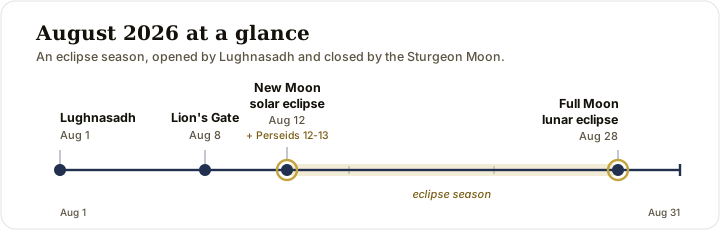
August 2026 opens with Lughnasadh on Saturday August 1 and closes with a full Sturgeon Moon lunar eclipse on Friday August 28, with a total solar eclipse and the Perseid peak both landing on August 12. It is an eclipse-season month, so many practitioners rest, release, and cleanse instead of casting or charging.
Six datable events, one month, and permission from the start to work only the ones that call you.
The month in one table
| Date (2026) | What happens | How practitioners tend to work it |
|---|---|---|
| Sat Aug 1 | Lughnasadh / Lammas, first-harvest cross-quarter sabbat | Gratitude, bread, harvest check-in |
| Sat Aug 8 | Lion's Gate (8/8), a modern online belief | Optional intention-setting, held lightly |
| Wed Aug 12 | New Moon in Leo and a total solar eclipse (opens eclipse season) | Rest and cleanse, not cast (never view without certified eclipse glasses) |
| Night Aug 12-13 | Perseid meteor peak on a moonless sky | Watch, silent wish if a meteor crosses |
| Fri Aug 28 | Full Sturgeon Moon in Pisces and a deep partial lunar eclipse (closes eclipse season) | Emotional release, cleansing, letting go |
| Whole month | No Mercury retrograde | One less thing to worry about |
More on the underlying rhythm sits in the Wheel of the Year and moon phase calendar if you want the wider context.
The shape of the month
August 2026 has a very clear shape once you look at the sky: two eclipses roughly two weeks apart, with Lughnasadh opening the month and a Sturgeon Moon closing it. The middle sits under an eclipse season, which is the traditional signal to do less, not more.
Honest reassurance up front for anyone new to the craft: there is no Mercury retrograde in August 2026. The last one ended July 23 and the post-shadow clears around August 7. So if this month feels chaotic, that is not the reason.
Depth on each event lives on the pages linked from every section, so if a single date pulls you in, follow it there.
Lughnasadh / Lammas, Saturday August 1
Lughnasadh is a cross-quarter sabbat marking the first grain harvest, sitting roughly halfway between the summer solstice and the autumn equinox. Some practitioners observe the astronomical midpoint, which lands on or around August 7 this year, rather than the calendar date. Either is honest.
In tradition, Lughnasadh reads as a gratitude and first-fruits festival. Practitioners bake or share bread, give thanks for what has ripened, and take stock of what they set moving earlier in the year. It is closer to a harvest check-in than a manifestation push, which is why I like it: it asks what came good, not what you still want.
For a beginner practice: light a candle, eat a piece of bread slowly, and name three things that have actually come good since spring. That is the whole rite. The rest lives in the full Lughnasadh guide, and the sabbat's place on the year is set out in the Wheel of the Year.
Lion's Gate, Saturday August 8
Lion's Gate (8/8) is a modern, largely online belief, not an ancient or documented festival. It links the 8/8 date, the numerology of the number eight, Leo season, and the heliacal rising of the star Sirius into a portal frame. It is a real practice in real communities. It is not old.
In this contemporary practice the day is treated as a manifestation or fresh-start "portal" that some people use for intention-setting and journaling. Take it or leave it. Held lightly, with no promised outcome, it is a fine excuse to write down something you actually want.
Beginner practice: write one clear intention on paper, read it aloud once, close the notebook. That is it. Because this sits outside the older sabbat tradition, I would not build a whole altar around it. If you want more on the underlying frame, the intention-setting page has the honest version.
The total solar eclipse and Leo new moon, Wednesday August 12
The new moon in Leo peaks at 17:37 UTC and the total solar eclipse reaches greatest eclipse around 17:46 UTC, according to NASA. The path of totality crosses the Arctic Ocean, Greenland, Iceland, and northern Spain, which makes it the first total solar eclipse to touch mainland Europe since 1999. It opens the eclipse season.
Never view a solar eclipse without certified eclipse glasses. Ordinary sunglasses do not protect your eyes. If you are traveling into the path of totality, bring the glasses.
A new moon would ordinarily read as a fresh-start, intention-setting window. Under an eclipse, most of the practitioners I trust deliberately do not cast or manifest. In eclipse lore the energy is treated as unpredictable, better observed than worked. That is why you will see people who cheerfully cast on a normal new moon lean into rest, release, and cleansing on an eclipse day, and specifically avoid charging tools or crystals in eclipse light. Hold that as a widely shared tradition, not a rule you owe anyone.
For a beginner practice on Aug 12: do less. Genuinely. Take it as a rest-and-observe day, and if you want a small action, do a gentle cleanse rather than a spell. Open a window, tidy the altar, wash your hands mindfully, put the phone down. Route depth for cleansing and release work out to release work and home cleanse; the "wait a couple of weeks" note lives in charging crystals and moon water.
Perseid meteor peak, night of August 12-13
The Perseids peak the same night as the new moon, which means the sky is moonless and dark. According to the American Meteor Society and EarthSky reporting, the rate can reach around 100 meteors per hour under good conditions, best viewed after midnight into the pre-dawn hours of August 12 and 13. This is going to be one of the better Perseid displays in years, purely because the moon is out of the way.
No equipment. Naked eye. Get somewhere dark, lie down or lean back, give your eyes about twenty minutes to adjust, and let them wander the sky rather than fix on one point. The meteors streak in from the direction of Perseus but appear all over.
In tradition a "shooting star" is a moment some practitioners use to make a quiet wish or set a soft intention. That pairs naturally with the eclipse rest theme: watching rather than working. If a meteor crosses while you are out there, silently name one hope and let it go. If none crosses, you still saw the sky, and that counts.
Full Sturgeon Moon in Pisces with a deep partial lunar eclipse, Friday August 28
August closes with the full Sturgeon Moon in Pisces coinciding with a deep partial lunar eclipse. Greatest eclipse is around 04:12 to 04:18 UTC, which falls the evening of August 27 into early August 28 across the Americas. About 93% of the Moon passes into Earth's umbra, so most of the disc darkens and reddens. Timeanddate.com puts visibility across the Americas, Europe, and Africa. This closes the eclipse season.
Lunar eclipses are safe to view with the naked eye. No equipment needed. Step outside, look up.
An ordinary full moon reads as a peak-energy release or gratitude night in most lunar practice. With the eclipse overlay, the eclipse-caution tradition steps in again, and many practitioners lean toward release, cleansing, and letting go rather than casting or charging. Pisces is traditionally read as emotional and intuitive, so the emphasis tilts toward emotional release and rest specifically. A number of practitioners I know skip charging moon water during the eclipse window entirely and wait a couple of weeks for an ordinary full moon instead. Held lightly.
Beginner practice: write down one thing you are ready to release, then safely tear or bury the paper. No open flame required, and no theatrics. Or simply sit and watch the eclipse with a cup of tea and let that be the whole rite. Full-moon depth sits in full moon esbats and moon magic; the eclipse-and-moon-water question is on moon water.
No Mercury retrograde this month
There is no Mercury retrograde in August 2026. The last one ended July 23 and its post-shadow clears around August 7.
"Everything feels chaotic" often gets pinned on retrograde online, and this month that particular pin does not fit. If something feels off in August, look for the actual cause.
How to work an eclipse season without burning out
Two eclipses in one month can read as pressure to do all the rituals. The traditional counsel is exactly the opposite. Eclipse seasons are times to do less, not more, and restraint is a valid practice, not a failure to participate.
Lughnasadh at the start is a gentle harvest check-in. The middle of the month is watch-and-rest, with the eclipse pulling the tone toward stillness and the Perseids giving you something beautiful to sit under. The end of the month is release, worked softly under the eclipse full moon.
You do not need to act on all six events. You do not need to act on any of them. Skipping most of this month and still calling August honored is a completely reasonable practice. If you want the steadying drills that make an eclipse season feel workable, grounding is the practical anchor, and release work carries the emotional weight. If one date does pull you in and you want to build something around it, build a ritual around one date walks the structure.
If you want to build one small thing this month
If you would rather have a single anchor than the whole calendar, pick one of three low-risk options: the Lughnasadh candle-and-bread on Aug 1, meteor-watching on the night of Aug 12-13, or a release note on Aug 28. Each takes under an hour, none require anything you have to buy, and any of the three is enough on its own to have "done" August.
Structure lives on plan a small ritual, and if this is your first month working the calendar at all, start here if you are new first.
What comes next: Mabon and the turn toward autumn
August closes on a release-flavored eclipse full moon, and the next sabbat waiting on the other side is Mabon and the autumn equinox, the second harvest and a balance point heading into the darker half of the year. Once the eclipse season lifts, the calendar softens again and the year tilts toward gathering in.
If you want the fuller arc, the wider Wheel holds it. And if the eclipse-caution tradition made you wonder what else is worth holding back on this month, what to avoid is the honest list.
Keep exploring
Browse more guides, or start with the basics of the practice you are curious about.
Browse more guides