Mabon: Autumn Equinox Rituals and the Witch's Thanksgiving
On this page
Mabon is the autumn-equinox sabbat, the moment the year tips its head from light into dark, and most witches keep it as a second harvest and a quiet thanksgiving. You do not need a robe, a coven, or a name you can pronounce in Welsh; you need an apple, a knife, and a few minutes of attention. The name itself is younger than your parents, and the honesty about that is part of why the rest of the practice is worth your trust.
What Mabon Is (and the Honest Catch About the Name)
Mabon is the autumn-equinox sabbat, the second harvest of fruits and vines, kept by most witches as a thanksgiving and a moment of balance before the descent into the dark. The name was coined in 1974 by an American Wiccan writer named Aidan Kelly for a Pagan calendar, which means it is modern, not ancient, and that is fine.
The harvest impulse it carries is old. People in cold climates have been gathering apples, pressing grapes, and naming the in-between of light and dark for a very long time. What Kelly gave us in 1974 was a label with mythic weight, set on top of an instinct that pre-dates all of us.
TL;DR. Mabon falls on the autumn equinox (around September 21 in the north, around March 21 in the south), and witches keep it as the second harvest (after the grain at Lughnasadh and before the final harvest at Samhain), a gratitude rite, and a tipping point into the dark half of the year. The centerpiece is simple: cut an apple sideways, find the star in its seeds, and say what you are grateful for. More on the full eight-sabbat shape in the wheel of the year.
When Mabon Falls (Northern and Southern Hemispheres)
In the Northern Hemisphere the autumn equinox lands between September 20 and 24, most often on the 21st or 22nd, when the sun crosses into Libra. Day and night come close to equal, the sun's center spends almost the same time above and below the horizon, and after that the dark wins by a minute or two every day until Yule.
In the Southern Hemisphere it flips. Witches in Australia, Aotearoa, Argentina, and South Africa celebrate Mabon between March 20 and 23, when the sun crosses into Aries and their season is actually turning toward autumn. The rest of the year shifts the same way; while the north is at Mabon, the south is at Ostara.
That flip is not a technicality. Earth-based practice is tied to the land you stand on, and a harvest rite makes no sense in the middle of your local spring. If you want the live date for wherever you are, the next sabbat page keeps the count.
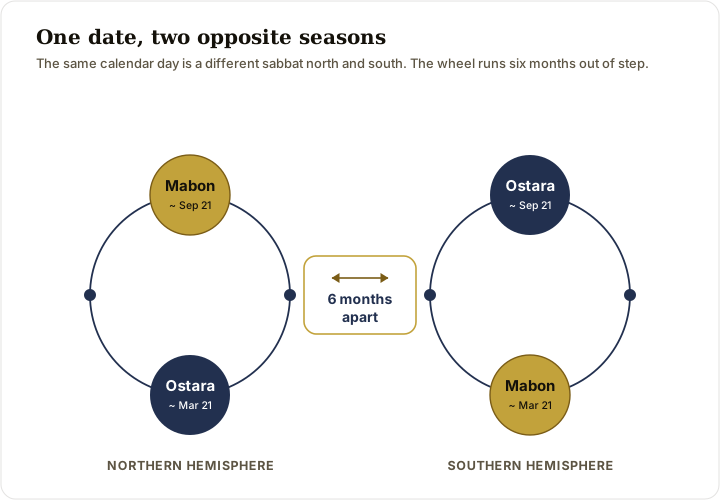
A Quick Note for Southern-Hemisphere Witches
If you are scrolling past artificial autumn leaves in a shop window while the jacaranda is blooming outside, you are not imagining the disconnect. The commercial calendar is northern; your land is not. Celebrate Mabon in March when your light is actually starting to lose, and let the internet's September pumpkin posts wash past you.
Online covens that span hemispheres often run dual-focus rituals: half the circle is releasing the year's weight at Mabon, half is planting seeds at Ostara. It works because the wheel is round, not because anybody is doing it wrong.
The Honest History: Where the Name "Mabon" Came From
Before 1974, witches and Pagans mostly called this sabbat by its astronomical name (the autumn equinox) or by an old farming name (Harvest Home, the In-Gathering, the Second Harvest). The four cross-quarter sabbats, the older ones (Samhain, Imbolc, Beltane, Lughnasadh), had real Gaelic names that the Insular Celts actually used. The equinoxes and solstices did not. The Anglo-Saxons noticed them; the Celts mostly did not name them as religious festivals.
In 1974, Aidan Kelly was assembling a Pagan/Craft Calendar for the Pagan Way movement and decided the autumn equinox deserved something with mythic resonance, the way Samhain or Beltane carries it. He went to the Mabinogion, a medieval Welsh story collection, and picked the name Mabon. The name spread fast through Timothy Zell's Green Egg magazine and is now the standard term in most Wiccan-influenced traditions.
The historian Ronald Hutton, whose The Stations of the Sun is the closest thing modern Paganism has to a sober reference book, has documented this clearly. So have Janet and Stewart Farrar in their work on the sabbats. The name is modern; the harvest is not. That distinction is part of what makes the practice trustworthy.
The Welsh Myth Kelly Borrowed
Mabon ap Modron means "Divine Son of the Divine Mother." In the medieval Welsh tale Culhwch and Olwen, Mabon is stolen from his mother's arms when he is only three nights old, locked in an underwater dungeon, and forgotten by the world. Culhwch, set an impossible series of quests by a giant, eventually has to rescue him, because Mabon is the only huntsman who can track a particular fabled wild boar.
Kelly chose that story because he saw a structural rhyme with the Greek myth of Persephone, who is dragged into the underworld, prompting her grieving mother Demeter to let the green world die. A son stolen, a mother mourning, the light vanishing, the dark winning: same architecture, Welsh dressing.
The honest catch, which some Pagans have raised since, is that the original Welsh tale is not about the harvest and not about the equinox. It is a rescue story. Kelly grafted a meaning onto a name. The graft has held because witches have practiced it for fifty years and because the resonance, once you sit with it, actually works. You can use the name and know where it came from; both are true.
What Other Traditions Call It
Plenty of practitioners skip the name "Mabon" entirely. Some Druidic traditions use Alban Elfed, Welsh for "The Light of the Water." Older folk traditions call it Harvest Home, the Feast of the In-Gathering, or simply the Second Harvest. None of these are more correct than another; they are different doors into the same room. Pick the one that fits your practice and move on.
The Three Themes Mabon Asks You to Hold
Mabon is doing three things at once, and the rite works best when you hold all three. The harvest, the balance, and the gratitude are not separate ideas; they are the same idea at three different distances.
The Second Harvest
Three harvest sabbats sit on the wheel. Lughnasadh in early August is the first, the grain harvest, the moment the wheat and barley come down. Samhain at the end of October is the third, the final harvest, the slaughter of meat animals and the lifting of the last roots. Mabon sits between them and brings in what ripens in the middle: tree fruits, vines, gourds. Apples, grapes, early squash.
Spiritually, the second harvest is the year's stocktake. The seeds you planted at Ostara, the fires you lit at Beltane, the bread you baked at Lughnasadh: what did they actually become? A farmer at Mabon walks the orchard and counts what is in the barn. You can do the same with your year. What grew? What did not? Do you have enough, of whatever it is you needed, to carry you through the dark?
Balance (and Why It's Fleeting)
The equinox is the astronomical balance point: nearly equal hours of day and night. Many witches use Mabon to mirror that outside-in, asking where they are out of balance (work and rest, giving and receiving, action and reflection, light and shadow) and where a small correction would help. That is the easy half.
The harder half is that the balance does not hold. It tips. After the equinox the nights grow longer until the winter solstice, and the dark wins by a margin every single day. Mabon's balance is the last moment of equal footing before a slow descent, and that is why it can feel beautiful and a little melancholy at once. It is meant to. The descent it points toward is the inner one as well: the shadow work season runs from here to Yule. The matching solstice on the other side, the longest night, is Yule.
The Witch's Thanksgiving
Informally, plenty of witches call Mabon the witch's thanksgiving. The practice is explicit gratitude, spoken or written or simply held: for the literal harvests of the year (a paycheque, a roof, a body that mostly worked), and for the spiritual ones (a lesson, a friendship, a thing you finally let go of).
In Wiccan myth-cycle the gratitude is paired with reverence for sacrifice. The Sun God is read as a waning king who pours his own energy into the ripening crops so the people can eat, then returns to the earth to rest until he is reborn at Yule. You do not need to believe that literally for the move to work. Gratitude pointed at a felt cost lands harder than gratitude floating in the air.
Some witches prefer the term "witch's thanksgiving" precisely because the American holiday in late November carries a colonial history many practitioners do not want to celebrate. The core impulse (gathering, feasting, naming what you are grateful for) is the same; the cultural baggage at Mabon is lighter. Building a baseline gratitude practice the rest of the year is its own habit; more on that in daily practice.
Correspondences for Your Mabon Altar
Correspondences are tradition and practice, not law. They are a vocabulary witches share so the altar reads as autumn to anyone who walks in, and so the items on it agree with each other. Use what you have. A jam jar with three apples in it is a Mabon altar.
| Category | Item | What practitioners reach for it for |
|---|---|---|
| Color | Red | The fading heat of summer, endurance for the cold months coming |
| Color | Orange | The bounty of the harvest, the turning leaves, transition |
| Color | Gold | Gathered grain, the waning power of the aging Sun |
| Color | Brown | Bare bark, rich soil, grounded stability |
| Color | Russet | Waning life force, preparation for dormancy |
| Color | Deep green | The evergreens that hold on through the cold |
| Herb | Sage | Cleansing stagnant summer energy as the doors close against the cold |
| Herb | Rosemary | Remembering ancestors, warding off wandering spirits |
| Herb | Thyme | Courage, restful sleep in the lengthening nights |
| Resin | Myrrh | Emotional healing, honoring the Goddess in her Crone aspect |
| Resin | Frankincense | Solar energy honoring the waning Sun, focus in meditation |
| Resin | Benzoin | Emotional comfort, sweet purification of the space |
| Symbol | Apple | Wisdom, hidden knowledge, the star inside the fruit |
| Symbol | Grapes and vine | Transformation, abundance, ecstatic harvest |
| Symbol | Cornucopia | The earth's abundance, God and Goddess together |
| Symbol | Acorn | The whole oak hidden in the seed, potential through dormancy |
| Symbol | Pinecone | Evergreen persistence, longevity |
A full altar walkthrough is in witch altar, and the herb side gets deeper treatment in herb correspondences; the color shorthand sits inside color magic.
The Apple, Cut to Reveal the Star
The apple is Mabon's centerpiece, and there is a reason for that beyond aesthetics. In Celtic mythology the apple ties to Avalon, the Isle of Apples, the otherworldly orchard where King Arthur was carried to rest. In magical practice it carries wisdom, hidden knowledge, and immortality.
The visual move that makes the symbol click is this: cut the apple horizontally through its middle (its equator) instead of vertically from stem to base. The seeds inside form a five-pointed star, a pentagram, every single time. In Pagan practice that star reads as the four elements (Earth, Air, Fire, Water) crowned by the fifth, Spirit. It is a tiny piece of cosmology that has been sitting inside every apple you have ever eaten.
The first time you do it, slow down. A firm apple gives under a sharp knife in two quiet stages; the second half falls open and the star is wet and white inside, and the seeds are not always in perfect symmetry but they are unmistakably a five-pointed star. Some apples are more generous than others. Honeycrisp and Granny Smith give a particularly clean star; very soft apples turn the star into a smudge. If your first attempt is messy, try another.
Grapes and the Vine
Mabon is also the wine harvest, which is why grapes and vines run through its imagery. Fermentation reads, to practitioners, as a magical transformation: pressure and time turn raw fruit into something that alters how you feel. The vine deities in the Greek and Roman traditions (Dionysus, Bacchus) are reached for here in the belief frame as patrons of ecstatic harvest, the joy that comes after the hard work.
You do not need wine. Grape juice on the altar carries the symbol just fine, and so does a single bunch of grapes in a bowl.
The Cornucopia
The cornucopia, the woven horn-shaped basket spilling over with fruits, nuts, and root vegetables, is the household-Mabon symbol you have seen on a hundred dining tables. Its esoteric reading in Wiccan tradition is that the horn shape carries the God and its hollow interior carries the Goddess: divine creation and harvest in one object. You can buy a wicker one in any craft shop for under ten dollars, or you can pile a wooden bowl with what is in season and call it the same thing.
A Solitary Mabon Ritual: The Apple Pentagram Rite
This is a solitary rite, which means you do it alone, which means there is nobody to perform for and nobody to impress. It takes about twenty minutes if you slow down. It is built on three pieces: cast a space, find the star, name your gratitude. You can strip it lighter than this or richen it up.
What You Need (No Athame Required)
- A surface (a windowsill, a coffee table, a kitchen counter). Cover it with a brown, gold, or red cloth if you have one.
- Seasonal decor (fallen leaves, an acorn or two, a pinecone, whatever the season is offering outside your door).
- Four candles for the four directions (any tealights work, but yellow for East, red for South, blue for West, green for North is the standard if you want it).
- One firm apple.
- A regular kitchen knife. A ritual blade is fine if you have one, but a sharp paring knife is what most witches actually reach for.
- A chalice or any cup, filled with apple cider, dark grape juice, or wine.
- A small bowl for an offering, or just a step outside to a patch of earth.
Permission to swap is total. A finger casts a circle as well as a wand. A jam jar lid holds an offering as well as a brass bowl. The dollar-tree-witch version of this works because the intention is doing the lifting. More on that approach in witchcraft on a budget, and on the wider tool kit in witch tools.
Step 1: Set the Altar
Spread the cloth. Lay the leaves and acorns the way a child decorates a sandcastle (placed, not arranged). Put one quarter candle at each of East, South, West, North; a compass app does fine if you do not know which way is which. Put the apple and the knife front and center, where you will see them.
Take a minute before you start. Sit, close your eyes, breathe down into your hips, and let the day fall off your shoulders. The full version of that settle lives in grounding and centering, but a long exhale will do.
Step 2: Cast the Circle (Deosil from the East)
Stand. Point your wand, your athame, or your index finger toward the East. Walk slowly clockwise (deosil, in the traditional language) around your space, tracing a circle in the air at about hip height. As you walk, picture a sphere of soft light rising from the floor under you, doming over the top of you, and closing behind you. Some witches name it as they go: As above, so below; this is sacred space. Some just walk and breathe.
The first time you do this it can feel theatrical. After a few tries the room genuinely does start to feel like it has closed. The shift is small and a little embarrassing to describe, like the air pressure changes, or a hum settles. That is the cue you are looking for. Long-form circle mechanics are in circle casting.
Step 3: Invoke the Four Quarters
Turn to the East and light its candle. Speak something simple: Spirits of the East, element of Air, lend your clarity to this rite. Move to the South, light it, speak: Spirits of the South, element of Fire, lend your warmth as the days grow cold. West, light, speak: Spirits of the West, element of Water, lend your compassion and flow. North, light, speak: Spirits of the North, element of Earth, lend the promise of a sheltered winter.
This is one common way of inviting the quarters; there are dozens of others. The words matter less than the attention. You are not commanding anything; you are addressing the room.
Step 4: The Apple Pentagram Meditation (The Heart of It)
Return to the center. Pick up the apple in both hands. Feel its weight.
Walk it back in your mind: a blossom on a tree in spring, a tiny green knot in early summer, a long swell through July and August, the cool nights that pulled the sugars up, the hand that picked it, the truck and the shop and the table and you. This is the meditation, and it takes as long as it takes.
Place the apple on the plate. Take the knife and cut horizontally, straight through the middle. Not from the stem; through the equator. Open the two halves slowly. There is the star.
Look at it. The seeds make five points, every time. Pagans read those five as the four elements crowned by Spirit, the same pentagram that goes on so many altars. Then sit with the part that does the actual work: the apple's skin is bruised or dull or scratched; the star inside is untouched. Whatever the year did to you on the outside, the thing inside you has not been dented. That is the resilience reading, and it lands harder when you are looking at the star than when you are reading about it.
Some Mabons that reading hits hard and you sit there with wet eyes. Some Mabons it does not, and you note the star and move on. Both are fine. The rite does not require a feeling to work.
Step 5: The Gratitude Libation
Pour the cider, juice, or wine into the chalice. Hold it. Speak out loud the things you are grateful for from this turn of the wheel. Literal ones first (the rent paid, the body that walked you here, the friend who picked up the phone), then the harder ones (the relationship that ended cleanly, the thing you finally said, the lesson that arrived disguised as a bad year).
Take a slow sip. Cider in a closed room at the end of September smells like warm apples and wood; the smell does some of the work for you.
Pour a portion into the offering bowl, or step to a window or a doorway and pour it onto the earth. As you do, the traditional line is: Autumn's grain is Spring's seed. With death comes new life. If those words feel borrowed, your own line is fine.
Step 6: Open the Circle (Widdershins from the North)
Reverse the direction. Turn to the North and put out its candle. Spirits of Earth, thank you for your presence. Stay if you will, go if you must. I bid you farewell. Move counterclockwise (widdershins) to West, then South, then East, thanking and extinguishing each.
Walk the perimeter counterclockwise once and picture the sphere of light sinking back into the floor. Close with: The circle is open, but unbroken. So mote it be.
Eat the apple. That part is not optional. The rite ends in your body.
A Kitchen-Witch Take: Spiced Mabon Baked Apples
If a formal rite is not your thing this year, cook. Kitchen witches treat the preparation of a seasonal dish as a sabbat in itself: the ingredients are the correspondences, the oven is the cauldron, the eating is the communion. Baked apples are the canonical Mabon recipe and they take almost no skill.
The spell logic, if you want to read it that way: apples (wisdom, hidden star), cinnamon and nutmeg (fire-warmth, prosperity, protection), raisins and honey (preservation, summer's joy held through the dark months), butter (richness and care).
Quick method. Heat the oven to 375°F (190°C). Core four to six firm apples (Honeycrisp, Fuji, Granny Smith, Gala all hold up), leaving the bottom intact so the filling stays in. In a bowl, mix half a cup of brown sugar or a heavy drizzle of honey with a quarter cup of raisins, a half cup of chopped walnuts or pecans, a tablespoon of cinnamon, and a teaspoon each of nutmeg, cardamom, and freshly grated ginger; blend in three or four tablespoons of softened butter until it makes a coarse paste. Stuff the apples generously. Set them in a baking dish and pour about an inch of water, apple juice, or cider into the bottom of the pan (not over the apples). Bake 45 to 60 minutes, checking at 30. They are done when a fork goes through cleanly but the apple still holds its shape. Spoon the syrupy bottom over them when you take them out.
Eat hot with cream, vanilla yogurt, or ice cream. The whole house will smell like a sabbat. More on this path in kitchen witchcraft, and on building the basics in kitchen witch starter kit.
How the Rest of the World Marks the Autumn Harvest
The name Mabon is fifty years old. The thing it points at is not. Most cultures that ever farmed grain in a temperate climate built a festival into the same patch of the calendar, because the human body responds to shortening days with a fairly specific instinct: gather, count, give thanks, prepare. The shapes vary; the move is the same.
| Tradition | Region | Timing | Core food or offering | Core ritual action |
|---|---|---|---|---|
| Michaelmas / Harvest Home | British Isles | Around the equinox; Michaelmas September 29 | Struan Micheil bannock, roast goose, carrots | Cutting the Last Sheaf into a corn dolly; baking the protective bannock; settling tenant accounts |
| Guldize | Cornwall | End of the local wheat harvest | Steamed Guldize pudding | "Crying of the Neck" (raising the final grain bundle); the "Cock in Britches" folk dance |
| Dożynki | Poland and Slavic regions | Mid-August to late September | Bread from the new grain, roasted meats, local beer | Weaving wheat crowns (korony dożynkowe), costumed procession, Bread and Salt ceremony |
| Oktoberfest | Bavaria, Germany | Late September to early October | The year's new beer, roasted meats | Communal feasting and consumption of the harvest's brewing efforts |
| Thanksgiving | Canada and the US | Mid-October (CA), late November (US) | Roast turkey, root vegetables, corn, pumpkin | Family feast, explicit verbal gratitude |
| Higan | Japan | Seven days around the equinox | Sweet rice cakes, red spider lilies | Cleaning ancestral graves, offering incense, prayer for the cycle of life and death |
Harvest Home and Michaelmas
In the British Isles, rural communities celebrated Harvest Home around the equinox to mark the end of the grain harvest. The big ritual move was the cutting of the Last Sheaf, sometimes called the harvest cailleach: the final stand of grain was believed to house the spirit of the field. It was ceremonially cut, brought into the house, woven into a corn dolly or harvest knot, and kept all winter to hold the field's fertility until spring planting, when it would be returned to the earth.
Michaelmas, the Feast of Saint Michael the Archangel on September 29, sat just after the equinox and acted as one of the quarter days that organised the British year. It came with specific foods (roast goose, the harvested carrots, and the struan Micheil, a barley-oats-and-rye bannock that the eldest daughter of the house was meant to bake as a protective omen) and specific superstitions (do not pick wild brambles after Michaelmas, because folklore says the Devil cursed them when Michael cast him out). Saint Michael is traditionally pictured holding scales to weigh the souls of the dead, which is a pleasingly eerie echo of the equinox itself weighing day against night.
Guldize, Dożynki, and Oktoberfest
In Cornwall the festival was Guldize, from the old Cornish Gool dheys, "the feast of the ricks." Its signature ritual was the "Crying of the Neck," in which the final bundle of grain was held triumphantly aloft and claimed with shouts of gratitude. The party included steamed Guldize pudding and folk dances that mimed the sowing and harvesting of grain.
In Poland and the Slavic countries, Dożynki runs from mid-August through late September. After the last sheaf is cut, women weave huge harvest wreaths (korony dożynkowe) from wheat, rye, and barley, dressed with flowers and ribbons; the wreaths are carried in costumed procession to the local landowner or parish priest, where a Bread and Salt ceremony marks the day. The throughline (gather the last of the grain, dress it, parade it, feed everyone) recurs across the region.
Oktoberfest, the Bavarian festival that became globally famous, sits in the same lineage. It was formalised in the 1700s as a late-September celebration of the year's brewing, the communal exhale before the central European winter sets in. Underneath the lederhosen, the impulse is identical: drink the harvest, eat together, brace.
Higan in Japan
Higan is a seven-day Buddhist observance around the autumn equinox: the three days before, the day itself, and the three days after. Families visit ancestral graves to clean the headstones, offer red spider lilies (which bloom right at the equinox), burn incense, and pray. Sweet round rice cakes, ohagi, are offered for the unbroken cycle of life and death.
Higan is officially Buddhist, but scholars trace its roots back to older agricultural observance of the changing seasons. The psychological move underneath is exactly Mabon's: acknowledge the descent into darkness, hold the dead in mind, mark the balance between life and what comes after.
Thanksgiving in North America
The American and Canadian Thanksgivings sit later in the autumn (mid-October in Canada, late November in the US), but their ideological roots are identical to Mabon's: a providential celebration of a successful harvest, anchored in family feasting and explicit verbal gratitude.
Some witches deliberately use "witch's thanksgiving" as a name for Mabon because the colonial history of the American holiday is heavy and they want the gratitude without that weight. The instinct is the same; the calendar and the politics are lighter at the equinox.
Common Mabon Questions
Do I have to use the name "Mabon"?
No. The name is from 1974. "Autumn Equinox" is the plainest option; "Second Harvest" is the most descriptive; "Alban Elfed" is the Druidic; "Harvest Home" is the folk-English. They all point at the same sabbat. Use the one your mouth wants to say.
What if I have nothing but an apple?
Then the apple is the whole rite. Cut it sideways. Look at the star. Name three things you are grateful for. Eat it. That is a complete Mabon and it is not a lesser version of anything. Starting with what you have is the whole point, and there is more on that approach in witchcraft for beginners.
Am I supposed to feel sad at Mabon?
A little, sometimes, yes. The balance tips. The light is leaving. Mabon is built to hold gratitude and melancholy together, because that is how the year actually feels at the equinox: thank god for the harvest, and also, here comes the dark. If grief shows up at the altar, it is on time. The deeper inner descent it points at gets its own work over the winter; more on that in shadow work.
Where to Go From Here
Mabon hands the year off. The veil is not thin yet, but the days have started to lean toward the dark, and the next stop on the wheel is the final harvest and the night the dead come back to the table. That is Samhain, six weeks down the road, and it is the natural next read.
If you want the wider map first, the full eight-sabbat shape lives in the wheel of the year, and the live date for whichever sabbat is next where you are is at next sabbat. Either way: eat the apple, say the thanks, and let the dark come.
Keep exploring
Browse more guides, or start with the basics of the practice you are curious about.
Browse more guides