Myths About Witchcraft: What It Really Is (and Isn't)
Most of the scary myths about witchcraft are not describing the practice; they are describing a stereotype that was bolted together in the 15th century and re-cemented by horror cinema in the 20th. You can be curious and still wary, and you can read this without committing to anything. The four fears that send most people here (devil worship, soul-selling, inherent evil, an obsession with cursing) have answers, and the answers are kinder and less dramatic than the films suggest.
So, what are the actual myths about witchcraft?
The four biggest myths (worshipping the Devil, selling your soul, being inherently evil, being all about curses) are all false. They were manufactured by a 15th-century inquisition manual and amplified by horror cinema. What modern witches actually do looks closer to seasonal ritual, journaling, and intention-setting than to anything sinister.
The fears are inherited, not the practice. Centuries of propaganda and a hundred years of movies trained us to flinch at the word "witch"; the actual people using it for themselves are mostly lighting a candle, writing in a journal, and trying to feel a little less powerless.
Myth 1: Witches worship the Devil
Modern witches do not worship the Devil because, in the theology of nearly every contemporary path, the Devil does not exist. Satan is an Abrahamic figure (Judaism, Christianity, Islam); the Pagan and Wiccan frameworks most witches operate inside sit entirely outside that binary. Accusing a Wiccan of worshipping Satan, as practitioners often put it, is like accusing a Buddhist of insulting Zeus. The deity is in a different building.
Witchcraft is also famously decentralised. It includes secular witches who treat deity as psychological archetype, atheist practitioners, animists, polytheists, and the structured duotheism of Wicca. None of those rooms contain the Christian Devil.
The visual confusion has a real source: the Horned God. He shows up in Wicca and in older Pagan tradition as a deity of the hunt, the wild, and the turning life cycle, and he carries the faces of figures like Cernunnos and Pan. Early Christian authorities deliberately fused that horned nature spirit with their own image of the Devil as a discouragement to pagan worship, and the visual stuck. The horns still read as evil in 2026 because of a deliberate rebrand a thousand-plus years ago, not because of what they originally meant. (More on the moral fear in is it a sin.)
Then what about Satanism?
Satanism is a separate thing, and the distinction is worth holding. Most self-identified Satanists are atheistic and use Lucifer as a philosophical symbol of rebellion against authority; a very small minority are theistic. Either way, Satanism structurally needs Christianity to exist, because it defines itself in opposition to it.
Witchcraft does not. It is a magical and spiritual practice that long predates any single religion's framing of it, and one that mostly is not arguing with Christianity at all. Two different rooms, two different buildings, and the floorplans do not overlap.
Myth 2: You have to sell your soul
The demonic-pact idea is absent from modern witchcraft. In the working theology of contemporary practice, magic is not power borrowed from a dark master; it is an inherent natural energy that a person directs through focused intention. There is nothing to sign, no one to sign with, and no soul changing hands.
That framing matters because the alternative (magic as a buy-now-pay-later transaction with damnation as the fee) is a fictional device, not a practice. It comes from a specific lineage of European stories.
Where the soul-pact story actually comes from
- Theophilus of Adana (6th century): The earliest recorded "blood pact with the Devil" story belongs to Theophilus, a cleric in what is now Turkey. He was, according to the legend, passed over for promotion, signed a contract in his own blood to get the bishopric, then repented and was rescued by the Virgin Mary. It was a Marian morality tale designed to glorify her intercession, not a description of any actual witchcraft.
- The Faust legend (Renaissance Germany): A bored scholar trades his soul to Mephistopheles for unlimited knowledge and pleasure. This is where "Faustian bargain" entered the European imagination, again as literature, not practice.
- The Inquisition (15th century onward): Before the witch trials, village folk healers and cunning folk who practised everyday magic were largely treated as ordinary community workers, not as soul-sellers. Inquisitors took the older Theophilus-style pact and welded it onto local folk practice, claiming accused witches had signed literal contracts with the Devil. The pact-with-witchcraft equation is roughly six hundred years old. The practice is older than that.
Treat the soul-pact story the same way you would treat any plot device that escaped its book and started running around as if it were history.
Myth 3: Witchcraft is inherently evil or "dark"
The picture flips when you look at what people actually cast for. The overwhelming majority of modern spells are aimed at growth, healing, boundaries, calm, protection, love, courage, and rest. Older texts filed that benevolent majority under white magic, a label most practitioners have since retired along with its opposite. The bubbling cauldron in the woods is a costume from a different century.
Most contemporary paths also operate inside explicit ethical codes. In Wiccan tradition, the central guideline is the Rede ("an it harm none, do what ye will"), and many Wiccans also hold to the Threefold Law, the belief that energy you put out returns to you threefold. These are tradition and belief rather than universal rules of the craft, but they shape an enormous share of what new practitioners are taught, and they explicitly forbid harm.
The texture of an average week of practice is closer to a long bath with a list of intentions than to anything Hollywood would film. A candle for a hard conversation, a jar with herbs for a deposit you need to land, a slow Sunday tidying the altar. Much of the practice overlaps with what people are also doing for healing and calm.
What about "dark" practices like shadow work?
Shadow work sounds occult, and in witchcraft circles it gets ritualised in a way that can read as sinister from the outside. The substance underneath is Jungian psychology adapted into a ritual container. The "shadow" in this framework is the part of yourself you have repressed, avoided, or never been allowed to look at; the work is bringing it into conscious view with self-compassion rather than fear, so it stops running the show from the basement.
It is honest, and it is hard, and it has nothing to do with demons. One real boundary: if what surfaces is genuine trauma, that belongs with a licensed therapist as well as a journal. Shadow work sits alongside professional support, not in place of it. Useful entry points are in the prompts.
Myth 4: It's all about hexes and curses
The trope exists in folklore, and pretending otherwise is dishonest. Cursing is real as a tradition; there are old recipes, there are practitioners who will do it, and there is a long history of curse-work in regional folk magic. (More on hexes in folklore in the dedicated piece.)
The weight is the issue. Cursing is a small, contested edge of the craft. The center is intention-setting, protection work, shadow integration, ancestor honouring, seasonal ritual, divination, and what is generally called "set it and forget it" energy work for one's own life. Many traditions, Wicca most prominently, forbid harm outright.
If you went to a hundred witches' altars, you would find a lot of moon water and candles and pressed flowers, and you would have to look hard to find anything resembling a hex.
Where the scary stereotypes actually came from
The horror-movie witch did not arise organically out of European villages. She was engineered. Three forces did most of the work: a single 15th-century book, centuries of religious propaganda fusing pagan imagery with demonic imagery, and a hundred years of cinema mining the medieval stockpile for thrills.
The Malleus Maleficarum (1486)
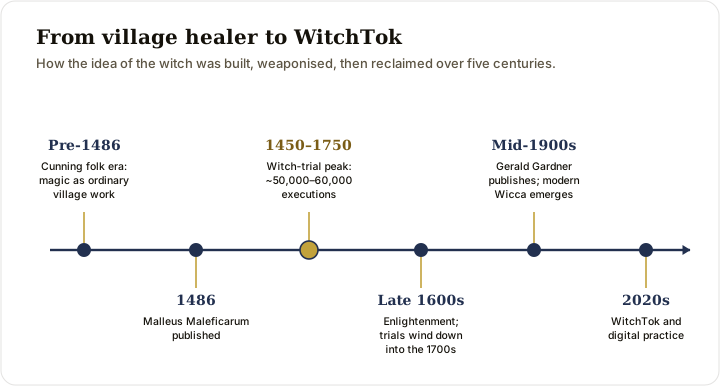
The most influential text in the demonisation of witchcraft is the Malleus Maleficarum, the "Hammer of Witches," published in Germany in 1486 by the inquisitor Heinrich Kramer. Before it appeared, the Catholic Church's official position was largely that witchcraft was illusion and superstition. Kramer, frustrated that local authorities did not share his alarm, wrote the Malleus to upgrade his obsession into doctrine.
The book has a three-part architecture, and each part did specific damage:
- Theological justification. Kramer argued witchcraft must be real because the Devil is real, welding magic to Satan as a single category. The argument leans heavily on a virulent misogyny that frames women as inherently more spiritually weak, and therefore more susceptible to demonic temptation.
- Codification of the "crimes." He catalogued the supposed activities of witches: diabolical pacts, sex with incubi and succubi, and maleficium, the harmful magic supposedly worked against neighbours. The shopping list of evidence to look for in your village was now standardised.
- The legal blueprint. The third section was a procedural manual for magistrates. It sanctioned torture to extract confessions and treated execution as the only acceptable end. As historian Ronald Hutton has documented in The Triumph of the Moon, modern witchcraft is not a survival of any ancient pagan witch cult; the Malleus helped create the figure it claimed to be exposing.
By the time the trials had run their course, the village healer, the outspoken widow, and the local cunning woman had been reframed as existential threats. The same template, slightly modified, would land in Massachusetts two centuries later (more on that in the the trials piece).
The witch trials: what's documented, what's lore
The honest separation is what builds trust here, so it is worth being plain.
Documented. Modern historians estimate roughly 50,000 to 60,000 executions across the European witch trials, stretching from about 1450 to 1750. The overwhelming majority were innocent women, many of them targeted for defying patriarchal norms, holding land, working as healers, or simply living without male supervision.
Lore. The "nine million burned" figure that circulates online is not supported by the documentary record; it is an inheritance from 19th-century activist rhetoric that has been quietly dropped by serious scholarship. The claim that an organised Satanic witch religion was operating during the trials, conspiring across borders, is also lore. Historians are in broad agreement that the conspiracy existed only in the minds of the inquisitors.
The smaller number is still a horror, and acknowledging it honestly is part of why the rest of this can be trusted.
Religious propaganda and the Horned God
The single most durable visual confusion is the horned figure. Pre-Christian Europe had a long tradition of horned nature spirits: Cernunnos in Celtic territory, Pan in the Greek world, various horned hunt deities elsewhere. They represented the wild, the hunt, fertility, the turning of the seasons.
Early Christian authorities deliberately overlaid that horned imagery onto their concept of the Devil, partly to discourage continued pagan worship by making the old deity into the new villain. The strategy worked, and worked far past its expiry date. A horned figure today still reads "evil" by reflex, even when the original meaning was closer to "the deer at dawn" than to anything infernal.
Hollywood and the horror tradition
A lot of what feels like ancient knowledge about witches is actually a 20th-century film memory. Häxan (1922) dramatised the inquisitor's worldview as documentary. Rosemary's Baby (1968) cemented the Satanic-coven trope in the mainstream. The Craft (1996) tied the iconography to teenage rebellion. The Witch (2015) returned the whole package to its grim Puritan frame with great craft and the same falsehoods.
Each one is a good film. Each one is also fiction that mines medieval anxieties for entertainment, and each one reinforces a false equation, witch as malevolent, that the historical and modern record will not bear. Notice when a feeling about witchcraft is actually a memory of a scene.
So what do witches actually do?
The relief, after all that, is that the practice itself is grounded and quiet. There is no single right way to do it, and the texture varies wildly between paths, but the broad shape is recognisable across most of them.
A working week for many practitioners includes some seasonal awareness (knowing roughly where the year stands), some daily or weekly small ritual (lighting a candle, brewing tea with intention, journaling), some kind of self-inquiry, and an altar or working space, however modest. Beneath all of it is a sense of the world as alive and responsive rather than inert. (The broader picture lives in modern witchcraft and the orientation in where to start.)
Intention and ritual (the "magic" part, plainly)
A spell, in practice, is hyper-focused intention given a sensory anchor. You decide what you want, you choose objects whose traditional correspondences match it (a green candle for growth, rosemary for clarity, a black stone for grounding), you set a small ritual frame around the act, and you direct your full attention through it. The objects are not the engine. The focused attention is the engine; the objects help your nervous system know that something is being done.
The framing that practitioners hold most often is "magic plus action." You light the candle for the job, and you send the application. You write the boundary in your journal, and you also stop answering the late-night texts. The candle on its own is half the work, and the action on its own often feels untethered; together they tend to land. (More mechanism in how spells work and a worked example in candle magic.)
Nature reverence and the Wheel of the Year
Underneath the practice for most witches is some form of animism, a working belief that the natural world is alive and that places, plants, stones, and waters hold their own presence. You do not have to subscribe to that as metaphysics for it to work as orientation; many practitioners hold it as a practice rather than a doctrine and find that treating the world as alive changes how they move through it.
The shared calendar most witches recognise is the Wheel of the Year, eight festivals called Sabbats that mark the solstices, equinoxes, and the cross-quarter days between them. (Full depth in the Wheel; the next sabbat tool tells you which one is coming up.)
| Sabbat | Approximate date | One-line theme |
|---|---|---|
| Yule | around 21 December | rebirth of the sun, hope, introspection |
| Imbolc | 1-2 February | first stirrings of life, inspiration, Brigid |
| Ostara | around 20 March | balance, fertility, new beginnings |
| Beltane | 1 May | passion, fire, the peak of spring |
| Litha | around 21 June | abundance, the height of light |
| Lughnasadh | 1 August | first harvest, gratitude, sacrifice |
| Mabon | around 22 September | second harvest, balance, storing up |
| Samhain | 31 October-1 November | ancestors, death, the thinning veil |
Self-work and shadow integration
The other half of contemporary practice, alongside ritual, is internal. Shadow work, journaling, dream tracking, deliberate self-questioning. The "darkness" that witches talk about exploring is the ordinary, painful, often very mundane depths of being a person: the inherited shame, the unexamined anger, the parts of yourself that were not safe to feel.
It is unglamorous, and it is most of what serious practitioners are quietly doing. Shadow work is the route in.
The map of paths (so "witch" stops meaning one thing)
There is no single witchcraft. "Witch" is more like "musician" than like "Catholic"; it describes a wide range of practices that share a family resemblance and very little dogma. A short map helps. (Fuller in types of witches and wicca vs witchcraft.)
| Path | Origin | Core theology | Ethical code |
|---|---|---|---|
| Wicca | Mid-20th c. (Gerald Gardner, Doreen Valiente) | Duotheistic: Horned God and Triple Goddess | The Rede ("harm none"), often the Threefold Law |
| Traditional / folk | Older cunning-folk lineages; 1960s revival via Robert Cochrane | Animistic; local spirits, ancestors, folkloric figures | Practical, contextual, no universal "harm none" |
| Eclectic / solitary | 1980s-90s publishing boom (Cunningham, RavenWolf); now massively online | Personalised, often eclectic or secular | Personal responsibility, experiential validation |
Most practitioners also identify with a focus on top of one of those, kitchen, green, hedge, sea, secular, and so on, which describes what their practice tends to work with rather than a separate religion.
Wicca, briefly
Wicca is a recognised, structured, nature-based religion founded in mid-20th-century Britain by Gerald Gardner, with Doreen Valiente shaping much of its surviving liturgy. Wiccans honour a Horned God and a Triple Goddess as complementary divine forces, observe the eight Sabbats, and operate inside the Rede and the Threefold Law. It can be practised in covens (often with a degree-based initiatory structure) or solitary. (Lineages go into the named branches.)
Traditional and folk paths
Traditional witchcraft is an umbrella term for practices that look further back than Wicca and draw on regional folklore, cunning-folk records, and surviving local folk magic. Theologically these paths are animist; practitioners work with local land spirits (the genius loci), with ancestors, and sometimes with folkloric figures including a "Devil" figure that, in this context, is not the Christian Satan but a darker face of the Horned God or an underworld trickster.
Ethics here are pragmatic rather than prescriptive. There is no universal "harm none" rule, and magic is treated as a practical, neutral tool with contextual moral weight, judged by situation rather than by doctrine. Reconstructionist work in particular regional traditions sits adjacent (more in recon paths).
Eclectic and solitary
Eclectic witchcraft is the most common path today, particularly online. The framework is personal: practitioners draw from tarot, astrology, herbalism, crystal work, candle magic, multiple deity systems or none, and assemble a practice that fits their own life. (More in secular witches for the non-theistic version, and solitary practice for the structural question.)
The ethical frame is personal responsibility rather than dogma. You decide what your practice will and will not include, you stay accountable to the people in your life, and you adjust as you learn. It is the path Scott Cunningham championed in Wicca: A Guide for the Solitary Practitioner, and it is where most beginners now actually start.
Real concerns worth naming (the honest part)
If demons and damnation are not the risks, what is? There are honest answers, and they are mundane.
- Solo deep-trauma work without a therapist. Intense shadow work and ritual journaling can crack open material that needs professional support to process safely. Pair the practice with real mental-health care; this is not advice that can replace a clinician.
- Spiritual bypassing inside the community. Some practitioners, often unintentionally, use positive-energy language to dismiss real pain or to imply that someone in difficulty "attracted" it. It is a misuse of the framework, and it is worth naming when you see it.
- Financial exploitation. There are real charlatans selling "curse removals," wildly overpriced courses, and fear-based upsells. Hype is the enemy, not the seller; honest tools recommended on merit are welcome, false necessity is not. (Start cheap: budget witchcraft and supplies to skip.)
None of these are reasons not to practise. They are reasons to practise with both feet on the ground.
Common follow-up questions
Is witchcraft real?
It depends what "real" means; the question splits into "does focused intention change the practitioner" (yes, demonstrably) and "does it change the external world" (a belief held with varying degrees of literalism). Full treatment in is witchcraft real.
Is witchcraft a sin?
The answer changes with the tradition you are asking from, and the question is really about your own conscience and your own relationship to whatever you grew up inside. The kind, long version is in is it a sin.
Do you have to belong to anything to be a witch?
No. No checklist, no initiation, no permission needed. If you feel the pull, you can begin with what you already have in the kitchen and on the windowsill, and you are not behind. (Am I a witch for the permission-granting long answer; where to start for the practical next step.)
Are witch aesthetics the same as practice?
No. The WitchTok visual language is a real culture and it is also a marketing surface; the lived practice can be cosy and aesthetic, or it can look like a regular living room with one candle. More in aesthetic vs practice.
If you want to keep going
If the historical piece is what drew you in, the next door is modern witchcraft for the wider picture. If the path map made you curious which one fits you, find your path. If you are ready to do something small with your hands, where to start will set you up gently, with whatever you already have on the shelf.
Keep exploring
Browse more guides, or start with the basics of the practice you are curious about.
Browse more guides