Secular Witchcraft: Magic Without the Supernatural
Secular witchcraft is witchcraft practiced without belief in the supernatural: the candles, tarot, herbs, and ritual stay, and the mechanism is psychology rather than deities or external energy. It suits the skeptic, the deconstructing reader, and the rationalist who still wants ritual.
What secular witchcraft actually is
A secular witch keeps the practice and drops the metaphysics. The match still strikes, the tarot deck still gets shuffled, the herbs still go in the simmer pot. What changes is the explanation: ritual works on you, not on the weather, the boss, or the universe.
A few words get used interchangeably and they are not the same thing:
- Secular witch. Practice with no religious frame at all. Spirituality and craft are kept separate.
- Atheist witch. Practices without belief in literal, sentient gods.
- Agnostic witch. Holds deities as unknowable; focuses on self, nature, or archetype.
- Naturalistic witch. Only the material world exists; earth-based practice viewed through a scientific lens.
You do not have to pick one of these labels to start. You can light the candle, write down what you noticed, and decide what to call yourself later, or not at all. No checklist, no gatekeeper, no one's permission needed. If you want to know whether any of this is "real" in a hard sense, that is its own question and lives in is it real; if you want the religion-and-craft distinction, that is wicca vs witchcraft.
"Spicy psychology": how the mechanism actually works
The skeptic's question is the obvious one: why perform a spell if you do not believe in magic. The answer the SASS community gives, half-jokingly, is spicy psychology, and the serious version is the open-label placebo.
In clinical research, an open-label placebo is a sugar pill that the patient is openly told is a sugar pill. The strange and well-documented result: people often still feel better, especially when they understand how the placebo effect actually works. Knowing the mechanism does not switch it off. Ritual runs on the same lever.
The loop is short and worth knowing by heart:
- Sensory cue. A struck match, a particular scent, a posture. The body registers that something is now different from the last ten minutes of doomscrolling.
- Theatrical gesture and spoken intention. You say the thing out loud. You move the object across the altar. The conscious mind quiets enough for the message to land.
- Closing punctuation. The candle goes out. The circle is closed. Your brain gets a clean state-change cue: that was then, this is now.
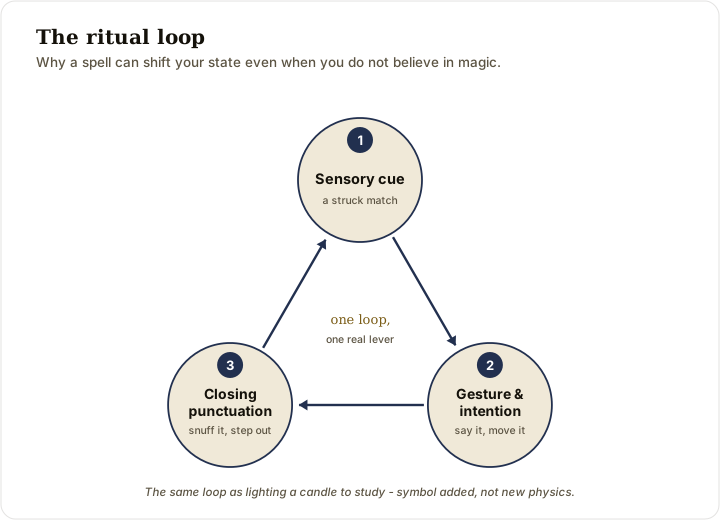
This is the same loop a skeptic already uses when she lights a lavender candle to study, or drinks her coffee from one particular mug to start the workday. Witchcraft adds the symbolic vocabulary and the lineage, not a different physics.
One boundary line, kept short on purpose. Ritual regulates how you feel and how you act. It does not treat illness, manifest money into your account, or substitute for a doctor, therapist, or financial advisor. If something physical or psychological is genuinely wrong, please get real help; secular witchcraft sits alongside that work, not instead of it.
The nocebo side deserves a flag too. If a ritual feels silly to you, in your own house, with no one watching, it can backfire and leave you in a worse mood than you started. The practice has to feel earnest enough to engage, even from a skeptic. If candles do nothing for you, try a card pull. If cards feel like a chore, try a simmer pot. The form has to fit you, or it does not work.
Reassigning the tools: same kit, secular meaning
The familiar witch kit translates cleanly into materialist terms. Same objects, different story about what they are doing.
Tarot becomes a deck of Jungian-archetype journaling prompts. When you draw The Tower, you are not receiving an omen of disaster; you are being asked which unstable structure in your life you are refusing to look at. The image does the work that a good therapy question does, faster and more visually. If you want to think about which deck to use, choosing a deck gets into the buyer side.
Crystals become tactile focal points. A piece of obsidian in the palm is a cool, heavy, specific object that pulls your attention out of your head and into your hand, which is the actual goal during a panic spike. The "frequencies" framing is not load-bearing for a secular practice; the weight is. There is more on stones and how practitioners use them in crystals.
Herbs become applied ethnobotany. Lavender is the easiest example: its active compound, linalool, modulates GABA receptors, which is the same neurotransmitter system that anti-anxiety medications target. That is why a lavender candle actually calms you down; no spirits are required for the chemistry. Pharmacologists have published this work, and it is worth knowing your correspondences have a real-life mechanism under them. The deeper chart lives in herb correspondences.
Candles become state-change cues. Striking the match opens the ritual; blowing it out closes it. The flame is doing what a curtain does in a theatre. Practitioners who want the longer technique can find it in candle magic.
For the wider tool family with a secular lens kept on, see the wider toolkit.
A worked example: a secular grounding ritual for anxiety
This is the one I come back to. It is small, it takes maybe four minutes, and it is the clearest single thing I can show you to make the abstract concrete.
- Name what's happening. Say it, ideally out loud, even if you feel ridiculous. "I'm anxious. This ritual is going to reset my nervous system. It is not going to fix my life." The honesty matters; the placebo works better when you tell it the truth about itself.
- Sensory setup. Light a lavender candle. The linalool is doing real work on the way in through your nose; you do not have to believe in it for it to happen.
- Tactile anchor. Hold a stone, a piece of obsidian or a river pebble or whatever lives on your altar. Notice the temperature first, then the weight. The point is to pull attention out of the loop in your head and into the palm of your hand.
- The poetic gesture. Say the line: "I am rooted to the earth; my mind is clear." Out loud lands better than in-your-head, even when (maybe especially when) it feels theatrical. The theatre is the point.
- The close. Blow out the candle. That is the punctuation mark. The ritual is over and you can go answer your email.
What bears out for me, honestly: step three does most of the work. The stone in the hand is the part I notice in the body. The spoken line is the part I would skip if I were tired, and I shouldn't, because skipping it is what makes the whole thing feel like a routine instead of a reset. The intention-naming in step one I used to think was redundant; it is not. Saying out loud "this is not going to fix my life" is the line that takes the pressure off the ritual to do something it cannot do.
Where it diverges from Wicca and traditional paths
Secular witchcraft and Wicca share a surface aesthetic and almost none of the philosophical wiring underneath. The one-line contrast: Wicca is a deity-centred religion that treats magic as the manipulation of external energies, and secular witchcraft is a non-theistic practice that treats magic as the manipulation of the self.
| Secular / SASS witchcraft | Atheopaganism | Traditional Wicca | |
|---|---|---|---|
| View of deity | Non-theistic; no literal gods | Naturalistic; the universe as science describes it | Duotheistic Goddess and Horned God |
| How "magic" works | Open-label placebo on the self | Metaphorical play; ritual as community technology | External energies and divine assistance |
| Moral code | Individual; no shared dogma | The 13 Atheopagan Principles | The Wiccan Rede and Rule of Three |
| Purpose of ritual | Self-care, mood, grounding | Earth-reverence and community | Worship and manifestation |
The ethics piece deserves its own room. The Rede ("an it harm none, do what ye will") and the Rule of Three are real, contested, and worth understanding even if you do not personally hold them; that conversation belongs in the wiccan rede. The believer's side of the duotheistic Goddess-and-Horned-God practice, with invocation and devotional work, is at deity work. And the broader religion-vs-craft framing, with the historical context of why these paths separated in the first place, is at wicca vs witchcraft.
Atheopaganism: the organized non-theistic path
For the reader who wants structure without dogma, Atheopaganism is the named, organized version. Founded by environmental writer Mark Green, it is an earth-revering, ritual-rich path that accepts the universe as science describes it and uses what Green calls the technologies of religious ritual to build community, mark seasons, and ground a life.
Its 13 Principles function as guidelines, not commandments. There is no one to enforce them, and no one to throw you out for failing.
- Skepticism and critical thinking. Evidence over assertion; the metaphor is not the literal.
- Reverence for the sacred Earth.
- Gratitude.
- Humility. A small, temporary place in a vast cosmos.
- Perspective and humour. Especially toward yourself.
- Praxis. Regular ritual play; willing suspension of disbelief to invoke presence.
- Inclusiveness.
- Legacy. Responsibility for the people who come after.
- Social responsibility.
- Pleasure positivity. Harmless pleasure is good.
- Curiosity. Knowledge is never complete.
- Integrity.
- Kindness and compassion. Including for yourself, when you fail at the list.
The Atheopagan calendar lines up with the Wheel of the Year, which is the seasonal framework most modern witches share regardless of theology. If you want the calendar itself, the wheel of the year is the hub, and each sabbat has its own page from there.
How a secular witch handles the sabbats (a worked example: Samhain)
The sharpest contrast shows up at Samhain, because mainstream Wicca's framing is at its most explicitly supernatural here.
In Wicca, Samhain is traditionally described as the night the veil between worlds thins and the dead are honoured as if literally present. Practitioners light fires, set a place at the table for ancestors, and use divination to communicate with them.
The Atheopagan version, sometimes called Dark Hallows, removes the Otherworld entirely and keeps the work. There is no veil and no wandering soul; there is a week-long observance of mortality as a biological fact, processed through ritual. Practices people actually do:
- Updating Death Documents: will, advance directive, organ-donor preferences, a password file someone you trust can find.
- A silent walk to a chosen "land of the dead," a graveyard or a wood or a coastline.
- Saying the names of the dead out loud around a fire, for grief and for gratitude that they existed at all.
I have done two of these and skipped one. The walk works; the spoken names work, painfully and well. The Death Documents one I keep meaning to do and not doing, which is its own honest report on the practice. The point is not which of these you complete; the point is that mortality is real, ritual is good at metabolising real things, and you do not have to believe in ghosts to need a way through grief.
The full samhain guide has the calendar and the wider practice; shadow work gets into the grief and self-confrontation side at more depth.
The community: SASS, gatekeeping, and the limits of skepticism
The community shorthand is SASS: Skeptical, Agnostic, Atheist, and/or Science-Seeking. It coalesced on Reddit in 2019, around r/SASSWitches, and has since become the easiest on-ramp for the deconstructing or rationalist reader. The bar to belong is low: you do not have to believe in the supernatural, and you have to respect that other practitioners might.
There is external friction worth knowing about. Some traditional, supernatural-believing witches will accuse secular practitioners of LARPing, or of borrowing the aesthetics of a centuries-old practice without doing the spiritual work. Sometimes this is a fair critique of someone treating the craft as a fashion accessory. More often it is a boundary policed by people who arrived two years earlier. You can practise anyway. The craft has never had a central authority and is not going to grow one for this.
There is internal friction too, and it is the more interesting one. Hardline materialists in SASS spaces sometimes shut down any talk of mystery with "that's not a thing"; soft skeptics push back that the point of being a witch, rather than just a regular atheist, is to find value in the poetic gesture and to stay open to corners of consciousness that science has not finished mapping. Both wings are welcome. The practice is broad enough to hold them.
A note for the reader carrying religious trauma from a strict Christian upbringing or another orthodox tradition. Secular witchcraft offers ritual, community, and seasonal meaning without asking you to swap one set of supernatural fears for another. There is no divine punishment in this frame, no test you can fail, no eternal stakes. That can be the whole reason this path is bearable when others are not. If reclaiming after deconstruction is your story, the witch wound is the longer arc, and the leftover "is any of this a sin" worry is held at is witchcraft a sin.
Starting a secular practice (a small, honest first week)
A real on-ramp, with nothing to buy. Pick three of these for a week and see what sticks.
- A daily grounding minute. One stone, one breath cycle, name three things you can feel in your body.
- One weekly tarot pull as a journaling prompt. Not "what will happen"; "what am I avoiding looking at."
- A Sunday-night candle and intention. Light it, say what next week is for, blow it out. Four minutes.
- A tactile anchor object kept in a pocket. Touch it before any meeting that scares you.
- A one-page log. What you did, what shifted, what was nothing.
Cast and release, reframed for skeptics: do the ritual, then take the mundane action. Light the candle for the job, and send the application. Pull the card for the conversation, and have the conversation. The pairing is the practice. A ritual on its own does no manifesting; an application on its own does the work, but cold; the two together is what tends to feel like something is moving.
One honest note. If a ritual feels like nothing in week one, it is allowed to be nothing. Try a different form, or come back to it in a month. Secular witchcraft does not require that everything you try work; it requires that you tell yourself the truth about what did.
For the wider beginner build, the beginner hub holds the on-ramp. For doing all of this without spending money, practising on a budget is the guide. For what week two and beyond look like, a daily practice. And if you want the same no-metaphysics frame applied to manifestation rather than to ritual, there is a version of that too.
Voices and books worth the skeptic's time
The explicitly atheist witchcraft shelf is small. These are the entries actually worth your evening.
- Atheopaganism: An Earth-Honoring Path Rooted in Science by Mark Green. The foundational manual: the 13 Principles, ritual structure, the whole non-theistic frame. For the reader who wants organised practice. Not the right book if you want unstructured eclecticism.
- Godless Paganism: Voices of Non-Theistic Pagans, edited by John Halstead. An anthology with many voices, from atheist to animist to humanist. Useful for sampling. Not a single how-to.
- Witchcraft Therapy: Your Guide to Banishing Bullsh*t and Invoking Your Inner Power by Mandi Em. Casual, mental-health-forward, funny. For the reader whose first question is "can this help me feel less terrible." Not the right book for dense philosophy.
- Braiding Sweetgrass by Robin Wall Kimmerer. Not a witchcraft book, and the one most secular and green witches name when asked what grounded their nature relationship. Indigenous knowledge and rigorous botany held together.
The broader beginner reading list, with the same honest-pros-honest-cons treatment, is at the beginner books roundup.
Common questions skeptics ask
Is secular witchcraft real witchcraft? Yes. Witchcraft is a practice, not a creed. Practitioners across history have framed it religiously and non-religiously; the modern split is a recent labelling exercise, not a new invention.
Do I have to be an atheist to practise secularly? No. Agnostics, soft skeptics, and the openly uncertain are at home here. The shared ground is "magic acts on me, not on the laws of physics."
Can a secular spell heal me, get me a job, or fix my finances? No, and any honest practitioner will say the same. Ritual changes you; the application, the doctor's appointment, the budget spreadsheet is what changes the world. Pair magic with action. If a particular spell felt like nothing or backfired, why spells don't work gets into the troubleshooting.
Is this just self-help with candles? Effectively, yes; with a longer aesthetic lineage, a richer toolkit, and a community of people doing the same thing. That is not a downgrade. Self-help with structure, sensory cues, and seasonal rhythm outperforms self-help without.
What if I love the aesthetic but do not actually want a practice? Also fine. The aesthetic-only path is a real and legitimate thing; aesthetic vs practice is the honest version of that conversation.
Take what serves you, leave what does not, and let the practice be as candlelit or as plain as you like.
Keep exploring
Browse more guides, or start with the basics of the practice you are curious about.
Browse more guides